
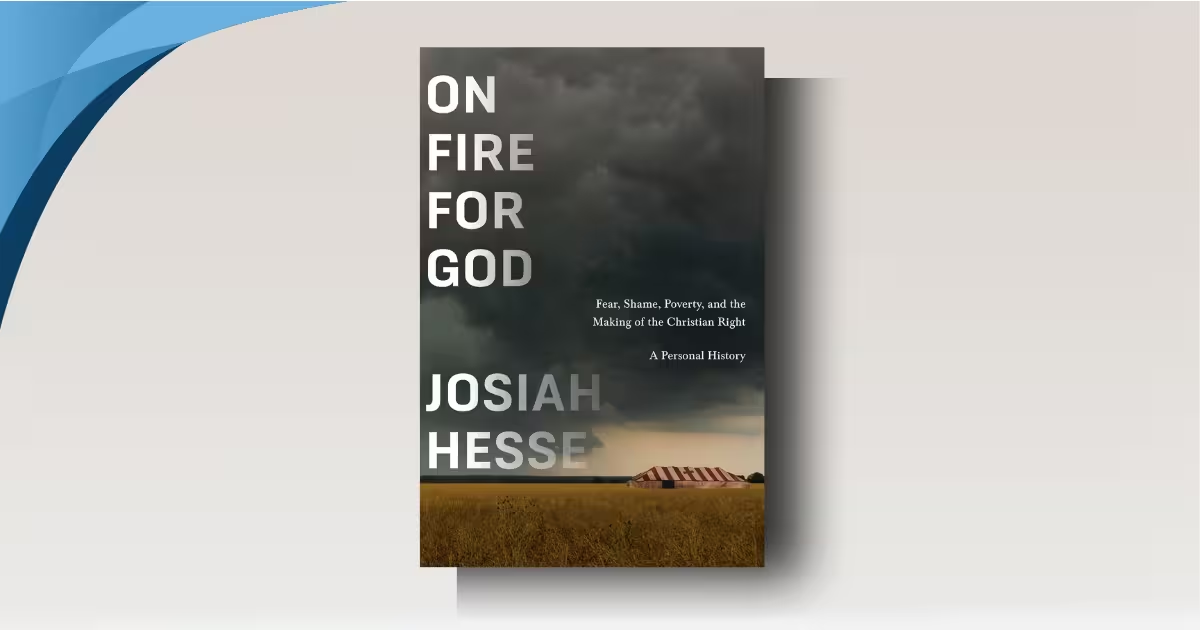
Do you remember the sheer, paralytic terror of thinking you’d been “left behind” in the Rapture because the house was too quiet? Or the gnawing suspicion that the only reason you weren’t rich yet was because you didn’t have enough faith? On Fire for God by Josiah Hesse covers this most haunting issue of human life.
On Fire for God is best for ex-evangelicals (exvangelicals) deconstructing their faith, political junkies trying to understand the rural white working class, and anyone who loves a gritty, survivalist memoir that punches you in the gut while holding your hand. Not for: Readers seeking a purely theological defense of fundamentalism, or those sensitive to graphic descriptions of self-harm, drug abuse, and religious trauma.
Table of Contents
1. Introduction
On Fire for God: Fear, Shame, Poverty, and the Making of the Christian Right – A Personal History is a searing 2026 memoir and cultural history by investigative journalist Josiah Hesse. Published by Pantheon Books, this work stands as a defining text of the post-Trump exvangelical movement.
Hesse, known for his previous works Runner’s High and the Carnality series, brings his journalistic chops (honed at Vice, The Guardian, and Politico) to the most difficult subject of all: his own harrowing upbringing in the apocalyptic fervour of Mason City, Iowa.
On Fire for God lands at a pivotal cultural moment. We are inundated with “hillbilly” narratives that often blame the poor for their own plight or romanticize rural grit without examining the systems that exploit it. Hesse flips the script.
This isn’t just a memoir; it’s an investigative autopsy of the American Heartland. It explores how the “Music Man” grift—a reference to the famous musical set in Hesse’s hometown—became the blueprint for the Christian Right.
Hesse argues that spiritual con artists and political operatives exploited the economic devastation of the 1980s Farm Crisis to radicalize a desperate population, replacing their collective bargaining power with a theology of fear, shame, and hyper-individualism.
Hesse’s central thesis is that the modern Christian Right was not an organic spiritual awakening, but a calculated political and economic project.
By weaponizing fear (of the devil, of liberals, of poverty) and shame (sexual purity, financial failure), leaders turned a once-progressive evangelical movement into a soldier class for unrestricted capitalism and authoritarianism.
As he writes in the introduction, he aims to “lift the heavy stone of the past and expose to daylight all that has been rotting in the dark”, tracing how “a once-progressive movement of evangelicals became co-opted by wealthy conservatives who fundamentally reshaped the American economy”.
2. Background
Growing up in the 80s and 90s, Hesse lived through the Satanic Panic, the rise of the Moral Majority, and the collapse of the family farm.
His journey from a tongue-speaking, Rapture-fearing child to a secular journalist gives him unique “insider-outsider” access to a world that baffles many coastal observers.
3. On Fire for God summary
This section provides a comprehensive breakdown of the book’s narrative arc, effectively replacing the need for a cursory read. It moves chronologically and thematically through Hesse’s life and the history of the Christian Right.
The Music Man and the Roots of the Grift (1920s–1930s)
Hesse brilliantly frames his story around the cultural legacy of his hometown, Mason City, Iowa—the real-life inspiration for Meredith Willson’s The Music Man.
He argues that the fictional “Professor Harold Hill,” who sells a town on a boys’ band to save them from the “trouble” of a pool table, is the archetype for modern evangelical leaders.
He takes us back to 1925, when the Ku Klux Klan marched down Federal Avenue in Mason City, not just as racists, but as defenders of “Christian family values” against immigrants and “big-city vice”. He introduces us to Burroughs Waltrip, a real-life con man and preacher who rolled into town in 1937 with the famous evangelist Kathryn Kuhlman.
Just like Harold Hill, Waltrip fabricated a crisis and sold a solution: a high-tech, air-conditioned “Radio Chapel” that would put Mason City on the map.
Key Event: Waltrip convinced the town to fund his lavish lifestyle and church, only to flee with the money, leaving the community in debt.
Hesse connects this historical trauma to his own family’s susceptibility to later grifts. He notes, “River City ain’t in any trouble… Then we’ll have to create some”, highlighting the manufactured crises used to fleece the faithful.
The Farm Crisis and the Fracture (1980s)
The narrative shifts to Hesse’s parents, Henry and Janet. They started as idealistic, hippie-adjacent Jesus People in the 1970s—a movement that was initially counter-cultural and somewhat progressive. However, as they settled into family life in the 1980s, the political winds shifted.
Hesse meticulously details the 1980s Farm Crisis, a pivotal moment where land values plummeted, and banks foreclosed on family farms that had been held for generations. The suicide rate in Iowa spiked 400 percent during this time. Instead of political solidarity, the church offered Prosperity Gospel.
The Theological Trap: Hesse’s parents were taught that wealth was a sign of God’s favor. They invested in a waterbed store and a tanning salon, leveraging massive debt at 21-percent interest.
When the businesses failed, the church didn’t offer systemic critique; it offered shame. They were told to “laugh at your bills” and that their financial ruin was a result of secret sin or lack of faith.
The Impact: The stress destroyed his parents’ marriage. His father, Henry, spiraled into rage, drug addiction (meth and weed), and infidelity, haunted by his own abandonment issues. His mother, Janet, retreated into dissociation and hoarding, overwhelmed by the impossible standards of Christian motherhood.
Growing Up in the End Times (1990s)
This is the most harrowing part of the memoir. Hesse describes a childhood defined by terror. He was raised to believe the Rapture could happen at any second. If he sinned—by having an impure thought or failing to pray enough—he would be “Left Behind” to face the Antichrist.
The Demon Caldonia: Hesse personifies his internalized shame and fear as a witch demon named “Caldonia” who spoke to him in his mind. “If you don’t believe, you won’t be saved, she reminds me. And then you’ll be tortured for all eternity”. This wasn’t a metaphor for him; it was a psychological reality that led to severe insomnia, sleepwalking, and self-harm.
Purity Culture & Self-Hatred: As he hit puberty, the church’s obsession with sexual purity (and the demonization of his queer desires) led to profound self-loathing. He describes cutting himself in the basement to “atone” for his sins, reciting scripture while bleeding: “In your struggle against sin you have not yet resisted to the point of shedding your blood”.
The Educational Bubble: Hesse attended Christian schools that taught Young Earth Creationism via VHS tapes of Kent Hovind, framing evolution as a Satanic plot to usher in communism. This isolation made the outside world—and critical thinking—seem dangerous.
The Drift and the Escape (2000s)
As Y2K approached and failed to bring the Apocalypse, a crack formed in Hesse’s belief system. He dropped out of high school (or rather, was pushed out due to undiagnosed neurodivergence and trauma responses).
The Lost Years: He drifted through “disposable jobs”—Subway, Walmart, day labor—feeling the crushing weight of being unskilled in a dying economy. He bonded with his friend Thad over drugs and rock music.
They worked a horrific stint transporting puppies for a puppy mill, witnessing animal cruelty that mirrored the commodification of life in their region.
The Turning Point: Hesse eventually moved to Denver and then San Francisco. Distance provided clarity. In a pivotal scene on a beach under the Golden Gate Bridge, he finally admitted to himself: “I don’t think God exists”. This wasn’t a sad loss, but a liberation from the terror of Hell.
The Return (2020s)
The memoir is framed by Hesse’s return to Iowa as an adult journalist. He interviews his parents, his siblings, and his old friend Thad.
Confronting the Past: He finds his father, Henry, has softened, finding peace in solitude and government disability checks, having abandoned the “Hell” theology. His mother has built a successful career but still carries the scars of the past.
The Tragedy of Thad: In a heartbreaking contrast, his friend Thad has fallen down the alt-right pipeline. Isolated on the farm, addicted to opioids and conspiracy theories, Thad parrots anti-trans rhetoric and feels bitter about being “left behind” by the culture.
This illustrates the divergence: Hesse escaped through curiosity and art; Thad was trapped by isolation and algorithms.
4. On Fire for God analysis
Evaluation of Content
Hesse effectively supports his “Music Man” argument by layering historical data over personal anecdote.
He doesn’t just say “the church exploited us”; he shows the receipts—literally. He notes his parents gave an estimated “$125,000 to our church in less than a decade… Adjusted for inflation, that’s around $360,000 today”. This financial data grounds the emotional narrative in hard economic reality.
He connects the dots between the Satanic Panic of the 80s and the QAnon movement of today, demonstrating that the mechanics of fear (protecting the children from an invisible, demonic elite) remain unchanged.
His use of academic sources, like the “Rat Park” addiction studies and the history of the Fairness Doctrine, bolsters his personal observations with sociological weight.
Contribution to the Field
On Fire for God fulfills a crucial gap in the literature of the American Right. While Hillbilly Elegy focused on individual moral failure, On Fire for God focuses on systemic exploitation.
It contributes meaningfully to the field of Religious Trauma Syndrome (RTS) studies, offering a visceral, first-person account of what it feels like to have one’s nervous system wired for terror.
It challenges the media narrative that rural Trump voters are simply “stupid” or “hateful,” instead framing them as victims of a sophisticated, multi-generational psychological operation.
5. Strengths and Weaknesses
Strengths (The Compelling):
- Visceral Imagery: Hesse’s writing is electric. He describes the sound of rain as “a thousand wineglasses shattering” and his anxiety as a “clogged vacuum-cleaner hose”. You feel the humidity of the Iowa cornfields and the cold sweat of a panic attack.
- Empathy for the “Villains”: Despite the abuse he suffered, Hesse paints his parents with profound empathy. He recognizes his father not just as a source of terror, but as a frightened man who was himself abused and exploited.
- The Music Man Metaphor: This literary device is brilliant. It provides a cohesive framework for understanding the “grift” of the Christian Right without being overly academic.
Weaknesses (The Shortcomings):
- Relentless Intensity: The middle sections detailing his self-harm and the puppy mill are grueling. For some readers, it might feel like trauma dumping, though it serves the narrative purpose of showing rock bottom.
- Lack of Resolution with Thad: The storyline with his best friend Thad ends on a sour, unresolved note. While realistic, readers hoping for a “redemption arc” for the MAGA-supporter friend will be disappointed. It reflects the deep, perhaps unbridgeable, divide in America today.
6. Comparison with Similar Works
- On Fire for God vs. Hillbilly Elegy (J.D. Vance): Hesse explicitly positions his book as a rebuttal to Vance. Where Vance scolds the poor for buying TVs they can’t afford, Hesse asks who sold them the idea that buying the TV would bring God’s blessing. Hesse looks at systems; Vance looks at individuals.
- On Fire for God vs. Jesus Camp (Documentary): Hesse’s book feels like the sequel to Jesus Camp. It answers the question: “What happened to those kids when they grew up?” (Spoiler: Drug addiction, trauma, or total deconstruction).
- On Fire for God vs. Educated (Tara Westover): Both share themes of escaping a survivalist, fundamentalist family through self-education. However, Hesse focuses more on the political and economic machinery of the church, whereas Westover focuses more on the family dynamic and the power of formal academia.
7. Conclusion
On Fire for God is a masterpiece of trauma reporting. It is essential reading for anyone trying to understand the “Why” behind the 81% of white evangelicals who support Donald Trump. It is not just a memoir; it is a warning and a map.
Recommendation:
- Must-Read for: Survivors of high-control religious groups, progressive organizers in red states, mental health professionals treating RTS, and anyone who felt seen by the phrase “deconstruction.”
- Suitable for: General audiences. The prose is accessible and gripping, though the subject matter is heavy.
On Fire for God ultimately suggests that the way out of the “Swamps of Sadness” isn’t through debate or shame, but through the hard work of re-regulating our nervous systems and refusing to be afraid anymore.
As Hesse concludes in the waters of Clear Lake, it’s about finally feeling safe enough to float.







