
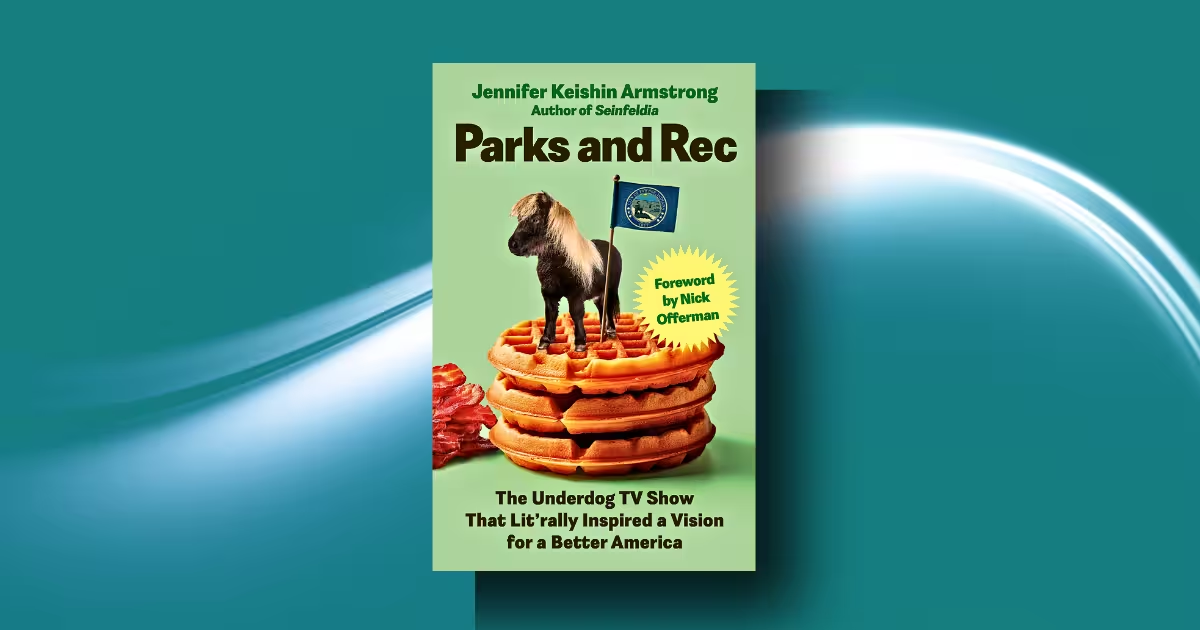
Why does a sitcom about potholes, permits, waffles, and small-town meetings still feel more emotionally useful than half the political commentary around us? Jennifer Keishin Armstrong’s Parks and Rec: The Underdog TV Show That Lit’rally Inspired a Vision for a Better America answered that for me: this is not just a book about television, but about why optimism still matters when public life feels exhausted.
This book is best for readers who love Parks and Recreation, readers interested in TV history, Amy Poehler and Nick Offerman fans, people curious about how comedy reflects politics, and anyone who still believes local government can matter.
It is also excellent for readers who like cultural criticism that is warm, accessible, and deeply reported. It is not ideal for someone looking only for a quick episode guide, or for a reader who wants a strictly academic media-studies monograph with heavy theory and less storytelling.
Table of Contents
Introduction
Parks and Rec: The Underdog TV Show That Lit’rally Inspired a Vision for a Better America is a 2026 nonfiction television history and criticism book by Jennifer Keishin Armstrong, published by Dutton, an imprint of Penguin Random House.
The book is positioned as television criticism and review, but in practice it also functions as political-cultural history, production history, and a study of why one sitcom became emotionally indispensable to so many viewers.
Armstrong is exactly the right writer for this subject. She is a bestselling pop-culture historian whose previous books include Seinfeldia, Mary and Lou and Rhoda and Ted, Sex and the City and Us, and When Women Invented Television.
Just as importantly, she brings a local-reporter’s eye to this story. In the book’s introduction, she explains that she spent years covering local government and came away with a lasting respect for the unglamorous, underpaid work of public service.
That journalistic background gives the book its pulse. She is not merely writing about a beloved sitcom; she is writing about why the sitcom’s faith in civic life still feels radical.
The central idea of the book, as I read it, is this: Parks and Recreation endured because it transformed a modest NBC comedy into something larger—a cultural argument for decency, collaborative public life, friendship, feminism, and incremental political hope.
Armstrong shows that the series was born from Obama-era optimism, struggled during its initial run, then became more necessary in the years after 2016 and during the pandemic, when its warmth, competence, and civic-mindedness began to feel less like sitcom fantasy and more like emotional first aid.
That idea is explicit in the book’s framing of the show as a “love letter to local government” and a symbol of “a better America.”
If you ask me what kind of book this really is, I would say it is part behind-the-scenes chronicle, part character study of a television show, part political mood-history of modern America, and part argument that comedy can do moral work without turning preachy. That is why the book feels so much bigger than a standard TV tie-in.
Background
There are several reasons this book matters now. First, Parks and Recreation itself ran from April 9, 2009, to February 24, 2015, across seven seasons, and it later returned for a 2020 reunion special produced during the COVID-19 pandemic.
The special drew 3.67 million viewers and raised at least $3 million for Feeding America, a reminder that the series was not merely remembered fondly; it was activated as a civic comfort object in a national emergency.
Second, the show’s afterlife has been extraordinary. Public-facing sources still frame it as a “comfort” rewatch, and Peacock continues to position it as a flagship legacy comedy. Armstrong’s own book argues that streaming helped new audiences discover the series long after its original NBC run ended.
That matters because the book is not simply about a past show; it is about a show whose relevance intensified after broadcast television had already moved on.
Third, the book arrives in a period when television history is increasingly treated as a way to explain social feeling. Critics and institutions continue to rank Parks and Recreation among the standout series of the century, and the show’s influence is visible in later feel-good but socially aware comedies. Armstrong is writing into that conversation, but she improves it by bringing reporting, interviews, and political context.
Parks and Rec Summary
The book opens by establishing that Armstrong’s interest in Parks and Recreation is not fan-only nostalgia. She links the show directly to her own years in local journalism and to the very real frustrations and dignity of municipal life.
That opening matters because it tells us what kind of reading experience we are about to have: this is not a hollow celebration of catchphrases, but a serious look at why Pawnee’s fictional bureaucracy resonated with real civic experience. From the start, Armstrong argues that local government, messy as it is, remains one of the most intimate sites of democratic life.
From there, the book traces the creation of the show out of The Office orbit. Greg Daniels and Michael Schur were under pressure to produce an Office-adjacent follow-up, and NBC initially wanted a spin-off. Armstrong shows how the project slowly transformed from a possible spin-off into a distinct series centered on a “gullible, optimistic” believer in government, contrasted with a libertarian foil.
Amy Poehler’s availability became the turning point.
Daniels and Schur eventually decided that getting Poehler mattered more than keeping the post-Super Bowl launch slot, which is one of the book’s clearest early examples of how much this show depended on casting intuition and long-term vision rather than corporate scheduling logic.
Armstrong then details how deeply the show was shaped by the political mood of 2008. Obama-era language of hope, gradual change, and civic repair runs through her account. Michael Schur is presented not just as a comedy producer but as a thinker interested in philosophy, politics, and moral seriousness.
Armstrong ties the show’s DNA to David Foster Wallace, The West Wing, The Wire, local-government reporting, and the desire to imagine government workers not as faceless obstructionists but as flawed human beings trying to help. In one of the book’s most revealing formulations, Schur says the show was designed around making a town “one percent better” than it was yesterday.
That small phrase captures the entire moral engine of both Leslie Knope and Armstrong’s book.
One of the great pleasures of the book is its casting material. Armstrong makes clear that Parks and Recreation did not simply assemble a funny cast; it built characters around unusual performers and let that chemistry reshape the writing.
Aubrey Plaza helps invent April’s deadpan hostility. Nick Offerman’s path to Ron Swanson is almost painful in its suspense, and Armstrong presents his audition as a hinge moment in sitcom history. Chris Pratt’s Andy arrives through surprising comic instincts rather than résumé prestige.
Rashida Jones, Aziz Ansari, Jim O’Heir, and Retta each become part of a workplace ecosystem that the book treats as delicately balanced. You come away feeling that the series succeeded not because it had stars, but because it discovered how to arrange energies.
Armstrong is especially good on the first-season problem. The show did not fully know itself yet. It was too close to The Office, too dependent on mockumentary assumptions, and not yet clear enough about Leslie.
The crucial breakthrough, as Nick Offerman notes in the foreword, was recognizing that Leslie could not be another cynical or humiliatingly inept sitcom boss. She needed optimism. She needed what he calls “ebullience.” Armstrong treats that tonal correction as the decisive act of self-discovery.
Once the show stopped trying to mine cringe from Leslie and instead made her energetic, sincere, competent, overcommitted, and absurdly hopeful, Parks and Recreation became itself.
The book also gives real attention to production design and world-building. I loved this part. Pawnee becomes more than a fictional town; it becomes a satirical civic universe.
The notorious murals, the invented local history, the raccoon infestation, JJ’s Diner, Eagleton, town-hall eccentricity, and all the tiny absurdities combine to make Pawnee feel like an exaggerated but emotionally true Everytown USA. Armstrong makes the point that what looks whimsical on screen was actually built through serious labor, research, and very deliberate aesthetic choices.
As the book moves through later seasons, Armstrong expands her scope. She tracks the show’s artistic growth, its politics, its feminism, its cultural inventions, and its shift from “underdog NBC sitcom” to cherished civic fable.
She notes how the series gave the culture Galentine’s Day, how Leslie Knope became a feminist icon, and how the show balanced romance, friendship, and government work without turning any of them into a joke. That balance is a central theme of the book: Parks and Recreation is funny because its characters care so much, not because caring is ridiculous.
Armstrong also makes room for complication.
Ron Swanson became a beloved symbol far outside the intentions of some viewers, especially in a polarized political climate. The show’s liberal optimism was celebrated by many and dismissed by some conservatives as flattering bureaucratic sensibilities. Armstrong does not erase that tension.
Instead, she argues that the show’s real achievement lay in dramatizing disagreement without abandoning mutual regard. Leslie and Ron are ideological opposites, but the show insists that political difference need not cancel affection, respect, or shared duty. That may be one reason the book feels almost elegiac now. It is remembering not only a sitcom but a vanishing hope about public life.
By the final chapters, the argument becomes broader and more emotional. Armstrong connects the series’ afterlife to the post-2016 crisis of democratic confidence, to pandemic-era loneliness, and to the public hunger for narratives where people still try to do the right thing.
Her discussion of the 2020 reunion special reinforces the point: in a frightening moment, the return of Leslie and company felt like reassurance that civic tenderness was still imaginable.
The special was the first scripted broadcast series to depict pandemic-era social distancing and Zoom communication, and it succeeded not because it was technically perfect but because it revived the emotional promise of the original show: we get through hard times together.
By the time I finished the book, I felt that Armstrong had not only summarized the making of Parks and Recreation but also explained why its emotional architecture still holds. She argues, persuasively, that this was never just a show about parks. It was about competent care, relational loyalty, civic patience, and the stubborn refusal to let cynicism have the last word.
Parks and Rec Analysis
I think this is an outstanding book—warm, intelligent, funny, and far more meaningful than a “TV history” label might suggest. Jennifer Keishin Armstrong understands something that many media books miss: the greatest television stories are not only about ratings, contracts, episodes, and celebrity anecdotes.
They are also about the emotional and moral atmospheres that shows create around us. This book succeeds because it never forgets that Parks and Recreation changed people’s feelings before it changed their critical reputation.
What impressed me most is how effectively Armstrong supports her argument with evidence. She combines her own municipal-reporting background, extensive interviews, production details, cultural criticism, and broader political context.
The result feels lived-in rather than assembled. She does not merely say the show mattered; she demonstrates how it was born from a specific national mood, how it evolved creatively, and why it later returned as a comfort object in moments of public strain. That is exactly the sort of argument a good cultural history should make.
The book also fulfills its purpose because it recognizes that Parks and Recreation was both specific and symbolic. Specific, because Armstrong can tell you how the casting worked, why the early season wobbled, how Pawnee’s visual world was built, and how the cast dynamic reflected the show’s values.
Symbolic, because she is ultimately writing about a vision of America in which local institutions, neighbors, oddballs, feminists, bureaucrats, and ideological opponents are all still bound by some common project. That is the book’s beating heart.
As criticism, the book is persuasive because it does not confuse niceness with shallowness. That distinction matters. For years, some people wrote off warm television as soft, unserious, or unserious precisely because it rejected acid irony.
Armstrong argues the opposite. She suggests that Parks and Recreation was artistically daring in its insistence that optimism could be funny, that institutions could be imperfect yet still worth defending, and that public service could be portrayed as noble without becoming sanctimonious. I agree. In a media culture addicted to detachment, sincerity can be formally disruptive.
My strongest emotional response to the book came from how honestly it handles the difference between the show’s political dream and the real world that followed. Armstrong never pretends that Leslie Knope’s America won.
In fact, the later framing makes the show feel almost tragic in retrospect. But she also refuses to reduce the show to nostalgia. Instead, she treats it as a surviving example of civic imagination. That move is what keeps the book from becoming a mere souvenir. It becomes an argument for why we still need stories that remind us what public good can look like.
Strengths and Weaknesses
The greatest strength of this book is its tone. It is affectionate without being gushy, informed without being academic to the point of lifelessness, and reflective without losing momentum. Armstrong clearly loves Parks and Recreation, but she loves it responsibly. She reports, contextualizes, compares, and interprets. That balance is rare.
Another major strength is characterization. Amy Poehler, Nick Offerman, Michael Schur, Greg Daniels, and the ensemble all emerge as working artists rather than mythic celebrities. The book captures how collaborative TV really is.
Reading it, I kept feeling grateful for the number of hidden laborers behind any beloved half-hour comedy: editors, designers, writers, casting directors, producers, and everyone else who makes a fictional town feel alive. Offerman’s foreword reinforces this beautifully.
I also think Armstrong is excellent on feminism. Leslie Knope could have been written as a punchline, a shrill overachiever, or a parody of female ambition. Instead, the series gradually made her one of television’s most generous, ambitious, and unapologetically feminist characters.
Armstrong rightly treats that as culturally important. She notes that critics called the show one of television’s most feminist comedies and ties its worldview to broader fourth-wave feminist conversations around representation and equality.
The book’s other great strength is how thoroughly it explains the show’s second life. Too many television histories end when the finale airs. Armstrong knows that streaming changed the destiny of this series.
The show’s movement into comfort-watch status, its reunion special, its continuing influence, and its place in best-of-the-century lists all matter to the story she is telling. That historical extension makes the book feel complete.
As for weaknesses, I would say the book’s biggest limitation is also part of its charm: it is deeply invested in the goodness of Parks and Recreation. That means readers looking for a sharper adversarial critique may find it too sympathetic.
Armstrong does acknowledge tensions around liberal optimism, Ron Swanson’s contested political symbolism, and the show’s fantasy version of public life, but she is ultimately more interested in illumination than dismantling. For me that worked. For some readers, it may feel a shade too generous.
A second minor weakness is that readers with no emotional connection to the series may not feel the same cumulative payoff. This is a book that grows more powerful the more you already care about Leslie, Ron, April, Ben, Ann, Tom, Donna, Andy, and Jerry. Armstrong writes well enough that a newcomer can still appreciate the argument, but the emotional voltage is plainly higher for existing fans. That is not a fatal flaw, but it is real.
Comparison with Similar Works
The most obvious comparison is with Armstrong’s own Seinfeldia. Both books use a television show as an entry point into a wider American mood. But if Seinfeldia is about irony, observation, and the codification of modern comic cool, Parks and Rec is about sincerity, civic faith, and emotional generosity.
They almost mirror each other as cultural case studies.
It also invites comparison with behind-the-scenes TV histories more broadly, especially books that chronicle how a show was made and why it mattered.
What makes this one stand out is that it is less industrial and more ethical. It cares about writerly and production detail, yes, but it never loses sight of values: community, care, feminism, civic work, and hope. In that sense, it is closer to cultural criticism than to a standard oral history.
Compared with many newspaper or magazine retrospectives on Parks and Recreation, Armstrong’s book has the luxury of depth.
The short-form reviews and tributes tend to emphasize the same handful of themes—comfort, warmth, Leslie Knope, friendship, political optimism. Armstrong keeps those themes but gives them chronology, causation, texture, and evidence. She tells you not just that the show mattered, but how it became the version of itself that could matter.
Conclusion
I would absolutely recommend this book, and not just to die-hard Parks and Recreation fans. I would recommend it to readers of cultural history, television studies, media criticism, political storytelling, feminist pop-culture analysis, and anyone who has ever wondered why some works of entertainment become emotional shelter.
Jennifer Keishin Armstrong has written a deeply readable, deeply human account of how an underdog sitcom became a civic myth.
If I had to sum up my feeling in two sentences, I would say this: Parks and Rec is a marvelous, important, unexpectedly moving book. It reminded me that the best criticism does not merely explain why art succeeded; it explains why we needed it.
The book’s lasting power lies in the same truth that animated the show itself: people do not become less ridiculous when institutions matter, and institutions do not become less necessary because people are ridiculous. Leslie Knope’s world may be idealized, but Armstrong convinces me that idealization is not always escapism.
Sometimes it is a way of preserving a public dream until reality is ready to deserve it.







