
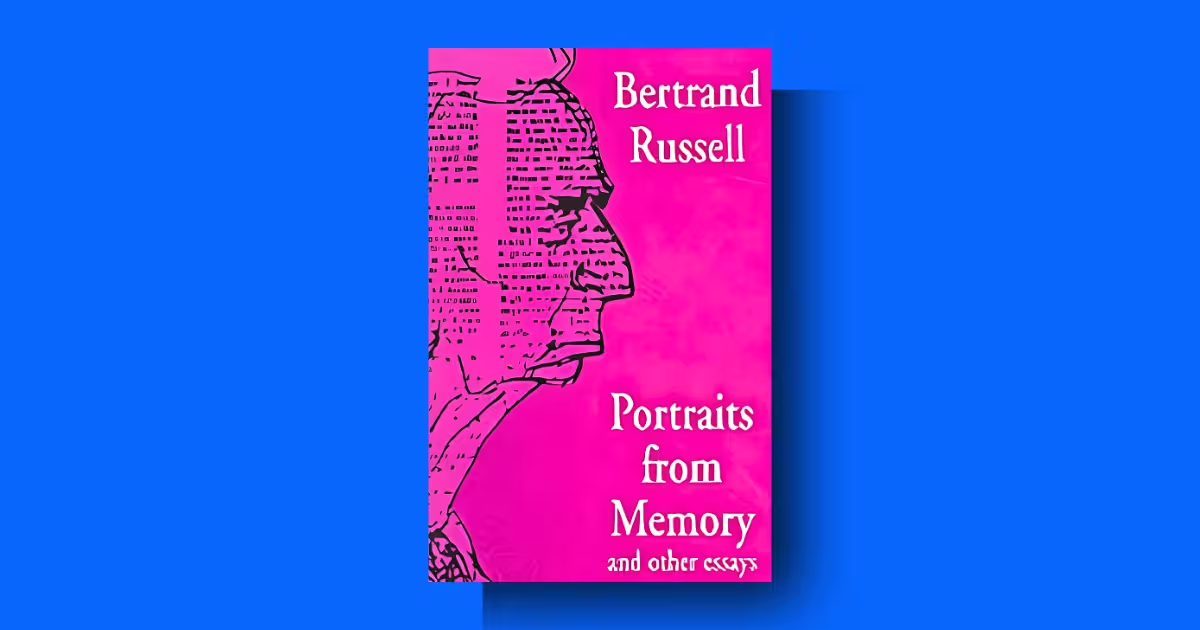
Did you ever question whether your most deeply held beliefs could survive the brutality of a global war? Bertrand Russell shows you in Portraits from Memory and Other Essays how to break free from comfortable illusions and face the crumbling of an old world with clarity, intellectual honesty, and a surprisingly stubborn optimism.
Overview
Portraits from Memory and Other Essays a collection of essays that track the evolution of a brilliant mathematical mind forced to confront the messy, violent reality of the twentieth century.
It maps the transition from a sheltered Victorian upbringing to the frontlines of pacifist activism, offering a firsthand account of the philosophical and political shifts that shaped modern history.
Reader recommendation
Portraits from Memory and Other Essays is best for history enthusiasts, philosophy students, and anyone who appreciates a radically honest examination of how political disasters can reshape personal convictions. Readers looking for clear, unpretentious prose will love this.
Portraits from Memory and Other Essays is not suggested for readers seeking rigid, comforting dogmas or those who prefer highly technical, abstract logic without any real-world application. If you dislike political history, you will probably bounce.
Table of Contents
1. Introduction
Portraits from Memory and Other Essays by Bertrand Russell, published by Simon and Schuster, Inc., New York, in 1956.
Context: Portraits from Memory and Other Essays is a non-fiction collection of autobiographical reflections and philosophical essays.
The book is about the personal and intellectual journey of one of the twentieth century’s most prominent thinkers. Russell was an aristocratic British philosopher, mathematician, and social critic.
His background in mathematical logic gives his writing an incredible sharpness, whereas his activism during the World Wars grounds his work in stark human reality.
Purpose: The book’s central thesis is that while human history is fraught with unnecessary misery caused by dogmatism and hatred, a better world is entirely possible if we rely on clear thinking and kindly feeling.
aFurthermore, the author aims to show how individual psychology and political structures are deeply intertwined.
2. Background
To put it in another way, you cannot understand Russell’s later political views without looking at his early life. He grew up in an atmosphere impregnated with tradition, specifically a puritanical aristocratic household. aa
He was taught a kind of theoretic republicanism by his family, who had a history of political involvement. Initially, it may seem that this sheltered life would produce a conservative thinker. Surprisingly, the exact opposite happened.
The world he knew as a child seemed as indestructible as granite, with an expectation of ordered progress and no revolutions. However, the outbreak of the First World War destroyed this Victorian optimism completely.
3. Portraits from Memory Summary
I want to summarize the text in a way that gives you the facts and preempts the thesis point by point, so that what I learned from the book is all here.
Adaptation: An Autobiographical Epitome: Russell describes his strict upbringing where virtue was prized at the expense of intellect, health, and happiness. As a result, he rebelled against this environment, first seeking refuge in the exactness of mathematics.
Demonstrating this, he explains that he hoped to find certain knowledge in math, though he later realized the proofs offered by his early teachers were fallacious.
The First World War shattered his academic isolation and forced him into political dissent. He opposed the war because he foresaw it would lower the general level of civilization and lead to future disasters. Consequently, he found himself alienated from many friends.
He also details his disillusionment with the Russian Revolution after a visit in 1920. He found the Bolshevik regime abominable due to its contempt for liberty and democracy.
Why I Took to Philosophy: He wanted to find knowledge that could be accepted as certainly true, while also looking for a substitute for religious belief. He describes his early encounters with geometry and his bitter disappointment when told that axioms had to be assumed rather than proved.
He briefly embraced Hegelian philosophy, finding comfort in the idea of the universe as a closely knit unity. In truth, he later rejected this philosophy as a farrago of confusions.
Some Philosophical Contacts: He details his interactions with other thinkers. For example, he discusses Louis Couturat, who wrote a book on the mathematical infinite, and Georg Cantor, who developed the theory of infinite numbers.
He notes how Gottlob Frege had already defined numbers in logical terms before he did, though Frege’s work went largely unrecognized at first.
Also, he talks about Ludwig Wittgenstein, who began as his pupil and ended as his supplanter at Oxford and Cambridge.
Experiences of a Pacifist in the First World War: Russell shares his horror at the outbreak of war in 1914. He noticed with amazement that average men and women were delighted at the prospect of violence.
He felt it was his business to protest, driven by a voice akin to the Voice of God. He describes a violent incident where he was attacked by a mob led by drunken individuals during a pacifist meeting.
Ultimately, he spent four and a half months in prison for his pacifist propaganda, a time he surprisingly found agreeable because it allowed him to read and write without interruption.
From Logic to Politics: The war made him think afresh on fundamental questions and showed him the connection between politics and individual psychology. He realized that a peaceful world cannot be built on a basis of populations that enjoy fighting and killing.
A comprehensive view of the issue cannot be formed due to ignoring human emotions, he argues.
He critiques the Marxist philosophy for assuming economic power is the only form of undesirable power. He asserts that the dynamic power of many fanaticisms, including Communism and Fascism, is largely due to hate.
Beliefs: Discarded and Retained: He explains his shift away from Hegelianism towards a belief in the bizarre multiplicity of the world. At first, he thought the universe was like a heap of shot with separate, absolute parts.
Influenced by A. N. Whitehead, he learned to apply mathematical logic to the real world. Nevertheless, he eventually admitted that mathematical exactness is a human dream that cannot be found on earth. Still, he maintains that the world is made up of an immense number of bits, rejecting the idea that all reality must be mental.
Hopes: Realized and Disappointed: Looking back, he contrasts the stable pattern of his youth with the terrifying modern world.
While internal developments in Britain, such as democracy and the standard of living, improved significantly, the international scene became dominated by cruel despotisms. He notes that the terror of atomic war hangs over everything.
Despite this, he refuses to submit his judgments of right and wrong to the momentary course of events.
How to Grow Old: He advises having wide and keen interests to avoid noticing that you are growing old. He warns against living in the past or clinging to youth in the hope of sucking vigor from its vitality.
He suggests that a successful old age is easiest for those with strong impersonal interests.
Reflections on My Eightieth Birthday: He concludes that his life was devoted to finding out if anything could be known and trying to create a happier world.
He remains completely incapable of agreeing with those who accept fatalistically the view that man is born to trouble.
4. Portraits from Memory and Other Essays Analysis
Portraits from Memory and Other Essays is an outstandingly clear and poignant reflection on a century of turmoil. Reading it feels like sitting down with a remarkably smart friend who has witnessed the best and worst of humanity. I found myself deeply moved by his admission of how terrifying the shift from the 19th to the 20th century truly was.
Evaluation of Portraits from Memory and Other Essays
Russell effectively supports his arguments with raw, lived experience and rigorous logical reasoning. When he critiques political fanaticism, he does not just use abstract theory, he points to his firsthand observations in Russia in 1920.
The book easily fulfills its stated purpose, serving as both a historical document and a philosophical guide. He manages to show exactly how intellectual beliefs must adapt to the harsh realities of physical and political survival.
5. Strengths and Weaknesses
Strengths: The incredible clarity of his writing is a major trait. He takes complex philosophical concepts and makes them accessible.
His honesty about his own changing beliefs, specifically regarding his early mathematical idealism, is truly refreshing. In addition, his refusal to sugarcoat the horrors of war while maintaining a stubborn optimism makes the text incredibly compelling.
Weaknesses: On the other hand, there are drawbacks to his approach. Some readers might find his brief dismissals of certain philosophers a bit too swift or heavily biased by his mathematical preferences.
Due to insufficient evidence presented in these short essays, his critique of figures like Hegel can feel slightly rushed to a specialist.
6. Comparison with Similar Other Works
A case in point for comparison is John Stuart Mill’s “Autobiography”.
Both men were heavily educated from a young age, both suffered crises of faith regarding their highly analytical upbringings, and both turned their attention toward social and political reform.
However, whereas Mill’s journey was largely internal and intellectual, Russell’s was forcibly shaped by the external violence of the First World War.
7. Conclusion
Ultimately, clear thinking is the greatest tool we have. I highly recommend this book for anyone interested in history, philosophy, or politics.
It is especially suitable for general audiences because of its conversational, unpretentious language. If you want to understand how a brilliant mind navigates a world falling apart, you must read this.







