
Why does a psychology textbook written before most American homes had electricity still explain your phone habit better than the self-help book you bought last month? That question is what pulled me through William James’s The Principles of Psychology, Volume 1, and it’s the question I want to answer for you before you decide whether to open it yourself.
Overview
The Principles of Psychology, Volume 1 is William James’s monumental 1890 work that established psychology as a serious scientific discipline in America. It’s part textbook, part philosophical manifesto, and part literary masterpiece.
James argues that consciousness isn’t a collection of separate “ideas” but a continuous “stream of thought,” that habits are the brain’s way of making life easier, and that our emotions are actually bodily sensations interpreted by the mind (the famous James-Lange theory).
He covers everything from brain function to memory, attention, and the nature of the self—all written with a clarity and wit that makes complex ideas feel like a conversation with a brilliant, slightly chaotic friend.
Preferred readers
The Principles of Psychology is best for psychology students who want to understand where their field came from, philosophy lovers who enjoy wrestling with big questions about consciousness and self, curious readers who don’t mind dense but beautifully written prose, and anyone who’s ever wondered why they can’t remember names but can recall song lyrics from twenty years ago.
Not for anyone looking for a quick, easy read or a summary of current psychological research. James’s facts are often outdated, and his arguments can feel meandering. If you want practical self-help or a concise overview of modern psychology, look elsewhere—this is a book to savor, not skim.
1. Introduction
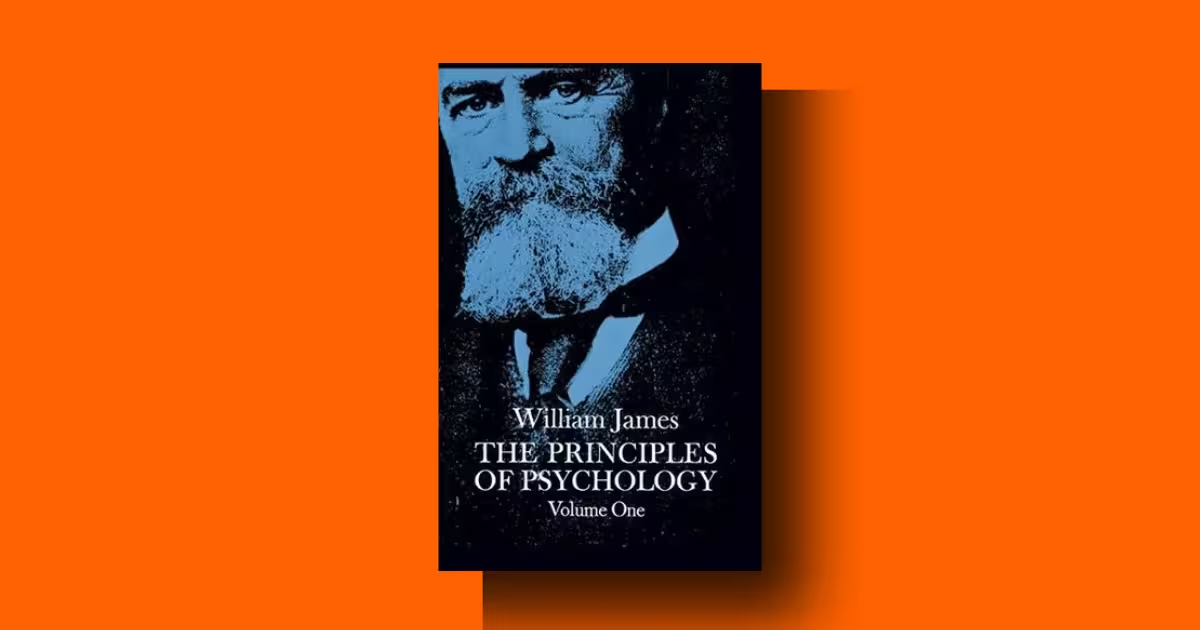
The Principles of Psychology, Volume 1 by William James. Published in 1890 by Henry Holt and Company. James (1842–1910) was a Harvard professor, physician, philosopher, and the man widely credited as the “father of American psychology”.
The Principles of Psychology runs to nearly 700 pages in Volume 1 alone, with a second volume bringing the total to over 1,300 pages. James originally agreed to write a brief textbook for the American Science Series in 1878, but the project grew into what he himself called his “dropsical mass”.
Context of The Principles of Psychology : This book is about the scientific study of the human mind—but it’s also about so much more. James wasn’t content to just catalogue mental facts; he wanted to understand what consciousness is, how it works, and why it matters.
He wrote at a pivotal moment when psychology was breaking away from philosophy and theology to become an experimental science. Yet James remained deeply skeptical of reducing the mind to mere mechanics.
As one contemporary reviewer noted, “although Mr. James deals with the science of psychology as a positivist, he still has faith in metaphysics, and it is this circumstance… that gives the work its most characteristic quality”.
Purpose of The Principles of Psychology : James’s central argument is that psychology must study the mind as it actually functions in real life, not as a collection of abstract faculties or a passive recipient of sensations.
He defines psychology as “the Science of Mental Life, both of its phenomena and of their conditions”. The mind, for James, is active, adaptive, and deeply connected to the body.
He insists that “no mental modification ever occurs which is not accompanied or followed by a bodily change”. This functional, embodied approach—influenced heavily by Darwin—was radical for its time and remains influential today.
2. Background
By the time James sat down to write this book, psychology as a separate discipline barely existed. Wilhelm Wundt had opened his experimental laboratory in Leipzig in 1879, and it’s generally treated as the first laboratory built specifically for psychological experimentation.
James, working independently, had already set up a smaller teaching laboratory at Harvard around 1875 to demonstrate psychological and physiological principles to students, though it was built for classroom demonstration rather than original research, so historians usually credit Wundt’s Leipzig lab as the first true experimental one.
James’s own path to psychology was anything but direct: he trained first as a painter, then studied chemistry, then took a research trip to Brazil with the naturalist Louis Agassiz, and finally earned his medical degree from Harvard in 1869 before drifting into physiology and, eventually, psychology.
This background matters because it explains the book’s split personality. James writes as a trained physician who wants a physical account of mental life, and at the same time as a philosopher uneasy with reducing a person to a machine.
That tension runs through the entire volume, and it is, in my opinion, one of the reasons the book still reads as alive rather than as a museum piece.
There’s also a school-of-thought angle worth knowing before you start reading. James’s approach became known as functionalism, which asks what a mental process is for and how it helps an organism adapt, in contrast to the structuralism of Wundt and his student Edward Titchener, which tried to break consciousness down into its basic elements the way a chemist breaks down a compound.
James thought that project was asking the wrong question entirely, and Volume 1 is, among other things, his sustained argument for why.
He married Alice Howe Gibbens in 1878, the same year he signed his contract with Holt, and by his own later account, the twelve years of writing this book left him convinced he had said what he had to say about psychology; he spent most of the rest of his career on philosophy and religion instead, producing The Will to Believe, The Varieties of Religious Experience, and Pragmatism.
3. The Principles of Psychology Summary
Let me be honest: reading The Principles of Psychology, Volume 1 is not a casual weekend activity. It’s dense, detailed, and sometimes maddeningly digressive. But it’s also one of the most rewarding intellectual experiences I’ve ever had.
Here’s what I learned.
The Stream of Consciousness: Your Mind Isn’t a Train, It’s a River
James’s most famous metaphor is the “stream of consciousness.” He argues that our mental life isn’t a series of discrete, separate “ideas” or “sensations” strung together like beads on a string. Instead, it’s a continuous flow, a river that’s always changing.
“Consciousness, then, does not appear to itself chopped up in bits. Such words as ‘chain’ or ‘train’ do not describe it fitly as it presents itself in the first instance. It is nothing jointed; it flows. A ‘river’ or a ‘stream’ are the metaphors by which it is most naturally described.”
This might seem obvious to us now, but in James’s day, the dominant view was that the mind was composed of separate “ideas” that associated with each other. James turned that on its head. He insisted that our thoughts are always changing, always fluid.
He even argued that we never have exactly the same thought twice: “no state once gone can recur and be identical with what it was before”.
Think about that. Every time you remember a memory, you’re not replaying a recording. You’re reconstructing it in a new context, with new feelings and associations. James anticipated this by over a century.
The Consciousness of Self: Who’s Really in Charge?
One of the most fascinating sections of Volume 1 is James’s analysis of the self. He distinguishes between the “I” (the subjective thinker, the stream of consciousness itself) and the “Me” (the empirical self, everything we can call “mine”—our body, our possessions, our reputation, our memories).
James argues that the self isn’t a fixed, unchanging soul or a bundle of separate ideas (as Hume had claimed). Instead, it’s a dynamic process, a “stream” of thoughts that continuously appropriate and own certain experiences.
“The consciousness of Self involves a stream of thought, each part of which as ‘I’ can remember those which went before, and know the things they knew; and emphasize and care paramountly for certain ones among them as ‘me,’ and appropriate to these the rest.”
He also introduces the idea that we have multiple social selves:
“A man has as many social selves as there are individuals who recognize him and carry an image of him in their mind.”
This is remarkably prescient. Long before social media, James understood that we perform different versions of ourselves for different audiences—and that each of these versions matters deeply to us.
Habit: The Brain’s Economy Mode
James dedicates an entire chapter to habit, and it’s one of the most practically useful parts of The Principles of Psychology. He argues that habits are the brain’s way of saving energy:
“The great thing, then, in all education, is to make our nervous system our ally instead of our enemy. It is to fund and capitalize our acquisitions, and live at ease upon the interest of the fund. For this we must make automatic and habitual, as early as possible, as many useful actions as we can.”
Habits, for James, are literally pathways worn into the nervous system. The more we repeat an action, the easier it becomes, until it runs on autopilot. This is why he famously advised: “Never suffer an exception to occur till the new habit is securely rooted in your life. Each lapse is like the letting fall of a ball of string which one is carefully winding up; a single slip undoes more than a great many turns will wind again.”
He also warns that habits can trap us:
“Could the young but realize how soon they will become mere walking bundles of habits, they would give more heed to their conduct while in the plastic state. We are spinning our own fates, good or evil, and never to be undone.”
Attention: You Are What You Notice
James’s chapter on attention is another highlight. He defines attention as “the taking possession by the mind, in clear and vivid form, of one out of what seem several simultaneously possible objects or trains of thought”.
He argues that attention is fundamentally selective. We can’t notice everything, so we choose—consciously or unconsciously—what to focus on. This choice, he says, shapes our entire experience:
“My experience is what I agree to attend to. Only those items which I notice shape my mind—without selective interest, experience is an utter chaos.”
James also distinguishes between passive attention (grabbed by loud noises, bright lights, or instinctive interests) and active, voluntary attention (the effortful focus we bring to difficult tasks). He’s realistic about the limits of the latter:
“There is no such thing as voluntary attention sustained for more than a few seconds at a time. What is called sustained voluntary attention is a repetition of successive efforts which bring back the topic to the mind.”
The James-Lange Theory of Emotion: We Feel Because We Act
One of James’s most famous contributions is the theory of emotion he developed alongside the Danish physiologist Carl Lange. The James-Lange theory, as it’s now known, argues that emotions are not the cause of bodily changes—they’re the perception of those changes.
“We feel sorry because we cry, angry because we strike, afraid because we tremble.”
In other words, you don’t run because you’re afraid; you’re afraid because you run. Your body reacts to a stimulus (a bear, a threat, a surprise), and your mind interprets those bodily sensations as an emotion. This was radical in 1890, and it’s still debated today.
It also explains why James was so interested in the connection between mind and body.
The Automaton Theory: Is Consciousness Just a Passenger?
James spends a significant chunk of Volume 1 wrestling with what he calls the “automaton theory”—the idea that consciousness is merely an “epiphenomenon,” a useless side-effect of brain activity that has no real causal power.
According to this view, our thoughts and feelings don’t actually do anything; they just accompany the mechanical processes of the brain.
James rejects this. He argues that consciousness is useful, that it helps us make choices and adapt to our environment. He admits we can’t fully explain how consciousness affects the brain, but he insists that “the study of the phenomena of consciousness which we shall make throughout the rest of this book will show us that consciousness is at all times primarily a selecting agency.”
This is a crucial point. For James, we are not passive observers of our own mental processes. We are active participants, capable of directing our attention, forming habits, and choosing our responses.
Memory: The Great Selector
James’s chapter on memory is both technical and philosophical. He distinguishes between “primary memory” (the immediate after-image of a sensation, which lasts only a few seconds) and “secondary memory” (the ability to recall events from the distant past).
He argues that memory isn’t a simple replay of past experiences; it’s a reconstruction, a complex mental act that involves the present self, the past event, and a sense of personal continuity.
“Memory requires more than mere dating of a fact in the past. It must be dated in my past. In other words, I must think that I directly experienced its occurrence. It must have that ‘warmth and intimacy’ … as characterizing all experiences ‘appropriated’ by the thinker as his own.”
He also makes a practical point that still resonates: the key to a good memory isn’t native ability; it’s making lots of associations. “The secret of a good memory is thus the secret of forming diverse and multiple associations with every fact we care to retain.”
The Will: The Struggle Is Real
The final chapters of Volume 1 (and the entire Volume 2) deal with the will. James argues that willing is essentially a matter of attention: we choose what to focus on, and that choice determines our actions. He acknowledges that effort is often required, especially when we’re trying to resist temptation or do something difficult.
“The faculty of voluntarily bringing back a wandering attention, over and over again, is the very root of judgment, character, and will.
No one is compos sui if he have it not.”
This is both inspiring and sobering. It means that self-control is something we can practice and improve—but it also means that willpower is finite and requires constant effort.
4. The Principles of Psychology Analysis
The Principles of Psychology is a strange, wonderful, and deeply flawed book. It’s not a textbook in the modern sense—it’s more like a sprawling, passionate conversation with one of the most brilliant minds of the 19th century.
What Makes It Great
The Writing: James is a master stylist. He writes with clarity, wit, and an almost novelistic sense of drama. Even when he’s discussing dry neurological facts, he manages to make them interesting. As one modern psychologist put it, “the sheer elegance of his writing… makes a huge difference.
The fact that it’s well written doesn’t mean it’s oversimplified; the ideas presented are very complex. But they are presented in a way that makes them consumable.”
The Intellectual Courage: James isn’t afraid to take on the big questions. He doesn’t just describe mental phenomena; he wrestles with what they mean. He tackles consciousness, free will, the self, and the nature of reality itself. He’s willing to admit when he doesn’t have the answers, and he’s open to multiple perspectives.
The Insights: James’s observations are often remarkably prescient. His concept of the “stream of consciousness” anticipated modern theories of cognition. His ideas about habit and attention are now central to cognitive-behavioral therapy.
His theory of emotion, though debated, sparked a century of research. And his emphasis on the embodied, functional nature of the mind foreshadowed the rise of evolutionary psychology and neuroscience.
The Balance: James manages to be both a scientist and a humanist. He respects the data, but he never forgets that he’s studying real people with real lives. He’s skeptical of reductionism, and he insists that psychology must account for the richness and complexity of human experience.
What’s Problematic
The Outdated Science: Let’s be blunt: much of the specific science in The Principles is obsolete. James relied on brain physiology that was cutting-edge in 1890 but is now hopelessly dated. His discussions of specific brain functions, localization, and the nature of nerve impulses are often wrong. If you’re looking for an accurate summary of current psychology, this is not the book.
The Structure: The Principles of Psychology is famously disorganized. James himself admitted it was a “mass of descriptive details”. He jumps from topic to topic, sometimes without a clear logical thread.
The chapters are long, and the arguments can be meandering. As one scholar noted, critics have long complained about its “impressionistic approach, loose logic, relatively unsystematic and oddly organized character”.
The Ambivalence: James is often indecisive. He presents multiple viewpoints and sometimes seems reluctant to commit to a single position. This can be frustrating for readers who want clear answers.
As one commentator put it, James has a reputation for “ambivalence when confronting stark choices and for inconsistency in theoretical exposition.”
The Length: It’s a massive book. Even Volume 1 alone is nearly 700 pages. It’s not something you can read in a weekend. It requires patience, time, and a genuine interest in the subject.
5. Strengths and Weaknesses: My Personal Take
What I Loved: I loved James’s voice. He feels like a living presence on the page—witty, humble, passionate, and endlessly curious. I loved his willingness to admit uncertainty and his respect for the mystery of consciousness.
I loved his practical insights into habit, attention, and willpower, which I’ve already started applying to my own life. And I loved the way he made me think about my own mind in a new way.
What Frustrated Me: The lack of structure was genuinely challenging. Some chapters felt like they could have been half as long. The outdated science was occasionally jarring—I had to remind myself constantly that this was written in 1890. And James’s ambivalence, while admirable in some ways, could be exhausting. Sometimes I just wanted him to take a stand.
The Verdict: Despite its flaws, The Principles of Psychology is a masterpiece. It’s not a book you read for the facts; it’s a book you read for the thinking. James invites you into his mind, and he makes you a better thinker in the process.
It’s a book that rewards patience and reflection. It’s not for everyone, but for those who are willing to put in the work, it’s an experience you won’t forget.
6. Comparison with Similar Works
The Principles of Psychology stands alone in many ways, but it’s useful to compare it to other major works in psychology and philosophy.
William James, Psychology: The Briefer Course (1892): This is James’s own abridgment of The Principles. It’s much shorter and more accessible, but it loses some of the richness and detail of the original. If you’re intimidated by the full version, start here.
Wilhelm Wundt, Principles of Physiological Psychology (1874): Wundt’s book is the other great foundational text of experimental psychology. But where James is literary and philosophical, Wundt is dry and technical. Wundt’s approach is more rigorously scientific, but it lacks James’s warmth and humanity.
Sigmund Freud, The Interpretation of Dreams (1900): Freud and James were contemporaries, but they took very different approaches.
Freud focused on the unconscious and the hidden meanings of behavior; James focused on conscious experience and the adaptive functions of the mind. James was deeply skeptical of Freud’s theories, and the feeling was mutual.
John Dewey, Psychology (1887): Dewey was a student of James and a fellow founder of functionalism. His textbook is more systematic and less personal than James’s, but it shares James’s emphasis on the practical, adaptive nature of the mind.
B.F. Skinner, Science and Human Behavior (1953): Skinner represents the behaviorist tradition that largely rejected James’s introspective methods. For Skinner, the mind wasn’t something you could study scientifically; only behavior mattered. James would have strongly disagreed.
7. Conclusion: Who Should Read This Book?
The Principles of Psychology, Volume 1 is not for everyone. If you’re looking for a quick, easy summary of modern psychology, this isn’t it. If you want practical self-help advice, there are better, more accessible books.
But if you’re curious about the history of psychology, if you enjoy wrestling with big philosophical questions, if you appreciate beautiful writing, and if you’re willing to put in the effort, this book is an absolute treasure. It’s a window into the mind of one of the most brilliant and humane thinkers of the modern era.
It will make you think differently about your own thoughts, habits, and sense of self. And it will remind you that psychology, at its best, is not just a science—it’s a way of understanding what it means to be human.
As Henry L. Roediger III put it, James’s masterpiece is “the classic of all classics”. More than 130 years after its publication, it still has the power to surprise, challenge, and inspire. That’s the mark of a truly great book.