
Last updated on October 20th, 2026 at 02:43 pm
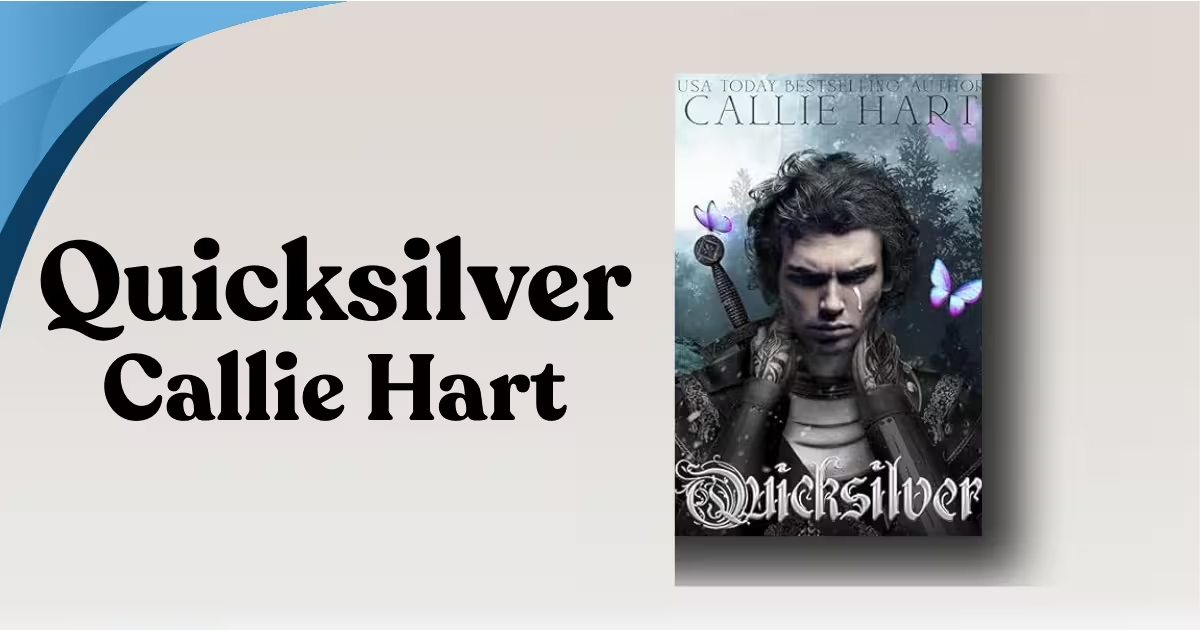
Quicksilver by Callie Hart is worth your time if you can push through a clunky first third. Once Saeris crosses into the Fae realm it becomes a war novel, a slow-burn romance and a grim lesson about reading the fine print, all at once. I finished all 45 chapters and landed on 4 out of 5.
This review covers the pacing with chapter numbers, the spice and violence to expect, a full spoiler recap with the ending explained, and the angle most summaries skip: nearly every disaster in this book starts with a badly worded promise.
Table of Contents
Brief Summary
What it is: an adult romantasy, book one of the Fae & Alchemy series. Callie Hart self-published it in June 2024, and Forever (US) and Hodderscape (UK) published it traditionally after a bidding war.
Premise: a 24-year-old thief from a water-starved desert city accidentally wakes a portal made of liquid silver. She lands in a frozen Fae realm at war with vampires.
My verdict: 4/5. A slow, clunky opening, then a book that is funny, violent and unexpectedly tender.
Pacing: the Fae realm starts at roughly the 12% mark and the war camp at about the halfway point. The last 13% is the best stretch.
Content: explicit sex, graphic violence, parental murder and a cliffhanger. The UK ebook listing recommends it for readers 17 and up.
Ending in one line: Saeris kills the vampire king Malcolm, is nearly killed herself, and is remade as a half-Fae, half-vampire being who is about to be crowned queen of Sanasroth.
Screen: Netflix bought the film rights in December 2024. I found no announced cast, director or release date.
Who should read it, and who may bounce. If you like enemies-to-lovers with a lot of banter, a grumpy warrior who hides grief behind jokes, and found-family loyalty, this will probably get its hooks in you. Readers who loved ACOTAR-style Fae courts will feel at home.
The publisher’s own blurb pitches it to fans of ACOTAR and Fourth Wing. You also need patience, because some readers on StoryGraph report the first 30% feels slow and clunky. If you dislike heavy profanity, an aggressive male lead who bosses the heroine around, or characters who don’t talk plainly to each other, you may bounce.
One reviewer rated it 2.5 stars for exactly those reasons. Readers who need a closed ending should also wait until the sequel is in hand, because this one stops on a cliffhanger.
Introduction
Quicksilver is the first novel in Callie Hart’s Fae & Alchemy series. Hart is a British author who had published more than 40 dark romance novels before trying fantasy. She uploaded it to Kindle herself on June 4, 2024 (one outlet gives June 3). The traditional edition followed on December 3, 2024, and the sequel Brimstone arrived on November 18, 2025. By my count the PDF I read runs about 196,000 words across 45 chapters, plus an author’s note that mentions “622 pages.”
Quick Verdict
A loud, funny, violent war romance that takes a third of the book to find its feet and then wrecks you on purpose. Recommended for fans of Fae-court romantasy who don’t mind a slow start.
Should You Read It?
| Pros | Cons |
|---|---|
| Sharp banter and real chemistry between Saeris and Fisher | The first third is clunky and slow |
| Fisher’s guarded grief pays off emotionally | Heavy profanity (my own text search found roughly 350 uses of the f-word and its variants) |
| Strong set pieces: the Darn battle, the sword naming, Gillethrye | Many tropes stacked together, and some readers find the lead’s bossiness grating |
| Found family, plus a fox named Onyx | Saeris repeatedly ignores warnings, then pays for it |
| A world that flips desert heat into snow and one sun into two moons’ worth of strangeness | A hard cliffhanger |
What Is It About?
Saeris Fane, a thief from a desert city ruled by an immortal queen, accidentally wakes an ancient portal and is carried to the frozen Fae realm of Yvelia. There she is bound by oath to a warrior named Kingfisher and must forge protective relics for a war against vampires. The deeper she goes, the more she learns about his past, her own magic and a trap that has been waiting centuries.
Rating: 4 / 5
How Did a Self-Published Fantasy End Up at Netflix?
It happened through BookTok, and the speed is part of why people are curious. Sales sank at first, to around 4,000th place on Amazon’s charts. Hart then offered free copies to about 30 BookTok creators, and roughly half responded. The buzz produced a 10-bidder auction that Forever won in the US, with Hodderscape taking UK rights.
Per the same Wikipedia entry, the traditional edition debuted at number one on the New York Times list, and the book earned a Goodreads Choice Awards nomination for Best Romantasy in 2024. According to Deadline’s report, Netflix then won a seven-figure film auction that same month.
Hart has also said she turned down her agent’s request for heavy cuts (about 70,000 words, per the Q&A summarized on Wikipedia) and published the book as she wrote it.
After reading it, I think that explains both its best and worst traits. It is bold and unpolished at once.
When Does Quicksilver Actually Get Good?
It gets good in layers, and the first real jolt comes earlier than the “slow 30%” reviews suggest. I mapped it with my own word counts from the PDF, so treat the percentages as approximate.
| Chapters | What happens | Roughly where |
|---|---|---|
| 1 to 5 | Zilvaren, the stolen gauntlet, capture, near-death | 0 to 12% |
| 6 to 12 | Yvelia, the forge, quicksilver tests, first sparks | 12 to 30% |
| 13 to 19 | Escape attempt, the bargain, Cahlish, the feeder attack | 30 to 50% |
| 20 to 29 | War camp, the Ice Breakers, the naming of Avisiéth | 50 to 73% |
| 30 to 38 | Solace, the battle at the Darn, the hostage, the God Binding | 73 to 87% |
| 39 to 45 | Gillethrye and the ending | 87 to 100% |
My honest advice: if chapter 12, with the fox bite and the stolen ring, doesn’t hook you, the war camp at chapter 20 probably will.
Quicksilver Plot Summary
Part 1: A thief in the Silver City (Chapters 1 to 5)
Saeris Fane is 24 and lives in the Third Ward of Zilvaren, a wheel-shaped desert city ruled by the immortal Queen Madra and scorched by twin suns, Balea and Min. Water is currency, and Saeris survives by stealing. Her mother was murdered in the street years earlier, and she has a younger brother, Hayden, who never does what he’s told.
In chapter 1 she lifts a guardian’s golden gauntlet in the wealthy Hub, talks her way past a near-strangling under a false name, and discovers the metal hums and whispers to her. She hides this gift, an uncanny ability to feel and move metal.
The theft goes badly. Elroy, her old glassmaker friend, refuses to let the gauntlet near his furnace (Ch. 2). Carrion Swift, a smuggler and her former lover, warns her to get it out of the Third before the guards tear the ward apart. Hayden vanishes with her bag, and when the guardians catch up, Saeris takes the blame to save him.
She tells Hayden to run to Elroy and cruelly insults him so he’ll go, and the book frames it as a line worth remembering: “the cruel things we said served the kindest purpose” (Ch. 3).
In the palace cells (Ch. 4), Queen Madra tells Saeris she will take her life first, then burn her people, and she threatens to level the Third Ward and the hundred thousand people in it. Captain Harron drags her to the hall and stabs her (Ch. 5). As she is dying, a silver pool in the hall wakes.
A man in black steps out of it, kills the guards and leaves Harron raving about obsidian passages that move. Saeris thinks of him as Death. He hangs a silver chain around her neck and carries her into the pool.
Part 2: The Winter Palace (Chapters 6 to 12)
Saeris wakes in a stranger’s bed in Yvelia, a frozen realm with one sun and real snow. Everlayne, the cheerful daughter of King Belikon, takes charge of her wardrobe and her education.
The dress-and-corset scenes are the comic part of the book, and they cover a lot of worldbuilding: the Fae worship gods, they are at war with the vampire realm of Sanasroth, and Madra turns out to be human, which doesn’t comfort Saeris much.
“Death” is a warrior named Kingfisher, Fisher to his friends, with quicksilver swirling in one eye and a talent for being insufferable. Belikon wants Saeris to learn to wake the quicksilver pools again.
Fisher is told to help, and he decides the best teaching method is a trial by fire. He drops a bead of liquid silver into her hands (Ch. 10), nearly freezing her mind, then coaches her through putting it to sleep. She punches him. Between the library with the fussy librarian Rusarius, the forge that Fisher magically cleans after making her scrub it, and the fox she calls Onyx, the book finds its comic rhythm.
By chapter 12 Saeris has kissed Fisher and stolen his signet ring in a plan to use the palace pool to get home.
Part 3: The bargain and Cahlish (Chapters 13 to 19)
Saeris runs to the deep pool with Onyx in a bag. Fisher blocks her, furious, and tells her the ring is just a trinket that wouldn’t have shielded her mind (Ch. 13). They make a deal. He will go back to Zilvaren to bring her loved ones to Yvelia, and she will help him forge relics.
She asks for Hayden and Elroy. Fisher returns with Carrion Swift, who lied about being Hayden when Fisher grabbed him (Ch. 14).
Fisher then hurries them out of the palace by night. In a tavern, patrons toast him and his friend Renfis (Ren) as war heroes, which is the first hint that “the dog” the court sneers at is a legend among ordinary Fae (Ch. 15). At the shadow gate, Saeris demands that Fisher repeat her vow word for word: he will release her “the moment you have made enough relics for my people” (Ch. 16).
In the next chapter we learn what “enough” means. He has fifteen thousand warriors and a trunk of fifteen thousand rings to melt down, and she realizes she missed the detail again (Ch. 17).
They are at Cahlish, Fisher’s family estate. Saeris studies old alchemist books written in Old Fae, then is attacked by Sanasrothian “feeders,” vampire foot soldiers who can only be killed with silver. She is clawed and poisoned, and Fisher carries her to healers (Ch. 18 and 19).
Part 4: The war camp (Chapters 20 to 29)
Fisher takes her and Carrion to the war camp along the Darn, a frozen river between the Fae lands and a charred wasteland that leads to the vampire fortress of Ammontraíeth.
A hostile warrior named Danya sneers at the human, and Saeris, by instinct, shatters Danya’s sword into hundreds of needle-like shards (Ch. 20). “She’s mine,” Fisher says. The Ice Breakers scene follows: warriors smash the river ice so the dead cannot cross, and the white-haired vampire king, Malcolm, taunts Fisher from the far bank, hinting that the two are in league (Ch. 21).
The romance turns physical when Fisher brings her back to his bedroom at Cahlish (Ch. 22). A morning later, when Carrion teases her, Fisher snaps that she isn’t “Sunshine,” that “she is moonlight,” and that Carrion should call her Majesty (Ch. 23).
Lorreth, one of Fisher’s closest friends, reveals that Fisher once gave him a piece of his own soul. If Fisher dies, Lorreth’s soul stays anchored, and Lorreth says he will die first or take his own life before leaving his friend trapped (Ch. 24).
Fisher takes Saeris to his mother’s old apartment in Ballard. She wakes to him screaming in a nightmare, stays beside him, and learns his mother was murdered too (Ch. 25 to 27). Back at the forge, she strikes a bargain with the quicksilver itself, promising something it wants, and the shards of Danya’s sword come back together. With Lorreth’s help she forges a new blade.
Lorreth names it Avisiéth, “The Unsung Song,” and a column of white light explodes into the sky (Ch. 28 and 29).
Part 5: The Darn, the bond and Fisher’s disappearance (Chapters 30 to 38)
Fisher gives Saeris his father’s sword, Solace, which had been sitting in Madra’s palace for a thousand years (Ch. 30). When vampires swarm the Darn, Lorreth’s new sword unleashes lightning that turns Malcolm’s army to ash, and the camp roars his name (Ch. 31).
Then Everlayne appears across the river, bitten and surrounded by a hundred vampires. Taladaius, Malcolm’s silver-haired second, names the price: Fisher must show up at dusk in Gillethrye, and Malcolm also wants the Alchemist (Ch. 32).
Fisher finally says Saeris’s name aloud (Ch. 34). She learns from a healer named Te Léna that the runes on her hands are the first sign of a God Binding, a mate-bond that storytellers say always ends in tragedy. She confronts Fisher, who has been planning to reject the bond and die (Ch. 35).
They fight and half-reconcile, then spend a night in Ballard. Fisher accepts the bond, tells her he loves her, and says he came to Ballard “for a little hope” (Ch. 37). When she wakes, he is gone. He left a goodbye note, a sword on the mantle and an open shadow gate (Ch. 38).
Saeris, Carrion and Lorreth chase him through a gate in the library ceiling and fall into a freezing lake.
Part 6: Gillethrye and the ending (Chapters 39 to 45)
Harron, now silver-eyed and in Madra’s service, leads feeders to the lake and forces the group through a vortex into a ruined amphitheater (Ch. 39).
Fisher is kneeling and bloodied. Belikon, Malcolm and Madra are revealed as siblings who have been working together against both realms. Belikon releases Fisher from a blood oath so he can finally speak about Gillethrye (Ch. 40).
Fisher’s story comes out in one terrible piece. A horde of vampires was at the gates of the Fae city, Gillethrye. He arrived too late, and Belikon offered a coin-toss deal: if the coin landed leaf-side up, Malcolm would withdraw. Malcolm caught the coin before it hit the ground.
With the city already infected, Fisher burned it with nearly 200,000 people inside to stop the spread. Malcolm then built a labyrinth around the coin and filled the stands with the burning dead, who are still conscious, and told Fisher he could end their suffering by finding the coin (Ch. 41).
Fisher then drives Solace through Belikon’s stomach and throat, and the fight explodes (Ch. 41 and 42).
In the labyrinth, Saeris senses quicksilver and finds the coin inside a dead spider demon’s throat. Carrion lets Malcolm bite him and reveals his real name, Carrion Daianthus. His family’s blood was used in the blood curse that made vampires, and drinking it nearly destroys Malcolm.
Malcolm tears into Saeris’s stomach. She flips the coin so it lands, and a wind sweeps through Gillethrye and turns the burning dead to ash at last.
Then she picks up Solace and cuts off Malcolm’s head (Ch. 42 and 43). Madra flees through the quicksilver.
Saeris is dying. Fisher wants to heal her with his soul, and she refuses, reminding him that he swore never to take her choices away again: “Never is a long time, Fisher.” Taladaius offers another way, turning her into a vampire. Fisher says, “She consents” (Ch. 43).
The quicksilver calls in the favor she promised it and pulls her into a field to meet the God of Chaos, Zareth. He says the gods have meddled with her fate and that she is meant to cut her thread from the fates to save Fisher and perhaps the universe. She agrees, and he shoves her into the quicksilver (Ch. 44).
She wakes with pointed ears and fangs, a half-Fae, half-vampire nobody has seen before.
Fisher has had his quicksilver dampened with help from Te Léna and a woman named Iseabail. Because Saeris killed the vampire king and Malcolm never named an heir, she is about to be crowned queen of Sanasroth in two days (Ch. 45).
Analysis and Critic
Who Are the Main Characters in Quicksilver?
The two leads carry the book, and they carry it because they are flawed in complementary ways. Saeris Fane is a thief, a fighter and a talker with a short fuse.
Her superpower is that she really does listen to people, yet she keeps skipping the details that matter. In chapter 17 she realizes she did it again: “I hadn’t paid attention to the details.”
Her arc is from survival to choice. By the end she has refused to let Fisher die for her, and she has chosen a body and a future nobody forced on her, at least in the way that matters to her.
Kingfisher is the grumpy warrior who is genuinely funny and genuinely wounded. His cruelty in the early chapters (“I told you I was magic”) covers real guilt about Gillethrye, and the late reveal reframes his arrogance as a habit of treating himself as expendable. He is also bound by Fae oath law.
As he puts it in chapter 12, humans “can lie whenever you want,” while he cannot. That limit makes his bargains dangerous and his silences meaningful.
Carrion Swift starts as comic relief, an ex who lights cigarillos in the middle of grief and calls Saeris “Sunshine.” The Daianthus reveal turns him into the story’s most surprising weapon and a reminder that a smuggler’s patience can be strategy.
Everlayne, sunny and fierce, anchors the found-family side of the book, and her capture gives the middle its stakes. Ren and Lorreth are the loyal brothers, and Lorreth’s soul-link with Fisher and his redemption with Avisiéth make him my favorite supporting arc.
Taladaius is the best written of the vampires: calm, amused and secretly a rebel. Malcolm, Belikon and Madra are the weakest part. They are cruel in a theatrical, almost cartoonish way, and the sibling reveal explains their cooperation but doesn’t deepen them.
Onyx the fox is proof that every great fantasy needs a small animal who won’t stay out of trouble.
What Are the Main Themes and Symbols in Quicksilver?
Promises and the fine print. This is the theme I think most reviews miss. The book is full of bargains with hidden terms. Saeris’s vow in chapter 16 sounds airtight, and then “enough relics” becomes fifteen thousand relics. Belikon’s coin toss in Gillethrye looks like a fair gamble until Malcolm catches the coin. The quicksilver’s “favor” is called in at her weakest moment.
Zareth offers a bargain with a hidden price: her thread is cut from the fates. Even chapter 14 is titled “The Fine Print.” The book repeatedly asks who wrote the terms and who benefits from the wording.
Water, class and desperation. Zilvaren’s whole economy runs on water, and the people in the Third are lawful only when they’re thirsty. Saeris steals because the system gives her no other route. This setting also explains why she is so quick to sign up for any deal that promises Hayden’s safety.
If you like stories about people squeezed by an authoritarian system, the historical-fiction side of that idea shows up in Polostan by Neal Stephenson: Review And 5 Takeaways.
Consent and free will. Fisher’s promise never to take her choices away again is tested to its limit in chapter 43. Her refusal of the soul-sacrifice is a clear statement that love without consent is still a trap.
It also echoes against Madra, whom Fisher accuses of “spaying” Saeris as a child (Ch. 41), a reference to a violation of her bodily autonomy that adds real weight to the book’s later insistence on choice.
Sacrifice versus staying alive. Fisher spends the book trying to die usefully. Saeris, Lorreth and Ren spend it trying to stop him. Chapter 38 is titled “Martyrs for Friends,” and his note says he has “no interest in having martyrs for friends.”
Symbols. Quicksilver is an old name for mercury, a metal that is both solid and fluid. That fits a substance that is a portal, a poison, a voice and a creditor.
The coin in Gillethrye (leaf or fish) is fate rigged by the one who flips it. The runes on Saeris’s skin and wrists show how much of the story is about being marked by other people’s choices.
The twin suns of Zilvaren are mirrored by the twin goddesses Bal and Mithin that Everlayne names in chapter 7, a quiet hint that the desert city and the Fae realm are linked. Fisher’s nickname for Saeris, “Little Osha,” comes from the butterfly he calls her (Ch. 30), and it shifts from mockery to endearment over the book.
Is Quicksilver Actually Good? My Evaluation
Quicksilver is a loud, messy, very funny and unexpectedly tender war romance that spends its first third clearing its throat and its last third breaking your heart on purpose.
Strengths
The banter works because both leads have something to hide. Fisher’s grief isn’t played for easy sympathy, and the Gillethrye reveal pays off the earlier teasing without cheating.
The set pieces are memorable, especially the Darn battle and the moment Lorreth names his sword. Despite the grim material, the book is often funny, and Onyx the fox earns his place.
Weaknesses
The first third drags, and some reviewers on StoryGraph call the opening clunky. One reader writes that the human-world portion is paced too slowly. The profanity occasionally flattens the tone, Saeris’s repeated recklessness gets old, and the villains are thin next to the heroes.
For some readers, Fisher’s bossiness and the miscommunication between the leads will be a dealbreaker.
Impact and Controversy
Chapter 38 gutted me. The letter, the sword on the mantle and the open gate are the first time Fisher’s habit of treating himself as expendable costs the reader something. Reception has been split.
Goodreads shows an average of about 4.33 from over 846,000 ratings on one list page I checked, while other readers are cooler. That kind of divide is common for BookTok-driven hits, and it isn’t a flaw in the book so much as a sign of how much it leans on taste.
Comparison With Similar Works
A First for Women reviewer compared it to ACOTAR, and the setup does echo it: a human pulled into a Fae realm and entangled with a dangerous warrior.
In contrast, Quicksilver trades courtly intrigue for a war camp and gives its human heroine real forge skills. Readers who like mortal-among-Fae stories such as The Cruel Prince may enjoy the survival angle, and Fourth Wing‘s war-college setting is the closest match for the military tone.
For readers who want the story to continue, Brimstone switches to dual points of view.
Is the Quicksilver Netflix Movie Happening?
Yes, it is in development, but I could not find any announced director, cast or release date. Netflix announced the acquisition on December 3, 2024 in a seven-figure deal, with Elizabeth Cantillon producing and Hart as executive producer. Hart has said she wants the film to stay dark and adult rather than becoming a YA adaptation.
As of November 2025, a screenplay was complete and the project was looking for a director.
Because nothing has been released, there is no box-office data and no honest book-versus-screen comparison yet. My opinion, flagged as opinion: a film will have to compress roughly 196,000 words, and the first third is the obvious place to cut. The risk is losing the quiet forge scenes that make the romance believable.
What Can a Fantasy About Stolen Water Teach Us About Real Bargains Made Under Pressure?
It teaches that scarcity makes people sign things they haven’t read. Saeris doesn’t lack intelligence. She lacks time, and her brother’s safety is the only number she is tracking.
According to the WHO and UNICEF’s 2025 update, 2.1 billion people still lack safely managed drinking water, including 106 million who drink directly from untreated surface sources. Coverage in fragile contexts is 38 percentage points lower than elsewhere.
Those are real people with far fewer options than Saeris has, and desperate people everywhere are the ones most likely to be handed terms they can’t afford to question.
The book makes that point through plot rather than statistics. Every time Saeris is rushed, she gets the wording wrong. Every time Fisher is cornered, he trades away something he can’t get back.
Five lessons I took from it:
Urgency is a tool someone else can use. If a deal feels like it must be signed today, ask who set the deadline.
Define “enough” before you agree. Saeris’s vow failed on one vague word and one missing number.
Repeating terms back only works if you choose the right terms. She made Fisher repeat her sentence verbatim, but the sentence itself was the problem.
A bargain made under duress isn’t a free choice. Fisher keeps saying so, and the book backs him up.
The people with the least slack need the clearest terms. Plain language isn’t a courtesy. It is protection.
Which Quotes From Quicksilver Stand Out?
I’m keeping these short and citing chapters. Full spoilers apply.
- “Monsters thrive best in the dark.” (epigraph, front matter)
- “The cruel things we said served the kindest purpose.” (Ch. 3, Saeris sending Hayden away)
- “It’s not kidnapping if you come willingly.” (Ch. 14, Fisher’s idea of a joke)
- “I need fifteen thousand relics.” (Ch. 17, the moment the fine print bites)
- “Because she is moonlight.” (Ch. 23, Fisher to Carrion)
- “I came for a little hope.” (Ch. 37, Fisher in Ballard)
- “I don’t need magic to mess you up.” (Ch. 41, Fisher before he strikes Belikon)
- “Never is a long time, Fisher.” (Ch. 43, Saeris refusing his sacrifice)
- “One foot in front of the other.” (Ch. 45, Fisher after the ending)
- “You will always be most sacred to me.” (Ch. 45, Fisher on who she has become)
Conclusion
Quicksilver is a strong 4/5, and a book I’m glad I finished rather than one I enjoyed from page one.
The early chapters wobble, and the villains aren’t as sharp as the heroes. Still, the leads are unforgettable, the Gillethrye reveal is earned, and the way the story keeps returning to promises and choices gives the romance more weight than it first seems to carry.
It is best for readers who like ACOTAR-style Fae stories with a war-camp edge, slow-burn enemies-to-lovers, and heartbreak delivered with jokes.
Skip it, or wait, if you want a polished opening, minimal profanity or a closed ending. It matters because it shows how far a self-published, unrevised vision can travel when readers find it, and the sequel promises to deal with the questions it leaves open.
Quicksilver

Quicksilver by Callie Hart is worth your time if you can push through a clunky first third. Once Saeris crosses into the Fae realm it becomes a war novel, a slow-burn romance and a grim lesson about reading the fine print, all at once. I finished all 45 chapters and landed on 4 out of 5.
URL: https://www.sopranu.com/quicksilver-callie-hart-review/
Author: Callie Hart
4
Pros
- Chemistry and banter; an emotional payoff for Fisher's arc; memorable set pieces; found family; a strong cliffhanger
Cons
- Slow, clunky first third; heavy profanity; thin villains; repeated reckless choices from the lead; a hard cliffhanger







