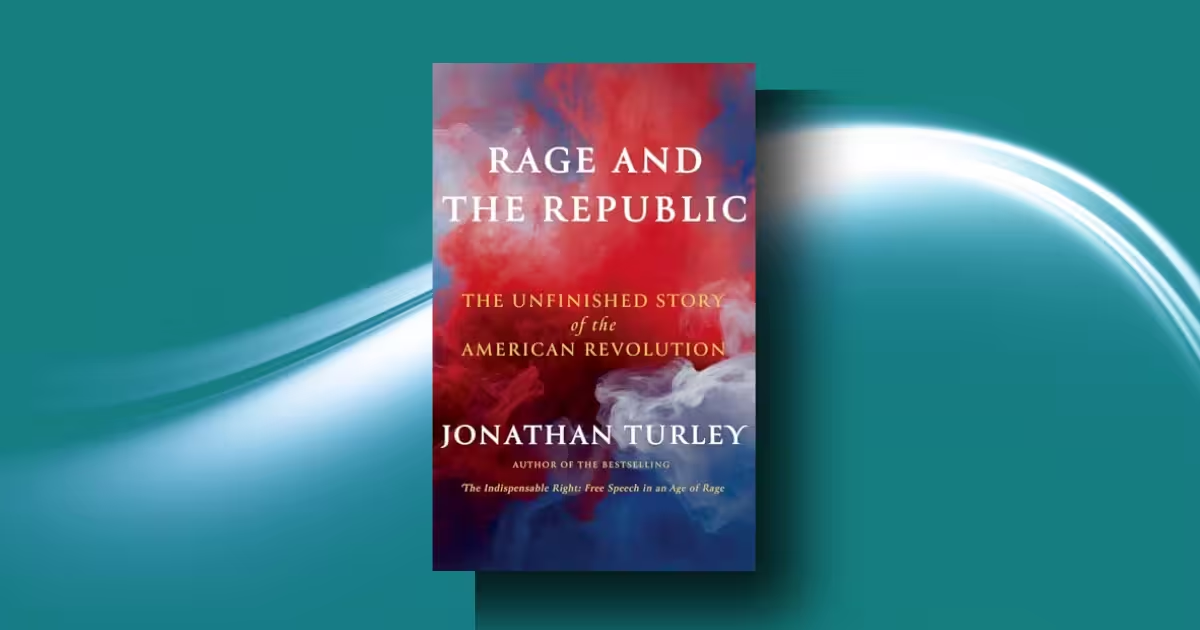

Why does politics sometimes feel like it’s become a permanent street-fight—and what if the American Revolution left us an actual blueprint for climbing back down? Turley’s Rage and the Republic reads like a historical warning flare aimed straight at our present moment.
Rage and the Republic is best for readers who want American Revolution history that doesn’t stop at 1776 or Yorktown, but follows the Revolution’s aftershocks into constitutional design—and into today’s “age of rage”; anyone interested in constitutional law, free speech, and how political systems can slide into what Turley calls “democratic despotism”; readers who like “big-arc” arguments that connect Athens → Paris → Philadelphia → the modern technological world.
Not for
- Readers who want a neutral, minimal-judgment narrative. Turley is making a case; he’s not writing a purely detached timeline.
- Readers who dislike modern parallels inside historical analysis (he deliberately bridges past-to-present, including technology, global governance, and civic culture).
- Anyone looking for a short read. The book is built as a long walk through revolutions, factions, and institutions.
Table of Contents
1. Introduction
Rage and the Republic: The Unfinished Story of the American Revolution is Jonathan Turley’s sweeping argument that the American Revolution wasn’t simply a war, or even a founding moment—it was the start of a long experiment in preserving liberty without letting democracy devour itself.
This is popular history + constitutional analysis + political warning, stitched together by one central obsession: how revolutions end.
Turley frames revolutions as more than dramatic ruptures; he calls them “the story of human exploration and exploitation,” and he sets Rage and the Republic up as an anatomy of how societies can flip from liberation into coercion.
That framework matters because he isn’t only asking “What happened?” He’s asking, “What design choices helped prevent America from collapsing into the kind of revolutionary tyranny seen elsewhere?”
Purpose of Rage and the Republic
Turley’s core thesis is that the United States is not automatically protected by its founding myth. It survives only if it remembers what the Revolution prioritized: liberty—not merely “democracy”—and if it maintains constitutional architecture that can channel rage into politics rather than violence.
He makes two early thesis-level moves that shape everything that follows:
- He describes the Declaration as a force that “shattered” centuries of justification for authority, and notes it did so in 1,320 words.
- He then pivots sharply into the present, noting that technologies like AI are reframing society and asking whether American democracy can survive—or collapse—into “democratic despotism.”
That term—“democratic despotism”—is his recurring warning: democracy’s most common threat is not always a king, but the “despotism of the many over the few,” where majorities erode rights and destabilize legitimacy.
2. Background
Turley’s argument sits inside a bigger modern reality: rage is now a political force, not just a private emotion. In his framing, the danger is not that people are angry; it’s that systems can fail to process anger through legitimate institutions, and then anger begins to seek its own “solutions.”
Turley also stresses that revolutions are not only fought with weapons. They are fought in civic consciousness. He underscores this through John Adams’ idea that the real Revolution occurred “in the Minds of the People” from 1760 to 1775—before Lexington.
That becomes a warning: if a republic is sustained by civic belief, it can also be weakened by civic disintegration.
3. Rage and the Republic Summary
Turley builds Rage and the Republic as a wide historical and civic argument with a clear structural contrast:
- Paris becomes a case study in how revolutionary rage can harden into moralized violence when institutions fail.
- Philadelphia becomes a case study in constitutional design: how the Founders tried to convert volatile human impulses into durable self-government through structure, delay, and divided power.
- The twenty-first century becomes the stress test: AI disruption, class polarization, corporate power, and transnational governance all challenge the original architecture.
A. Revolutions begin in rage—and then the real crisis is what happens after
Turley is explicit that revolutions don’t end when the enemy retreats. The hardest part begins after authority collapses and a society has to decide what replaces it.
He describes the American republic as “born in rage,” and reminds readers that the Boston Tea Party—now treated as an icon—was condemned at the time as violent criminality.
But he insists the Declaration wasn’t simply rage; it was a universal rights claim—rights “not as Englishmen, but as human beings born to liberty.”
Then comes one of his most provocative reframings: the Declaration does not mention “democracy.” It was liberty, not majority rule, that “defined the revolution.”
This becomes his yardstick: revolutions that elevate “the people” without protecting liberty often collapse into coercion.
B. The “unfinished story”: America had to invent an ending—and the ending was constitutional design
Turley leans on Tocqueville’s idea that revolution’s greatest difficulty is “the ending,” and he uses that to argue that America’s true revolutionary achievement was the creation of a political structure capable of ending revolutionary energy without betraying its ideals.
The emotional center here is his insistence that political stability is not accidental—it is constructed. And that construction is fragile if citizens stop understanding why the structure exists.
C. “Democratic despotism”: how democracies can destroy themselves
Turley defines “democratic despotism” as a pattern the Founders feared: majorities curtail rights and wealth to satisfy demands, chaos follows, and then citizens accept a tyrant to restore stability.
He emphasizes the historical recurrence of tyrants “emerging not from aristocracy but democracy.”
From there, he traces the pattern across historical cases and uses it as a warning lens for the modern republic.
D. Philadelphia: the Madisonian answer to revolutionary instability
A major portion of Rage and the Republic is Turley walking readers through how the Founders—especially Madison—diagnosed the problem and tried to design around it.
Turley argues the Constitution wasn’t created as a democracy-celebration. It was designed as a liberty-defense system. His line is blunt: “Democracy was a means to protect individual rights, not the inverse.”
He anchors liberty in limits through Jefferson’s definition: liberty is the “unobstructed action according to our will” within the equal rights of others.
This is where Rage and the Republic becomes intensely practical: Turley is arguing that liberty requires boundaries—not as a moral lecture, but as a political survival tool.
Madison’s fear: “elective despotism”
Turley highlights Jefferson’s warning about “an elective despotism”—the idea that simply electing rulers does not prevent tyranny.
In Turley’s presentation, Madison’s mission becomes the prevention of concentrated power—whether in one leader, one institution, or one faction.
This is where Turley’s structural discussion is unusually readable:
- Checks and balances aren’t polite formalities; they are anti-rage engineering.
- Federalism creates “double security” by splitting authority across levels.
- Bicameralism forces competing constituencies into compromise rather than domination.
If you only remember one thing from Turley’s Philadelphia argument, it’s this: institutions are not just paperwork. They are shock absorbers for human anger.
E. Paris: what happens when rage becomes a virtue
Turley’s French Revolution sections aren’t there for spectacle. They function like a diagnostic scan: what happens when a society starts treating opponents as contaminants rather than fellow citizens?
He warns that mobs are “rarely ‘right.’”
He uses a chilling Robespierre line as a moral alarm bell: “terror is only justice: prompt, severe and inflexible.”
Importantly, he also clarifies he doesn’t see modern academics as literal replicas—he says he does not view them as “little Robespierres.”
His point is more unsettling: environments shape people, and once rage is socially rewarded, cruelty can begin to feel like virtue.
F. The modern “age of rage”: factions, retaliation, and the temptation to punish
Turley ties revolutionary collapse to something we can recognize immediately: retaliation becomes moralized, and politics becomes punishment.
He describes how “the means become the ends,” with political choices driven by punishing opponents rather than governing coherently.
He then focuses hard on economic factionalism as an “ageless” pathway to power.
One of his most pointed claims here is a tax-share comparison: he notes rhetoric about “fair share,” and states that the top 1% pay more taxes than the bottom 90% combined.
Whether a reader agrees with his framing or wants to debate measurement categories, the role of the claim in his argument is clear: rage politics thrives on villain classes, and rights become negotiable once politics is reduced to punishment.
G. Technology revolution: AI, robotics, and a new pressure cooker
This is where Rage and the Republic stops feeling like distant history and starts feeling like a forecast.
Turley argues that global markets, robotics, and AI are displacing workers, and he doubts that “most, or even a large percentage,” of low-wage workers will be retrained into high-paid tech roles.
He predicts “a rapidly rising population of the statically unemployed,” deeper class polarization, and an environment where expanded support structures could intensify separation.
In his framework, the political danger is not merely economic pain; it’s the way pain fuels “unrestrained democratic impulse,” setting up the familiar cycle: chaos → demand for stability → embrace of authoritarian power.
He also uses Huey Long’s line about Louisiana to capture the paradox that “perfect democracy” can resemble dictatorship.
H. Corporate power: when authority migrates from the state to private empires
Turley’s modern section is not only about government power. It’s also about power migrating into corporate structures that are not designed to protect rights.
He warns that companies building AI systems and robots may have “immense” ability to carry out agendas while public objection becomes minimal.
He frames the danger clearly: such entities control jobs and wealth but are “not designed for participatory politics.”
Whether you agree or disagree, this is central to his “unfinished story” claim: concentrated power—public or private—can smother liberty if citizens lose leverage.
I. Transnational governance and free speech: stability vs. legitimacy
Turley also warns about governance moving upward into transnational bureaucracies and the resulting legitimacy gap.
He describes how free speech can be treated as dangerous “disinformation,” citing the WHO “infodemic” framing and global censorship efforts.
He argues stability can be “illusory” in bureaucratic systems, and worries about what happens when pressures rise while citizens feel detached from decision-making.
He also warns, in his EU discussion, that rights are unlikely to be “enhanced” under remote governance structures.
J. The ending question: “What then is the American…?”
Near the latter sections, Turley pivots into identity and purpose, using Crèvecoeur’s famous question: “What then is the new American, this new man?”
He highlights what made “American” a striking identity term: a relatively classless society of freeholders and “framers of their own laws,” building civic identity across diverse origins.
Then he turns the blade softly: in the twenty-first century, citizenship feels less anchored, and people can begin to wonder whether America means anything beyond “wealth or power.”
For me, that’s the book’s emotional core—not just fear, but a kind of civic grief: the possibility of forgetting what the Revolution was even for.
4. Rage and the Republic Analysis
This is an urgent, muscular book—almost a civic intervention. If I had to summarize my reaction in one sentence: Rage and the Republic is a bracing reminder that liberty is not self-sustaining; it has to be engineered, taught, and defended.
Does Turley support his arguments with evidence and reasoning?
On the book’s internal logic: yes. He repeatedly links (1) economic pressure, (2) faction escalation, (3) rights-curtailment, and (4) the public’s desire for an “ending” that often looks like concentrated authority.
He also shows how the Founders built a system meant to direct those pressures into political process, particularly through divided power and layered governance.
Does the book fulfill its purpose?
Yes—because its purpose isn’t to hand you trivia or a clean war chronicle.
It’s to deliver a mental model for how free societies slide into coercion without noticing the slide, especially when democracy is confused with liberty and moral certainty is confused with justice.
5. Strengths and Weaknesses
Strengths (what I found genuinely compelling)
Liberty-first framing that clarifies everything. “Democracy was a means to protect individual rights” is not a throwaway line—it reorganizes how you interpret modern conflict.
Institutional design becomes emotionally real. Bicameralism, federalism, and checks-and-balances stop feeling abstract; Turley makes them feel like the difference between argument and bloodshed.
The AI/robotics argument lands hard. Whether you agree with his scale or not, he connects disruption to historical volatility with a coherent chain.
The identity question hits like a quiet alarm. “What then is the American…?” becomes a demand for civic self-definition, not nostalgia.
Weaknesses (what frustrated me)
Modern parallels may feel politically lopsided depending on a reader’s priors. Even when he’s criticizing patterns rather than teams, some readers may feel attacked and stop listening—ironically mirroring the factional deafness he warns about.
Certain claims invite technical debate. The tax-share comparison is rhetorically powerful but will make detail-oriented readers want the underlying methodological breakdown.
The scope is enormous. Athens-to-AI is thrilling, but if you prefer a tighter narrative history, this will feel like a thesis-driven panorama.
7. Comparison with similar works
Gordon S. Wood, The Radicalism of the American Revolution (1992): Wood emphasizes the social and ideological transformation unleashed by 1776; Turley shifts the focus to what came after—how constitutional design prevented revolutionary energy from collapsing into despotism.
Joseph J. Ellis, American Creation (2007): Ellis centers the personalities and political struggles of the Founding generation; Turley concentrates more on structural safeguards—federalism, checks and balances, and the fear of “elective despotism.”
Alexis de Tocqueville, Democracy in America (1835–1840): Tocqueville warned of “democratic despotism”; Turley explicitly revives that concern, applying it to modern polarization, technological disruption, and institutional fragility.
Contemporary “democracy in crisis” books (e.g., Levitsky & Ziblatt’s How Democracies Die, 2018): These works focus on norms and political behavior. Turley, by contrast, grounds his warning in the American Revolution itself, arguing that liberty—not mere majority rule—was the Founders’ central safeguard.
8. Conclusion
If you want a book that flatters your side, this isn’t it. If you want a book that insists the American Revolution was a finished victory, this isn’t it either.
But if you want a historically grounded, constitutionally literate, and sometimes unsettling answer to the question “Why does modern politics feel like a bonfire that keeps demanding fuel?”—Rage and the Republic is one of the most useful reads for anyone thinking seriously about the American experiment’s next chapter.
Who should read it?
- General readers who want an educational but forceful overview of how revolutions mutate.
- Students of history, law, politics, and civics who want a framework connecting founding-era design to present pressures.
- Anyone exhausted by the “age of rage” and trying to understand how societies climb down without surrendering liberty.