

Do you ever feel like you’re not a citizen anymore, just a data point being processed by algorithms you don’t understand? Jill Lepore’s The Rise and Fall of the Artificial State will tell you exactly how we got here, and why that feeling isn’t paranoia, it’s history catching up with us.
Overview
Jill Lepore’s The Rise and Fall of the Artificial State is a comprehensive history and urgent warning about how we’ve been building a government by machines, almost by accident. Published in 2026 by Liveright, this book traces the journey from the first census counts to today’s AI-driven governance, showing how the liberal nation-state that promised freedom is being replaced by something far more troubling.
The book argues that the Artificial State, government by automation, prediction, and corporate-owned machines, represents a return to tyranny and mystification, just dressed in the language of progress and efficiency.
Lepore, a Harvard historian and New Yorker staff writer, brings her characteristic rigor to this sprawling narrative, connecting the dots between 17th-century mechanical philosophy, 1930s Technocracy, Cold War computing, and today’s Silicon Valley billionaires.
What makes this book essential reading is its refusal to accept the hype. While tech executives promise salvation and abundance, Lepore shows how their grand plans are actually about abandoning democracy, the natural world, and even humanity itself.
Key facts from the The Rise and Fall of the Artificial State:
- Between 1958 and 2024, trust in the U.S. government fell from over 70% to barely 20%
- By 2025, nearly 2 in 5 people across 70 countries agreed that “AI could make better decisions on my behalf than my government representatives”
- Between 2025 and 2030, AI is expected to drive a power increase for global data centers of as much as 200%
- By 2023, data centers had doubled their electricity consumption
- In 2024, the U.S. had fallen to 28th place in the Democracy Index
Who Should Read The Rise and Fall of the Artificial State
If you’re concerned about democracy, read this. This book gives you the historical context to understand what’s happening to our political systems.
If you work in tech, read this. Lepore’s critique is devastating precisely because it’s not anti-technology. She’s pro-thoughtful innovation and deeply skeptical of hype.
If you voted for someone and wonder why nothing changes, read this. The book explains how predictive algorithms have paralyzed politicians, making them slaves to data rather than principles.
If you’re young and feel alienated from politics, read this. Lepore shows that this isn’t your fault, the system has been designed to make you feel powerless.
Who shouldn’t read this? If you’re looking for simple solutions or techno-utopian cheerleading, this book will frustrate you. It’s a diagnosis, not a prescription.
Table of Contents
Introduction
Title: The Rise and Fall of the Artificial State
Author: Jill Lepore
Publication: 2026, Liveright Publishing (W. W. Norton)
Pages: 331 (excluding notes and index)
Genre: History, Political Science, Technology Studies
Jill Lepore is the David Woods Kemper ’41 Professor of History at Harvard University and a professor of law at Harvard Law School. She’s also a staff writer at The New Yorker. Her previous books include “These Truths: A History of the United States” and the Pulitzer Prize-winning “We the People: A History of the U.S. Constitution.”
The book began as the 2026 Tanner Lectures on Human Values at Yale, and draws on her work for the BBC and years of teaching and writing about technology, politics, and history. This isn’t someone parachuting into a subject, Lepore has been thinking about these issues for decades.
What’s striking about the book’s origin is Lepore’s admission that she’s a historian who normally prefers her “meat cooked”, meaning she’s uncomfortable with the rawness of the present. But she decided to set aside her historian’s timidity because the situation was urgent enough to warrant it.
Central argument: The Artificial State is a fantasy about humans, machines, and the earth. It’s the dream of “a future in which humans are untethered, free and alone, disembodied minds, with no ties, not to one another, not to any place, not to any village or city or nation or mountain or forest or valley or ocean, lake, or river, or possibly even to Earth itself.”
Background
To understand the Artificial State, we need to go back. Lepore traces the origins of government by machine to something fundamental: counting people.
The Book of Numbers
Before about ten thousand years ago, there were only about ten million humans on Earth. Most people had only ever met a few dozen others. Some very old languages have no words for numbers. You couldn’t count a large group because there weren’t large groups to count.
Everything changed when humans began clustering together under powerful states. Ancient rulers counted their subjects to measure their strength, to muster armies and levy taxes. The first reliable censuses were taken by Chinese and Roman emperors.
But counting people wasn’t always accepted. Some Christians considered it a usurpation of power. As Lepore notes, when King David ordered Joab to count the people of Israel in the second book of Samuel, “David’s heart smote him after that he had numbered the people.” Early English colonists in North America forswore counting because “David’s example sticksomewhat with us.”
This resistance to counting is important because it shows that the idea of a state knowing its population was controversial. It represented a change in the relationship between rulers and ruled.
She writes:
“For much of human history, not only the numbers of people but most other knowledge of the natural world, why stars exist, what causes thunder, when life begins, had been the domain of deities, mysteries known only to gods, wonders to hold in awe.”
The Shift from Mystery to Facts
The modern state’s capacity to count people and Enlightenment philosophers’ interest in deducing mathematical rules for political affairs gave rise to statistics, etymologically, population data recorded in the interest of the state.
A “fact” is something done, a deed. In Western history, its prominence as an elemental unit of knowledge is associated with trial by jury. The 1215 Magna Carta established that “no free man is to be arrested, or imprisoned… except by the lawful judgment of his peers or by the law of the land.”
Trial by jury, replacing trial by ordeal, which allowed God to determine guilt or innocence, led to what historians call “the culture of fact.” The idea that observation and evidence, not revelation, should determine truth.
As Jill Lepore puts:
“The founding of modern liberalism, the beginnings of the liberal nation-state, required questioning the mysteries of state: challenging the divine right of kings, and arguing instead for the sovereignty of the people, whose power was to be exercised in proportion to their numbers.”
The Rise of Political Arithmetic
The first modern census, counting everyone, not for raising armies or collecting taxes, dates to 1703 in Iceland. Modern censuses are a function of the modern nation-state and the emerging science of demography.
The field began with Sir William Petty and Captain John Graunt, who extrapolated from records of births and deaths to derive England’s population. Petty called this “political arithmetic.”
Proportional representation is, of course, a mathematical formula. As James Wilson said at the Constitutional Convention in Philadelphia, “If… we depart from the principle of representation in proportion to numbers, we will lose the object of our meeting.”
The Rise and Fall of the Artificial State Summary
Chapter 1: Technocracy Inc.
The Artificial State rests on two ideas. The first is mechanical philosophy, the idea that everything is a machine that operates according to deducible laws. The second is technological determinism, the idea that machines determine the course of history.
Lepore traces these ideas to the 17th and 19th centuries. But the most direct precursor to today’s tech billionaires is Technocracy Inc., a movement that briefly captured the American imagination in the 1930s.
Founded by Howard Scott, a charismatic fraud who claimed to be an engineer, Technocracy Inc. proposed the abolition of all existing economic and political arrangements. They would be replaced by engineers who would rule by numbers. Members didn’t have names, they had numbers. One Technocrat called himself “1x1809x56.” Joshua Haldeman, Elon Musk’s grandfather, was Technocrat number 10450-1.
Jill Lepore writes:
“Scott explained that Technocracy ‘does not subscribe to the basic tenet of the democratic ideal, namely that all men are created free and equal,’ since, in the modern world, only scientists and engineers have the intelligence and education to understand the industrial operations that lie at the heart of twentieth-century life.”
The movement was briefly huge. In the four months between November 1932 and March 1933, the New York Times published more than 170 stories about Technocracy. Seven thousand people showed up for a rally in Seattle. A Technocrat rally drew ten thousand people to the Hollywood Bowl.
But Technocracy failed because democracy succeeded. FDR’s New Deal offered hope, and the movement was revealed to be a fraud. Yet its ideas lived on, passed from Haldeman to his grandson Elon Musk, who would later build companies that seemed to come straight from Technocracy’s playbook.
Chapter 2: Machines That Think
During the Second World War, statistics became more mathematical for the sake of prediction, calculating missile trajectories, cracking codes. This required faster and more adaptive calculating machines, leading to the development of the general-purpose computer.
Key fact: During the war, it took women mathematicians known as “computers” a month to calculate the possible trajectories of certain missiles. In 1943, the War Department commissioned the development of ENIAC, which could do the same work nearly instantly.
After the war, these machines found new applications. The UNIVAC’s first use was to tabulate the 1950 U.S. Census. But it wasn’t long before they were being used for something more ambitious: predicting human behavior.
As Jill Lepore expresses in The Rise and Fall of the Artificial State :
“The Times report made clear, the most readily obvious application of such a machine was in counting and sorting people, their votes, and their opinions.”
The first commercial pitch for what would become the artificial state came in 1958, when a Madison Avenue ad man and an MIT political scientist built a “People Machine” that they claimed could both predict and influence voting behavior. Their company was called Simulmatics Corporation.
The Simulmatics team believed they had invented “the A-bomb of the social sciences.” Their first client was the Democratic National Committee. In 1959, they were hired to run simulations on an artificial electorate and tell the nominee what to say, to whom, and when. Jill Lepore writes:
“‘Without prejudicing your judgment, my own opinion is that such a thing (a) cannot work, (b) is immoral, (c) should be declared illegal,’ wrote Adlai Stevenson’s advisor Newton Minow to the historian and John F. Kennedy confidant Arthur Schlesinger Jr. ‘I shudder at the implication for public leadership of the notion… that a man shouldn’t say something until it is cleared with the machine.'”
When Kennedy won the presidency, many in the press attributed the victory to Simulmatics’ People Machine. Theodore H. White wrote in “The Making of the President” that politics was no longer about uncertain facts but exact science. The New York Herald Tribune called the machine Kennedy’s “secret weapon.”
Chapter 3: Computopia and the Automated State
The 1960s and 1970s saw wild speculation about what computers might mean for society. Would we get Computopia, a world where machines and humans lived in harmony, or the Automated State?
Yoneji Masuda, a Japanese sociologist, predicted either “a symbiosis in which man and nature can live together in harmony” or “a horrible and forbidding age” where our future society would become a prison. The two futures had much in common, since the path toward either led humans “to neglect the need for coexistence with nature.”
J.C.R. Licklider, the man most credited with inventing the internet, made his own predictions in 1969. He foresaw a “Multinet” that would replace everything from the telephone and postal system to shops and banks. But he also warned about “clandestine artificial-intelligence programs, searching through the data bases, altering files, fabricating records, and erasing their own audit trails, [which] would bring a new meaning to ‘machine politics.'”
She writes:
“‘Computer power to the people is essential to the realization of a future in which most citizens are informed about, and interested and involved in, the process of government,'” Licklider concluded.
The hope was that computers would advance democracy. The reality would prove different.
Chapter 4: The Twitter Revolution
When Twitter was launched in 2006, its founders had no political ambitions for their technology. It was meant as a kind of group text for posting status updates, like “just made a yummy BLT.” The name Twitter was chosen to connote “a short burst of inconsequential information.”
Twitter was quickly adapted for political purposes. Barack Obama’s 2008 campaign was the first to effectively deploy the internet to win an American presidency. After Obama won, conservatives used Twitter to undermine both his administration and the press.
The promises were enormous. In 2010, Hillary Clinton, then Secretary of State, declared that “there are more ways to spread more ideas to more people than at any moment in history” and that the United States would guarantee “the freedom to connect.”
But the evidence showed something else. By 2019, political scientists found that 97% of all tweets about U.S. national politics were posted by fewer than 10% of all users. Political tweeters were younger, better educated, more Democratic, wealthier, and more partisan than the general population. They didn’t represent anyone but themselves.
Key statistic: By 2021, about a third of Americans were regularly getting their news from Facebook. In the Philippines, nearly three-quarters of the population got their news from Facebook. Facebook held the personal data of more than a quarter of the world’s people, 2.7 out of 7.9 billion.
The Supreme Court in Packingham v. North Carolina ruled that social media operates as a public square, explicitly citing Twitter as a modern means of exercising First Amendment rights. This was a mistake. Twitter was never a public square, it was a privately owned company with its own financial interests, and the “Twitterate” was nothing like the electorate.
Chapter 5: AI.gov
By the 2020s, the Artificial State had become a purposeful plan, animated by a politics that had more in common with Technocracy Inc. than with the U.S. Constitution.
The release of ChatGPT in November 2022 set off a frenzy of competition. In February 2023, Microsoft’s CEO announced, “A race starts today.” The U.S. and China were the only national runners in this race.
Jill Lepore puts:
“‘Artificial intelligence is the future not only of Russia but of all of mankind,’ Vladimir Putin had said in 2017, predicting that ‘whoever becomes the leader in this sphere will become the ruler of the world.'”
Tech companies that had earlier supported restraint began lobbying against it. They used the urgency of an arms race to defeat antitrust reforms, data protection laws, and AI accountability measures.
Key fact: By 2024, Microsoft was opening a new data center every three days. Between 2025 and 2030, AI was expected to drive a power increase for global data centers of as much as 200%.
The architects of the Artificial State were no longer apologizing. Marc Andreessen’s “Techno-Optimist Manifesto” celebrated the triumph of the “techno-capital machine” and humankind’s emancipation from nature through robots, brain implants, space colonies, and uploading human minds to machines.
Jill Lepore says in The Rise and Fall of the Artificial State:
“Andreessen cited, among his inspirations for this manifesto, on a list of Patron Saints of Techno-Optimism, Filippo Tommaso Marinetti. In 1908 Marinetti wrote the Futurist Manifesto… Ten years after Marinetti wrote the Futurist Manifesto, he cowrote the founding document of the movement led by Mussolini: the Fascist Manifesto.”
Part Two: What Robots Want
The second half of the book turns to science fiction, examining how writers have imagined the Artificial State. Lepore argues that Silicon Valley executives took cautionary tales and read them as instruction manuals.
Key observation:
“The architects of the Artificial State read science fiction, and read it badly: they misread it. Having dismissed philosophy, history, literature, and every humanistic way of learning, thinking, and knowing, including the very act of reading, and hoping for a future in which the work of reading was to be done by machines, perhaps the architects of the Artificial State no longer knew, as humans, how to search for meaning in a text.”
The word “robot” comes from science fiction, from a root for “slave.” Karel Čapek’s 1920 play R.U.R. coined the term and imagined robots rising up against their human creators. But instead of heeding the warning, Westinghouse immediately started building its own robots to demonstrate household appliances.
Lepore traces the history of robot stories from Samuel Butler’s “Darwin Among the Machines” (1863) through E.M. Forster’s “The Machine Stops” (1909) to Philip K. Dick’s “Do Androids Dream of Electric Sheep?” (1968). In all of these stories, the Artificial State is a nightmare. Yet Silicon Valley billionaires treated them as blueprints.
Jill Lepore says:
“In science fiction, robots annihilate humans, as a species, with the very remorselessness with which humans have hunted and used, eaten, held captive, or destroyed so many other species. Robots are our Ahab, and we the whale.”
Chapter 12: Murderbot
The culmination of the book brings us to the present, where tech executives invoke the fear of a robot apocalypse to justify building robots that might cause that apocalypse.
Jill Lepore describes:
“By the middle of the 2020s, vastly consequential decisions about the future of Earth and everyone and everything on it were being made by a handful of men based on their colossal accumulation of wealth, their catastrophic misreading of history, literature, and philosophy, and their breathtaking contempt for ordinary people, living and dead.”
In 2025, Sam Altman, CEO of OpenAI, said that he guessed that pretty soon most of the surface of the earth would be covered in data centers. His response: “maybe we put them in space.”
Elon Musk, Jeff Bezos, Peter Thiel, and Mark Zuckerberg all have escape plans, Mars, space, New Zealand, the Metaverse, uploaded brains. They aren’t saving humanity. They’re preparing to abandon it.
Key fact: “Between 1970 and 2024, vertebrate populations declined by an average of 73%, mostly due to habitat loss.” The human-driven apocalypse has already come. We’re replacing animals with machines.
The Rise and Fall of the Artificial State Analysis
What makes The Rise and Fall of the Artificial State so effective is Lepore’s refusal to accept the tech industry’s framing. She doesn’t treat AI as inevitable progress or a mysterious force. Instead, she shows us the people who are making these decisions, and the ideologies driving them. Jill Lepore writes:
“The rise of the Artificial State is inseparable from the fall of the natural world. The Artificial State is the factory farming of humans, the sorting and segmenting, the isolation and alienation, as if humans were becoming to machines what animals had become to humans.”
This is a powerful metaphor. Factory farming reduces animals to products, denies them any agency or dignity. The Artificial State does the same to humans. We’re being sorted, segmented, and isolated, our behavior predicted and manipulated.
Lepore is particularly good at showing the historical precedents for today’s tech utopians. Her discovery that Elon Musk’s grandfather was a Technocrat who moved to South Africa to defend apartheid is genuinely shocking. But she doesn’t make too much of it. The point is that these ideas, that engineers should rule, that democracy is stupid, that the price system should be abolished, aren’t new. They’re old ideas being recycled. As Jill Lepore expresses:
“Elon Musk was born in Pretoria in 1971. Haldeman died in a plane crash when his grandson was only a toddler. Elon was a very clever, very lonely boy who loved comic books and science fiction.”
The book also shows how science fiction predicted the Artificial State. Samuel Butler’s “Darwin Among the Machines” and “Erewhon,” E.M. Forster’s “The Machine Stops,” Karel Čapek’s “R.U.R.” and “War with the Newts,” the works of Stanislaw Lem and Isaac Asimov, all warned us. We didn’t listen.
Strengths
1. Historical depth. Lepore connects the dots between 17th-century mechanical philosophy, 1930s Technocracy, and today’s AI race. This isn’t a shallow analysis of current events. It’s a deep dive into how we got here.
2. Intellectual honesty. Lepore is a historian who prefers the past to the present. She’s uncomfortable with the rawness of current events. But she writes this book anyway because the situation is urgent. This gives her credibility, she’s not rushing to publish hot takes.
3. Human scale. The book is about big ideas but it’s also about people. Elon Musk’s grandfather. Howard Scott’s fraud. The women operators of the Voder. The individual stories matter.
4. Science fiction framework. The second half of the book is a master class in reading. Lepore shows how tech billionaires misread cautionary tales as instruction manuals. This is a devastating critique.
5. Ecological awareness. The book refuses to separate the Artificial State from its environmental impact. The data centers are destroying the planet. The two are connected. This is how Jill Lepore says:
“The Artificial State’s dependence on the natural world is the squishy underbelly beneath its Terminator T-600 titanium-hard endoskeleton. The way to dismantle the Artificial State is to flip it on its back the way a fisher cat turns over a porcupine to slice open its gut.”
Weaknesses and Criticisms
1. Dense and sprawling. The book covers a lot of ground, from 17th-century philosophy to 2025 AI policy. This can feel overwhelming. Some readers might wish for a tighter focus.
2. What about the Global South? The book’s focus is largely American and European. The rise of Chinese AI is mentioned, but the book could have done more with the non-Western experience of the Artificial State.
3. Limited prescriptions. Lepore is better at diagnosis than prescription. The conclusion offers some suggestions, public debate, democratic governance, defending the natural world, but it’s short on specifics. This is intentional, but it might leave readers frustrated.
4. The science fiction framework. The argument that tech billionaires misread science fiction is persuasive. But it might not be as central to the story as Lepore thinks. The forces driving the Artificial State are deeper than bad reading habits.
5. Potential underestimation of resistance. Lepore’s tone is grim, which is appropriate given the subject. But she might underestimate the human capacity for resistance. The backlash against data centers is growing. People are starting to fight back.
Comparison with Similar Works
These Truths by Jill Lepore: Lepore’s earlier history of the United States covers similar ground in terms of democracy and its challenges. This book is a natural extension of that work, focusing on the technological threats to self-government.
The Human Condition by Hannah Arendt: Lepore explicitly acknowledges Arendt’s influence. Both books ask what it means to be human in an age of machines. Arendt worried about automation making humans superfluous. Lepore shows how that worry has become reality.
Technocracy and the American Dream by William Akin: The standard history of the Technocracy movement. Lepore draws heavily on this work, connecting it to the present.
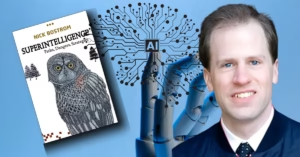
Superintelligence by Nick Bostrom: Lepore cites Bostrom as a major influence on Silicon Valley. Where Bostrom sees an existential risk to be managed, Lepore sees a self-fulfilling prophecy.
The Age of Spiritual Machines by Ray Kurzweil: Kurzweil’s techno-utopianism is a target of Lepore’s critique. Where Kurzweil celebrates the coming of spiritual machines, Lepore warns of the artificial state.
Conclusion
The Rise and Fall of the Artificial State ends with a plea to remember what we’re fighting for, not just what we’re fighting against.
Jill Lepore expresses:
“The Artificial State is not alive; it cannot be killed. But because it is a construct, at once an idea and a thing, something built, if half built, it can be dismantled. Other very stubborn systems for organizing human societies without consent have been dismantled before: the divine right of kings, feudalism, human bondage, imperialism, fascism.”
This is the book’s final argument. The Artificial State is not inevitable. It was built by human choices, and it can be unbuilding by human choices. But that requires understanding what we’re dealing with. It requires history.
As Jill Lepore explores:
“A wall of mirrors can be smashed with the slightest hammer, the nearest rock. That rock is the right of the people to elect a government by consent and not by automation.”
The book’s final message is simple but profound: Ask not the machines. Ask the beasts, the trees, the rivers. Reconnect with the natural world. Remember that you are a citizen, not a data point.
Reader Recommendation
I’d recommend The Rise and Fall of the Artificial State to:
- Anyone concerned about democracy. The book gives you the historical context to understand what’s happening.
- People who work in tech. Lepore’s critique is more devastating because it’s not anti-technology.
- Young people. If you feel alienated from politics, this book shows you why, and it’s not your fault.
- Voters. The book explains why politicians seem paralyzed and unresponsive.
- Environmentalists. The book connects the tech industry’s environmental destruction to its political agenda.
Who shouldn’t read this?
- People looking for simple solutions. The book is a diagnosis, not a prescription.
- Techno-utopians. If you believe AI will save us, this book will frustrate you.