
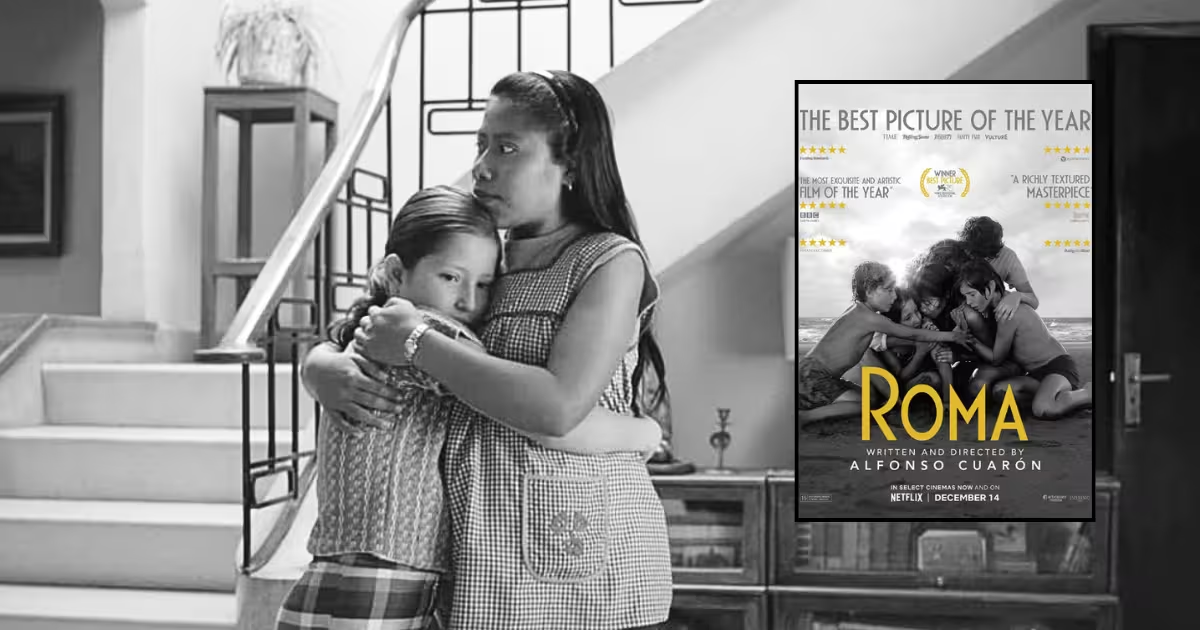
Have you ever watched a film that feels less like entertainment and more like quietly stepping into someone else’s childhood home, hearing the echoes of conversations long past, and feeling the weight of unspoken sorrows? That’s exactly what happened to me the first time I saw Roma 2018 , Alfonso Cuarón’s breathtaking semi-autobiographical drama.
Released in 2018 and streamed primarily on Netflix after a limited theatrical run, this black-and-white gem follows the life of a young indigenous housekeeper in 1970s Mexico City. It’s not just a movie—it’s a love letter to the women who hold families together, often invisibly.
For me, Roma 2018 isn’t merely one of the best films of the 21st century; it’s the kind that gently breaks your heart and then puts it back together, wiser and more empathetic.
Table of Contents
Background
Alfonso Cuarón, already celebrated for works like Gravity and Children of Men, took a deeply personal turn with Roma. The film draws directly from his own upbringing in Mexico City’s Colonia Roma neighborhood during the turbulent early 1970s.
Named after that very district, Roma 2018 recreates the house he grew up in (even filming across the street from the original at 22 Tepeji Street) and centers on Cleo, a character inspired by Liboria “Libo” Rodríguez, the Mixtec domestic worker who helped raise him.
Shot in luminous black and white, with Cuarón himself handling cinematography, editing, and co-editing duties, the movie was filmed chronologically to preserve emotional authenticity—especially important since lead actress Yalitza Aparicio had no prior acting experience.
Production faced real challenges, including a robbery on set in November 2016 when crew members were attacked. Yet the result is seamless, intimate, and profoundly moving.
Premiering at the Venice Film Festival in August 2018, where it won the Golden Lion, Roma 2018 became Netflix’s boldest awards contender, sparking debates about streaming versus theatrical releases while earning universal acclaim.
Roma (2018) at a Glance
Director / Writer / Cinematographer: Alfonso Cuarón
Genre: Historical Drama / Semi-Autobiographical
Language: Spanish & Mixtec
Runtime: 135 minutes
Release: Netflix (December 14, 2018) after limited theatrical run
Setting: Mexico City, 1970–1971 (Colonia Roma neighborhood)
Quick Synopsis
A deeply personal black-and-white portrait of a middle-class family seen through the eyes of their live-in indigenous maid, Cleo. Amid domestic turmoil (a crumbling marriage) and larger political unrest (including the Corpus Christi massacre), the film quietly explores love, loss, class, race, and resilience.
Main Cast
- Yalitza Aparicio as Cleodegaria “Cleo” Gutiérrez (the maid – Oscar-nominated debut)
- Marina de Tavira as Sofía (the mother – Oscar-nominated)
- Fernando Grediaga as Antonio (Sofía’s absent husband)
- Jorge Antonio Guerrero as Fermín (Cleo’s lover)
- Marco Graf as Pepe (youngest son)
- Daniela Demesa as Sofi (daughter)
- Diego Cortina Autrey as Toño (eldest son)
- Carlos Peralta as Paco (third son)
- Nancy García García as Adela (second maid, Cleo’s friend)
- Verónica García as Teresa (Sofía’s mother)
Key Accolades
- 3 Oscars: Best Director, Best Cinematography, Best Foreign Language Film (Mexico’s first)
- 10 Oscar nominations (tied for most that year)
- Golden Lion (Venice Film Festival)
- Widely regarded as one of the best films of the 21st century
A slow, immersive masterpiece – perfect if you love thoughtful, visually stunning cinema.
Roma 2018 Plot Summary
Set between 1970 and 1971 in Mexico City’s Colonia Roma, Roma 2018 centers on Cleodegaria “Cleo” Gutiérrez (Yalitza Aparicio), a quiet, devoted Mixtec live-in maid working for an upper-middle-class family.
Cleo and fellow maid Adela share small quarters, speak Mixtec when alone, and handle the endless chores—washing clothes by hand on the rooftop, cleaning up after the family’s oversized dog, serving meals, and tucking the four children into bed each night.
The family includes Sofía (Marina de Tavira), a chemistry teacher trying to hold everything together; her physician husband Antonio (Fernando Grediaga); grandmother Teresa (Verónica García); and the children: rebellious eldest Toño, sensitive Paco, sweet Sofi, and imaginative youngest Pepe.
Early on, we sense cracks in the household. Antonio frequently leaves for “conferences” in Quebec, but his prolonged absences and Sofía’s quiet distress reveal he’s having an affair.
Meanwhile, Cleo begins a tentative romance with Fermín (Jorge Antonio Guerrero), a cocky young man obsessed with martial arts training under the eccentric Professor Zovek. After an awkward movie date, they have sex, and soon Cleo suspects she’s pregnant. When she tells Fermín in a cinema, he excuses himself to the bathroom—and never returns, abandoning her completely.
Cleo confides in Sofía, who responds with surprising kindness, arranging a doctor’s visit that confirms the pregnancy. To lift spirits, Sofía takes the family and maids to a hacienda for New Year’s, where guests casually extinguish a massive forest fire while singing—a surreal moment underscoring class privilege amid environmental chaos.
Back in the city, Cleo spots Antonio openly flirting with his mistress.
Desperate for support, she tracks Fermín to a dusty training field on the city’s outskirts. There, surrounded by young men practicing with wooden rifles, Fermín brutally rejects her, denying paternity and threatening violence if she ever approaches again. His cold cruelty foreshadows something darker.
As Sofía’s marriage crumbles—Antonio eventually leaves for good—she struggles to shield the children from the truth, drinking heavily at night. With Cleo’s due date nearing, Teresa takes her shopping for a crib downtown.
Suddenly, student protests erupt outside the furniture store, escalating into the real-life Corpus Christi Massacre of June 10, 1971. Paramilitary group Los Halcones storms the streets, firing on protesters. Chaos spills into the store: a young student is shot dead at point-blank range.
Then Fermín, now revealed as one of Los Halcones, enters with gun drawn, points it directly at pregnant Cleo and Teresa, hesitates, and walks away without a word. The terror triggers Cleo’s labor.
Traffic from the violence delays their rush to the hospital. Antonio briefly appears, offers hollow reassurance, then vanishes again. In the delivery room, doctors fight to save the baby, but the girl is stillborn. Cleo’s devastation is palpable—she collapses in silent grief as nurses whisk the infant away.
Months later, Sofía, now openly separated, takes Cleo and the children to the beaches of Tuxpan for a “vacation” that’s really meant to give Antonio time to clear out his belongings. At the ocean, strong currents sweep Sofi and Paco out to sea.
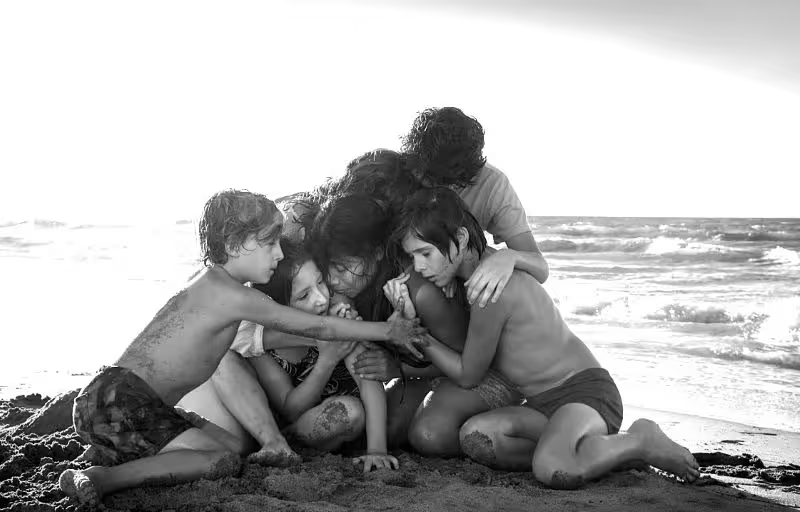
Cleo, who cannot swim, wades in anyway and rescues both children at great personal risk. On the sand, soaked and shaking, the family embraces. Sofía and the children repeatedly affirm, “We love you, Cleo,” while Cleo, tears streaming, confesses something heartbreaking: “I didn’t want her [the baby] to be born.” She had sensed the child would face the same hardships she endures.
The film closes quietly. Back home, Antonio’s study has been converted into a playroom; his belongings are gone. Cleo resumes her routine—sweeping, washing laundry on the rooftop—while a plane overhead echoes the opening shot. Life continues, hierarchies intact, yet something intangible has shifted.
Roma 2018 Analysis
1. Direction and Cinematography
Cuarón’s direction feels almost documentary-like in its patience, yet every frame is meticulously composed. Long, unbroken takes follow Cleo through crowded streets or the family home, immersing us in her daily reality.
The black-and-white choice isn’t nostalgic gimmickry—it strips away color to focus on texture, light, and shadow. Wide shots of Mexico City streets contrast with intimate close-ups, making ordinary moments feel monumental.
According to The New York Times’ Manohla Dargis, Cuarón uses “intimacy and monumentality to express the depths of ordinary life.” I couldn’t agree more.
2. Acting Performances
Yalitza Aparicio’s performance as Cleo is nothing short of miraculous for a complete newcomer. Her expressive eyes convey volumes—resignation, tenderness, quiet strength.
The beach rescue scene still gives me chills; her raw terror feels utterly real because, like Cleo, Aparicio herself couldn’t swim.
Marina de Tavira brings heartbreaking dignity to Sofía’s unraveling, shifting from composed matriarch to vulnerable woman. The children feel authentically chaotic and loving. Even minor roles, like Fermín’s menacing volatility, land perfectly.
3. Script and Dialogue
Cuarón’s screenplay trusts silence as much as words. Dialogue is naturalistic—overlapping, mundane, sometimes in Mixtec without subtitles—forcing us to observe rather than be told everything. Pacing is deliberately slow, mirroring domestic life’s repetitive rhythm. Some viewers find it meditative; others might call stretches languid. For me, the restraint makes emotional peaks devastating.
4. Music and Sound Design
Roma 2018 uses almost no traditional score. Instead, diegetic sound dominates—street vendors, car radios, crashing waves, barking dogs.
Occasional source music (like “I Don’t Want to Talk About It” during a painful moment) hits like a gut punch. The soundscape feels alive, grounding us in 1970s Mexico City. When silence finally falls after the stillbirth, it’s deafening.
Roma 2018 Themes
Diving deeper into Roma, what strikes me most is how Alfonso Cuarón weaves a tapestry of interconnected themes that feel both intimately personal and urgently societal.
This isn’t a film that preaches; it observes, letting the quiet accumulation of everyday moments reveal profound truths about class, race, gender, motherhood, and the shadow of political violence.
For me, watching it feels like peeling back layers of my own assumptions about privilege and empathy—Cuarón doesn’t just tell a story from his childhood; he forces us to confront the invisible structures that shape lives like Cleo’s.
At the heart of Roma 2018 is the stark reality of class inequality and invisible labor.
Cleo, as a live-in Mixtec maid, is the backbone of the household—she cleans endless dog feces from the garage, hand-washes laundry on the rooftop, cares for the children with genuine tenderness, and even risks her life saving them at the beach.
Yet she remains peripheral: sleeping in a small room with Adela, eating separately, and never fully integrated into the family’s emotional circle. The children adore her, calling “¡Cleo!” with affection, but they also take her for granted, much like Sofía does in moments of crisis.
Cuarón, drawing from his own privileged upbringing, subtly critiques this dynamic without vilifying the family.
As one analysis notes, it’s a “personal message to the Latin American upper class,” urging self-reflection on systemic oppression. I’ve always felt this hits hard—the love is real, but it’s conditional, bounded by hierarchy.
Cleo’s devotion persists even after her stillbirth, returning to chores as if nothing happened, symbolizing how domestic workers’ grief is often sidelined.
Race and indigenous identity layer onto this powerfully. Cleo’s Mixtec heritage is evident in her quiet use of the language with Adela and her rural roots, contrasting sharply with the urban, middle-class whiteness of the family.
Fermín’s abandonment and later role in the paramilitary attack underscore how indigenous and poor Mexicans were often caught in cycles of exploitation or violence. Yet the film doesn’t delve deeply into Cleo’s cultural world—her village life or traditions remain in the background, which has drawn criticism for presenting indigeneity through a privileged lens.
Some argue it harnesses indigenous suffering to humanize the elite family, or that it stops short of true empowerment. Slavoj Žižek, for instance, contended that audiences celebrate Cleo’s “grace” and resilience without recognizing the need for her to break free from oppressive moral constraints.
Personally, I see validity in this; the film romanticizes her quiet strength, but does it challenge the system enough? Yalitza Aparicio’s casting—a non-actor from an indigenous background—sparked real-world change, highlighting Mexico’s anti-indigenous bias and contributing to labor reforms for domestic workers.
Still, Roma 2018 reminds us that representation alone isn’t revolution.
Gender roles and maternal sacrifice form another emotional core. Both Cleo and Sofía navigate abandonment—by Fermín and Antonio, respectively—in a patriarchal world where men wield power destructively.
Antonio’s affair and departure shatter the family facade, while Fermín’s brutality (denying paternity, threatening violence, joining Los Halcones) embodies toxic masculinity. Women, meanwhile, endure and rebuild: Sofía masks her pain to protect the children, Cleo sacrifices her own desires (confessing she didn’t want the baby, fearing it would suffer like her).
The beach rescue is the pinnacle—two mothers, one biological, one surrogate, affirming love amid chaos. As some readings suggest, Roma 2018 portrays a hidden matriarchy, where women hold society together despite male absence or violence.
This resonated with me deeply; it’s a tribute to the unspoken burdens women carry, echoing Cuarón’s dedication to the real-life Libo who raised him.
Political violence intrudes like a sudden storm, mirroring personal turmoil. The Corpus Christi massacre—where paramilitaries attack students, and Fermín points a gun at pregnant Cleo—shows how state-sponsored repression (tied to land disputes and the Dirty War era) bleeds into private lives.
The New Year’s forest fire, casually extinguished by privileged guests, symbolizes environmental and social neglect. Cuarón juxtaposes domestic intimacy with national chaos, suggesting personal stories are never isolated from broader power structures.
Symbolism reinforces these ideas: water (rain, waves, amniotic fluid) represents life, loss, and cleansing; planes overhead evoke transience and aspiration; recurring motifs like feces or broken objects highlight life’s messiness. The circular structure—opening and closing with rooftop washing—implies cycles of repetition, where inequality persists despite individual resilience.
Ultimately, Roma’s message is one of fragile solidarity across divides. The final embrace on the beach, with affirmations of love, offers hope, but the return to routine underscores limits.
For me, it’s a poignant call to see the “background” people in our lives—to acknowledge their humanity without expecting endless sacrifice. In today’s world of deepening inequalities, it feels more relevant than ever: empathetic, unflinching, and quietly revolutionary.
Comparison
Whenever I think about where the film sits in Alfonso Cuarón’s filmography, it feels like the quiet heartbeat amid his more explosive works.
Films like Y tu mamá también (2001) burst with youthful energy and road-trip freedom, while Children of Men (2006) and Gravity (2013) deliver visceral, high-stakes spectacle.
Roma, by contrast, is introspective and restrained—almost the opposite of blockbuster pacing. Yet it shares Cuarón’s fascination with Mexico’s social fabric and human fragility. If Gravity is about survival in the void of space, Roma 2018 is survival in the crowded, noisy intimacy of home.
Compared to classics in the domestic-worker genre—like Vittorio De Sica’s neorealist Umberto D. or even Lucretia Martel’s The Headless Woman—Roma 2018 stands out for its autobiographical tenderness.
It doesn’t judge the family harshly; instead, it observes with love and sorrow. Where some films might lean into overt political critique, Cuarón lets the hierarchy reveal itself naturally through small details: the dog feces Cleo cleans daily, the children calling her name affectionately yet never quite treating her as equal.
What sets Roma 2018 apart is its refusal to rush—those long, panoramic takes make you live in the moment, something rarer in today’s faster cinema.
Audience Appeal and Reception
Roma 2018 isn’t for everyone, and that’s part of its strength. It’s catnip for cinephiles who adore slow-burn art-house films—think fans of Apichatpong Weerasethakul or Tsai Ming-liang. If you love historical dramas with social depth or stories centered on marginalized voices, this will resonate deeply.
Casual viewers seeking plot-driven entertainment might find the pacing challenging; there’s no traditional three-act structure, just life unfolding.
Reception was overwhelmingly positive. On Rotten Tomatoes, it holds 96% from over 400 reviews, with critics calling it “enthralling” and a “masterpiece.”
Metacritic scores it 96/100, making it one of the best-reviewed films of 2018 and the 56th highest-rated ever.
Box office was modest theatrically—around $5 million globally—but streaming numbers were huge, with millions watching on Netflix.
Awards
The accolades poured in. The film won the Golden Lion at Venice, was runner-up for Toronto’s People’s Choice, and dominated awards season: three Oscars (Best Director, Best Cinematography, Best Foreign Language Film—Mexico’s first), four BAFTAs including Best Film, two Golden Globes, and four Critics’ Choice awards.
It tied for most Oscar nominations (10) that year and remains celebrated in 21st-century best-of lists, ranking high in polls from The New York Times, Rolling Stone, and Writers Guild surveys as late as 2025.
Personal Insight and Lessons: Why Roma Still Matters in 2026
Watching Roma 2018 today, in 2026, hits differently because its themes feel painfully current.
The film’s quiet portrayal of class and racial divides in 1970s Mexico mirrors inequalities that haven’t vanished—they’ve evolved. Mexico remains one of Latin America’s most unequal countries, with a Gini coefficient hovering around 0.42 in recent years.
Indigenous women, like Cleo, still make up a disproportionate share of domestic workers, often earning below minimum wage and lacking formal contracts.
When the film released, it sparked real change. Advocacy groups used the film to push for better rights, contributing to Mexico’s 2019 domestic workers law that mandated minimum wages, social security, and limited hours.
Yet enforcement remains spotty—many employers ignore it, and workers fear retaliation. Recent 2026 labor reforms (a 13% minimum wage hike and gradual shift to a 40-hour week) offer hope, but domestic roles are often excluded or poorly monitored.
Yalitza Aparicio’s journey amplifies this relevance.
After her Oscar-nominated debut, she became a powerful voice for indigenous rights, serving as a UNESCO goodwill ambassador and receiving a 2025 Trailblazer Award at the Guadalajara Film Festival.
She’s spoken openly about racism she faced post-Roma—online abuse questioning her worthiness for Vogue covers or awards—highlighting how Mexico still grapples with colorism and anti-indigenous bias.
For me personally, the film is a reminder of invisible labor everywhere. During the pandemic, we briefly applauded “essential workers,” yet many domestic helpers, nannies, and cleaners—often migrants or minorities—remained underpaid and undervalued. In a world of gig apps and remote work privilege, Cleo’s story asks: who cleans up after us, literally and emotionally?
It’s taught me to notice the people in the background of my own life—the delivery drivers, caretakers, service staff—and consider the hierarchies we perpetuate without thinking.
Ultimately, Roma 2018 isn’t just nostalgia; it’s a call for empathy in an era of widening gaps. Cuarón dedicated it to Libo, his real-life Cleo, saying he wanted to “honor the women who raised me.” In 2026, with ongoing debates about inequality, migration, and women’s labor, that honor feels urgent.
The film doesn’t offer solutions, but it makes you feel the weight of silence—and that, honestly, is where change begins.
Quotes
- “We are alone. No matter what they tell you, we women are always alone.” – Sofía, in a raw moment of vulnerability with Cleo.
- Cleo’s heartbreaking beach confession: “I didn’t want her to be born… I didn’t want the baby.”
- Cuarón himself, on the film’s intent: “I wanted to do a modern film that looks into the past.”
- Critic Peter Bradshaw in The Guardian: “Roma 2018 is thrilling, engrossing, moving—and just entirely amazing.”
- Manohla Dargis, The New York Times: “An expansive, emotional portrait of life buffeted by violent forces, and a masterpiece.”
Pros and Cons
| Pros | Cons |
|---|---|
| Stunning black-and-white visuals and immersive long takes | Deliberately slow pacing may test patience for some |
| Extraordinary debut performance by Yalitza Aparicio | Minimal plot momentum; more observational than narrative-driven |
| Profound emotional depth and authentic recreation of 1970s Mexico | Lack of traditional score might feel sparse |
| Nuanced exploration of class, race, and gender | Subtlety means some themes require close attention |
| Masterful direction and cinematography by Cuarón himself | Limited theatrical accessibility at release due to Netflix model |
Conclusion
Reflecting on Roma 2018 years later, I still believe it’s Alfonso Cuarón’s finest achievement—a film that feels both intimately personal and universally human. It doesn’t shout its messages; it whispers them through everyday gestures, making the emotional impact linger long after the credits.
If you appreciate thoughtful cinema that challenges you to see the world differently, the film is essential viewing. A must-watch for anyone interested in powerful storytelling, social reflection, or simply beautiful filmmaking.
Rating: 5/5 stars







