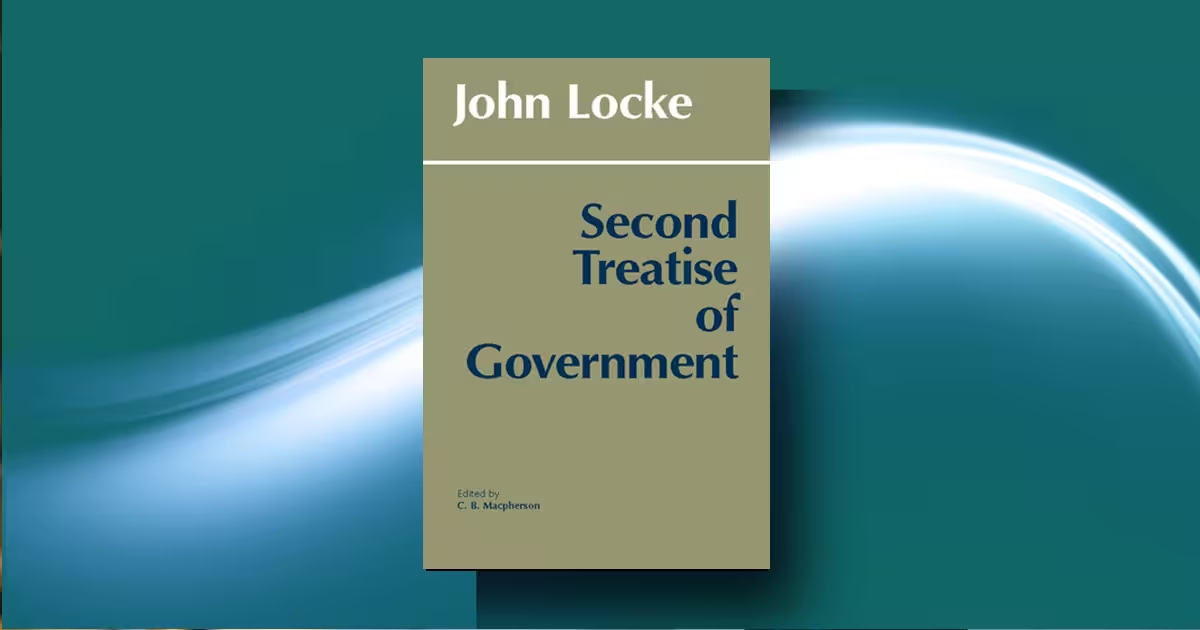

Does your government serve you — or does it just tell you it does? John Locke’s Second Treatise of Government is the book that dares to answer that question out loud, and its answer, written over 330 years ago, feels more urgent today than it did when kings still burned dissidents.
Second Treatise of Government is best for political philosophy students and teachers, history enthusiasts, lawyers, activists, policy thinkers, and anyone who wonders where concepts like “consent of the governed,” “natural rights,” and “the right to revolution” actually came from.
Also perfect for readers who want the intellectual DNA of the American Declaration of Independence and the U.S. Constitution in one place.
But not a favourable read for readers seeking light, narrative-driven non-fiction. Locke writes in dense 17th-century English, and his arguments wind and repeat before arriving at their destinations. If you prefer your politics in digestible bites, this may exhaust rather than enlighten.
Table of Contents
Introduction
Second Treatise of Government — formally subtitled An Essay Concerning the True Original, Extent, and End of Civil Government — is a political philosophical essay written by English philosopher John Locke (1632–1704) and published in 1689–1690 as part of his Two Treatises of Government.
The edition most commonly read today is the Hackett Publishing Company edition, edited with an introduction by C. B. Macpherson and first published in 1980, reproduced from the corrected 1764 sixth edition — the first to incorporate all of Locke’s own revisions and corrections.
The book belongs to the genre of political philosophy and the broader Enlightenment tradition of natural rights theory. Its context is the turbulent late 17th century in England — a period defined by the conflict between the Stuart monarchy and Parliament, culminating in the Glorious Revolution of 1688, which deposed the Catholic King James II and installed the Protestant William III and Mary II.
Locke, who had been personally involved in Whig conspiracies against Charles II and later fled to Holland for his own safety, returned to England in February 1689. The Two Treatises followed shortly after — a text long drafted in the shadows of political danger now released into the open as a triumphant justification.
Locke’s central thesis is as powerful as it is plain: political power is not God-given to kings, it is not inherited from Adam, and it is not absolute.
Government exists only by the consent of the people, for the protection of their lives, liberty, and property. When a government betrays that trust, the people not only have the right — they have the duty — to dissolve it and begin again.
Background
To fully appreciate what Locke was doing in this text, one must understand the intellectual battlefield he was entering. His primary target in the Two Treatises was Sir Robert Filmer, whose posthumously published Patriarcha (1680) argued that kings derived their absolute authority from Adam’s God-given dominion over the earth, passed down to monarchs through descent.
Filmer’s views, though they may seem absurd today, were widely preached from Anglican pulpits and had real political traction among royalist gentry in the 1670s and 1680s.
Locke dismantled Filmer in the First Treatise, and in the Second he moved to the affirmative — constructing his own vision of where political authority legitimately comes from.
He was also operating in the shadow of Thomas Hobbes, whose Leviathan (1651) had argued that humans in the state of nature were so violent and self-destructive that they needed an all-powerful sovereign to keep them in order. Locke agreed that government was necessary, but fundamentally disagreed about human nature and about how much power government could ever legitimately claim.
Born in 1632 in Somerset to a family of modest landed gentry, Locke was educated at Westminster School in London and Christ Church, Oxford, where he remained from age 20 to 34, teaching philosophy and taking a medical degree. He was elected to the Royal Society in 1668. His lasting connection with Anthony Ashley Cooper, the first Earl of Shaftesbury — first as his physician, then as political confidant — pulled him into the center of England’s most dangerous political intrigues.
According to the editor C. B. Macpherson, strong evidence suggests Locke wrote a near-complete draft of the Two Treatises between 1679 and 1683, amid active conspiracy against Charles II, requiring only minor revision to become the published justification for the 1689 Whig Revolution.
Locke was no unworldly scholar.
By the 1670s, he was a fairly wealthy man with investments in the raw silk trade, the Royal Africa Company, and other commercial ventures. This background is not incidental — it shaped his profound preoccupation with property as the foundation of civil society.
Second Treatise of Government Summary
Chapter I — The Starting Point
Locke opens by dismissing Filmer entirely.
Having refuted Filmer’s claim that Adam held God-given dominion over the world in the First Treatise, Locke now asks: if kings do not rule by divine right descended from Adam, where does political power come from?
His working definition of political power is sharp: “a right of making laws with penalties of death, and consequently all less penalties, for the regulating and preserving of property, and of employing the force of the community, in the execution of such laws, and in the defence of the common-wealth from foreign injury; and all this only for the public good”.
That phrase — “only for the public good” — carries the entire weight of the book on its back.
Chapter II — Of the State of Nature
This is perhaps the most famous and foundational chapter in the entire text. Locke’s state of nature is not Hobbes’s war of all against all. Instead, it is “a state of perfect freedom to order their actions, and dispose of their possessions and persons, as they think fit, within the bounds of the law of nature, without asking leave, or depending upon the will of any other man”.
This matters enormously. For Locke, the state of nature is also a state of equality — not enforced equality, but natural equality in the sense that no one has natural jurisdiction or dominion over another.
He grounds this in reason itself: “reason, which is that law, teaches all mankind, who will but consult it, that being all equal and independent, no one ought to harm another in his life, health, liberty, or possessions”.
Crucially, this is also a state of law — the law of nature — even without any government to enforce it. In the state of nature, every person has the executive power of that law of nature. If someone harms you, you have the right to punish them, not out of passion, but proportionately, for “reparation and restraint”.
Locke acknowledges this is a strange doctrine, but defends it brilliantly: if individuals in a state of nature had no right to punish transgressors, then no magistrate would ever have the right to punish a foreign criminal either, since the legislative authority of one state reaches no stranger.
Chapter III — Of the State of War
Locke draws a crucial and often overlooked distinction here between the state of nature and the state of war. The state of nature is defined by living under reason without a common superior.
The state of war, by contrast, is triggered by force or a declared design of force. “He who attempts to get another man into his absolute power, does thereby put himself into a state of war with him”. Because anyone seeking absolute power over me “would use me as he pleased when he had got me there, and destroy me too when he had a fancy to it,” resisting such a person — even killing a thief who is merely trying to rob you — is legitimate.
This is one of Locke’s most radical claims: freedom itself is so fundamental that to threaten it is to threaten life.
This leads to a sharp, clarifying observation: “Want of a common judge with authority, puts all men in a state of nature: force without right, upon a man’s person, makes a state of war, both where there is, and is not, a common judge”.
Chapter IV — Of Slavery
Locke’s chapter on slavery is brief and philosophically elegant, though it contains an unresolved tension given his own financial investment in the slave trade.
His argument is that natural liberty — freedom from any superior power on earth — is inseparably bound to self-preservation. Therefore, “this freedom from absolute, arbitrary power, is so necessary to, and closely joined with a man’s preservation, that he cannot part with it, but by what forfeits his preservation and life together”. No person can voluntarily enslave himself, because no person has the power to take his own life.
Slavery, in Locke’s framework, can only legitimately arise as the continuation of a state of war — a conquered enemy who has forfeited his life by aggressive action may be kept as a slave rather than executed. This is a very narrow and historically convenient definition that critics have rightly challenged.
Chapter V — Of Property (The Most Famous and Most Debated Chapter)
This is the chapter that has generated the most commentary, controversy, and influence across the centuries. Locke begins from an apparently paradoxical premise: God gave the earth to mankind in common. So how can any individual own anything?
His answer is the celebrated Labour Theory of Property: “every man has a property in his own person: this no body has any right to but himself. The labour of his body, and the work of his hands, we may say, are properly his”. When you remove something from nature and mix your labour with it, you appropriate it to yourself. The acorns you pick, the fish you catch, the land you cultivate — these become yours, because your labour transformed them.
Locke initially imposes two natural law limits on this appropriation: first, you may only take as much as you can use before it spoils (the spoilage limit); second, you must leave “enough, and as good” for others (the sufficiency limit). Within those constraints, private property needs no consent from anyone.
Then comes the pivot that editor Macpherson rightly identifies as transformative. Locke argues that men, while still in the state of nature, tacitly consented to the invention of money — a durable, non-spoiling medium of exchange. The introduction of money dissolves both limits. You can now convert perishable goods into gold, which does not spoil, and thereby accumulate indefinitely.
Moreover, Locke argues that enclosed, cultivated land produces roughly ten times more than common land (“I have here rated the improved land very low, in making its product but as ten to one, when it is much nearer an hundred to one”), so even after all land is taken up, there is more overall produce for everyone.
Crucially, Locke also addresses wage labour. In a famous passage, he writes: “the turfs my servant has cut … become my property … the labour that was mine, removing them out of that common state they were in, hath fixed my property in them”.
When you hire someone, their labour becomes yours. This effectively removes the third limit — that you can only appropriate what you yourself have laboured upon — because the employer’s property absorbs the employee’s labour.
The result is a philosophical justification for unlimited private property accumulation — all in the state of nature, before civil government even exists. Government, then, does not create property rights. It merely protects them.
Chapter VI — Of Paternal Power
Locke takes on one of Filmer’s central pillars here: the idea that paternal power over children is the model and justification for monarchical power over subjects. Locke dismantles this methodically.
Parental power is temporary, mutual (belonging equally to both parents — he pointedly suggests the term “parental power” rather than “paternal power”), and limited in purpose: it exists to nurture children until reason matures. “The bonds of this subjection are like the swaddling clothes they are wrapt up in, and supported by, in the weakness of their infancy: age and reason as they grow up, loosen them, till at length they drop quite off, and leave a man at his own free disposal”.
Moreover, paternal power and political power are fundamentally distinct. Political power is about governance and legislation; parental power is about temporary care. A prince owes his mother filial duty just as any son does — but this does not make her his sovereign. The two categories simply do not overlap.
Chapter VII — Of Political or Civil Society
Political society, for Locke, begins when individuals give up their natural executive power to a community — surrendering the right to individually punish transgressors and handing it to a collective authority. This is what transforms the state of nature into civil society. The moment individuals agree to this transfer and authorize a legislative power to make laws for them, political society is born.
Importantly, Locke distinguishes this from all other associations: the family, the master-servant relationship, the husband-wife relationship. None of these are political society, because none involve the full transfer of executive power to a common judge.
Chapter VIII — Of the Beginning of Political Societies
Here Locke confronts an obvious objection: did any such original agreement ever actually happen?
His answer is pragmatic: even if no explicit historical moment exists, the principle still holds. People who unite and place legislative power in common constitute a political society, whether by express consent or tacit consent given over time.
He also argues that all peaceful governments have historically been built on consent — even early monarchies arose not from divine right but from voluntary deference to trusted leaders, usually fathers who had proven their competence in guiding their families.
He addresses the question of tacit consent carefully: any person who freely enjoys the benefits of a territory — its highways, its protection, even temporarily lodging there — gives tacit consent to the government of that place and is bound by its laws during that enjoyment.
However, only express consent makes you a permanent member of that commonwealth. This distinction matters enormously for political obligation theory.
Chapters IX–XI — The Ends and Extent of Government
Why do people leave the state of nature at all? Locke’s answer, stated plainly in , is that despite freedom, the state of nature is “full of fears and continual dangers” — because “all being kings as much as he, every man his equal, and the greater part no strict observers of equity and justice, the enjoyment of the property he has in this state is very unsafe, very unsecure.”
Three things are lacking in the state of nature that drive men into civil society: first, an established and known law accepted by common consent to define right and wrong; second, an indifferent judge with authority to decide disputes by that law; third, the power to enforce judgments.
Therefore, the great purpose of entering civil society and establishing government is “the preservation of their property” — understood broadly to include life, liberty, and estates. This purpose forever limits what government can do.
The legislative power — supreme within any commonwealth — cannot be arbitrary, cannot govern without standing laws, and crucially, “the supreme power cannot take from any man any part of his property without his own consent”. Taxation without representation is specifically condemned as an invasion of property rights.
Chapters XII–XIII — The Separation of Powers
Locke distinguishes three powers in any well-ordered commonwealth: legislative, executive, and federative (the latter handling relations with other states).
He argues powerfully that legislative and executive power must be separated because “it may be too great a temptation to human frailty, apt to grasp at power, for the same persons, who have the power of making laws, to have also in their hands the power to execute them, whereby they may exempt themselves from obedience to the laws they make”.
The legislative power remains supreme within any government, but even the legislative acts only as a trustee for the people: “the legislative being only a fiduciary power to act for certain ends, there remains still in the people a supreme power to remove or alter the legislative, when they find the legislative act contrary to the trust reposed in them”.
Chapter XIV — Of Prerogative
Locke acknowledges that the executive must sometimes act without or even against standing law — in emergencies, when the legislature cannot be convened, when the public good demands immediate action.
This is prerogative: “a power to act according to discretion, for the public good, without the prescription of the law, and sometimes even against it.” He accepts this is necessary, but insists prerogative must always be used for the public good, never for private advantage. When prerogative is consistently abused, the people have the right to judge and resist.
Chapters XV–XVI — Paternal, Political, and Despotical Power; Conquest
Locke separates three types of power that people often confuse. Paternal power arises from the needs of childhood. Political power arises from voluntary consent for the protection of property. Despotical power — power over life without property rights — arises only through forfeiture, as in a just war against an aggressor.
On conquest: even a just conqueror acquires no right over those who did not participate in the unjust aggression, nor over the property of anyone, nor over the children of the conquered. “Conquest is as far from setting up any government, as demolishing an house is from building a new one in the place”. Military victory, however absolute, creates no legitimate authority by itself.
Chapters XVII–XVIII — Usurpation and Tyranny
Locke defines usurpation as exercising a power that another rightfully holds, and tyranny as exercising power beyond one’s right — for private benefit rather than public good. His formulation here is crisp and memorable: “Where-ever law ends, tyranny begins, if the law be transgressed to another’s harm”.
Any magistrate who acts beyond the authority given to him by law can be opposed “as any other man, who by force invades the right of another.” Even a king who makes “his will, the rule” rather than the law becomes a tyrant, and citizens may lawfully resist.
Chapter XIX — Of the Dissolution of Government (The Most Radical Chapter)
This final chapter is where Locke’s entire philosophical edifice delivers its most revolutionary conclusion. Governments can be dissolved from without (by foreign conquest) or from within. Internal dissolution occurs when: the legislative is altered without the consent of the people; the prince prevents the legislature from assembling freely; elections are manipulated; or the people are handed to a foreign power.
In all such cases, the people are “absolved from any farther obedience” and may constitute themselves as supreme, erecting a new legislative as they see fit.
Locke pre-empts the objection that this doctrine encourages constant rebellion. His response is powerful: people are naturally conservative and slow to revolt.
They tolerate injustice at great length. But when “a long train of abuses, prevarications and artifices, all tending the same way, make the design visible to the people, and they cannot but feel what they lie under”, revolution becomes not just permissible but rational.
Most provocatively, Locke turns the standard accusation on its head: it is not the people who rebel when they resist a tyrannical government — it is the government that “rebels” (the Latin rebellare meaning “to bring back the state of war”) when it violates the trust placed in it.
The rebels, properly understood, are the rulers who abuse their power: “those who by force break through, and by force justify their violation of them, are truly and properly rebels”.
The people shall be the final judge of whether government has betrayed its trust.
And if there is no judge on earth, “the appeal then lies to God in heaven” — meaning that the people have both the right and the ultimate responsibility to determine when resistance is justified.
Second Treatise of Government Analysis
Second Treatise of Government is a remarkable, imperfect, world-changing book — and I mean all three of those adjectives simultaneously, with full weight.
It is remarkable because Locke, writing in the shadows of royal surveillance and personal danger, constructed a philosophical framework so logically tight that it became the intellectual architecture of modern democratic governance. It is imperfect because its ambiguities, contradictions, and silences are not minor blemishes but structural features with real-world consequences.
And it is world-changing because, frankly, the evidence of its influence is everywhere — in the U.S. Declaration of Independence’s language of “life, liberty, and the pursuit of happiness,” in constitutional separation of powers, in the right to revolt against tyranny that animated the American, French, and countless other revolutions.
Reading this book as a human reader and not merely as a scholar, I feel genuinely moved by its moral clarity in places.
When Locke writes that “where-ever violence is used, and injury done, though by hands appointed to administer justice, it is still violence and injury, however coloured with the name, pretences, or forms of law”, I feel the force of that truth in my bones. It describes every authoritarian state that has ever dressed its cruelties in legal language.
When he says that the purpose of law “is not to abolish or restrain, but to preserve and enlarge freedom”, I wish more lawmakers had internalized it.
But there are discomforts in this book that I cannot pretend away.
Evaluation
Locke effectively supports his core arguments with a combination of logical reasoning, appeals to natural law, scriptural citations, and historical examples — from ancient Israel’s judges to indigenous peoples in the Americas.
His argument for limited government is genuinely compelling. The separation of legislative and executive power, the insistence on consent as the basis of political obligation, and the right of revolution when trust is betrayed are not merely interesting ideas — they proved historically fertile in ways Locke perhaps could not have fully anticipated.
However, the book fulfills its stated purpose unevenly. His property theory, as editor C. B. Macpherson demonstrates at length in the Introduction, contains ambiguities that effectively justify unlimited private accumulation — not the modest, need-limited natural property rights Locke opens with.
Macpherson argues persuasively that Locke has smuggled in a class-divided society with a wage-labour market, set all of this in the “state of nature” before civil society, and then used the defense of that inequality as the primary motivation for entering civil society.
The philosophical sleight of hand is elegant. But it means that Locke’s defense of “life, liberty, and property” is, at its core, most urgently a defense of established property-holders against both arbitrary government and property-less workers.
Furthermore, Locke explicitly assumes that political representation belongs to the propertied. He specifies that representation should be proportional to tax contributions, and that taxpayers are those with “estate”.
Those without property are subject to the law but have no voice in making it. This is a foundational silence in liberal political theory that persists, in attenuated forms, to this day.
Strengths:
First and foremost, the book’s structural clarity is admirable. Locke builds his argument progressively — from the state of nature, to property, to political society, to the limits of government, to the conditions for dissolution — with a logical chain that holds together even across 19 chapters and over 300 years.
The distinction he draws between the state of nature and the state of war, for instance, is genuinely original and philosophically valuable.
Unlike Hobbes, who conflated the two, Locke preserves a vision of pre-political human life that is peaceful and rational, making government a choice rather than a desperate necessity.
Furthermore, his argument for the right to revolution is both bold and carefully constructed. He anticipates virtually every counterargument — that it will lead to constant rebellion, that the people are too ignorant to judge, that it gives license to turbulent spirits — and answers each one convincingly.
People, he notes, are historically slow to revolt and remarkably tolerant of injustice. Only sustained, systematic abuse tips them over.
What’s more, his treatment of consent — distinguishing express from tacit consent, and explaining how both types bind individuals to government — remains one of the most sophisticated treatments of political obligation in the Western canon.
Weaknesses and Criticisms:
Nevertheless, the contradictions within the text are real and important. As noted above, Locke presents two incompatible pictures of human nature — one peaceable and rational, one avaricious and untrustworthy — and needs both for different stages of his argument.
Editor Macpherson calls this an “ambiguity” that “allows Locke to argue both that there must and can be an agreement to establish an all-powerful civil society against which the individual retains no rights, and that no such power can arbitrarily be exercised by any government.”
This is not merely a minor logical inconsistency — it is the philosophical device that holds together two conclusions that would otherwise pull the argument apart.
Due to a lack of clarity on wage labour and class, Locke’s property theory also ends up doing double work: justifying both modest private property based on individual labour and unlimited capitalist accumulation based on employing others.
The same chapter that begins by insisting every person has the right to subsistence ends by providing a philosophical basis for excluding the labouring poor from property rights and political representation.
Additionally, his treatment of indigenous peoples in the Americas — used repeatedly as examples of people “in” the state of nature because they do not cultivate land in the European manner — reflects the colonial assumptions of his time and provides philosophical cover for dispossessing indigenous peoples of their lands.
This is not incidental. It is a structural feature of his labour theory of property that anyone who does not improve land in the approved manner loses any claim to it.
Books Like Second Treatise of Government
If Second Treatise of Government has captured your attention, several other works deepen and complicate its arguments.
Thomas Hobbes’s Leviathan (1651) is the essential counterpoint. Hobbes reaches broadly similar conclusions about the need for strong government but from a profoundly different view of human nature — and with no room for a right of revolution. Reading the two together reveals the full debate about sovereignty and consent that shaped early modern political thought.
Jean-Jacques Rousseau’s The Social Contract (1762) takes Locke’s concept of consent and the general will much further — and more radically — insisting that true political freedom requires active participation in lawmaking, not just passive subjection to representatives.
John Rawls’s A Theory of Justice (1971) is perhaps the most important 20th-century work in the Lockean tradition of liberal political philosophy. Rawls re-founds social contract theory on the thought experiment of the “veil of ignorance,” asking what principles of justice rational persons would choose if they did not know their place in society.
C. B. Macpherson’s The Political Theory of Possessive Individualism: Hobbes to Locke (1962), though an academic study rather than a primary text, is indispensable for anyone who wants to understand what Locke’s property theory actually implies about class, labour, and economic power.
Mary Wollstonecraft’s A Vindication of the Rights of Woman (1792) applies Lockean natural rights logic to women — exposing how Locke’s ostensibly universal language of liberty and equality was in practice limited to propertied men, and demanding its genuine extension.
Conclusion
Second Treatise of Government is not a comfortable book, and it was never meant to be. Locke wrote it under the shadow of a possible scaffold, in defense of political ideas that his own government considered treasonous. The fact that those ideas became the founding philosophical documents of democratic governance is a remarkable historical accident — or perhaps a vindication of the ideas themselves.
What I take from it, reading it now, in 2026, is not a blueprint but a set of questions that refuse to go away: Does your government rule by your consent? Do its laws protect your life, liberty, and property — or do they serve the interests of those already powerful?
Do you, as a citizen, have genuine recourse when your rulers betray the trust placed in them? Locke answers all of these with a clarity that strips away the comfortable fog of political habit.
The book is most valuable precisely where it is most uncomfortable: in its insistence that no authority is legitimate simply because it is authority, that “where-ever law ends, tyranny begins,” and that the people — all the people — are the ultimate judges of their own freedom.
However, it must be read critically. The “people” Locke actually has in mind is narrower than he claims. The “property” he defends becomes, in his hands, a justification for inequality as much as for freedom. The contradictions are not merely academic puzzles — they have had real consequences in centuries of political theory and practice.
Read Second Treatise of Government because it is the most important book in the intellectual genealogy of the world you live in. Read it critically, because its silences have shaped that world as much as its arguments have.
Who Should Read This Book? Anyone serious about political philosophy, history, law, or democratic theory. Students of the American and French Revolutions. Those interested in the intellectual origins of liberalism, property rights, and constitutional government. And anyone who has ever wondered: what actually gives a government the right to govern?
Is it for general audiences? With patience and a good edition (the Macpherson edition is recommended), yes — it rewards the effort far beyond what its 17th-century diction initially suggests.