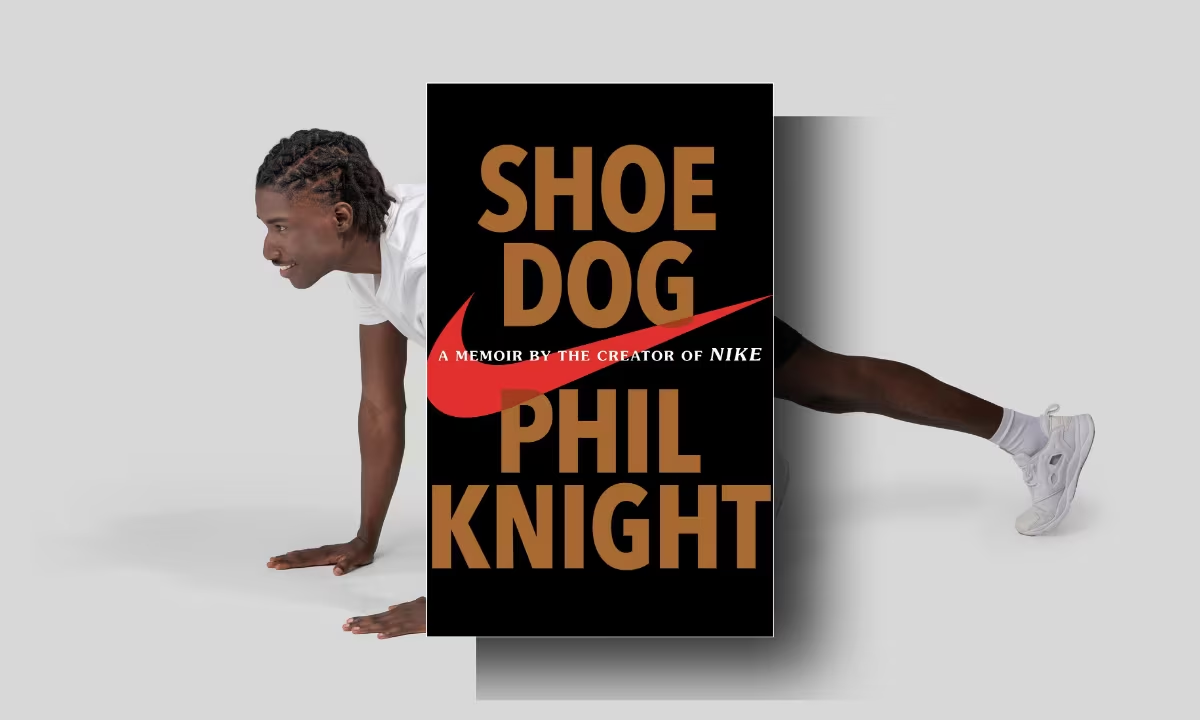
Shoe Dog is the most honest business memoir I have read in years, mostly because Phil Knight admits how often Nike came within days of dying. This Shoe Dog review answers the questions I would have asked before buying it: what actually happens, how much of it is about shoes, whether a ghostwritten voice can feel real, and what a story that stops in 1980 still tells us in 2026.
My short answer is that it reads like a thriller about late shipments, hostile bankers and a Japanese supplier who kept moving the goalposts, with a gruff running coach and a stubborn father holding the emotional center.
Shoe Dog is one of the 10 best books for CEOs.
I give it 4.5 out of 5.
Table of Contents
What Shoe Dog Teaches at a Glance
What it is: Knight’s memoir of founding Blue Ribbon Sports, later Nike, told from a foggy morning run in 1962 to the stock offering of December 1980, with a short coda set in 2007.
Biggest lesson: Cash flow, not competition, was Nike’s first enemy. Bank limits, late boats and unpaid invoices decided its fate more often than shoe design did.
Second lesson: Relying on one supplier almost ended the company. The break with Onitsuka forced Knight to build his own brand, factories and name.
Third lesson: Belief sells. Knight failed at selling encyclopedias and succeeded at selling shoes because he believed in running.
Fourth lesson: Loyal misfits built the company. Bowerman, Johnson, Woodell, Hayes and Strasser matter as much as Knight does.
Final note: Knight closes by urging young people to seek a calling, not a career, and he is candid about regrets, including the death of his son Matthew, who died in a 2004 scuba diving accident in El Salvador.
Quick Verdict
A fast, funny, surprisingly vulnerable memoir that works best as a survival story about money, loyalty and fathers. Recommended for founders, runners and anyone who suspects that great companies are built on near misses.
Should You Read Shoe Dog?
Yes, if you want a story more than a manual. Here is how I weigh it.
| Pros | Cons |
|---|---|
| Short, punchy chapters that read like a novel | Stops in 1980, so Jordan, Air Max and the global empire barely appear |
| Rare candor about debt, bad hires and bad bets | Sweatshop controversy gets a defensive treatment in the coda |
| Vivid portraits of Bowerman, Johnson, Woodell and Hayes | Knight’s own memory is shaky on dates, and he says so |
| Real tension from banks, customs and lawsuits | Few women appear in the business story |
| Honest grief and regret in the final pages | Reads more like a story than a how-to for founders |
What Is Shoe Dog About?
Shoe Dog follows Phil Knight from a 1962 Crazy Idea, importing Japanese running shoes, to the 1980 public offering that made Nike a household name. Along the way he fights bankers, a Japanese supplier, the U.S. government and his own self-doubt. Underneath, it is a book about fathers, friendship and the need to do work that feels like play.
Rating
Shoe Dog earns 4.5 out of 5. Half a point comes off for the truncated timeline and the guarded treatment of Nike’s labor controversy.
Who Will Love Shoe Dog, and Who May Bounce?
Founders, side hustlers, runners, sports fans and anyone who likes a company origin story told with jokes will probably devour this book.
If you have ever worried about making payroll or waited on a shipment that was already late, it will feel uncomfortably familiar. Readers who want a step by step startup playbook, or a full history of Nike’s marketing machine, may feel shortchanged, because Knight stops before the Jordan years and rarely stops to teach.

Anyone sensitive to casual language in business settings should also know that the people in this book swear, drink and call each other affectionate insults.
Who Wrote Shoe Dog, and When Was It Published?
Phil Knight, Nike’s co-founder, wrote Shoe Dog with heavy help from J.R. Moehringer, and Scribner published it in the United States on April 24, 2016. Press coverage describes Moehringer as the ghostwriter, also credited with Agassi’s Open and Prince Harry’s Spare.
The book’s own acknowledgments thank Moehringer as a friend whose storytelling gifts Knight relied on through many drafts. Bill Gates named it one of his five favorite books of 2016, and the same page records Warren Buffett calling it the best book he read the previous year.
A Young Readers Edition followed on September 26, 2017.
The book’s central claim is simple. Knight argues that a business can be play, that belief beats polish, and that the people beside you matter more than the product. He dedicates the memoir to his grandchildren, and he opens it with a line from Zen teacher Shunryu Suzuki about the beginner’s mind.
That choice tells you the tone: curious, a little mystical, and wary of experts.
What Was the Shoe Market Like When Knight Started?
In 1962 the athletic shoe business belonged to Adidas, and running was barely a sport. Knight describes drivers honking at joggers and throwing cups of soda at them (1965 chapter). He had a Stanford paper arguing that Japanese shoes could do to the Germans what Japanese cameras had already done in photography (1962 chapter).
That analogy, plus a backpack and a borrowed budget, was the whole business plan.
By 1970, Mr. Onitsuka himself told Knight that a company survey showed 70 percent of American runners owned a pair of Tigers (1970 chapter), which shows how fast the idea took off, even if the figure comes from the supplier’s own mouth.
What Happens in Shoe Dog? A Full Summary
The Crazy Idea (Dawn and 1962)
The book opens on a foggy morning in 1962. Knight, twenty-four, has just returned to Oregon after seven years away, with a University of Oregon degree, a Stanford MBA and a year in the Army. He sleeps in his childhood bedroom in the back of his parents’ house and feels like the same shy, pale kid he always was.
On a run he decides his life should feel like play, and the Crazy Idea comes back: sell Japanese running shoes in America. The advice he gives himself that morning is to keep going and not stop.
The Idea began as a Stanford paper. His classmates were bored, his professor gave him an A, and Knight never let go of it. He pitches his father, Bill Knight, publisher of the Oregon Journal, in the TV nook during a commercial break.
Bill worships respectability and drinks more than he admits, and Phil half wants to become someone less obsessed with appearances. To his surprise, his father says yes to a trip around the world and the cash to fund it. Knight sells his MG, packs one good green suit, and leaves in September 1962 with Stanford friend Carter.
They stop in Hawaii and never leave quickly. Knight surfs, fails at selling encyclopedias, and then sells mutual funds for Bernard Cornfeld’s boiler room operation, where honesty turns out to be a selling point. The Cuban Missile Crisis passes, Carter falls for a girl, and Knight decides alone to go on. On Thanksgiving 1962 he flies to Tokyo, sees a city still scarred by firebombing, and reads about Zen. Two ex-GI editors of a trade magazine called Importer coach him on Japanese business manners, which means no hard sell and no demands for a flat yes or no.
In Kobe he arrives at the wrong Onitsuka building, then the right one, half an hour late. Four executives, led by Ken Miyazaki, ask what company he works for. He has none.
He blurts “Blue Ribbon,” the name of the ribbons he once won in track, and recites his Stanford pitch from memory. They leave the room, return with sample shoes called Limber Up, Spring Up and Throw Up, and ask whether Blue Ribbon will represent Tiger in the United States. Knight agrees to send fifty dollars for samples and asks his father to wire it.
He then finishes his world tour through Hong Kong, Manila, Bangkok and Vietnam, and by the time he gives his neighbors a slide show back home he has also reached the pyramids and the Temple of Nike.
Selling Out of a Valiant (1963 to 1964)
Home again, Knight waits for shoes that do not come, and an older family friend, Pacific Power & Light’s CEO Don Frisbee, urges him to become a CPA.
He takes accounting classes at Portland State and joins Lybrand, Ross Bros. & Montgomery. He drives a sea-foam green Plymouth Valiant, eats lunch outside a travel agency window, and writes a friend that he is considering blowing his brains out. Bored accounting is the book’s low note (1963 chapter).
The samples finally arrive around the start of 1964: twelve creamy white pairs with blue stripes. Knight sends two to his old Oregon track coach, Bill Bowerman, a war hero from the Tenth Mountain Division who, according to a teammate’s story, once rigged his mailbox with explosives and who spent years tearing apart his runners’ shoes. Bowerman does not just want to buy shoes.
At lunch at the Cosmopolitan Hotel in Portland on January 25, 1964, he asks to become a partner.
Fifty-fifty becomes fifty-one to forty-nine so Knight keeps control, with Bowerman’s lawyer and neighbor John Jaqua drafting the papers. Knight admits his memory of the date disagrees with his own documents (1964 chapter).
The first real order is 300 pairs at $3.33 each, about $1,000. His father balks, and his mother, Lota, quietly buys a pair of Limber Ups for seven dollars to make her point.
Knight sells from the trunk of his Valiant at track meets and decides that he is not really selling at all. “Belief is irresistible,” he writes. By July 4, 1964, the first shipment is gone, and a bank approves a loan on the strength of his father’s reputation.
Then a wrestling coach from Long Island, a former Marlboro Man, writes claiming to be Onitsuka’s exclusive American distributor. Knight flies to Kobe in a black bowler hat, meets Onitsuka’s new man Mr. Morimoto in a revolving restaurant, and finally meets founder Kihachiro Onitsuka, who tells him that one day everyone in the world will wear athletic shoes.
Onitsuka gives him thirteen western states for one year. Knight celebrates by climbing Mount Fuji at night with a stranger named Sarah.
Growing Too Fast (1965 to 1969)
Jeff Johnson, a Stanford runner turned social worker, starts writing Knight endless letters. In 1965 Knight offers him a commission, then agrees to hire him as the company’s first full-time employee at $400 a month. At the same time, Knight takes a day job at Price Waterhouse and learns, from auditing other companies, that lack of equity kills businesses.
His banker at First National Bank of Oregon, Harry White, is sympathetic, but White’s boss Bob Wallace is not. Wallace tells Knight his growth is too fast for his equity. Knight responds that you grow or you die (1965 chapter).
Over the following years the cast fills out.
Johnson runs a store in Santa Monica and later opens an East Coast office, Bork takes over the store, and Bowerman steers Bob Woodell to Knight after a fraternity accident leaves the former Oregon long jumper in a wheelchair. Woodell becomes the operations man Knight cannot do without.
In 1968, Knight begins dating Penny Parks, they marry that year in Portland, and Penny becomes the quiet anchor of the rest of the book.
The Nissho Rescue and the Birth of Nike (1970 to 1971)
By 1970 Onitsuka renews Blue Ribbon for only three years and promotes the cold, ambitious Kitami. Shipments arrive late and wrong, Bowerman’s Cortez is so popular that Johnson begs for more, and Wallace caps the credit line. Knight tries a small public offering under the name Sports-Tek, and sells exactly three hundred shares, all to Woodell and Woodell’s mother.
An article in Fortune about Japanese trading companies changes everything. Knight walks across the street from First National into the Bank of Tokyo and is introduced to Nissho Iwai, a huge trading company with an office upstairs.
Nissho’s Cam Murakami and later Tom Sumeragi offer credit that Blue Ribbon cannot get anywhere else. At the same moment Knight learns that Onitsuka is scouting replacements.
He plans the break. He signs a contract for football shoes at a Guadalajara factory called Canada, asks a young Portland State artist named Carolyn Davidson to sketch a logo, and pays her thirty-five dollars. Knight admits he does not love the Swoosh and hopes it will grow on him. For a name, the staff argue between Falcon, Bengal, Condor and Knight’s own Dimension Six.
Johnson phones Woodell after a dream with a single word: Nike, the Greek goddess of victory. Knight, out of time, telexes it to the factory. He also raises money through convertible debentures, and Stanford friend Chuck Cale writes a check for $10,000.
The War With Onitsuka (1972 to 1974)
Blue Ribbon and Onitsuka end up in court. Bowerman keeps ruining waffle irons to design a lightweight sole, which becomes the Waffle trainer, while a young Oregon star named Steve Prefontaine becomes the face of the brand, having appeared on the cover of Sports Illustrated in 1970 (1970 chapter).
At trial in Portland, Judge James Burns, whom the team nicknames James the Just, finds that Kitami lied, noting that Kitami corrected his own translator in perfect English.
Blue Ribbon keeps the rights to the names Boston and Cortez and wins damages. Onitsuka offers $400,000, and the sides sign on July 4, with a stunned Kitami admitting he has not brought a check.
Instalment 6: The Bank Pulls the Plug (1975)
This is the best stretch of the book. Knight and Hayes, who handles the money with him, live by one rule: “Pay Nissho first.” In spring 1975 they owe Nissho its first million dollar payment and are about $75,000 short. They drain every account to cover it, and a late $50,000 check from United Sporting Goods sets off a chain reaction. Paychecks bounce at a secret factory in Exeter that Johnson runs. The Bank of California freezes Blue Ribbon’s funds and tells Knight it has notified the FBI, calling it fraud.
Knight stays awake all night wondering whether he is going to jail. Nissho’s Mr. Ito, whom Knight privately calls the Ice Man, and Sumeragi spend two days auditing the books.
They find the secret factory and also learn that Sumeragi had been hiding invoices in a drawer to protect Blue Ribbon’s credit rating, out of affection. Knight and his team stage a farcical operation to keep two furious creditors from meeting each other.
Then Ito marches to the bank, pays off Blue Ribbon’s entire debt with a check, and tells the bankers that their talks to join Nissho’s banks are over. Ito tells Knight afterward that ambition is far from the worst sin. The FBI matter evaporates.
Aftershocks and Air (1975 to 1979)
There is no victory party. Soon after, Prefontaine, twenty-four, wins a race in Eugene on a Friday night of Memorial Day weekend, then dies in a car crash on the way home from a party. Knight calls it the exact age he was when his own life began, and he and his partners vow to preserve what fans leave at the crash site.
The company finds a new bank, First State Bank of Oregon, and keeps growing. Bowerman’s Waffle trainer sells at the low price of $24.95.
Aerospace engineer Frank Rudy brings cushioning air soles, and Strasser, then a lawyer turning marketer, offers Rudy ten cents for each pair of soles sold. The Tailwind, the first big showcase for air soles, launches in late 1978 at the Honolulu Marathon, then comes back in droves because bits of metal in the silver paint shred the fabric. Half the first run ends up in recycling bins.
Bowerman, who always doubted air shoes, loves being right.
China, Customs and the Offering (1980)
In 1980 Nike fights U.S. Customs over how import duty on its shoes is calculated, a dispute Knight calls the American Selling Price fight.
His response is bold: launch a cheap shoe called One Line to set a new reference price, run a patriotic TV ad, and file a $25 million antitrust suit on February 29, 1980. The government settles after months of haggling, and Knight reluctantly agrees to pay $9 million.
He then leads a delegation to China with David Chang, a Shanghai-born go-between who helps Nike request an invitation, and the trip goes sideways. Hayes has a panic attack in Tokyo, brings twelve quarts of vodka through Beijing customs and sets his own shirt on fire in a ministry meeting.
Still, Nike signs deals with the Chinese track federation and two factories, becoming the first American shoemaker in twenty-five years to do business there.
Back home, Chuck Cale, who once worked at Kuhn, Loeb, explains how to go public with two share classes so the founders keep control. In December 1980 Nike goes public, and Knight holds out for $22 a share, matching Apple’s price, against Kuhn, Loeb’s lower proposals.
That night he tells his sons a bedtime story about Valley Forge, does the math on his partners’ new wealth and feels not joy but regret.
He wishes he could do it all over again. By morning he is worth $178 million, and he is at his desk before anyone else.
Night, a Coda in 2007
The final chapter jumps to Christmas 2007. Knight and Penny see The Bucket List in Cathedral City, run into Bill Gates and Warren Buffett, and then Knight lies awake counting what he has done and what he regrets.
He has stepped down as Nike CEO after forty years, and the company’s 2006 sales were $16 billion (Knight’s own figure).
He tells us what happened to the cast. Bowerman died on Christmas Eve 1999, back in his hometown of Fossil. Strasser died in 1993 after leaving for Adidas, and Knight never forgave him. Hayes bulldozes on a farm, Woodell flies his own plane and later runs the Port of Portland, and Johnson fills a barn with books in New Hampshire.
Knight recounts the sweatshop crisis, admitting his own angry reactions made it worse, then argues that Nike turned it into a push for better factories and the Girl Effect.
He visits Vietnam and asks General Giap how he won, and Giap calls himself a “professor of the jungle.” And he describes the death of his son Matthew in a scuba accident in El Salvador, which public reports place in 2004. Knight chooses to believe his son did not suffer.
Midway through the coda he insists that business is never just business. He closes with advice to a young reader: pause, think hard about how and with whom you want to spend the next forty years, and seek a calling, not a job.
He warns that rebels always wear a bull’s-eye, admits that luck may decide the outcome, and says giving up on one plan does not mean you should stop.
The last scene finds him awake in his recliner, sensing one more Crazy Idea, and starting a new list.
What Are the Main Ideas in Shoe Dog?
The main idea is that a company is a chain of survival decisions, and the people who make them with you decide whether you last. I came away with six threads that run through the whole memoir.
Cash is oxygen. Almost every crisis is a cash problem wearing a different costume. Wallace caps credit because Knight grows too fast, Onitsuka ships late so the boats miss the season, and Nissho becomes the lifeline. Knight’s rule of paying the supplier first kept the machine alive, and it is also the reason the Bank of California panicked.
Belief beats polish. He could not sell encyclopedias, but he could sell shoes because he believed that running would make the world better. People, he says, want some of that belief for themselves.
Dependence is danger. Onitsuka gave Blue Ribbon its start, then tried to replace it. Each time Knight leaned on someone else’s factory, bank or customs official, he nearly lost the company. His answer was to spread the risk, find Nissho, open Exeter and create a brand of his own.
The team is the product. Bowerman’s obsession with weight, Johnson’s letters, Woodell’s steadiness, Hayes’s money sense and Strasser’s nerve do more work than any single shoe. Knight’s later regret over Strasser shows the cost of losing someone you built with.
Fathers and sons. Knight’s father, Bill, wanted respectability and gave in to his son’s wild idea. Years later, Knight takes him around the world to show him the Swoosh. That thread returns in the grief for Matthew, whose death Knight tells with painful restraint.
Work as play, and luck as a fact. The book begins by asking how to turn work into play and ends by admitting that luck can decide the outcome. I found that balance more believable than the usual founder myth.
Does Shoe Dog Back Up Its Claims?
Mostly yes, because the evidence is lived experience, not statistics. Knight’s thesis, that belief, loyalty and persistence can carry a company, is supported by dozens of scenes where those traits save him, and by an equal number where recklessness nearly ruins him.
That makes the argument more credible than most business books. The weakness is that a memoir cannot test its claims.
Knight warns us that his memory disagrees with his own documents on the date he partnered with Bowerman (1964 chapter), and his acknowledgments thank Johnson and Woodell for their patience when their memories differed from his. I would treat the dates with caution and the emotions as the real record.
One reviewer argues that Knight did not invent anything, because Bowerman made the waffle sole, outsiders had the air idea and a colleague supplied the name. I agree, and I think the book agrees too. Knight’s skill, as it appears here, was recognizing talent and refusing to quit, which is a different kind of invention.
My Critic’s Verdict
Shoe Dog is a funny, bruised, quietly devastating memoir, the rare business book that makes you worry about invoices and cry about a father in the same chapter.
What worked for me. The chapters are short, the jokes land, and the money scenes grip like a courtroom drama. I could not put down the 1975 bank freeze, with the creditors being kept apart like rival gangs. The portraits of Bowerman, Johnson and Sumeragi are generous without being gooey.
The ending, with its regrets about missing time with his sons, is what lifts it from good to memorable. A Povich Center review noted the same pace and the raw emotion around Prefontaine, and I felt both.
What frustrated me. The story stops in 1980, so you never see the Michael Jordan deal, the marketing machine or most of what made Nike enormous.
The sweatshop section is the least candid in the book: Knight admits his angry reaction made things worse, yet he spends more energy on how the press framed Nike than on the workers. Women, apart from Penny, Lota and a few colleagues, mostly sit at the edges of the business story, and Carolyn Davidson’s thirty-five dollar fee for the Swoosh is mentioned almost in passing.
Finally, the memoir’s polish is a reminder that this is a carefully shaped narrative, not a raw confession, and it was written with professional help.
Does it fulfill its purpose? Yes. Knight wanted to tell the human story behind the Swoosh before others got the facts wrong, and he wanted to leave something for young strivers. It does both, and it does them with more vulnerability than I expected from a billionaire’s memoir.
What Does Shoe Dog Say About Nike in 2026?
It says that supply chains and customs rules have always been Nike’s weak spot, and the 2026 numbers prove the point. Nike’s fiscal 2026 revenue was flat at $46.4 billion, and the company expects roughly $965 million in IEEPA tariff refunds for North America after the Supreme Court ruled in February that those tariffs were illegally collected.
A year earlier, Nike had warned of about $1.5 billion in annualized tariff costs. In the same Digiday report, executives said the consumer is under pressure worldwide and that tariffs remain a cost headwind.
Knight’s 1980 fight with customs over duty, and his earlier terror about late shipments from Japan, read like a prequel.
Here are five lessons I took from that link between 1975 and 2026:
- Map your single points of failure. Knight nearly lost everything to one supplier, one bank and one invoice drawer. Ask which one you have today.
- Treat cash flow as a product. Growth feels good until the check is due. Build a weekly cash view before you build a new line.
- Have a lawyer read the contract. Knight signed a flimsy Onitsuka renewal of a few paragraphs with no legal review (1970 chapter), and the dispute that followed ended up in court.
- Be transparent with lenders. Nissho’s Ito saved Blue Ribbon because Knight told him the whole truth, secret factory included.
- Build something of your own. The Swoosh, the Nike name and the factories were Knight’s answer to dependence. In 2026, ownership of design, data and relationships still protects a company better than any tariff refund.
What Happened to Onitsuka?
The company that nearly crushed Blue Ribbon did not vanish. Onitsuka merged with two other companies in 1977 to form ASICS, and the Onitsuka Tiger name lives on under that umbrella. It is a satisfying epilogue for the thread that runs through the first half of the memoir.
Passages Worth Marking
I kept direct quotations to a minimum for copyright reasons, so here is where to look in your own copy.
- The opening run (Dawn): the morning in 1962 when Knight decides life should feel like play.
- The Kobe boardroom (1962): the moment he invents the name Blue Ribbon under pressure.
- Bowerman’s shoes (1964): the lunch at the Cosmopolitan Hotel and the cod-skin experiments.
- The Swoosh and the naming scene (1971): Davidson’s sketches and Johnson’s dream, ending with the telex.
- The creditors summit (1975): the Code Red plan to keep two angry creditors apart.
- Ito at the bank (1975): the check that ends the FBI scare.
- Prefontaine’s last race (1975): Knight’s grief and Bowerman’s eulogy.
- The IPO night (1980): the bedtime story and the word regret.
- Night: Knight’s advice to young people and his closing list.
Books Like Shoe Dog
If you finish Shoe Dog hungry for more, these are the closest cousins I know, though I have not re-checked their publication details for this review.
Open by Andre Agassi: the same ghostwriter, J.R. Moehringer, and an equally honest sports memoir. Press reports confirm Moehringer wrote it.
Steve Jobs by Walter Isaacson: a larger, more critical portrait of a founder and his company.
The Everything Store by Brad Stone: a hard-driving company story where logistics, not shoes, are the drama.
Let My People Go Surfing by Yvon Chouinard: a founder who also hates the word businessman.
Losing My Virginity by Richard Branson: a looser, cheekier founder memoir.
Conclusion: Is Shoe Dog Worth Your Time?
Yes. I would hand it to a friend who is thinking about quitting a safe job, to a runner who wants to know where their shoes came from, and to anyone who suspects that success is mostly stubbornness and good friends. It stumbles on the sweatshop section and ends too soon for readers who want the full Nike empire.
Still, the bank-freeze chapters, the Bowerman scenes and the late-night grief make it one of the best business memoirs I have read. My rating stays at 4.5 out of 5.
Shoe Dog: A Memoir by the Creator of Nike

Shoe Dog is the most honest business memoir I have read in years, mostly because Phil Knight admits how often Nike came within days of dying. This Shoe Dog review answers the questions I would have asked before buying it: what actually happens, how much of it is about shoes, whether a ghostwritten voice can feel real, and what a story that stops in 1980 still tells us in 2026.
URL: #
Author: Phil Knight
4.5
Pros
- Gripping short chapters; honest about debt, mistakes and grief; vivid portraits of Bowerman and the early team; real tension in the bank and lawsuit scenes; strong, human ending
Cons
- Stops at the 1980 IPO; guarded on the sweatshop controversy; few women in the business story; memory and dates occasionally shaky