Last updated on October 26th, 2026 at 04:41 pm
The best books for CEOs are the ones that change a decision you make on Monday: High Output Management for running the week, The Hard Thing About Hard Things for the moments nobody trains you for, and Never Split the Difference for any negotiation. Most of the rest of the genre is padding.
I have kept the list to ten, and for each book I say what it gives you, what to doubt, and who can skip it.
Table of Contents
At a glance
Best for running your week: High Output Management by Andy Grove and The Effective Executive by Peter Drucker.
Best for crisis and hard calls: The Hard Thing About Hard Things by Ben Horowitz.
Best for setting direction: Good to Great by Jim Collins and Measure What Matters by John Doerr.
Best for negotiation and judgment: Never Split the Difference and Thinking, Fast and Slow.
Best for resilience and well-being: Walk Through Fire, The How of Happiness and Shoe Dog.
Read with care: Collins’s case studies, Kahneman’s priming chapters, and the 40 percent happiness claim all have known problems. I flag each one below.
Quick comparison
| Book | Author | Read it for | Main caution |
|---|---|---|---|
| High Output Management | Andy Grove | Running meetings, one-on-ones and output | Written for 1980s Intel, so some examples feel dated |
| The Effective Executive | Peter Drucker | Time, priorities, decisions | Dry, and older than most of its readers |
| The Hard Thing About Hard Things | Ben Horowitz | Crisis leadership | Narrowly about venture-backed tech |
| Good to Great | Jim Collins | Strategy vocabulary | Several “great” firms later collapsed |
| Measure What Matters | John Doerr | Goal setting with OKRs | Needs the right culture to work |
| Thinking, Fast and Slow | Daniel Kahneman | Decision quality | Some cited priming studies failed to hold up |
| Never Split the Difference | Chris Voss, Tahl Raz | Negotiation | Repeats the shaky 7-38-55 rule |
| Shoe Dog | Phil Knight | Founder grit | A memoir, so it is one man’s version |
| Walk Through Fire | Sheila Johnson | Resilience and reinvention | Personal story more than a method |
| The How of Happiness | Sonja Lyubomirsky | Well-being habits | The 40 percent figure is a teaching device |
How did I choose these books?
I looked for titles that leaders, coaches and researchers keep recommending to one another, then asked a harder question: does the book change what a CEO does, or does it only make them feel productive?
Three of the original picks passed because they cover what most management books skip: resilience, happiness and negotiation. The seven I added fill the obvious holes in operations, strategy, goals, decisions and crisis.
I did not rank by sales. Rank by sales and you get books everyone owns and few have finished.
High Output Management teaches you to run the actual week
High Output Management by Andy Grove (1983). Grove was CEO of Intel, and he became president in 1979 and CEO in 1987. He also taught at Stanford’s business school for twenty-four years, which shows in the clarity of the writing.
The argument is simple: a manager is judged by the output of their team, not their own. Grove builds everything from that, including how to run one-on-ones, how to think about meetings as the medium of management work, and how to match supervision to a person’s skill and motivation.
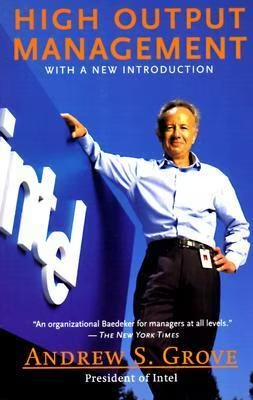
A Wikipedia summary notes that the book describes concepts Grove used at Intel, including objectives and key results. It also notes the book never reached the bestseller lists in the 1980s or 1990s, yet became a cult classic. Dropbox founder Drew Houston listed it among his four favorite business books, per the same page.
Take from it: protect your calendar like a production line, and judge every meeting by what it produces.
Doubt: the book is thirty years older than Slack. Translate the principles, not the tools.
Skip it if: you run a very small team and have no managers under you yet.
The Effective Executive: a classic that explains why your day feels out of control
The Effective Executive by Peter Drucker (1967). Drucker defines the measure of an executive as the ability to “get the right things done”. He then lists five practices: managing time, choosing what to contribute, mobilizing strengths, setting priorities, and making decisions that tie the rest together.
The time chapter is the one I would photocopy.
According to a reader’s notes on the text, Drucker argues you must first record where your time goes, then cut waste, then consolidate what is left into large blocks. That order matters. Most of us try to “manage” a calendar we have never measured. Drucker also treats effectiveness as a habit that can be learned, which is a kinder claim than most leadership books make.
Take from it: keep a time log for two weeks. You will not like the result, and that is the point.
Doubt: the prose is dry, and the examples come from mid-century organizations.
Skip it if: you want stories. Pick Horowitz instead.
The Hard Thing About Hard Things: for a CEO when everything is going wrong
The Hard Thing About Hard Things by Ben Horowitz (2014). Horowitz co-founded Loudcloud with Marc Andreessen and later ran it as Opsware, which Hewlett-Packard bought for $1.6 billion in 2007. Between founding and sale came the dot-com crash.
According to Toyo Keizai, the company was at constant risk of bankruptcy during that stretch.

The book is his account of surviving it.
Its best-known idea is the split between the peacetime and wartime CEO. Horowitz writes that “the peacetime CEO does not resemble the wartime CEO”. In one retelling of the book, his team presented forty-five slides arguing that his plan to start a software division was misguided, and that was the moment he stopped seeking consensus and started deciding.
The book also covers layoffs, demoting a loyal friend, and the lonely calls that come with the job. Horowitz told Toyo Keizai that people who were not CEOs also liked it, even though he wrote it for technology CEOs.
Take from it: name which mode you are in. Peacetime habits applied in a crisis cost you months.
Doubt: one Goodreads reviewer points out that the war stories matter most if you care about venture-backed, fast-growth tech. Publication dates also differ by source (March 2014 in the interview above, October 2014 on Goodreads), so check your edition before you cite it.
Skip it if: you run a stable small business with no hypergrowth and no board pressure.
Good to Great
Good to Great by Jim Collins (2001). Collins and his research team started with 1,435 Fortune 500 companies and narrowed them to eleven that beat the market roughly sevenfold over fifteen years.
A library catalogue summary describes the book as the result of five years of team research, built around three factors: disciplined people, disciplined thought and disciplined action. The tools are Level 5 leadership (personal humility plus fierce professional will), the Hedgehog Concept, and the flywheel.
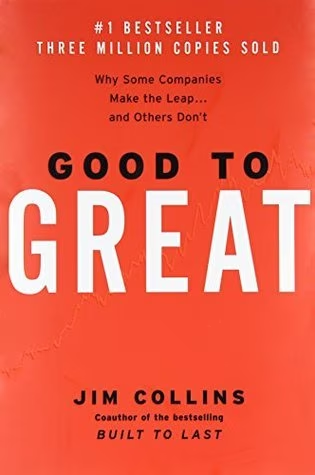
Collins also gave leaders a line they still quote: “Good is the enemy of great.”
Now the caveat. According to Deepak Gupta’s reading notes, several of the eleven (Circuit City, Fannie Mae, Wells Fargo) later imploded, which Collins addressed himself in How the Mighty Fall. Case-study research like this is a good source of vocabulary and a weak source of prediction.
Treat the frameworks as questions to ask your team, not as a recipe that guarantees results.
Take from it: ask “what can we be best in the world at, and does it drive our economics?” once a year, out loud.
Doubt: the success stories. Read the sequel for the postscript.
Skip it if: you already speak Hedgehog and Flywheel fluently, because every strategy deck does.
Measure What Matters: to help you get a whole company pointed at the same goals
Measure What Matters by John Doerr (2018). Doerr gave Google’s founders $12.5 million in the fall of 1999, the biggest investment of his career at that point, and taught them Objectives and Key Results (OKRs).
He had learned the method at Intel in the 1970s from Andy Grove, whom he calls “the greatest manager of his or any era.” The book follows OKRs through Google, the Gates Foundation, and Bono’s campaigning work.
This is the practical sequel to Grove. Where Grove tells you how to run the week, Doerr tells you how to pick the three things the quarter is about. Be careful with the evidence, though. A getAbstract review notes that Doerr himself warns OKRs work only in the right culture. In other words, the system does not rescue a company where people hide bad news.
Take from it: limit objectives to a handful, and make key results measurable enough that nobody argues about whether you hit them.
Doubt: the case studies come from success stories, and the book reads at times like a sales pitch for the method.
Skip it if: your team is under ten people and a shared whiteboard already does the job.
Thinking, Fast and Slow: to know why smart leaders keep making the same bad decisions
Thinking, Fast and Slow by Daniel Kahneman (2011). Kahneman won the Nobel Prize in Economics in 2002, and this book summarizes decades of his research, often with Amos Tversky. Its thesis is a split between System 1, which is fast, instinctive and emotional, and System 2, which is slower and more deliberate. It won the 2012 National Academies Communication Award.
For a CEO the useful lesson is overconfidence. The book summarizes research suggesting people trust their own judgment more than the evidence warrants. A small example from the summary: in 2002, American kitchen remodeling was expected to cost $18,658 on average and actually cost $38,769. If a kitchen can miss by double, your product roadmap can too.
Here is the honest caveat.
The integrity of some priming studies cited in the book has been questioned during the replication crisis, and Kahneman himself called the situation “a train wreck” in a 2012 open letter. That source argues the core dual-process model and the major biases still stand, while the priming claims do not.
I agree with that reading, but you should treat it as one analysis and not a final verdict.
Take from it: before any big decision, ask what you would need to see to change your mind. Write the answer down first.
Doubt: the priming chapters.
Skip it if: you want a quick read. It is long and dense.
Never Split the Difference: a negotiation book written by a hostage negotiator to help you close deals
Never Split the Difference by Chris Voss and Tahl Raz. Voss spent years as an FBI hostage negotiator, and the book turns that experience into rules for salary talks, sales and everyday disagreements. Executive coach Joyce Guan West, who helps clients negotiate pay, is one of many professionals who return to it regularly.
The toolkit is practical:
- “No” opens a conversation. It often means the other side needs more information or more safety, not that the deal is dead.
- Tactical empathy. Show that you understand how the other person feels before you try to change their mind.
- Mirroring. Quietly repeating the last few words someone said invites them to keep talking and reveal more.
- Labelling emotions. Saying “It sounds like you are worried about…” takes the heat out of a tense moment.
- The accusation audit. List the worst things they might think about you and say them first.
- Calibrated questions. “How am I supposed to do that?” lets the other person solve your problem for you.
- Use silence. Most people rush to fill a pause, and they often fill it with useful information.
- Know your walk-away point. A good alternative gives you the calm to hold your ground.
A caveat worth knowing: Voss repeats the popular “7-38-55 rule,” the idea that only 7 percent of meaning comes from words.
That figure comes from Albert Mehrabian’s small experiments on how people judge feelings from tone and expression, and Mehrabian himself has warned against applying it to all communication. Your words still matter more than 7 percent.
Skip it if: you negotiate rarely. Read it before a funding round, an acquisition, or a salary review.
Shoe Dog: teaches to build a company from nothing
Shoe Dog by Phil Knight (2016). Knight’s memoir about Nike, published by Scribner, begins with a young man borrowing $50 from his father to import low-cost athletic shoes from Japan. He sold them from the trunk of a Plymouth Valiant and grossed $8,000 in the first year.
The publisher’s description notes that Nike’s annual sales top $30 billion. (Sources differ on whether that first year was 1962 or 1963, so avoid quoting a year unless you check the edition in your hands.)

It is a story and not a framework. The value for a CEO is in the texture: the cash-flow terror, the hostile bankers, and the doubters. The publisher’s description lists those risks plainly.
You will not find a six-step model here. You will find what it feels like to bet the company repeatedly, which no model captures.
Take from it: growth strains cash before it rewards it. Plan the financing before you plan the expansion.
Doubt: it is one man’s version of his own success, and memoirs flatter their narrators.
Skip it if: you need techniques more than perspective.
Walk Through Fire: a memoir about rebuilding yourself in leadership
Walk Through Fire by Sheila Johnson (2023). Johnson co-founded Black Entertainment Television with her then-husband, became the first Black woman in the United States to be named a billionaire, and later built Salamander Hotels & Resorts. Her 2023 memoir is not a victory lap.
It describes years of feeling small inside her own marriage and company, and what it took to rebuild herself after both fell apart.

The book has a strong following among women founders. Deryl McKissack, who started her Washington construction firm McKissack & McKissack with very little money in 1990, has said she keeps books like Johnson’s nearby for encouragement when the industry feels closed to her.
Take from it:
- Your sense of worth cannot be outsourced. Success did not protect Johnson from losing confidence.
- Racism and sexism are real business obstacles, and naming them is the first step to working around them.
- Reinvention is possible at any age. She entered hospitality, sports ownership and philanthropy after most people would have retired.
- Partnerships shape everything. Choose them as carefully as you choose your strategy.
- Healing is part of leadership. The chapters on rebuilding after divorce are among the most honest in the book.
Skip it if: you want a management method. This is a story of recovery, and its strength is honesty.
The How of Happiness: a science-based book on well-being a busy CEO can use
The How of Happiness by Sonja Lyubomirsky. Lyubomirsky is a psychology professor at the University of California, Riverside, and her book turns research on well-being into practical exercises.
Workplace wellness coach Kortni Alston Lemon, who teaches positive psychology to managers, often recommends it to people who are not sure what happiness even means for them. A short quiz in the book helps you pick the activities that suit your personality, which beats one-size-fits-all advice.
Take from it:
- Gratitude works best as a habit, not a mood. A weekly written practice beats occasional bursts.
- Small kindnesses add up. Several good deeds in one day can lift your mood more than spreading them thin.
- Relationships are the strongest predictor of well-being. Protect time for the people close to you.
- Flow is underrated. Activities that fully absorb you are a reliable source of contentment.
- Forgiveness is mostly for you. Letting go of a grudge frees attention you need elsewhere.
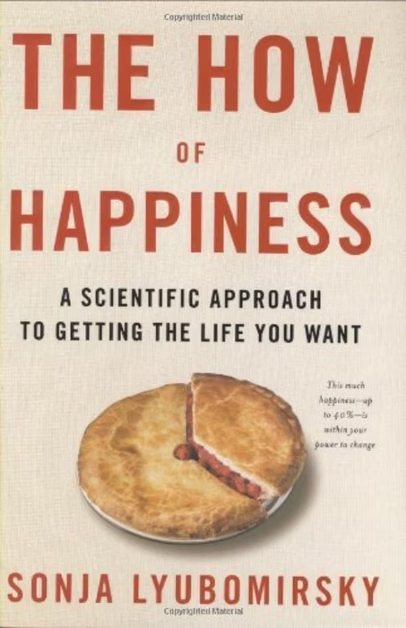
A caveat worth knowing: the book is famous for a pie chart claiming that about 40 percent of our happiness is under our own control. Later researchers criticized that figure as too neat, and Lyubomirsky herself has agreed it was an oversimplification.
Treat the percentage as a teaching device and the exercises as the real content.
In what order should you read them?
Start with the book that matches your most urgent problem, not the one with the best reputation.
- Your week is chaos: Drucker, then Grove.
- Your company has no clear direction: Collins for the questions, then Doerr for the system.
- You face a crisis or a hard people decision: Horowitz first, and keep Knight nearby for company.
- You have a deal coming: Voss, then Kahneman to check your own judgment.
- You are running on empty: Lyubomirsky, then Johnson.
If you could read only three, I would pick Grove, Horowitz and Voss. They cover how you run the company, how you survive its worst day, and how you negotiate for it. Not one of them is a comfortable read, and I mean that as praise.
Frequently asked questions
What is the best book for a first-time CEO?
The Hard Thing About Hard Things is the closest thing to a realistic preview of the job, though it leans toward fast-growth tech. If your company is smaller or slower, start with The Effective Executive.
Are older management books still worth reading?
Yes, with translation. Drucker’s book dates to 1967 and Grove’s to 1983, and both still describe problems every manager has. Their tools are old, but their questions are not.
Which books on this list should I treat with the most skepticism?
Good to Great for its case studies, Thinking, Fast and Slow for its priming chapters, and The How of Happiness for the 40 percent figure. All three remain worth reading. They are simply not gospel.
Do I need to read every book cover to cover?
No. Grove, Drucker and Doerr reward targeted reading. Knight and Johnson reward the whole story.
Final thoughts
None of these books will make you a CEO by themselves. Together they cover the inner work (resilience, well-being, judgment) and the outer skills (operations, strategy, negotiation) that leadership demands, and that mix is rarer than it should be.
For more on money and leadership, see my list of books on building wealth.