
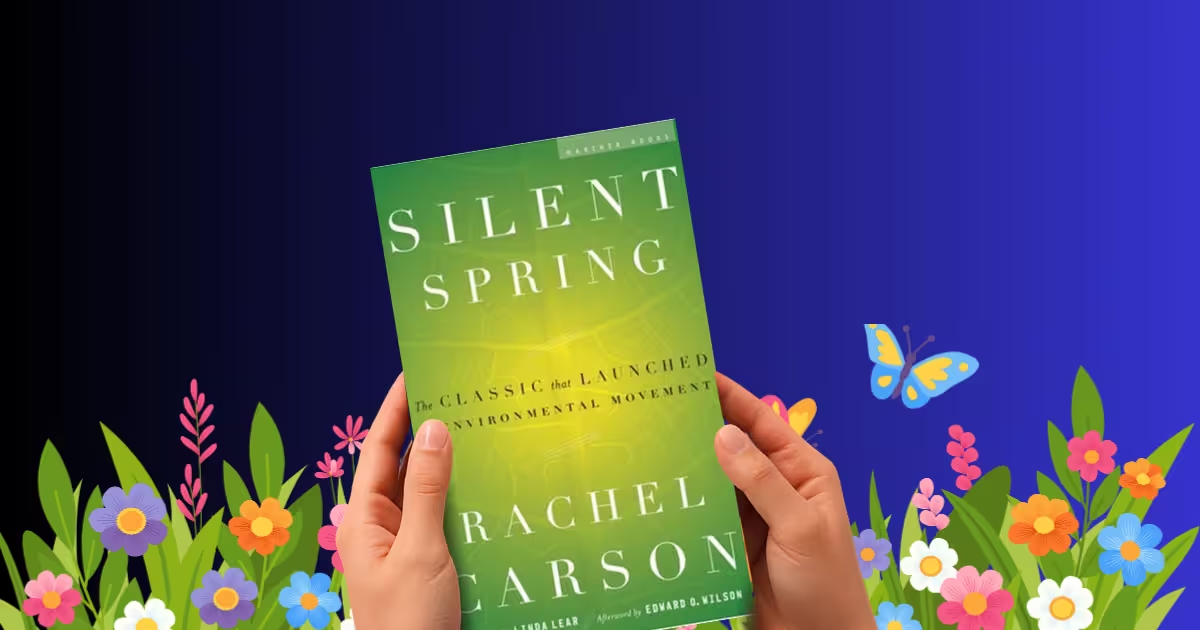
Do you ever walk outside on a spring morning and notice how quiet it’s become—fewer birds, fewer bees, the absence of that once-familiar dawn chorus? Rachel Carson noticed this silence over sixty years ago, and her investigation into what was causing it led to one of the most consequential books ever written.
Overview
Silent Spring is Rachel Carson’s meticulously researched 1962 exposé of the chemical industry’s indiscriminate use of synthetic pesticides—particularly DDT (Dichlorodiphenyltrichloroethane, a synthetic organochloride insecticide )—and their devastating, often invisible, effects on wildlife, ecosystems, and human health.
Carson argued that these “biocides” (her preferred term over “insecticides”) were poisoning the entire web of life, from soil microorganisms to birds to human beings, through bioaccumulation and food chain magnification.
The book sparked the modern environmental movement, led to the 1972 U.S. ban on DDT, inspired the creation of the Environmental Protection Agency, and fundamentally changed how we think about humanity’s relationship with nature. It remains a masterclass in scientific communication and moral courage.
Suggested readers
Silent Spring is a great read for anyone concerned about environmental issues, public health, or the unintended consequences of technological “progress.” Students of science communication, environmental studies, or public policy. Readers who appreciate passionate, evidence-based advocacy writing. Those who want to understand the origins of the modern environmental movement.
Not for readers seeking a light, uplifting read—this book is sobering and often disturbing. Those who prefer purely detached, academic scientific writing—Carson’s prose is deeply emotional and persuasive. Anyone who wants a quick, surface-level treatment of environmental issues—this is a dense, thoroughly documented work.
Table of Contents
Introduction
Title: Silent Spring
Author: Rachel Carson
Publication Date: September 27, 1962
Publisher: Houghton Mifflin
Awards: The Schweitzer Medal, Constance Lindsay Skinner Achievement Award, Conservationist of the Year (National Wildlife Federation), and several others
Rachel Carson was not an activist by nature. She was a marine biologist and writer who had spent most of her professional life with the U.S. Fish and Wildlife Service, finding joy in studying the ocean and its creatures. But when a friend wrote to her in 1958 about a small world made lifeless by pesticide spraying, Carson felt she could no longer remain silent. “There would be no peace for me,” she wrote to a friend, “if I kept silent”.
What emerged from four years of painstaking research was a book that would sell over 500,000 copies in 24 countries within a year of publication, stay on the New York Times bestseller list for 31 weeks, and ultimately sell over two million copies. It would also make Carson the target of a vicious smear campaign from the chemical industry—a campaign that, ironically, only amplified her message.
Background
To understand the seismic impact of Silent Spring, you have to understand the world into which it was dropped.
In 1962, the post-WWII enthusiasm for synthetic chemicals was at its peak. DDT, which had been hailed as a miracle weapon against insect-borne diseases during the war, had been released for civilian use and was being sprayed with abandon.
The chemical industry was booming, and the prevailing attitude was one of technological optimism—science and industry could solve any problem, and any suggestion otherwise was seen as backward or hysterical.
Carson wrote: “The chemical war is never won, and all life is caught in its violent crossfire”. She noted that since the mid-1940s, over 200 basic chemicals had been created for use in killing insects, weeds, and rodents—sold under several thousand brand names. These “nonselective chemicals” had “the power to kill every insect, the ‘good’ and the ‘bad,’ to still the song of birds and the leaping of fish in the streams”.
The agricultural establishment, government agencies, and chemical companies had formed a powerful alliance. Anyone questioning the safety of pesticides was dismissed as unscientific or emotional. This was the battleground Carson entered.
Silent Spring Summary
Chapter 1: A Fable for Tomorrow
Carson opens with one of the most effective rhetorical devices in environmental literature: a fictional portrait of a once-thriving American town that falls victim to a mysterious blight.
“There was once a town in the heart of America where all life seemed to live in harmony with its surroundings”.
The town had prosperous farms, orchards heavy with bloom, streams clear and cold where trout lay, and a famous abundance of bird life. Then “a strange blight crept over the area.” Chickens died, cattle sickened, children were stricken suddenly while at play and died within hours.
The birds disappeared. The feeding stations stood deserted. It was “a spring without voices”. On the farms, no chicks hatched, no pigs survived. The apple trees bloomed but no bees droned among the blossoms, so there was no fruit. The roadsides were lined with browned vegetation. The streams were lifeless.
In the gutters, a white granular powder remained. “No witchcraft, no enemy action had silenced the rebirth of new life in this stricken world. The people had done it themselves”.
Carson then reveals the devastating truth: this town doesn’t actually exist, “but it might easily have a thousand counterparts in America or elsewhere in the world”.
Chapter 2: The Obligation to Endure
Carson establishes her central argument: humans have acquired “significant power to alter the nature of his world”, and the most alarming assault on the environment is “the contamination of air, earth, rivers, and sea with dangerous and even lethal materials”.
She introduces a crucial distinction: the pace of human change versus the pace of nature. “For time is the essential ingredient; but in the modern world there is no time”. The rapidity of change “follow[s] the impetuous and heedless pace of man rather than the deliberate pace of nature”.
Carson argues that these chemicals should not be called “insecticides” but “biocides”—they kill everything. She dismisses the justification that pesticides are necessary to maintain farm production, pointing out that the U.S. was paying over a billion dollars a year to store surplus food. The real problem, she suggests, is not a lack of food but a distorted sense of proportion.
The chapter concludes with a powerful question from ecologist Paul Shepard:
“Why should we tolerate a diet of weak poisons, a home in insipid surroundings, a circle of acquaintances who are not quite our enemies, the noise of motors with just enough relief to prevent insanity? Who would want to live in a world which is just not quite fatal?”
Chapter 3: Elixirs of Death
This chapter is a toxicological tour de force. Carson systematically explains the chemistry and dangers of the major classes of pesticides.
She begins with a sobering statement: “For the first time in the history of the world, every human being is now subjected to contact with dangerous chemicals, from the moment of conception until death”.
Carson explains that DDT was first synthesized in 1874 but its insecticidal properties weren’t discovered until 1939. Its discoverer, Paul Müller, won the Nobel Prize—a fact that gave the chemical an aura of legitimacy.
But Carson reveals the dark side: DDT is fat-soluble and accumulates in the body. An intake of as little as 1 part per million in the diet results in storage of about 10 to 15 parts per million—an increase of 100-fold or more. The Food and Drug Administration had declared as early as 1950 that “the potential hazard of DDT has been underestimated”.
Carson then moves through the chemical arsenal: chlordane (which she describes as “one of the most toxic of insecticides”), dieldrin (5 times as toxic as DDT when swallowed, 40 times when absorbed through the skin), and endrin (15 times as poisonous to mammals as DDT, 30 times to fish, and about 300 times to some birds).
She introduces the organic phosphates—parathion, malathion, and others—which are “among the most poisonous chemicals in the world”. These work by destroying the enzyme cholinesterase, which regulates nerve impulses.
Perhaps most chilling is her description of “systemic insecticides”—chemicals that make plants and animals actually poisonous. “The entomologists’ dream of the built-in insecticide” had become a reality, but with horrifying consequences.
Chapter 4: Surface Waters and Underground Seas
Carson turns to the contamination of water, calling it “the most precious” of our natural resources. She explains how pesticides enter waterways—through direct application, runoff from agricultural lands, and groundwater seepage.
One of the most disturbing examples is Clear Lake, California. To control a small gnat, officials applied DDD (a DDT relative) to the lake at concentrations of 1 part in 70 million parts of water.
The gnats were controlled, but the poison traveled up the food chain: plankton contained 5 parts per million, plant-eating fish 40 to 300 parts per million, carnivorous fish up to 2,500 parts per million, and grebes—birds that ate the fish—contained an astonishing 1,600 parts per million. The grebe population plummeted from more than 1,000 pairs to about 30 pairs.
Carson warns: “It is not possible to add pesticides to water anywhere without threatening the purity of water everywhere”.
Chapter 5: Realms of the Soil
Carson takes us underground, into the “dark realms of the soil” where billions of bacteria, fungi, and other organisms maintain the fertility of the earth.
A single teaspoonful of topsoil may contain billions of bacteria. Earthworms, which Darwin studied, play a fundamental role in soil formation and aeration.
The question Carson poses is devastating: “What happens to these incredibly numerous and vitally necessary inhabitants of the soil when poisonous chemicals are carried down into their world?”.
She documents the long persistence of these chemicals in soil—aldrin recovered after four years, chlordane after twelve years, DDT accumulating to levels of 30 to 50 pounds per acre in orchards. Arsenic provides a “classic case of the virtually permanent poisoning of the soil”—tobacco plants continue to pick up arsenic applied decades earlier.
Chapter 6: Earth’s Green Mantle
Carson examines the destruction of vegetation—not just crops but the “weeds” and wild plants that make up the web of life. She describes the campaign to destroy sagebrush in the western plains, a program that not only eliminated sage but also the willows, moose, beavers, and trout that depended on them.
She quotes Justice William O. Douglas, who visited a sprayed area in Wyoming and was shocked by the “vast, incredible damage”. The moose were gone, the beavers were gone, the lake had drained away, and the trout were gone.
Carson makes a powerful argument for selective spraying and biological control. She cites the example of Klamath weed in California, which was controlled by importing beetles that feed exclusively on that plant. In Australia, prickly pear cactus was brought under control by introducing an Argentine moth—at a cost of less than a penny per acre.
Chapter 7: Needless Havoc
This chapter documents the direct killing of wildlife. Carson focuses on the 1959 spraying of 27,000 acres in southeastern Michigan with aldrin—one of the most dangerous chlorinated hydrocarbons—to control the Japanese beetle.
The results were catastrophic: robins were “almost annihilated,” ground squirrels “virtually annihilated,” 90% of farm cats died, and pheasant populations crashed. One of the most heartbreaking details: a local school made the collection of insecticide-poisoned birds a science project.
Carson writes of a meadowlark found near death: “Although it lacked muscular coordination and could not fly or stand, it continued to beat its wings and clutch with its toes while lying on its side”. Ground squirrels were found “biting at the ground” in their death throes.
She concludes with a moral challenge: “By acquiescing in an act that can cause such suffering to a living creature, who among us is not diminished as a human being?”
Chapter 8: And No Birds Sing
Perhaps the most famous chapter, this documents the disappearance of birds—particularly robins—from areas sprayed for Dutch elm disease.
The cycle is devastatingly simple: elms are sprayed with DDT to kill bark beetles. The leaves fall, are eaten by earthworms, which concentrate the poison. Robins eat the worms and die. As few as 11 large earthworms can transfer a lethal dose to a robin.
But the effects go beyond immediate death. Carson documents sterility in surviving birds. At Michigan State University, which had 370 adult robins before spraying, only two or three dozen remained. In 1958, not a single fledgling robin could be found on the entire campus.
Carson connects the dots to the bald eagle, our national symbol. Eagle populations in Florida had collapsed, with 80% of nests failing to produce young. At Hawk Mountain Sanctuary, the proportion of young eagles had dropped from 40% to just 20%. The cause: DDT thinning eggshells.
Chapter 9: Rivers of Death
Carson turns to fish—particularly salmon in Canadian rivers sprayed for spruce budworm. In 1954, the Northwest Miramichi was sprayed with DDT. All the young salmon that had emerged that spring died. The aquatic insects that salmon feed on were wiped out.
Carson documents fish kills across the United States: 60,000 game fish in California, hundreds of thousands in Texas when insecticides washed into the Colorado River, and in Florida, 20-30 tons of fish killed in salt marshes.
She raises the alarm about estuaries and coastal waters—the nursery grounds for shrimp, crabs, and many fish species. “The inshore waters—the bays, the sounds, the river estuaries, the tidal marshes—form an ecological unit of the utmost importance”.
Chapter 10: Indiscriminately from the Skies
Carson examines aerial spraying programs, particularly the campaigns against the gypsy moth and the fire ant. Both were ill-conceived, based on exaggerated threats, and caused massive collateral damage.
The fire ant program is a case study in bureaucratic arrogance. The Department of Agriculture launched a campaign to “eradicate” the fire ant, using heptachlor and dieldrin, despite having no evidence that the ant was a serious pest. The result: wildlife was devastated—quail, turkeys, songbirds, even livestock.
One farmer reported burying 19 cows killed by the poison. Another couldn’t raise young pigs for nine months after the spraying. By 1962, the program was acknowledged as a failure—there were more fire ants than when it began.
Chapter 11: Beyond the Dreams of the Borgias
Carson turns to the everyday contamination of our lives—the pesticides in our homes, gardens, and food. She notes that we can buy substances “of far greater death-dealing power than the medicinal drug for which he may be required to sign a ‘poison book'”.
She documents pesticide residues on food, including prison meals that contained up to 100.9 parts per million of DDT in bread. The Food and Drug Administration’s inspection system is woefully inadequate: fewer than 600 inspectors for all its work, checking less than 1% of interstate food shipments.
Carson calls for the elimination of tolerances on toxic chemicals and a shift to less dangerous alternatives. “The ultimate answer is to use less toxic chemicals”.
Chapter 12: The Human Price
Carson examines the effects of pesticides on human health—not just acute poisoning but the chronic, cumulative effects of low-level exposure.
She explains how chlorinated hydrocarbons are stored in fatty tissues and can cause liver damage. Both major types of insecticides—chlorinated hydrocarbons and organic phosphates—affect the nervous system. British investigators who deliberately exposed themselves to DDT reported “extreme irritability,” “mental incompetence,” and tremors that shook their whole bodies.
Carson documents the link between organic phosphate insecticides and mental illness, citing 16 cases of schizophrenia and depression among people with prolonged exposure.
Chapter 13: Through a Narrow Window
Carson takes us into the cell, explaining the process of biological oxidation—how cells produce energy. Pesticides can “uncouple” this process, turning cells into “racing engines, generating heat but yielding no power”.
She connects this to the reproductive failure documented in birds: eggs loaded with DDT lack the energy to complete development. And she raises the specter of genetic damage—the possibility that pesticides, like radiation, can cause mutations.
Carson cites the work of Nobel Prize winner H.J. Muller, who found that radiation causes mutations. She notes that chemicals can have the same effect, yet “the fact that chemicals may play a role similar to radiation has scarcely dawned on the public mind”.
Chapter 14: One in Every Four
Carson tackles cancer, arguing that the environment is being filled with carcinogens. She cites the work of Dr. W.C. Hueper, who warned that “the danger of cancer hazards from the consumption of contaminated drinking water will grow”.
She documents that several pesticides—including arsenic, DDT, and aminotriazole—are known carcinogens. The chapter title refers to her prediction that one in four Americans would eventually die of cancer if the wholesale use of pesticides continued.
Chapter 15: Nature Fights Back
Carson argues that chemical controls are self-defeating: they weaken natural predators and allow pest populations to explode. She cites the example of the spider mite, which became a worldwide pest as DDT killed off its enemies.
She writes: “The balance of nature is not the same today as in Pleistocene times, but it is still there: a complex, precise, and highly integrated system of relationships between living things which cannot safely be ignored”.
Carson quotes ecologist Charles Elton: “We are hearing the early rumblings of what may become an avalanche in strength”.
Chapter 16: The Rumblings of an Avalanche
Carson documents the rise of insect resistance to pesticides. Before 1945, only about a dozen species were resistant to insecticides; by 1960, the number had reached 137.
She notes that malaria mosquitoes had developed resistance in 28 species by 1960. The World Health Organization declared that “resistance is at present the most important single problem facing vector-control programmes”.
Chapter 17: The Other Road
Carson concludes with a vision of alternatives to chemical control: biological controls, sterilization techniques, insect attractants, and microbial insecticides.
She describes the successful eradication of the screw-worm fly using sterile males. She discusses bacterial insecticides like Bacillus thuringiensis. She praises the work of European foresters who use ants, spiders, and small mammals for pest control.
Carson ends with a powerful call to action:
“We stand now where two roads diverge. But unlike the roads in Robert Frost’s familiar poem, they are not equally fair.
The road we have long been traveling is deceptively easy, a smooth superhighway on which we progress with great speed, but at its end lies disaster. The other fork of the road—the one ‘less traveled by’—offers our last, our only chance to reach a destination that assures the preservation of our earth”.
Silent Spring Analysis
Characters
Carson herself emerges as the central figure: a scientist who refuses to stay silent, a woman who challenges a powerful industry, a voice for the voiceless creatures of the earth.
Carson’s tone is one of moral authority grounded in scientific rigor. She doesn’t appeal to emotion alone; she presents evidence, cites studies, and documents sources. Yet her prose is deeply felt, and she doesn’t apologize for her emotional response to the destruction she documents.
The antagonists are the chemical companies—Monsanto, Velsicol, and others—and the government agencies that colluded with them. Carson portrays them as driven by profit and ideology, indifferent to the suffering they cause.
The victims are the birds, fish, and other wildlife—and ultimately, humans. Carson gives voice to creatures that can’t speak for themselves, describing their deaths in vivid, heartbreaking detail.
Silent Spring Themes and Symbolism
Interconnectedness: Carson’s central theme is that everything is connected. The DDT sprayed on elms doesn’t just kill bark beetles; it travels through earthworms to robins, through the food chain to eagles, and eventually to humans. “In nature nothing exists alone” is the implicit message throughout.
The Limits of Technology: Carson challenges the assumption that technology can solve all problems. She argues that our faith in chemicals is misplaced—they create more problems than they solve.
Hubris and Humility: Carson repeatedly criticizes the arrogance of “the control of nature.” She calls it “a phrase conceived in arrogance, born of the Neanderthal age of biology and philosophy”. She advocates humility before the forces of nature.
The Poisoning of the Innocent: The book is filled with images of innocent creatures suffering for human convenience—robins dying in convulsions, eagles unable to reproduce, fish floating blindly downstream. This is a moral as well as an ecological argument.
Silence: The title itself is a powerful symbol. Spring should be a time of renewal and song, but chemical poisoning has brought silence. This silence represents not just the absence of birds but the absence of life, joy, and natural order.
Silent Spring Evaluation
Strengths
Silent Spring is a masterpiece of scientific communication. Carson takes complex biochemical and ecological concepts and makes them accessible without dumbing them down. She explains bioaccumulation, biomagnification, enzyme inhibition, and carcinogenesis in clear, compelling prose.
The book is meticulously researched. Carson spent four years gathering evidence, consulting experts, and documenting sources. The result is a work that has stood up to decades of scrutiny—and attack.
Carson’s prose is beautiful. She writes with the precision of a scientist and the passion of a poet. Her descriptions of nature—the “white clouds of bloom” drifting over green fields, the “dawn chorus of robins”—make the destruction she documents all the more painful.
The structure is masterful. The fictional opening draws the reader in; the scientific chapters build the case; the concluding chapters offer hope and a way forward.
Weaknesses
Critics have pointed to several weaknesses. Carson’s prediction that one in four Americans would die of cancer was an overstatement—though it’s worth noting that cancer rates have indeed risen.
Carson sometimes overstates her case. She presents the worst-case scenarios as if they were typical, and she doesn’t always acknowledge the complexities of risk assessment.
The book is relentlessly grim. There’s little relief from the catalog of horrors, which can be emotionally exhausting.
Some of the alternatives Carson proposes—particularly chemical sterilization—have their own risks, which she acknowledges but perhaps doesn’t fully explore.
Impact and Controversy
Silent Spring triggered a firestorm of controversy. The chemical industry launched a massive counterattack, spending hundreds of thousands of dollars to discredit Carson. According to biographer Linda Lear, she was described by Dr. Robert White-Stevensas “an ignorant and hysterical woman” who wanted to “turn the earth over to the insects”. Some critics even accused her of being a Communist.
Carson was also attacked for being a woman writing about science. Many of her critics questioned her credibility on gendered grounds.
Despite the attacks—or perhaps because of them—the book had a profound impact. President Kennedy’s Science Advisory Committee investigated the pesticide issue and vindicated Carson’s findings.
The Environmental Protection Agency was created in 1970. DDT was banned in the U.S. in 1972. The book inspired the Clean Air Act, the Clean Water Act, the Endangered Species Act, and other landmark legislation.
Comparison with Similar Works
Silent Spring is often compared to Upton Sinclair’s The Jungle (1906), which exposed the horrors of the meatpacking industry and led to the Pure Food and Drug Act. Both books used investigative journalism to expose corporate malfeasance and trigger government action.
It’s also comparable to Ralph Nader’s Unsafe at Any Speed (1965), which exposed the dangers of the automobile industry and led to safety regulations.
In the environmental canon, Silent Spring stands alongside Aldo Leopold’s A Sand County Almanac (1949) and John Muir’s writings. But while Leopold and Muir celebrated nature, Carson warned of its destruction.
More recent works like Elizabeth Kolbert’s The Sixth Extinction (2014) and David Wallace-Wells’s The Uninhabitable Earth (2019) carry on Carson’s tradition of using science to warn of environmental catastrophe.
Adaptation
Silent Spring has been adapted into several documentary films, including:
Silent Spring (1993) – A PBS American Experience documentary.
Rachel Carson’s Silent Spring (2007) – A PBS documentary featuring footage of Carson and interviews with experts.
There is no major Hollywood adaptation—the book is nonfiction and doesn’t lend itself to dramatization in the traditional sense.
Personal Insight and Relevance
Reading Silent Spring in 2026 is a strange experience. On one hand, the book feels dated—DDT has been banned, the EPA exists, and environmentalism is mainstream. On the other hand, Carson’s warnings feel more urgent than ever.
Insect populations are crashing worldwide. A 2017 study found that flying insect biomass in German nature reserves had declined by 75% over 27 years. The same study shows that average flying insect biomass declined by 76%, with a peak mid-summer decline of 82%.
Another similar study, conducted by Rosenberg, K. V., et al. (2019), finds that since 1970, North America has lost nearly 3 billion birds, which is almost 30% of the total bird population. Bird populations in North America have declined by nearly 30% since 1970. The “silent spring” Carson warned of is becoming a reality.
Moreover, another 2025 study finds that America’s bird population continues to decline.
Carson’s central insight—that we are part of nature, not separate from it—has never been more relevant. The climate crisis, biodiversity loss, and chemical pollution are all symptoms of the same disease: the belief that we can dominate nature without consequences.
The chemical industry continues to fight regulation, and new chemicals continue to be introduced with inadequate testing. The precautionary principle that Carson advocated—better safe than sorry—is still not the norm.
But there’s also hope. Carson’s book shows that one person can make a difference—that courage, persistence, and truth-telling can change the world. She wrote Silent Spring while battling breast cancer, knowing she would be attacked, and she persisted anyway. Her example is a reminder that we too can make a difference.
Five Lessons from Silent Spring:
1️⃣ Everything is connected. The DDT that kills insects eventually ends up in human bodies. We can’t poison one part of the environment without poisoning ourselves.
2️⃣ Technology is not neutral. “Progress” isn’t always progress. We need to question the assumption that new is always better.
3️⃣ The precautionary principle matters. We should prove that something is safe before releasing it into the environment, not after.
4️⃣ Courage matters. Carson faced a powerful industry, sexist attacks, and a fatal illness—and she spoke truth to power anyway.
5️⃣ Hope is essential. Carson ended her book not with despair but with a vision of a better way. We need that same hope today.
Silent Spring Quotes
“No witchcraft, no enemy action had silenced the rebirth of new life in this stricken world. The people had done it themselves.”
“For time is the essential ingredient; but in the modern world there is no time. The rapidity of change and the speed with which new situations are created follow the impetuous and heedless pace of man rather than the deliberate pace of nature.”
“These sprays, dusts, and aerosols are now applied almost universally to farms, gardens, forests, and homes—nonselective chemicals that have the power to kill every insect, the ‘good’ and the ‘bad,’ to still the song of birds and the leaping of fish in the streams.”
“Can anyone believe it is possible to lay down such a barrage of poisons on the surface of the earth without making it unfit for all life? They should not be called ‘insecticides,’ but ‘biocides.'”
“The ‘control of nature’ is a phrase conceived in arrogance, born of the Neanderthal age of biology and philosophy, when it was supposed that nature exists for the convenience of man.”
“We stand now where two roads diverge. But unlike the roads in Robert Frost’s familiar poem, they are not equally fair. The road we have long been traveling is deceptively easy, a smooth superhighway on which we progress with great speed, but at its end lies disaster.”
“There is something infinitely healing in the repeated refrains of nature—the assurance that dawn comes after night, and spring after winter.”
Conclusion
Silent Spring is more than a book—it’s a turning point in human history. It marks the moment when we began to realize that our power over nature could destroy us.
Carson’s achievement is remarkable: she took a complex scientific subject, made it accessible to a mass audience, and sparked a movement that changed the world. She faced down a powerful industry, sexist attacks, and her own failing health, and she persisted.
The book has its flaws—some of the science has been challenged, and Carson sometimes overstates her case. But its central message is as urgent today as it was in 1962: we are poisoning our world, and if we don’t stop, we will poison ourselves.
Silent Spring is essential reading for anyone who cares about the environment, public health, or the future of humanity. It’s a reminder that one person can make a difference—and that silence is not an option.
Recommendation: This book is for anyone who wants to understand the origins of the environmental movement, the dangers of chemical pollution, and the power of speaking truth to power. It’s for students, activists, policymakers, and anyone who has ever wondered why the birds are getting quieter.







