

Last updated on June 8th, 2026 at 10:53 pm
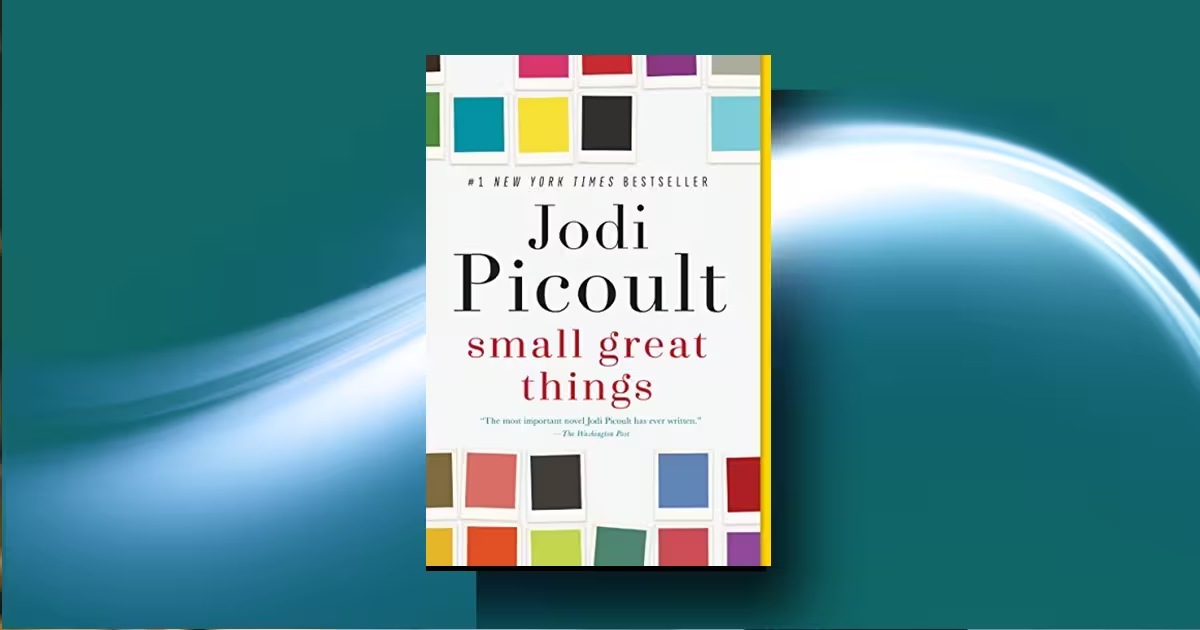
Small Great Things is the kind of novel that makes you set it down, stare at the wall, and reconsider something you said — or didn’t say — last Tuesday. It is one of the most important, and most structurally complicated, acts of American racial fiction in recent memory.
Does racism live only in the heart of the tattooed extremist, or does it also breathe quietly inside the well-meaning woman who insists she “doesn’t see colour”? That is the central, scalding question Jodi Picoult dares to put on trial in Small Great Things (2016), and the answer she delivers — carefully, compassionately, and sometimes frustratingly — is that the second kind is the one most of us carry without ever noticing the weight.
In a sentence: A Black labour-and-delivery nurse, barred from touching a white supremacist’s newborn, faces murder charges when the baby dies — and must navigate a legal system that insists race has nothing to do with any of it.
✓ Best For
- Readers who want to examine their own privilege honestly
- Fans of legal courtroom drama and moral dilemma fiction
- Book clubs that want productive, charged discussion
- Readers of My Sister’s Keeper, The Kite Runner, Just Mercy
- Anyone who has said “I don’t see colour” and meant it as a compliment
✗ Not For
- Readers who want subtlety — this novel has a thesis, and it states it
- Those uncomfortable with extended white-supremacist interior monologue
- Readers expecting moral ambiguity at the ending
- Those looking for an experimental or stylistically daring form
Table of Contents
1. Introduction
Small Great Things is Jodi Picoult’s twenty-fourth novel, published by Ballantine Books in October 2016.
The title derives from a sentiment commonly attributed to Dr. Martin Luther King Jr. — the idea that if one cannot do great things, one can do small things in a great way — and Picoult is candid in her author’s note that borrowing those words felt presumptuous for a white woman.
She used them anyway, and the tension in that decision mirrors the tension at the heart of the entire novel: who gets to speak for whom, and at what cost.
The book debuted at number one on the New York Times bestseller list and triggered the kind of fractured readership response that only the most genuinely provocative fiction manages to produce — Black readers divided on whether a white author had any right to this story; white readers confronted, many for the first time in literary form, with the concept of passive racism; and critics wrestling with whether Picoult’s considerable storytelling machinery served or slightly blunted the very cause she championed.
It is the sort of novel that makes everyone a little uncomfortable, and that, it turns out, was entirely the point.
2. Background & Historical Context
Picoult has stated that she spent roughly twenty years wanting to write about race in America before she finally felt capable of doing it. Two earlier attempts foundered because she could not give voice to a Black woman’s experience with conviction.
The immediate trigger for the final version was a real incident in Flint, Michigan, in which a Black labour-and-delivery nurse with over two decades of experience was formally requested by a white supremacist father to stay away from his infant. The hospital complied. Several African American nurses subsequently sued for racial discrimination and won.
The novel arrives in the specific cultural crucible of 2015–2016 America: the aftermath of Trayvon Martin, the emergence of the Black Lives Matter movement, and the slow, grinding public reckoning with police violence against Black Americans that had forced the phrase “systemic racism” from academic journals into everyday speech.
Picoult is deliberate about this context — her characters reference Eric Garner, Michael Brown, Sandra Bland by name — and the novel situates itself explicitly within that moment, which gives it both urgency and, for some readers, the feeling of a lecture delivered under fictional cover.
The historical backdrop Picoult weaves into the narrative runs considerably deeper, however, reaching back through the Amistad mutiny of 1839, Bacon’s Rebellion of 1676, the “one-drop rule,” and four hundred years of legislation designed to give one group a structural head start while insisting the race was fair. The novel is, among other things, a history lesson disguised as a legal thriller.
3. Small Great Things Summary
The novel opens not in a hospital nursery but in a Manhattan brownstone, with a memory. Ruth Jefferson, a Black nurse in her early forties, recalls being brought as a small girl to the Upper West Side home where her mother Lou worked as a domestic servant for the Hallowell family.
On a snow day in 1976, Ms Mina goes into premature labour, and Lou delivers the baby in the bedroom, an act of competence and grace absorbed into the household’s ordinary life without particular acknowledgement. The baby is named Louis, after Lou. The lesson Ruth draws is that certain labour becomes seamless and invisible precisely because of who performs it.
Decades later, Ruth is a senior labour-and-delivery nurse at Mercy–West Haven Hospital in Connecticut, with twenty years of impeccable service. She is widowed; her husband Wesley died in Afghanistan. She has raised a seventeen-year-old son, Edison, a National Merit Scholar and varsity athlete, alone.
She lives in an overwhelmingly white suburb because she calculated, years ago, that it would give Edison better schools and safer social standing. She has spent her entire adult life moving carefully, speaking carefully, and dressing carefully — absorbing the quiet humiliations of being the only Black professional in her department.
Into this life arrives Turk Bauer. Turk is twenty-five, a drywall worker and committed white supremacist with a swastika tattooed on his scalp. His wife Brittany has just delivered their son Davis — named for Jefferson Davis.
From the moment Ruth enters their room to perform the routine newborn exam, Turk’s hostility is palpable. When Ruth completes the exam and attempts to help with nursing, Turk orders her out and demands her supervisor.
Marie Malone, the charge nurse, caves. She places a Post-it note in Davis’s medical file: No African American Personnel to Care for This Patient. Ruth confronts her; Marie insists she is doing Ruth a favour. Ruth, furious, slams the break-room door and moves on.
Two days later, Ruth pulls an unscheduled overnight shift. The ward is chaos. Corinne, Davis’s new nurse, is called away for an emergency caesarean and asks Ruth to monitor Davis after his circumcision. Ruth, caught between protocol and professional instinct, stands in the nursery and stares at the sleeping infant.
Then Davis stops breathing.
Ruth unwraps the swaddling. She taps his heels. She turns him on his side. She does everything a nurse would do — every manoeuvre short of calling a code, because she is not supposed to be touching this child. She hears footsteps. She wraps Davis up again and steps back.
Marie walks in, sees the ashen colour of his cheek, and orders Ruth to call the code while she administers the Ambu bag. The crash team arrives. Davis Bauer is pronounced dead.
Ruth, terrified of losing her job, tells Marie — and later the risk management team, and later the police — that she did not touch Davis before Marie arrived. She did nothing, she says. She followed orders. This lie, born of fear and calculation, will haunt every subsequent page.
Turk Bauer tells the police that he saw Ruth beating on his son’s chest so violently she was “jackhammering” him. Within two weeks, the hospital suspends Ruth’s nursing licence. A grand jury convenes. Ruth is indicted for murder and involuntary manslaughter. At three in the morning, police break down her door and lead her away in handcuffs.
Ruth is assigned a public defender: Kennedy McQuarrie, a white woman in her late thirties with five years of criminal defence experience, a husband who is an ophthalmologist, a young daughter, and the sincere, impeccably performed belief that she does not see colour. Kennedy immediately tells Ruth that race cannot be mentioned in the courtroom. It is too risky. It alienates juries.
They need to build their case on medicine and procedure, not on the obvious fact that none of this would be happening if Ruth were white. Ruth, who has spent her entire adult life being told precisely this, bites down on her reply and agrees.
Meanwhile, the novel pursues Turk in parallel chapters. We learn his backstory: a dead older brother, an absent gay father he beat severely, a recruitment into a hate group by a charismatic leader who understood that loneliness and shame are far better recruitment tools than ideology.
We meet Francis Mitchum — Brittany’s father and the elder statesman of the local white supremacist network — and understand how Turk fell in love with Brittany at one of Mitchum’s events. Turk is monstrous, but Picoult renders him with specificity: he loves his wife; he loved his son with an intensity that undoes him; his grief is real.
Ruth, out of work, exhausts her savings, applies for welfare, and eventually gets a job at McDonald’s. When Kennedy encounters her behind the counter one morning, the scene is a masterclass in mutual humiliation.
The trial builds through jury selection — a bravura sequence in which Kennedy and her young Black co-counsel Howard scour social media and drive past jurors’ homes, attempting to identify implicit bias. Kennedy uses every tool except the one Ruth needs most: the truth about why Ruth is sitting at the defence table.
The state medical examiner testifies that Davis died of hypoglycaemia leading to cardiac arrest; the manner of death is officially “undetermined.” Kennedy, having subpoenaed Davis’s neonatal screening results, introduces the bombshell that Davis carried MCADD, a rare metabolic disorder that causes fatal episodes in infants when they fast.
Davis had been made to fast before his circumcision. In twenty percent of undiagnosed cases, the result is death. The medical examiner concedes that even if Ruth had performed every conceivable intervention, Davis might still have died. The murder charge is dismissed.
Then Ruth insists on testifying. She admits in open court that she lied — that she did touch Davis when he first stopped breathing, that she stopped because she heard footsteps and was afraid for her job. And then, under cross-examination, she says the words that explode the careful legal edifice: that when Davis died, she had thought the baby was better off dead than raised by a man like Turk Bauer.
The courtroom erupts. Edison runs. Kennedy is devastated. Ruth fires her lawyer. The judge forces Kennedy to continue.
Ruth and Kennedy have it out in the courthouse bathroom — and something finally cracks open in Kennedy’s understanding. She goes home, walks to a CVS and stands in front of hair-care products designed for Black women that she has never once needed to notice, takes a bus to Adisa’s neighbourhood and feels what it is like to be the only face of her kind in a room.
She sits with the realisation that she has spent her career defending people she thought of as beneficiaries of her progressive goodwill, when in fact the system that made her career possible was the same system that kept putting them in front of her.
On the day of closing arguments, Kennedy delivers a closing unlike anything she has ever said. She names race directly. She talks about headwinds and tailwinds, about the difference between active and passive racism, about the moving walkway at the airport and how standing still still carries you forward if the walkway is already moving in your direction.
She tells the jury — and means it — that she is a racist too. “Not because I hate people of different races,” she says, “but because — intentionally or unintentionally — I’ve gotten a boost from the colour of my skin, just like Ruth Jefferson suffered a setback because of hers.”
The jury deliberates. They are deadlocked eleven to one. Before a mistrial can be declared, the judge rules on the defence’s renewed motion for judgement of acquittal — he grants it outright. Ruth Jefferson is free.
But the novel does not end there. An epilogue unfolds months and years later. Brittany Bauer discovers she is half-Black — her father had concealed that her absent mother Adele was a Black woman with whom he had been in love before his conversion to white supremacy.
The revelation destroys the ideological world Brittany has built. She suffers a breakdown; Turk takes her to the hospital, where he sits through the night reckoning with truths he cannot reconcile: that Black people are inferior, that Brittany is half Black, that he loves Brittany.
The logic collapses quietly, in a cafeteria, over bad coffee.
The final pages jump forward. Turk is now living under his wife Deborah’s name, married to a Jewish woman, raising a daughter named Carys — meaning “love” in Welsh, the same letters as his LOVE knuckle tattoo.
He goes to schools and prisons talking about how hate fills the hole that loneliness digs. His daughter has strep throat. He brings her to a walk-in clinic. The nurse-practitioner who greets them is named Ruth Walker — and Turk, with his shaved head grown out and most tattoos removed, is not recognised.
Ruth examines the child with gentle competence. As she leaves, Turk calls her name. When she turns, he says simply: “Thank you.” The novel ends there, in that sentence, hanging.
4. Small Great Things Analysis
4.1 Characters
Ruth Jefferson is the moral core and the novel’s most fully realised creation.
Picoult draws her with tremendous care: a woman who has spent decades performing the exhausting double labour of her profession and her race, who has learned to modulate her voice and affect for white audiences, and who has convinced herself — almost — that assimilation is not a form of loss.
Her outburst on the witness stand, which appears to destroy her case, is in fact the first fully honest thing she has said in a public forum in her adult life.
Kennedy McQuarrie is Picoult’s most ambitious character construction. Kennedy is written to be recognisable: the progressive white woman who believes she has done the work, who votes the right way and would never consider herself complicit.
The novel engineers her slow, painful education with precision. That she ultimately delivers an extraordinary closing argument, naming race plainly, does not redeem her — it simply shows her catching up, imperfectly, to a conversation Ruth has been unable to have for forty-four years.
Turk Bauer divides readers most sharply. Some find Picoult’s attempt to humanise him irresponsible; others find it essential. If the novel argues that racism is a system rather than merely a personality disorder, it needs to show how ordinary people enter that system and sometimes, very quietly, exit it.
His violence is rendered in full; his ideology is not softened. Only in the epilogue does the novel permit him a kind of grace, and even then it is tentative, earned through years of work.
Adisa, Ruth’s sister, functions as a moral chorus — the character who has never assimilated, who names things plainly, and who remains exactly who she is, unchanged by the trial’s outcome.
Edison Jefferson, Ruth’s son, carries the novel’s future. He is the scholarship student, the varsity athlete, the boy whose best friend’s family will not let their daughter date a Black man; the boy who, in a misguided act of love, spray-paints a swastika and a racial slur on the hospital wall, trying to frame Turk and discovering instead that he has imported the oppressor’s toolkit.
4.2 Small Great Things Themes and Symbolism
The Post-it Note. The single most resonant symbol. “No African American Personnel to Care for This Patient.” Five words. It costs nothing. It destroys everything. The note is institutional racism in 3×3-inch form.
Passive Versus Active Racism. The distinction Kennedy articulates — between the man with the swastika and the woman who notices there are no people of colour in her office and does not ask why — is the novel’s central thematic engine. Picoult argues that passive racisms are not less harmful than Turk’s — only less visible.
The Invisible Knapsack. Drawing on Peggy McIntosh’s concept of white privilege, the novel threads through Kennedy’s education the advantages she carries without noticing — the ability to walk into any hair salon, to find dolls that look like her daughter, to speak without being assumed to represent her entire race.
The Moving Walkway. The airport moving walkway: standing still on a walkway already tilted in your direction and calling the result your own achievement.
Birth as Structure. The novel is divided into stages of labour — Early Labor, Active Labor, Transition, Pushing, Afterbirth — a metaphor for Kennedy’s emergence into racial consciousness and Ruth’s emergence into the right to speak in her own voice.
5. Evaluation
Small Great Things is a significant, morally serious, and frequently gripping piece of American fiction — not a masterpiece, but the kind of novel that performs a cultural function arguably more important than formal perfection.
5.1 Strengths
Kennedy McQuarrie is the novel’s greatest achievement — a discomforting mirror for the novel’s most likely readership. The legal architecture is exceptionally well-researched, and Ruth’s chapters are written with sustained dignity.
5.2 Weaknesses
The denouement is almost unbearably tidy for material this intractable. The narrative’s emotional logic strains toward resolution in ways the subject matter resists. The novel is also, occasionally, didactic to a fault — several passages read less like drama and more like annotated bibliography.
5.3 Impact and Controversy
The sharpest controversy surrounds authorship: does a white woman have the right to write Ruth Jefferson? Picoult is candid about the problem, and the resulting portrait is sensitively rendered.
Yet there is something structurally odd about a novel that argues Black voices have been suppressed, but whose commercial success depends on those concerns being articulated through a white author to a predominantly white audience.
That contradiction is not resolved, and the novel is more honest for not trying.
5.4 Comparison with Similar Works
| Book | Angle | Comparison to Small Great Things |
|---|---|---|
| To Kill a Mockingbird (Lee) | Legal racism, moral witness | SGT updates Mockingbird’s framework: white lawyer, Black defendant — but interrogates the white-saviour dynamic Mockingbird never questioned |
| Just Mercy (Stevenson) | True criminal injustice | SGT is fiction where Stevenson is memoir — but both argue that legal process is racialised at every step |
| My Sister’s Keeper (Picoult) | Medical ethics, moral dilemma | Picoult’s best-known earlier work; SGT is considerably more politically engaged and less emotionally manipulative |
| The Hate U Give (Thomas) | Police violence, Black girlhood | Thomas writes from inside the Black experience; SGT is explicitly addressed to white readers — a very different project |
| Between the World and Me (Coates) | Structural racism, essayistic | Coates is argument; SGT is dramatisation — both necessary, neither sufficient |
6. Personal Insight & Contemporary Educational Relevance
The most important thing this novel taught me is the vocabulary for passive racism — not the theory, exactly, but the feeling of it, dramatised. The moment Kennedy realises she has been walking into every room on a moving walkway and calling it her own speed — that landed.
The concept of systemic racism is empirically documented. Housing discrimination, healthcare disparities, unequal pain management — none of this requires a Turk Bauer. It requires only a lot of people acting reasonably within unreasonable systems.
5 Lessons from Small Great Things
7. Small Great Things Quotes
“If I cannot do great things, I can do small things in a great way.”
— Epigraph (attributed to Martin Luther King Jr.)“There is a difference between active and passive racism. Active racism is having a swastika tattoo on your head. Passive racism? It’s noticing there’s only one person of colour in your office and not asking your boss why.”
— Kennedy McQuarrie, closing argument“You say you don’t see colour…but that’s all you see. You’re so hyperaware of it, and of trying to look like you aren’t prejudiced, you can’t even understand that when you say race doesn’t matter all I hear is you dismissing what I’ve felt, what I’ve lived, what it’s like to be put down because of the colour of my skin.”
— Ruth Jefferson to Kennedy McQuarrie“It’s like if you up and moved to Japan. … Every time you turn on the TV or the radio you see and hear about white people going to high school and college… You learn how they live their lives, and you speak their language well enough to blend in with them. But how many white people you know who go out of their way to learn how to act around Black people?”
— Adisa to Ruth“I thought: What did I miss? Could I have done anything different? And then I thought: Would I have been allowed to?”
— Ruth Jefferson, on the witness stand“Prejudice goes both ways, you know. There are people who suffer from it, and there are people who profit from it. Who died and made you Robin Hood? Who said I ever needed saving?”
— Ruth to Kennedy, in the conference room“‘L. O. V. E.’ / ‘That’s right,’ I say proudly. We wait for Ruth to come back to us. I hold my daughter’s hand, or maybe she holds mine, like we are at an intersection, and it’s my job to take her safely to the other side.”
— Turk, in the epilogue, at the walk-in clinic
8. Conclusion
Small Great Things is not a perfect novel. It is too long in places, occasionally too comfortable with its own argument, and its ending hands its characters more resolution than the real world tends to offer.
But it is the right novel at the right time, doing the right work — it takes a conversation that has been labelled too difficult and insists on having it anyway, in the most accessible literary form available.
I read this novel in three long sittings, emerging from each one slightly altered. I thought about the assumptions I bring to institutional spaces.
I thought about who in my professional life has to perform an additional labour of representation that I do not, and whether I have ever named that or compensated for it. I thought about whether I have ever said “I don’t see colour” and what exactly I imagined I was offering when I did.
Ruth Jefferson deserved better than what happened to her. So does the reader who sits with this novel honestly, because the novel will ask you, quietly and persistently, to ask yourself what exactly you have been not seeing — and what it has cost the people standing next to you on the walkway, while you travelled forward at your comfortable pace.
9. FAQs
Is Small Great Things based on a true story?
The novel is fiction, but it was inspired by a real incident in Flint, Michigan, where a Black labour-and-delivery nurse was formally requested by a white supremacist father to stay away from his infant. The hospital complied. Several African American staff subsequently sued for racial discrimination and won.
What is MCADD and why does it matter to the plot?
MCADD (medium-chain acyl-coenzyme A dehydrogenase deficiency) is a rare metabolic disorder. Undiagnosed infants can suffer fatal episodes when they fast — which Davis was required to do before his circumcision. The discovery of Davis’s abnormal newborn screening results provides the defence with an alternative cause of death.
Does Ruth Jefferson go to prison?
No. The murder charge is dismissed mid-trial. After the jury deadlocks, the judge grants a motion for judgement of acquittal. Ruth is free.
What happens to Turk Bauer at the end?
Years later, Turk lives under his second wife’s surname, works with the Anti-Defamation League speaking about hate crimes, and brings his sick daughter to a walk-in clinic run by Ruth — who does not recognise him. He says “thank you” as she leaves.
Is there a film adaptation of Small Great Things?
A film has been in development since 2017, with Viola Davis as Ruth and Julia Roberts as Kennedy. As of mid-2026, it has not been released.
What does the title Small Great Things mean?
It comes from a sentiment attributed to Martin Luther King Jr.: “If I cannot do great things, I can do small things in a great way.” The novel uses it to reflect both Ruth’s individual acts of care and the idea that racism is perpetuated and dismantled through small acts.


