
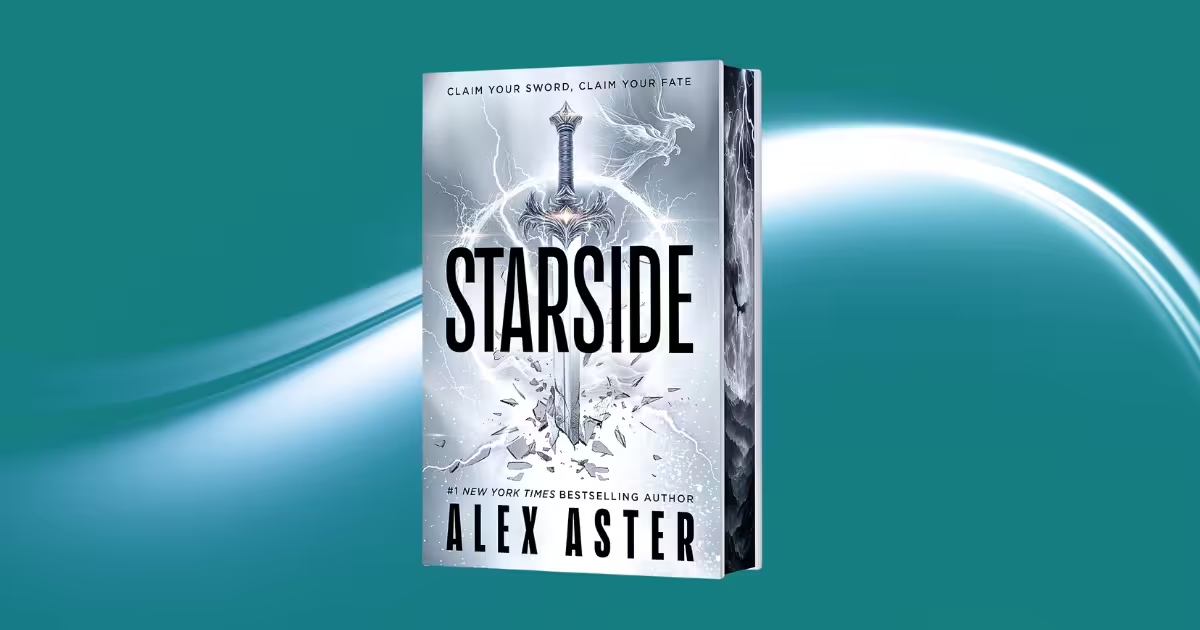

Did you ever wonder what you’d do if the gods who were supposed to protect you instead burned your entire world to ash—and then forgot you even existed? That question haunted me long after I closed Starside by Alex Aster, and it’s exactly why this book refuses to let go.
In a land split by an ancient war, a scarred blacksmith’s apprentice named Aris sneaks into a once-in-a-lifetime deadly competition not to win magic for her starving people, but to cross into the immortal realm of Starside and personally execute the goddess who murdered her family.
Starside is best for fans of gritty adult romantasy who crave high-stakes quests, morally gray enemies-to-lovers tension, found-family bonds forged in blood, and a heroine whose rage feels earned rather than performative. If you loved the Lightlark series (same author) but wanted it darker, spicier, and more emotionally raw, or if Fourth Wing and ACOTAR left you hungry for sword fights that actually matter, this is your next obsession.
Not for: Readers seeking cozy, low-conflict fantasy or anyone who hates slow-burn romance that simmers with real hatred before it ignites. If graphic violence or complex grief triggers you, proceed with caution—the Culling is brutal, and the emotional scars run deep.
1. Introduction
Starside (Avon / HarperCollins, March 31, 2026, ISBN 9780063462434, ~512 pages) is Alex Aster’s highly anticipated debut adult romantasy. The #1 New York Times bestselling author of the Lightlark series returns with a standalone (though sequel-ready) epic that feels both familiar and freshly ferocious. Deluxe limited editions with sprayed edges and foil accents flew off shelves, cementing its instant bestseller status.
2. Background
Aster has openly said she wrote Starside in secret for herself, channeling the same female rage and phoenix-like resilience that defined her earlier work. The book draws on classic “divided realms” mythology—think a brutal post-war version of mortal vs. immortal lands—but grounds it in very human grief.
No ancient prophecies here; just one orphan who decided the gods had it coming. The dedication sets the tone perfectly: “For all those phoenixes out there—keep rising from the ashes.”
3. Starside Summary
I still remember the opening line hitting me like a hammer on hot steel: “This will kill me.” Aris stands in the sweltering village square of Nightfell, dagger hidden up her sleeve, heart hammering as she eyes the black stone platform that will decide who gets to cross into Starside.
The Questral happens only every fifty years. Fifty mortals.
One deadly journey across the immortal realm to claim a goblet of raw magic that can heal drought, cure disease, or grant immortality—if you survive the Turn. Most don’t.
Aris isn’t there for magic. Ten years earlier, a goddess torched her village like kindling. She watched her family burn while the immortal simply walked away, cape fluttering. That night forged Aris into something sharper than any blade.
Her mentor Stellan—himself a rare Questral survivor—fished her from the ashes as a child and trained her in the forge. He gave her the greatest weapon he ever made: a dagger of pure Starside steel, the only mortal-forged piece of immortal metal on this side of the gates. “You rise,” he told her. “You rise from the ashes like a phoenix.”
She carved a tiny flame into the hilt herself, a reminder of why she fights.
The Culling is pure chaos. King’s guards in silver armor slaughter anyone who can’t reach the platform. Spectators cheer as lesser metals shatter. Aris slips through the crowd like a shadow, head low, until a silver hawk’s scream marks the countdown.
She watches Pagnus Ender, a mountain of a man from House Ender, almost kill her—then smirk and step aside, dismissing her as unworthy.
Rage gives her speed. When his sword arcs toward her head on the stone, she rolls, drives her dagger through his shin, and the superior metal sings as it bites bone. Cheers erupt. She makes the platform with three minutes to spare.
There she meets Kira—red-haired, sharp-eyed, fighting for her dying sister—and the masked knight Harlan Raker, head of the king’s guard, whose Starside steel sword makes even the immortals wary.
Aris once begged Raker for mercy during a drought; he gave her none. She hates him almost as much as the gods. Yet when the final fifty are chosen and the caravan rolls east toward the silver gates, Raker is among them.
The journey to the gates is its own gauntlet. Challengers dwindle in a flattened forest, a thorn labyrinth, and a graveyard of ancient swords that choose their wielders. Aris forms a fragile trio with Kira and a curious Great House heir named Zane. Raker watches from the shadows, mask hiding whatever expression lurks beneath.
Their hate simmers into something electric—stolen glances, blades clashing in practice fights that feel like foreplay. Aster writes the tension like a duel: every parry, every near-miss, every growled insult laced with unwilling respect.
The gates open. Starside explodes in color—forests that breathe, rivers of liquid starlight, creatures that could be weapons or gods.
But beauty hides teeth. Legendary beasts stalk them. Immortals toy with mortals for sport. Aris learns the war that split the realms was uglier than the stories: gods hoarded magic while Stormside starved, and some immortals now regret it. Others don’t.
The goddess who burned Aris’s village still walks these lands, unrepentant.
Trials test every alliance. Kira nearly dies protecting her friends. Zane’s curiosity costs him dearly. Raker saves Aris more than once, each rescue chipping at her armor.
Their first intimate scene is pure fire—literal swordplay turning into desperate, clothes-still-on need against a ruined temple wall. Aster doesn’t fade to black; she lets the duel continue in the bedroom, blades and bodies equally sharp.
The climax hits in the gods’ throne room. Aris finally faces the goddess.
The confrontation is visceral, personal, and cathartic.
She drives her dagger home, watching silver blood spill across marble while the immortal’s eyes widen in shock. Vengeance tastes like ash and triumph. But Raker steps forward then, mask gone, revealing the truth he’s hidden for decades: he is the God of Death himself, living among mortals to atone—or perhaps to wait. Aris stabs him too, grief and rage and unwanted love colliding.
He survives because “he is death,” but the wound buys her time.
In the final pages Aris makes her choice. She steals the magic goblet (enough to heal Kira’s sister and more), claims half of Raker’s legendary godsword, and sprints back through the closing gates.
Raker stands on the other side, bleeding but alive, watching her with something like pride and heartbreak.
The silver bars slam shut. Aris whispers the line that still gives me chills: “See you in fifty years, Raker.” She returns to Stormside not as a broken girl but as something new—scarred, powerful, free.
The ending subverts every easy happily-ever-after. Vengeance wins, love waits, and the cycle begins again.
4. Starside Analysis
4.1.Starside Characters
Aris is the heart and the blade. She begins as pure vengeance wrapped in long sleeves and silence, hiding cursed silver markings and a decade of nightmares.
By the end she’s still driven, but she’s learned she can want more than death—she just refuses to settle for less. Her growth feels earned, never preachy.
Harlan Raker is the ultimate morally gray MMC. Masked, terrifying, secretly Death incarnate—he’s the man who once poured out her water during a drought and the lover who fights beside her in Starside.
Their relationship is never simple; the betrayal at the end hurts because you’ve fallen for him too.
Kira and Zane round out the found family with raw humanity. Kira’s love for her sister grounds the epic stakes; Zane’s curiosity humanizes the entitled heirs. Even Stellan, back in Stormside, gets a poignant arc—his fear for Aris is love in its gruffest form.
4.2. Starside Themes and Symbolism
Vengeance vs. love is the core duel.
Aris’s final choice to walk away from Raker proves grief doesn’t have to define you forever, but it also shows how revenge can be its own kind of freedom.
The ash-flame motif (phoenix dedication, the carved hilt, the burning village) symbolizes rising from trauma.
Starside steel represents forbidden power—beautiful, deadly, and impossible to wield without cost.
The divided realms mirror real-world inequality: immortals hoarding magic while mortals starve. The mural in the ruined temple Aris visits daily is my favorite symbol—colorful past vs. gray present—reminding us that beauty can still exist in broken places.
5. Evaluation
Starside is a groundbreaking adult romantasy that feels like Aster finally writing the book she always wanted to read—unapologetically dark, sexually charged, and emotionally honest. It left me breathless, furious, and weirdly hopeful all at once.
Strengths: The worldbuilding is lush yet brutal, the action cinematic, the romance crackles with authentic hate-to-need tension, and Aris’s voice is unforgettable.
Weaknesses: A couple of mid-quest trials feel slightly repetitive if you’ve read a lot of romantasy, and some readers may find the ending too bittersweet (I loved it).
Impact: Intellectually it made me question cycles of vengeance; emotionally it cracked open old wounds and stitched them with steel. I finished it at 3 a.m. and just sat there staring at the wall.
Comparison with similar works: It shares DNA with Aster’s own Lightlark (divided realms, deadly games) but trades YA restraint for adult spice and moral ambiguity.
Echoes of The Cruel Prince in the court intrigue, Fourth Wing in the dragon-scale battles, and The Poppy War in the unflinching cost of revenge.
6. Personal insight with contemporary educational relevance
The most important theme is the cost and catharsis of revenge in a world that refuses to protect the vulnerable. Aris’s journey mirrors what psychologists call “moral injury”—when systems (or gods) betray you so deeply that only personal justice feels like justice.
In 2026 we’re still watching cycles of generational trauma play out in global conflicts and social media outrage; studies from the American Psychological Association show that while revenge fantasies provide short-term relief, sustained rumination correlates with higher rates of anxiety and depression (around 40% in trauma survivors per recent meta-analyses). Starside doesn’t preach forgiveness—it validates rage and then asks what comes after.
That lesson feels urgently relevant: how do we channel justified anger into something that builds rather than burns? Aris chooses both—vengeance and a future. It’s the kind of nuanced take on empowerment we need right now.
7. Conclusion
Starside is a ferocious, unforgettable ride that proves Alex Aster’s talent only grows sharper with each book. It’s significant because it refuses easy answers: sometimes the heroine gets her revenge and still walks away changed, lonely, and free.
If you love high-stakes romantasy with heart, blades, and a heroine who burns brighter than any immortal, read this immediately.
You’ll finish it feeling like you, too, can rise from whatever ashes life has left you in.
I read every page like it was forged just for me. If you pick it up, I’d love to hear what line broke you the most.