
Last updated on May 30th, 2026 at 11:06 am
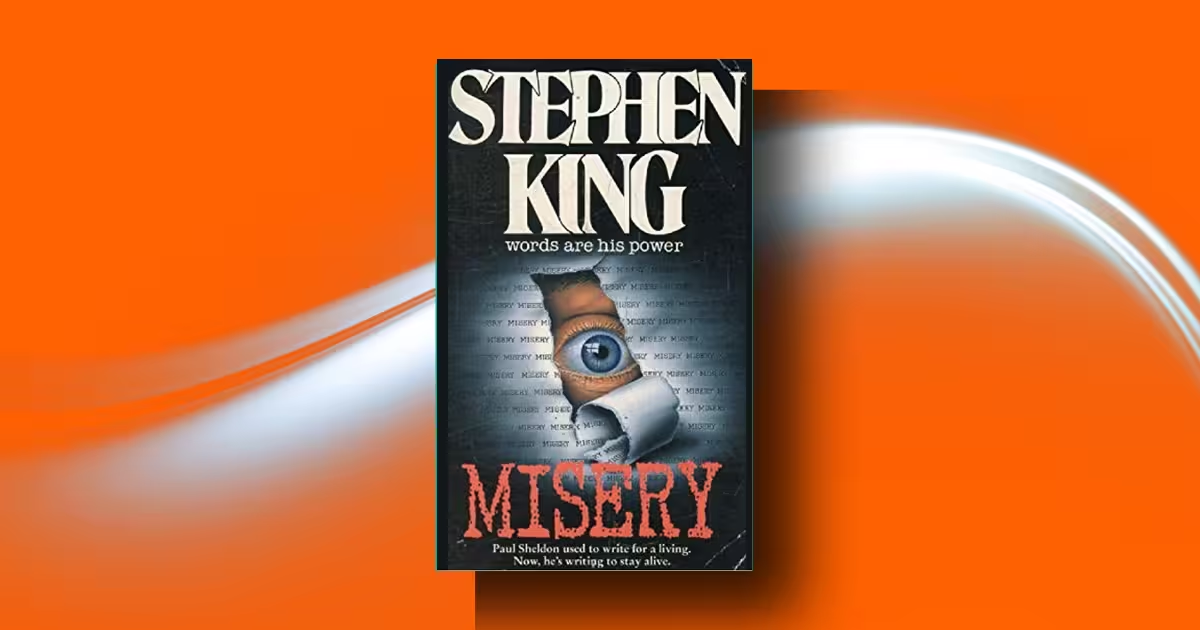
Did you ever wonder why the line between devoted fandom and dangerous obsession is so terrifyingly thin, and what happens when a creator becomes a prisoner to their own audience? Misery by Stephen King investigates the real reason behind.
After a near-fatal car crash, a famous novelist is held captive by his deeply disturbed, drug-hoarding “number-one fan,” forcing him to write for his life in a harrowing battle of wits, addiction, and endurance.
Misery is best for lovers of claustrophobic psychological thrillers, writers fascinated by the dark side of creativity, and readers who appreciate slow-burn, masterfully crafted suspense. Not for readers who are highly squeamish about severe physical torture, those who dislike confined, single-location narratives, or anyone looking for a light-hearted
arted escape.
Table of Contents
1. Introduction
Title: Misery
Author: Stephen King
Publication Details: First published in Great Britain in 1987 by Hodder & Stoughton; published in the US by Viking Press.
2. Background
Misery was born during a tumultuous time in Stephen King’s life. Traditionally, King had been known strictly for supernatural horror, but Misery marked a grounded, psychological shift. Specifically, it serves as a powerful historical allegory for King’s own battles with substance abuse during the 1980s.
The character of Annie Wilkes—who constantly controls Paul Sheldon’s access to his painkillers—represents the suffocating grip of addiction.
Furthermore, the novel explores the burgeoning concept of toxic fandom in contemporary pop culture, making it highly prescient.
3. Misery Summary
The Crash and The Awakening
Initially, it may seem like a stroke of incredible luck. Paul Sheldon, a highly successful author known for a series of Victorian romance novels featuring a heroine named Misery Chastain, finishes a manuscript for a gritty new novel titled Fast Cars.
In order to celebrate, he gets drunk and drives his 1974 Camaro into a massive blizzard in the Colorado mountains. He crashes, overturning his vehicle. When he wakes up, he is not in a hospital ward, but in a haze of agonizing pain. He has been rescued by Annie Wilkes, a former nurse who lives on an isolated farm in Sidewinder, Colorado.
As a result of the crash, Paul’s legs are shattered. Annie has set his legs herself and is feeding him a heavily addictive, codeine-based painkiller called Novril.
In fact, Paul quickly realizes that Annie has not called an ambulance, nor has she alerted the authorities. She claims the roads are impassable, but Paul soon discovers the horrifying truth: he is a prisoner. Annie proudly proclaims herself to be his “number-one fan.” Due to this issue, Paul recognizes that his life is in grave danger.
Annie is not just eccentric; she is deeply, dangerously psychotic, suffering from severe mood swings that plunge her into catatonic states or explode into violent rages.
The Manuscript and The Rinse-Water
Annie discovers Paul’s briefcase containing the only copy of Fast Cars. Typically, Paul never lets anyone read an unfinished or unproofed manuscript, but due to a lack of leverage and his desperate need for his pain medication, he grants her permission.
Surprisingly, Annie despises the new book.
In particular, she is enraged by the profanity and what she perceives as a lack of nobility in the characters. Her anger reaches a boiling point when she accidentally spills soup on his bed and blames him for it.
To give a simple example of her cruelty, she returns to clean the wall with a yellow plastic bucket of soapy rinse-water, and then forces Paul to swallow his Novril capsules using the dirty, lint-filled water. “Once nasty, never neat,” she tells him. Consequently, Paul realizes that in order to survive, he must appease her at all costs.
The Death of Misery and The Burning
Next, Annie finishes reading Paul’s latest published book, Misery’s Child. Unfortunately for Paul, he had killed off Misery Chastain at the end of the book so he could finally move on to serious fiction.
When Annie discovers this, she goes completely berserk. She nearly smashes Paul’s head in with a glass water-pitcher. She abandons him for days, leaving him to suffer severe withdrawal from the Novril and excruciating pain in his legs.
When she finally returns, she forces Paul to do the unthinkable. She brings him a barbecue grill, lighter fluid, and matches, and makes him burn the only existing manuscript of Fast Cars.
With this in mind, Paul’s spirit is momentarily broken. Annie then buys him a missing-toothed Royal typewriter and demands that he write a new novel: Misery’s Return. She wants Misery brought back to life, and it must be a book written exclusively for her.
Because of this, Paul begins to write to stay alive.
Explorations and Escapades
As noted earlier, Paul is heavily reliant on Annie for survival, but as his body slightly heals, he manages to pick the lock on his bedroom door using a hairpin. While Annie is away running errands in town, Paul ventures out of his room in his wheelchair.
During these terrifying excursions, he discovers a scrapbook Annie keeps, titled Smirk. Demonstrating this woman’s true nature, the scrapbook contains newspaper clippings revealing that Annie is a serial killer. She has murdered dozens of people, including elderly patients and infants in the maternity wards where she previously worked as a nurse.
In view of these revelations, Paul knows that Annie will never let him go; once the book is finished, she plans to kill him, and likely herself.
The Hobbling and The Law
Paul’s secret trips out of his room are eventually discovered. Annie notices that a small ceramic penguin on a table has been moved.
As a consequence, she decides to punish Paul to ensure he can never escape again. In one of the most gruesome scenes in modern literature, Annie performs an operation she calls “hobbling.” Using an axe and a blowtorch to cauterize the wound, she chops off Paul’s left foot.
Later, when Paul complains about a missing “n” key on his typewriter, a furious Annie slices off his thumb with an electric knife.
Meanwhile, a young state trooper named Kushner arrives at Annie’s house looking for the missing author. Paul manages to throw an ashtray out the window to get the officer’s attention. Nevertheless, before the trooper can save him, Annie attacks the officer, murdering him with a lawnmower cross-bar and then driving over his head with her riding mower. She hides the body and the cruiser.
This leads to Paul realizing that he is entirely on his own.
The Climax
Ultimately, Paul realizes his only weapon is the manuscript itself.
He finishes Misery’s Return. He tells Annie he needs a cigarette, a match, and a glass of champagne to celebrate—a tradition he has always maintained. However, Paul has secretly soaked a stack of blank paper in lighter fluid. When Annie comes in to celebrate, Paul sets the decoy manuscript on fire.
In truth, Annie’s obsession with the book overrides her sense of self-preservation. She desperately dives to save the burning pages.
Coupled with this distraction, Paul lifts the heavy Royal typewriter and smashes it down onto Annie’s back. A brutal, agonizing, bare-knuckle fight ensues.
Paul is severely handicapped, but he manages to force some of the burning pages into Annie’s mouth and eventually trips her, causing her to hit her head on the mantle. He crawls out of the room, locking the door behind him.
The Ending Explained
Briefly, Paul is eventually rescued by police who arrive to investigate the missing trooper. Surprisingly, when they check the bedroom, Annie is not there.
She had managed to escape through a window despite her fatal injuries, ultimately dying in her barn with her hands gripping a chainsaw, presumably intending to finish Paul off.
Back in New York, Paul’s life is forever altered. Misery’s Return is published to massive critical and commercial success, achieving a staggering first printing.
Despite this, Paul is broken. He requires a prosthetic leg, suffers from severe PTSD, and relies heavily on alcohol to cope with his trauma. He constantly hallucinates Annie Wilkes lurking in the shadows.
To that end, the ending explains that while Paul survived physically, the psychological scars of his captivity and the violation of his creative spirit will haunt him forever.
In the end, he finds a small glimmer of hope when a random sight inspires a new story idea, proving that while his body and mind were tortured, his creative spark—the very thing that kept him alive—has not been fully extinguished.
4. Misery Analysis
4.1. Characters
Paul Sheldon: First and foremost, Paul represents the creator trapped by his own success. In contrast to the heroic protagonists he writes about, Paul is deeply flawed, cynical, and arrogant.
However, his character development is profound; he goes from a man who passively accepts his fate to a feral, cunning survivor. A major trait of Paul is his adaptability.
Hence, his relationship with his art changes. He initially hates Misery Chastain, but by the end, he realizes that his storytelling ability is his greatest weapon and savior.
Annie Wilkes: Without a doubt, Annie is one of the most terrifying villains in literary history. Unlike a supernatural monster, Annie is terrifying because of her mundane, solid reality.
The novel frequently describes her as an “idol,” unyielding and fibrous. Her motivations are driven by extreme narcissism and a complete detachment from reality.
Moreover, she evaluates the complexity of the world in binary terms: things are either “good” or “dirty.” Consequently, her relationship with Paul is perverse; she is simultaneously his savior, his torturer, his mother-figure, and his lethal god.
4.2. Themes and Symbolism
The Creative Process as Survival: Indeed, the act of writing in Misery is not a luxury; it is a biological necessity. The Royal typewriter symbolizes the painful, mechanical, and often decaying nature of forced art. Every missing key (like the “n” or the “t”) represents a piece of Paul’s autonomy being chipped away.
Addiction and Captivity: As I have said, Novril is a massive symbol in the text. The tide coming in over the “splintered pilings” of his broken legs is Paul’s metaphor for the relief the drugs bring.
In fact, Stephen King has openly stated that Annie Wilkes is a metaphor for cocaine and alcohol. She demands all of you, isolates you, and will eventually kill you.
Toxic Fandom: Ranking above all others, the theme of audience entitlement is prescient. Annie feels she owns Paul and Misery. When the creator deviates from the fan’s desires, the fan’s love instantly curdles into violent hatred.
5. Evaluation
Misery is a groundbreaking, visceral triumph that expertly bridges the gap between pulp horror and high-tier psychological literature. To put it in another way, it is a masterpiece of sustained, claustrophobic tension.
Strengths / Positive Experiences: The pacing is impeccable. King’s ability to create an atmosphere of suffocating dread in a single setting is unmatched.
The vivid descriptions of Paul’s pain—both physical and mental—make the reader feel complicit in his captivity. Furthermore, the story-within-a-story (Misery’s Return) perfectly mirrors Paul’s real-world struggle.
Weaknesses / Negative Experiences: However, there are drawbacks to the intense pacing; the middle sections of the book can feel slightly repetitive as the cycle of Paul exploring and Annie returning plays out multiple times.
Due to insufficient evidence of Annie’s broader life outside the house, she sometimes borders on a caricature of madness, though King grounds her just enough in reality to keep her terrifying.
Impact: Personally, the book resonated deeply with me regarding the pressures of digital creation and audience expectations.
As a matter of fact, when managing high-level content platforms, the demand to produce what the audience expects versus what the creator wants to make is a constant battle. This book takes that concept to its most horrific extreme.
6. Personal Insight with Contemporary Educational Relevance
The most important theme of the book is the Entitlement of the Audience, an angle that is incredibly relevant to contemporary digital marketing, and content creation. With this in mind, here are five educational lessons we can draw from Misery:
The Danger of “Number-One Fans”: In today’s parasocial internet culture, creators often cultivate hyper-dedicated communities. However, as seen with modern “cancel culture,” when creators shift their brand, these ultra-fans can turn hostile, demanding a return to the content they feel they “own.”
Adaptation and Pivot: Paul Sheldon survives because he adapts. Therefore, creators must constantly innovate to survive algorithm shifts, much like Paul writing to stay alive.
The Prison of a Niche: Paul is physically trapped, but he was metaphorically trapped long before the crash by his romance series. This means that building a brand solely on one highly specific niche can become a creative prison.
Quality Under Pressure: Despite writing under the threat of death, Paul realizes Misery’s Return is actually quite good. Demonstrating this, strict constraints and deadlines can often force a creator to bypass writer’s block and tap into raw creativity.
Authenticity Cannot Be Faked: Annie knows when Paul is “cheating” the narrative. Modern audiences (and Answer Engines) are equally savvy; they can detect inauthentic, AI-generated, or poorly researched content. High authority requires genuine human effort.
7. Misery Quotes
- On the reality of his situation: “Paul Sheldon used to write for a living. Now, he’s writing to stay alive.”
- On the nature of toxic fandom: “I know… You’re my number-one fan.”
- On looking at Annie Wilkes: “‘When you look into the abyss, the abyss also looks into you.’ — Friedrich Nietzsche”
- On Annie’s twisted sense of perfection: “My mother had a motto, Paul, and I live by it. ‘Once nasty, never neat,’ she used to say.”
- On the creative process: “A man who could think of Misery Chastain, first think of her and then breathe life into her, could be nothing else.”
8. Conclusion
To summarize, Stephen King’s Misery is a staggering achievement in psychological horror.
It brilliantly dissects the parasitic relationship between an artist and their audience, utilizing the chillingly grounded character of Annie Wilkes to embody the ultimate nightmare of lost autonomy.
I highly recommend this novel for fans of intense, character-driven thrillers and anyone interested in the agonizing, beautiful, and sometimes deadly process of creating art. Ultimately, Misery is a significant read because it reminds us that while the pen is mightier than the sword, the typewriter can be just as heavy as an axe.







