
Last updated on January 13th, 2026 at 05:18 am
Why is it that The 21 Irrefutable Laws of Leadership can make it so clear how some people speak briefly and instantly create direction—yet others can plan flawlessly and still fail to inspire anyone to follow?
Leadership isn’t a title—it’s a set of learnable laws (like gravity): practice them and people will follow; ignore them and things fall apart. (Maxwell frames the book as “laws” for a reason.)
Best for / Not for
The 21 Irrefutable Laws of Leadership is best for new managers, founders, team leads, teachers, community builders, ministry leaders—anyone who needs buy-in, trust, momentum, and results without becoming controlling. (Basically: people who lead humans, not just tasks.)
Not for: readers who want “one hack,” hate stories/examples, or expect leadership to be a status reward instead of a responsibility with a cost.
The 21 Irrefutable Laws of Leadership
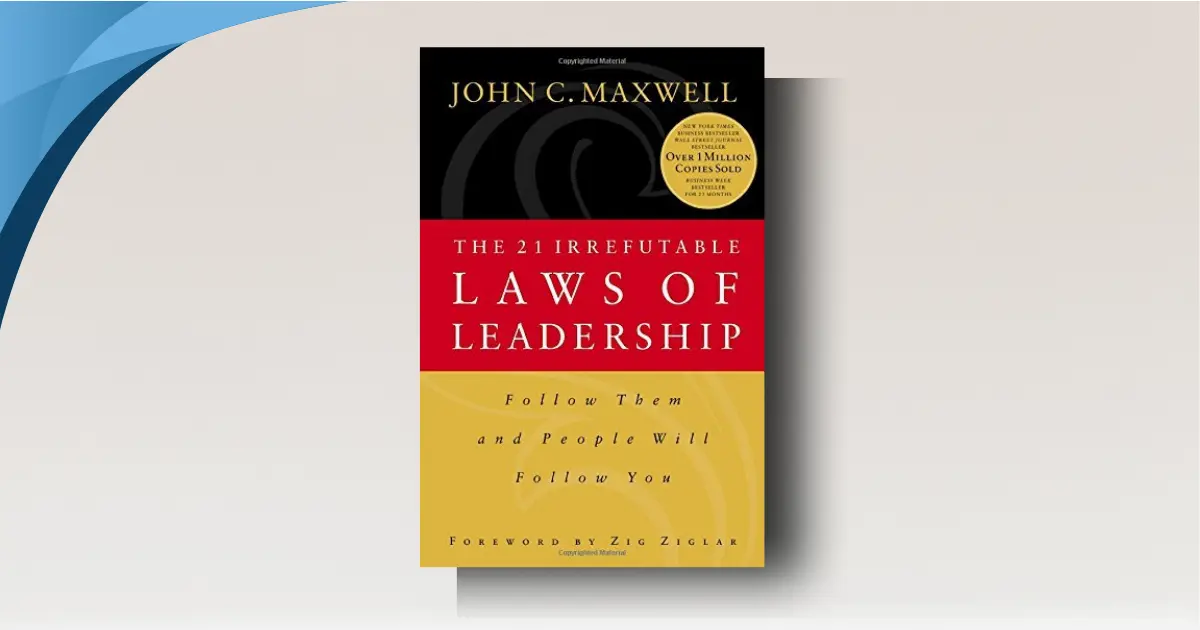
If you’re searching for a The 21 Irrefutable Laws of Leadership review, or trying to decide if John C. Maxwell’s The 21 Irrefutable Laws of Leadership: Follow Them and People Will Follow You is worth your time in 2026, here’s my honest answer:
This isn’t the kind of leadership book you read and forget. It’s the kind you re-measure yourself against—especially on the days when your team is disengaged, your family isn’t listening, or your “vision” sounds amazing in your head but dies the moment it hits real people.
Maxwell’s central promise is simple: leadership works like reality works. You can argue with it, you can ignore it, but the outcomes will still show up. That’s why he calls them “laws,” not “tips.”
And frankly, the world needs this conversation. Gallup-linked research frequently cited in leadership development argues that managers account for a large share of engagement differences across teams—often quoted as “at least 70% of the variance,” attributed to Gallup’s estimate.
If you’ve ever worked under a great manager and then a bad one, you don’t need a PhD to believe that.
What Maxwell does well is give you a full system: influence, trust, timing, momentum, buy-in, empowerment, priorities, and legacy—stitched together with stories that make the ideas stick.
Table of Contents
1. Introduction
Book: The 21 Irrefutable Laws of Leadership: Follow Them and People Will Follow You
Author: John C. Maxwell
The book’s earlier editions trace back to the late 1990s; Open Library lists an edition lineage indicating 1998 as the original publication year.
(There is also a 25th Anniversary Edition dated May 31, 2022 on Google Books under HarperCollins Leadership, which matters if you’re buying a fresh copy today.)
Genre-wise, this is classic leadership / self-development / management nonfiction—built around principles and examples rather than academic theory.
Maxwell is widely marketed (by his publishers) as one of the best-known leadership authors, and the book itself is frequently described as a best-selling leadership title.
Purpose
The thesis is that effective leadership is not random charisma. It’s built on consistent, repeatable “laws” that govern how people choose to follow.
Even more sharply: leadership is influence, not position. Maxwell states the law as: “The True Measure of Leadership Is Influence—Nothing More, Nothing Less.”
2. Background
Maxwell’s 10th Anniversary edition matters because it wasn’t just a reprint; he explains he reworked the structure, merging some earlier ideas and adding laws he felt he had missed.
He explicitly says he combined ideas because they were embedded in others, and he also added two new laws—The Law of Addition and The Law of the Picture—because he realized leadership is service and modeling, not just strategy.
He also drops a truth that sounds humbling but is actually strategic: nobody does all 21 laws well—so leadership is not “be perfect,” it’s “build a team that covers your gaps.”
That alone makes this book less “guru-ish” than people assume. It’s not pretending you’ll become a superhero. It’s pushing you toward self-awareness + team design.
3. The 21 Irrefutable Laws of Leadership Summary
Before the laws: Maxwell’s emotional definition of leadership
One of the reasons I stayed with this book is that Maxwell doesn’t treat leadership as cold mechanics. He opens with a pulse-check that reads like a human being talking to human beings—leadership as courage, responsibility, vision, care, and heart-to-heart communication.
That tone matters, because the laws can look like a checklist—until you realize each one is really about people.
Below is my full “reader-friendly” breakdown of all 21 Irrefutable Laws of Leadership, written so you don’t have to keep flipping back.
Law 1: The Law of the Lid : leadership ability caps everything
Maxwell’s first punch is brutal and clarifying: your leadership ability sets the ceiling on your effectiveness.
This is the cornerstone law. Maxwell posits that your leadership ability acts as a lid or ceiling on your effectiveness and the potential of your organization. If your leadership is a 4 on a scale of 10, your effectiveness can never exceed a 3. He illustrates this with the story of the McDonald brothers, Dick and Maurice.
They created an incredibly efficient burger restaurant system, but their “lid” was low. They failed at franchising because they were managers, not leaders.
Ray Kroc, with a much higher leadership lid, saw the national potential, bought them out, and built the McDonald’s empire we know today. “Leadership ability is always the lid on personal and organizational effectiveness,” Maxwell states (Page 37).
My takeaway: This law is uncomfortable because it removes excuses. If your business is stuck, your team is stuck, your community group is stuck—Maxwell is basically saying: the lid might be you. Not your intentions—your skill.
Practical application:
- Audit where growth stalls: communication, trust, delegation, conflict, clarity.
- Ask: “If I improved 10% as a leader this quarter, what would change first?”
- Don’t just work harder—raise your lid.
Law 2: The Law of Influence : leadership is influence, not position
This is the line people quote for a reason: “The True Measure of Leadership Is Influence—Nothing More, Nothing Less.”
Forget titles and positions.
Maxwell is unequivocal: “If you don’t have influence, you will never be able to lead others” (Page 42). He debunks leadership myths (The Management Myth, The Entrepreneur Myth, etc.) and uses the example of Mother Teresa, a woman of no official rank who moved millions through sheer influence.
He also shares a humble story from his own career, realizing a farmer named Claude was the true influencer in his first board meeting. “The proof of leadership is found in the followers” (Page 48).
My takeaway: You can be the boss and still not be the leader. And you can be the newest person in the room and still become the leader if people start taking their cues from you.
Practical application:
- Watch who gets listened to in meetings when decisions get real.
- Build influence by competence + consistency + care.
- Influence grows when people feel safe with you.
Law 3: The Law of Process : leadership grows daily
Maxwell states it cleanly: “Leadership Develops Daily, Not in a Day.”
This is where he quietly saves you from motivational junk. No “overnight transformation.” Leadership is reps. Practice. Feedback. Adjust.
My takeaway: The book itself becomes a training plan if you treat each law like a month-long focus, not a one-time read.
Practical application:
- Pick one law per week, one behavior per day.
- Keep a “leadership journal” of wins and failures.
- Ask for feedback before your ego asks for praise.
Law 4: The Law of Navigation : leaders chart the course
He writes: “Anyone Can Steer the Ship, but It Takes a Leader to Chart the Course.”
This law is about thinking ahead—planning, forecasting, risk, and reality.
Leaders are planners and strategists.
They see the trip ahead before leaving the dock. Maxwell uses the tragic contrast between explorers Roald Amundsen and Robert Falcon Scott’s race to the South Pole. Amundsen’s meticulous planning led his team to victory and safety.
Scott’s poor planning led his team to death. “Followers need leaders able to effectively navigate for them” (Page 74). Maxwell shares his personal “PLAN” acrostic strategy for navigating major organizational change (Page 80).
My takeaway: When things go wrong, people don’t just want hope. They want a leader who has looked around the corner.
Practical application:
- Plan with: what’s predictable, what’s risky, what’s controllable.
- Run “pre-mortems”: “If this fails, why will it fail?”
- Don’t confuse optimism with direction.
Law 5: The Law of Addition : leaders serve and add value
Maxwell defines it: “Leaders Add Value by Serving Others.”
And he explains why he added this law later—because leadership should be service, not privilege.
My takeaway: This law changes your posture. It asks: “Do people become better after contact with you?” If not, your leadership is decorative.
Practical application:
- Start meetings with: “What do you need from me?”
- Remove obstacles for your team.
- Praise in public, correct in private, serve consistently.
Law 6: The Law of Solid Ground : trust is the foundation
Maxwell states it plainly: “Trust Is the Foundation of Leadership.”
Trust is your leadership currency.
Every good decision deposits change in your pocket; every poor one spends it.
Once you’re out of change, you’re out as a leader. Maxwell shares a personal story where he made three good decisions but processed them poorly, breaking trust with his congregation. He had to publicly apologize to rebuild it.
He links the erosion of public trust in America to the Vietnam War and Robert McNamara’s lack of candor. “Character makes trust possible. And trust makes leadership possible”.
My takeaway: This is one of the most expensive laws to learn late. You can have strategy, charisma, and urgency—none of it matters if people don’t trust you.
Practical application:
- Tell the truth faster than you want to.
- Keep promises (or communicate early when you can’t).
- Admit mistakes—without theatrics.
Law 7: The Law of Respect : people follow strength
“People Naturally Follow Leaders Stronger Than Themselves.”
This isn’t about dominance; it’s about credibility and competence.
People don’t follow others by accident.
They are drawn to and respect leadership ability greater than their own. A level 7 leader will naturally attract 5s and 6s, not 9s and 10s. Maxwell uses the powerful example of Harriet Tubman.
Uneducated, a former slave, and a woman in a prejudiced society, her immense courage and leadership strength compelled over 300 people to risk their lives following her to freedom. “The more leadership ability a person has, the more quickly he recognizes leadership—or its lack—in others”.
My takeaway: People don’t respect perfection. They respect strength plus steadiness—especially under pressure.
Practical application:
- Grow where you’re weak or build a team around the weakness.
- Make hard calls when necessary (not cruel calls).
- Let your standards speak before your speeches do.
Law 8: The Law of Intuition : leaders read the room and reality
Maxwell writes that leaders measure and solve problems through intuition—a “leadership bias.”
He uses Steve Jobs as an example and even cites Apple’s market share drop and turnaround era decisions.
My takeaway: This isn’t mystical. It’s pattern recognition earned through experience—seeing what matters, faster.
Practical application:
- Ask “What’s the real problem?” before “What’s the quick fix?”
- Debrief failures to sharpen intuition.
- Learn from multiple domains: business, people, conflict, culture.
Law 9: The Law of Magnetism : you attract who you are
“Who You Are Is Who You Attract.”
You don’t attract who you want; you attract who you are.
Maxwell had readers list ideal follower qualities, then check which ones they themselves possessed—a revealing exercise.
If you want to attract loyal people, be loyal. If you want innovators, be innovative. He shares how his predecessor, a musician, filled the church with musicians. When Maxwell, a leadership teacher, took over, he began attracting leaders. The law extends to age, attitude, background, values, and ability. “Who you are is who you attract”.
My takeaway: If your team is cynical, chaotic, or lazy—Maxwell pushes you to check the mirror before you check the HR file.
Practical application:
- Improve your own character/discipline to raise the “talent temperature.”
- Hire for values and teach skills when possible.
- Build culture deliberately or it will build itself accidentally.
Law 10: The Law of Connection : touch the heart before the hand
This law hit me harder than I expected. Maxwell says the heart comes first, and you can’t move people to action unless you move them emotionally.
He states the core line: you touch hearts before you ask for help.
He even contrasts leadership connection moments (e.g., public leadership responses to crisis) to show how connection builds or breaks trust.
My takeaway: This law explains why some “logical” leaders fail. People are not spreadsheets. They are stories, fears, loyalties, and pride.
Practical application:
- Learn your people’s hopes, not just their KPIs.
- Communicate with stories and meaning—not only instructions.
- Be present in pain. Connection is built when it costs you time.
Law 11: The Law of the Inner Circle : your potential depends on your closest people
“A Leader’s Potential Is Determined by Those Closest to Him.”
No leader succeeds alone.
Maxwell uses Lance Armstrong’s seven Tour de France wins not as a story of solo genius, but as a testament to his team—coaches, tacticians, and “domestique” riders who sacrificed for him. “Nobody does anything great alone,” he writes (Page 183).
He provides five key questions to ask about potential inner circle members, including whether they have complementary gifts and add value. “It’s lonely at the top, so you’d better take someone with you”.
My takeaway: Leadership isn’t solo heroism. It’s team architecture.
Practical application:
- Identify your inner circle: who influences your decisions daily?
- Upgrade intentionally: mentors, honest peers, operators, creative thinkers.
- Reward loyalty and competence—don’t confuse them.
Law 12: The Law of Empowerment : secure leaders give power away
“Only Secure Leaders Give Power to Others.”
Insecure leaders hoard power; secure leaders give it away.
Maxwell details the tragic story of both Henry Ford and his grandson, Henry Ford II, who systematically undermined and fired strong executives, crippling the company’s innovation.
In contrast, he praises leaders like Jim Sinegal and Ritz-Carlton’s Horst Schulze, who empower their people. “Leading well is not about enriching yourself—it’s about empowering others”.
My takeaway: Insecurity creates micromanagement. Security creates multiplication.
Practical application:
- Delegate outcomes, not just tasks.
- Let people make decisions and learn.
- Celebrate when someone outgrows your supervision.
Law 13: The Law of the Picture : people do what they see
“People Do What People See.”
Modeling is the most potent form of teaching.
Leaders cannot expect behavior from others that they do not demonstrate themselves. Maxwell cites the heroism of Easy Company in WWII, directly attributable to the courageous example of their leaders. “The leader must be the first to take the new hill,” he asserts. Your actions set the standard.
Maxwell added this law later because modeling shapes culture.
My takeaway: Culture is not your values poster. Culture is your behavior repeated.
Practical application:
- If you want punctuality, be punctual.
- If you want honesty, admit mistakes first.
- If you want learning, let people see you learning.
Law 14: The Law of Buy-In : people buy the leader first, then the vision
This is one of the most quoted laws for a reason: “People buy into the leader first, then the leader’s vision.”
A great vision without a credible leader is just a hallucination.
People follow the leader first. If they believe in you, they’ll believe in your vision. If they don’t believe in you, it doesn’t matter how brilliant the vision is. Maxwell illustrates this with the Indian independence movement—people followed Gandhi, the man, before fully understanding the complex vision of non-violent resistance.
Maxwell even gives a personal story about earning buy-in before redirecting a major organizational decision (including a vote percentage).
My takeaway: A great vision without credibility is just a speech.
Practical application:
- Build trust deposits before you request commitment withdrawals.
- Create small wins early to earn belief.
- Ask: “Do they trust me?” before “Do they like my idea?”
Law 15: The Law of Victory : leaders find a way to win
Maxwell says victorious leaders refuse to accept defeat and will do what must be done.
True leaders embrace a “no-excuses” mentality. When the stakes are high, they find a path to victory. Maxwell points to Winston Churchill during the Blitz, Nelson Mandela ending apartheid, and coach Pat Summitt’s winning record.
Victory may require sacrifice, unity, and creativity, but leaders make it happen. “You can’t win without good leadership,” he states.
My takeaway: This is not about ego. It’s about responsibility. The leader carries the burden of “we have to get there.”
Practical application:
- Define “winning” clearly (metrics, deadlines, standards).
- Build unity; division kills victory.
- When pressure spikes, your calm becomes strategy.
Law 16: The Law of the Big Mo : momentum is a leader’s best friend
“Momentum Is a Leader’s Best Friend.”
Momentum is an amplifier. It makes leaders look better than they are and problems smaller than they are. Creating momentum often requires a initial, dramatic change or success—a “momentum kick.”
Maxwell uses the example of Pixar’s first short film, Luxo Jr., which created momentum that led to feature films and billions in revenue.
A leader’s job is to create and then sustain momentum.
My takeaway: Momentum makes everything easier—recruiting, confidence, courage, performance. Lack of momentum makes everything feel like dragging a dead engine uphill.
Practical application:
- Celebrate progress visibly.
- Remove chronic blockers fast.
- Protect morale like it’s a revenue stream—because it is.
Law 17: The Law of Priorities : activity isn’t accomplishment
“Leaders Understand That Activity Is Not Necessarily Accomplishment.”
Maxwell ties it to focusing heart and attention, not just time.
Busyness is not effectiveness.
Leaders must constantly focus on what brings the highest return.
Maxwell introduces the 20/80 Principle (Pareto Principle) and his own “3 R” framework: what is Required, what gives the highest Return, and what brings Reward. He uses the example of legendary UCLA basketball coach John Wooden, whose meticulous, priority-driven practice plans led to ten national championships.
My takeaway: This law exposes fake productivity. Busy leaders often feel important while drifting.
Practical application:
- Identify the 1–3 actions that move the mission.
- Use a “stop doing” list.
- Schedule priorities first; fit everything else around them.
Law 18: The Law of Sacrifice : leaders give up to go up
Maxwell states it with no sugar: “Leadership requires sacrifice. A leader must give up to go up.”
Leadership requires trade-offs.
To gain influence, you must give up personal rights. To gain momentum, you must give up old methods. To go higher, you must give up security.
Maxwell shares how Ray Kroc gave up salary and personal luxuries for eight years to build McDonald’s. “A leader must give up to go up. There is no exception”.
He repeats the principle: sacrifice is the heart of good leadership.
My takeaway: This law is the price tag nobody wants to read. Leadership costs comfort, time, ego, options—and sometimes reputation.
Practical application:
- Decide what you’re willing to trade for the mission.
- Don’t demand sacrifices you won’t make.
- Keep giving up to stay effective, not just to “arrive.”
Law 19: The Law of Timing : when matters as much as what
“When to Lead Is As Important As What to Do and Where to Go.”
The right action at the wrong time is still wrong.
Great leaders read the situation and sense the right moment to act, to pause, or to change course. Maxwell analyzes the failure of leadership at all levels during Hurricane Katrina as a violation of this law. Knowing when is a critical component of leadership intuition.
My takeaway: Great ideas die when delivered at the wrong time—too early, too late, or without readiness.
Practical application:
- Read readiness: culture, capacity, mood, trust, resources.
- Sequence change: small shifts before big transformations.
- If resistance is high, ask if the timing is wrong, not only the people.
Law 20: The Law of Explosive Growth : to multiply, lead leaders
“To Add Growth, Lead Followers—To Multiply, Lead Leaders.”
Maxwell even explains he merged the “reproduction” idea into this because multiplication implies developing leaders.
This is the mathematics of leadership.
If you develop followers, you get addition. If you develop leaders, you get multiplication. Maxwell’s organization, EQUIP, has trained over 1 million leaders globally (as of the book’s writing; the number is now over 6 million, according to EQUIP’s website).
The most impactful leaders invest their time in the top 20% of their people—the potential leaders.
My takeaway: If you only lead followers, you grow linearly. If you develop leaders, growth multiplies.
Practical application:
- Identify potential leaders and mentor them intentionally.
- Give them real responsibility, not pretend titles.
- Teach them to teach others.
Law 21: The Law of Legacy : succession measures lasting value
“A Leader’s Lasting Value Is Measured by Succession.”
A leader’s true impact is seen in what happens after they leave.
It’s about succession. Maxwell asks, “What will people say at your funeral?”. Lasting legacy is built by intentionally mentoring successors, investing in people who will carry on the work, and creating a leadership culture that outlasts you. It’s the culmination of all the other laws.
My takeaway: This law is the spiritual ending of the book. You stop asking, “How do I win?” and start asking, “What remains after I’m gone?”
Practical application:
- Document what you know.
- Build leaders who can run without you.
- Make yourself replaceable on purpose.
A reality check Maxwell builds into the book
Maxwell makes it explicit that leadership is multi-dimensional: when someone asks for “the one thing,” he responds that leadership requires more than one thing—hence 21 laws.
And he also says even he doesn’t do them all well, which is why leadership teams matter.
That’s the point where the book stops being “preaching” and becomes practical.
4. Strengths and Weaknesses
Strengths (what genuinely worked for me)
- The framework is sticky.
The “law” language makes it memorable. I still catch myself thinking: “Is this a lid problem? A buy-in problem? A connection problem?” - It respects the emotional side of leadership.
The Law of Connection is the heart of the book for me: you can’t move people without emotion and relationship. - It’s usable across life roles.
This isn’t only corporate. Parenting, community leadership, education, ministry, volunteering—these laws still apply because humans still apply. - It encourages team-based leadership, not superhero leadership.
“No one does all 21 laws well” is quietly liberating.
Weaknesses (where I felt friction)
- It’s story-heavy—great for memory, slow for speed.
If you want a tight, research-dense leadership manual, you may feel impatient. Maxwell teaches through narrative. - Some examples are time-bound.
The 10th Anniversary edition is older than today’s hybrid/AI workplace reality. The laws still hold, but you’ll translate examples into modern contexts yourself. - If you dislike values-based leadership language, you may resist it.
Maxwell clearly sees leadership as service and moral responsibility. If you want “purely tactical dominance,” this won’t scratch that itch.
5. Comparison with similar works
- If you like principle-based, character-first leadership: The 7 Habits of Highly Effective People (Stephen R. Covey, first published 1989) overlaps with Maxwell’s “laws” mindset—timeless habits and values—but Covey leans more personal effectiveness, while Maxwell stays tightly focused on leadership influence and followership.
- If you want research-driven company case studies: Good to Great (Jim Collins, 2001) is more data/case-analysis about what makes organizations leap from “good” to “great,” whereas Maxwell is a practical leadership playbook you apply person-to-person and day-to-day.
- If you want purpose and messaging (“why”) more than a full leadership system: Start With Why (Simon Sinek; Google Books lists 2009) is narrower and brand/communication-centered, while Maxwell covers the full arc—trust, timing, momentum, empowerment, succession.
- If you want emotional intelligence + culture chemistry: Leaders Eat Last (Simon Sinek; Google Books lists 2014) emphasizes safety, trust, and team dynamics in modern workplaces; Maxwell is more foundational and structured (21 laws) with broader applications beyond corporate life.
- If you want a super-quick manager toolkit: The One Minute Manager (Ken Blanchard & Spencer Johnson, 1982) is short, technique-driven management; Maxwell is deeper and more developmental—less “scripts,” more “leadership architecture.”
6. Conclusion : my recommendation
If you want one leadership book that gives you a complete, principle-based map—from influence and trust to buy-in, momentum, sacrifice, and legacy—The 21 Irrefutable Laws of Leadership by John C. Maxwell earns its reputation.
I’d recommend it most to:
- New leaders who feel the shock of “why won’t people just do the thing?”
- Experienced leaders who can execute but struggle with culture, trust, or momentum
- Anyone trying to lead without becoming controlling
And I’d skip it if:
- You only want quick hacks
- You hate examples and prefer purely academic writing
- You refuse the idea that leadership costs you something (because it does)
My personal final note: I didn’t finish this book feeling like a “better boss.” I finished feeling like leadership is a moral craft—a daily practice of adding value, building trust, reading timing, and leaving people stronger than you found them.







