

Last updated on May 13th, 2026 at 04:56 pm
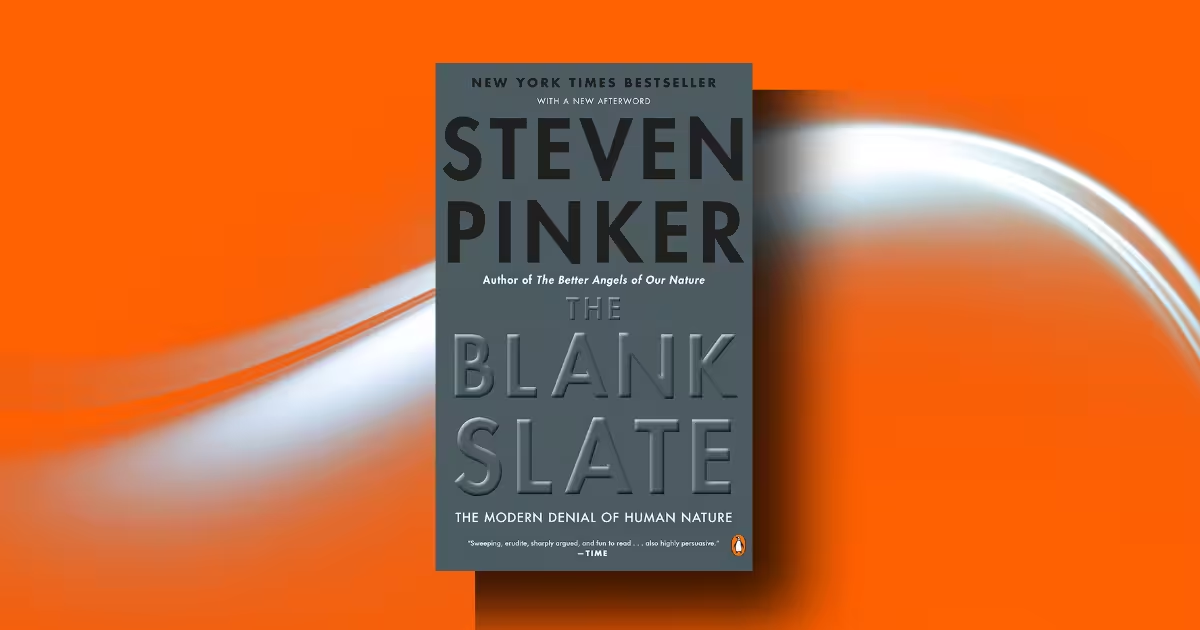
Did you ever wonder why two children raised in the same household by the same parents can turn out so radically different — one disciplined, another impulsive, one empathetic, another aloof? Does the idea that the human mind is nothing more than a blank page, ready to be written on entirely by culture and experience, strike you as too convenient to be true? The Blank Slate by Steven Pinker investigates answers to the questions we all have.
The Blank Slate is best for readers curious about human psychology, philosophy of mind, evolutionary biology, and the politics of science. Anyone who has ever argued about nature vs. nurture, who teaches or raises children, who wonders about gender differences, the roots of violence, or why political attitudes feel so viscerally personal.
Readers of Malcolm Gladwell, Richard Dawkins, Daniel Kahneman, and Jonathan Haidt will find this essential.
The Blank Slate may not be a good read for readers seeking a quick self-help fix, those who prefer light non-fiction, or anyone deeply allergic to science. It is also not for ideologues on either the far left or far right who are looking for their beliefs confirmed wholesale — Pinker makes everyone uncomfortable at some point, and he means to.
Table of Contents
1. Introduction
The Blank Slate: The Modern Denial of Human Nature is a landmark work of popular science and intellectual history by Steven Pinker, first published in 2002 by Viking Penguin and reissued in 2003 as a Penguin paperback. A new edition with an afterword was published in 2016.
The book runs to over 500 pages, is organised into six parts and twenty chapters, includes an appendix of human universals compiled by anthropologist Donald E. Brown, and carries extensive notes and references.
It was a finalist for the Pulitzer Prize and was nominated for the 2003 Aventis Prize.
Steven Pinker, born in 1954, is one of the most celebrated cognitive scientists alive. He was Johnstone Family Professor of Psychology at Harvard University, previously taught at MIT for over two decades, and has received eight honorary doctorates.
His research on vision, language, and social relations has earned prizes from the National Academy of Sciences, the Royal Institution of Great Britain, the Cognitive Neuroscience Society, and the American Psychological Association.
Time magazine named him one of “The 100 Most Influential People in the World.” He is also the author of The Language Instinct (1994), How the Mind Works (1997), The Better Angels of Our Nature (2011), and Enlightenment Now (2018), among others.
Context
The Blank Slate belongs to the genre of popular science and intellectual history — though it is as much a work of philosophy and political analysis as it is of empirical science.
Its subject is the idea of human nature itself: what it is, why it has been so fiercely denied throughout the twentieth century, what science actually tells us about it, and what the moral and political consequences of that denial have been.
Pinker brings his expertise in cognitive science, linguistics, and evolutionary psychology to bear on this question, moving fluently across disciplines — from genetics and neuroscience to literature, art, and political philosophy.
Purpose
The book’s central thesis is audacious in its clarity: the dominant view of human nature in modern intellectual and academic life — the idea that the human mind is essentially a “blank slate,” a structureless entity shaped entirely by culture and experience — is empirically wrong, politically naive, and morally dangerous.
Pinker argues that this doctrine, which he traces to certain strands in Enlightenment philosophy and traces through twentieth-century social science, has distorted research, corrupted public discourse, and done real harm to real people.
In its place, he calls for a scientifically honest reckoning with human nature: one that acknowledges our biological heritage without surrendering our deepest moral commitments to equality, dignity, and freedom.
2. Background
To understand why The Blank Slate provoked the reaction it did — picketed lectures, denunciations in The New York Times, heated exchanges in Congress — one has to understand the intellectual climate Pinker was addressing.
For most of the twentieth century, the social sciences and humanities had largely operated under the assumption that human behaviour, personality, and social organisation were products of culture, upbringing, and social conditions.
The idea that genes, evolution, or biology might play a significant role in shaping the mind — beyond basic physiology — was widely regarded not just as scientifically dubious but morally suspect, associated in many minds with Social Darwinism1, eugenics, and the horrors of Nazi race science.
This made biology feel taboo in the study of human affairs.
Researchers who suggested that IQ might be partly heritable, that men and women might differ psychologically in certain ways, or that aggression might have evolutionary roots were not merely challenged on scientific grounds — they were picketed, shouted down, and in some cases subjected to personal threats.
Pinker opens The Blank Slate by recalling the shocking reception that greeted books like The Bell Curve by Herrnstein and Murray (1994), The Nurture Assumption by Judith Rich Harris (1998), and A Natural History of Rape by Thornhill and Palmer (2000) — all of which were attacked with “searing invective,” not because their arguments were proven wrong, but because they dared to invoke nature alongside nurture.
This, Pinker argues, is a form of intellectual pathology, a cult-like insistence on a dogma that even most mainstream scientists had privately abandoned, but that persisted in public discourse and in the political assumptions of social policy.
3. Summary of The Blank Slate
Part I: The Blank Slate, the Noble Savage, and the Ghost in the Machine
Pinker opens by identifying three doctrines that he argues have functioned as “sacred” articles of modern intellectual faith, even when not explicitly avowed. He calls them the Blank Slate, the Noble Savage, and the Ghost in the Machine.
The Blank Slate — the idea that the human mind has no innate structure and can be “inscribed at will by society or ourselves” — is traced by Pinker to the philosopher John Locke (1632–1704), who proposed that the mind at birth resembles “white paper void of all characters.”
Locke’s empiricism served liberal political goals: if all minds begin equal, then differences in station are not the result of innate inferiority but of unequal experience, which can be changed.
The Blank Slate thus became the intellectual cornerstone of progressive politics, educational reform, and anti-discrimination policy. Pinker is quick to note that these goals are admirable; his quarrel is not with equality but with the factual claim on which it was made to rest.
The Noble Savage — the belief that humans in their natural state are peaceful, cooperative, and virtuous, and that aggression, greed, and war are products of civilisation — is associated with Jean-Jacques Rousseau (1712–1778), though Pinker notes that the phrase itself comes from Dryden’s 1670 play.
The doctrine lives on, Pinker observes, in contemporary reverence for all things “natural,” in romantic notions about indigenous peoples, in the assumption that violence is always a product of social conditions rather than any tendency within human beings themselves.
Archaeological and anthropological evidence, he argues, overwhelmingly refutes it: rates of violent death in pre-state societies were astonishingly high, often accounting for over 25 percent of male deaths.
The Ghost in the Machine — René Descartes’s doctrine that the mind is a non-physical substance, separate from and not reducible to the body — is named with characteristic wit after the philosopher Gilbert Ryle’s famous critique.
The doctrine survives, Pinker argues, in popular resistance to neuroscience, in the intuition that “there must be more to us than electrical and chemical activity in the brain,” in the widespread horror at the idea that human choice and consciousness might be explained in physical terms.
These three doctrines are linked, Pinker argues.
Together they served as a secular religion for twentieth-century intellectuals, granting moral meaning and political authority to a set of factual beliefs that have been steadily undermined by advances in genetics, evolutionary biology, neuroscience, and cognitive science.
The Science: What Research Actually Shows
Pinker marshals an enormous range of evidence to make the positive case for a richer, more complex conception of human nature. Several pillars of evidence are particularly striking.
Twin Studies and Behavioral Genetics. The most direct evidence that genes shape behaviour comes from studies of identical twins raised apart. On a wide range of psychological traits — personality, intelligence, temperament, even political attitudes — identical twins reared in separate homes are far more similar to each other than fraternal twins raised together.
According to Pinker, roughly 50 percent of the variance in many psychological traits is accounted for by genetic differences, while shared home environment accounts for surprisingly little.
As Pinker writes, political attitudes show a correlation coefficient of .62 between identical twins raised apart — a finding that suggests, provocatively, that your personality’s political lean is partly heritable.
Evolutionary Psychology and Human Universals. Anthropologist Donald Brown compiled a list of hundreds of traits found in every human culture ever documented: emotions like fear, anger, grief, and joy; facial expressions that are universally recognisable; social hierarchies, in-group favoritism, kinship systems, reciprocity norms, aesthetics, music, and narrative.
These universals suggest a species-wide psychological architecture that cannot be the product of any particular culture.
Brain Science and Neural Architecture. The brain is not an undifferentiated lump of tissue that can compute anything depending on input.
It consists of specialised circuits — for language, vision, face recognition, social reasoning, fear, and more — that develop largely according to a genetic programme.
Neural plasticity is real and important, but Pinker carefully demolishes the popular “extreme plasticity” hypothesis: the idea that the brain is so plastic that its organisation is essentially determined by experience.
The Genome. When the human genome was sequenced in 2001, commentators rushed to claim that the lower-than-expected gene count (around 34,000) proved that “biological determinism” was impossible. Pinker dismantles this argument with patience and some wit: the roundworm C. elegans has approximately 18,000 genes, consists of exactly 959 cells, and possesses exactly 302 neurons.
The number of genes says nothing about the complexity of the resulting organism. The meaningful measure is not the gene count but the intricacy of how genes interact — and by that measure, the human genome is almost incomprehensibly complex.
Part II: Fear and Loathing
Why, if the evidence for human nature is so compelling, has it been so fiercely resisted?
Pinker’s answer is that the Blank Slate has been recruited to serve political and moral purposes, and the fear is that abandoning it will mean abandoning those purposes. He identifies two principal sources of resistance.
The first comes from the political left, which has long feared that acknowledging innate differences among people — whether between individuals, between the sexes, or between populations — will provide a scientific justification for discrimination, inequality, and oppression.
The second comes from what Pinker calls the “Holy Trinity” of the Blank Slate, Noble Savage, and Ghost in the Machine as cultural and moral touchstones: to challenge them feels to many like an attack on humanity’s dignity, freedom, and moral perfectibility.
Part III: Human Nature with a Human Face
This is, intellectually speaking, the most important section of the book, and the one that has been most misrepresented by critics.
Pinker examines four specific fears that motivate resistance to the idea of human nature, and he argues that all four rest on confused thinking.
The Fear of Inequality. The worry is that if people differ genetically, discrimination might be rational or even justified.
Pinker’s response is emphatic: the case against discrimination is a moral case, not a factual one. Political equality is a principle about how people ought to be treated, not a claim that people are biologically identical.
As he writes: “The case against bigotry is not a factual claim that humans are biologically indistinguishable. It is a moral stance that condemns judging an individual according to the average traits of certain groups to which the individual belongs.”
Moreover, he notes that a Blank Slate could in principle be conditioned to enjoy servitude — so the doctrine provides no stable moral foundation for equality.
The Fear of Imperfectibility. The worry is that if human nature contains selfish or aggressive impulses, moral progress is impossible.
Pinker’s response is that moral progress does not require the human mind to be naturally virtuous — only that it possess other motives capable of counteracting selfish ones. We do not need to be blank slates to become better.
The Fear of Determinism. The worry is that if behaviour is shaped by genes, there is no room for free will, and therefore no basis for moral responsibility. Pinker argues this rests on a confusion: responsibility does not require behaviour to be uncaused, only that it respond to incentives, praise, and blame — which it does.
The Fear of Nihilism. The worry is that if meaning and values are not inscribed in the cosmos but are products of evolved psychology, they are somehow unreal or arbitrary.
Pinker argues that meaning in life does not require the process that shaped the brain to have a purpose — only that the brain itself has purposes. These, he argues, are entirely genuine.
Part IV: Know Thyself
These chapters apply the new understanding of human nature to four domains: perception and cognition, the limits of folk reasoning, the psychological roots of suffering and social conflict, and morality.
The chapter on the “sanctimonious animal” — our species’ remarkable tendency to moral self-righteousness — is particularly illuminating, drawing on evolutionary theory, social psychology, and philosophical ethics to explain why moral arguments so often generate more heat than light.
Part V: Hot Buttons
This is the section that made The Blank Slate notorious in certain circles — five dense, careful chapters on the topics where human nature intersects most explosively with politics.
Politics. Pinker draws on Thomas Sowell’s framework of the “Tragic Vision” and the “Utopian Vision” to explain why political beliefs cluster the way they do.
The Tragic Vision — associated historically with thinkers like Hobbes, Burke, Hayek, and Isaiah Berlin — holds that human beings are limited in knowledge, wisdom, and virtue, and that social arrangements must be designed with those limitations in mind. The Utopian Vision — associated with Rousseau, Godwin, and much of the modern left — holds that human failings are products of unjust social arrangements and can be overcome through reform.
Pinker argues that these visions are not merely political preferences but rival theories of human nature, and that the sciences of mind and behaviour clearly support the Tragic Vision’s more sober assessment.
Violence. Pinker challenges the romantic belief that pre-contact societies were peaceful.
Drawing on archaeological evidence and anthropological data, he argues that rates of violent death were dramatically higher in pre-state societies than in modern states — sometimes accounting for a quarter of all male deaths.
The idea that violence is an entirely modern pathology created by civilisation is empirically untenable.
Gender. This is perhaps the most politically charged chapter.
Pinker reviews the evidence for biological differences between male and female psychology: differences in certain spatial abilities, verbal fluency, risk-taking, and sexual motivation — while being careful to note that these differences are statistical, that the overlap between the sexes is enormous, and that they say nothing about what roles men and women should play in society.
He argues that the feminist goal of equal rights and dignity does not depend on the claim that men and women are psychologically identical.
Children. Pinker credits Judith Rich Harris’s The Nurture Assumption for marshalling evidence that parents have far less influence on their children’s personalities than is commonly believed.
Identical twins raised apart resemble each other more than fraternal twins raised together. Beyond genetic effects, the strongest environmental influences on personality appear to come from peer groups, not parents.
This is deeply counterintuitive and disturbing to many — including many parents — but Pinker argues the evidence is compelling.
The Arts. Pinker makes the controversial argument that the arts — particularly modernism and postmodernism in their more extreme forms — have been distorted by an implicit commitment to the Blank Slate.
If human aesthetic preferences are culturally arbitrary and infinitely malleable, then there is no reason to prefer accessible, representational, or emotionally resonant art over art that deliberately excludes or alienates audiences.
But if the arts evolved in part to engage universal human aesthetic faculties, then there is indeed something to be said for art that actually connects with people.
Part VI: The Voice of the Species
The book closes with a meditation on what the passing of the Blank Slate might mean for our understanding of ourselves.
Pinker argues it should be cause not for despair but for a more honest and ultimately more humane relationship with our own nature. “Man will become better when you show him what he is like,” he quotes Chekhov — and this is, ultimately, the animating conviction behind the entire book.
4. The Blank Slate Highlights / Points at a Glance
Core idea: Steven Pinker argues that the human mind is not a blank slate written entirely by culture, parenting, education, or society. Human beings are shaped by both nature and nurture, but modern intellectual life often denies or minimizes the role of innate human nature.
Main arguments
1. The “Blank Slate” is the belief that humans are born without built-in mental structure.
Pinker challenges the idea that personality, intelligence, gender differences, violence, morality, taste, and social behavior are created only by environment or culture.
2. Pinker rejects genetic determinism.
He does not say genes are everything. He says genes, brain, culture, learning, and environment interact. His target is the extreme claim that culture is everything and biology is almost nothing.
3. The book attacks three big myths:
The Blank Slate: the mind has no innate structure.
The Noble Savage: humans are naturally peaceful and corrupted only by civilization.
The Ghost in the Machine: the mind or soul is separate from the body and brain.
4. Human nature exists, but it does not excuse bad behavior.
Biological roots of violence, jealousy, selfishness, or status-seeking do not make them morally acceptable. “Natural” does not mean “good.”
5. Equality does not require sameness.
One of Pinker’s strongest points is that human rights should not depend on the false idea that all people are psychologically identical. People can differ while still deserving equal dignity, rights, and respect.
6. Parenting matters, but parents do not completely mold children.
Pinker questions the belief that parents can shape every aspect of a child’s personality. Genes, peers, temperament, chance, and wider social context also matter.
7. Culture is real, but culture depends on the human mind.
Pinker does not deny culture. He argues that culture works because humans already have evolved mental capacities for language, imitation, learning, morality, cooperation, competition, art, and social rules.
8. Violence has biological and social roots.
Pinker argues that violence cannot be explained only by poverty, media, or society. Human beings have aggressive impulses, but institutions, law, norms, and self-control can reduce violence.
9. Gender differences are controversial but cannot be dismissed automatically.
Pinker argues that some average differences between men and women may have biological components. However, he also argues that this does not justify sexism or discrimination.
10. The mind is physical, but meaning is not destroyed.
Pinker accepts that thoughts, emotions, and consciousness depend on the brain. But he does not conclude that love, morality, art, or responsibility are meaningless.
Best takeaway
The most important lesson of The Blank Slate is this:
A realistic view of human nature does not weaken morality; it strengthens it.
Pinker’s message is that we should build politics, education, justice, parenting, and ethics on what human beings are actually like—not on what we wish they were like.
5. The Blank Slate Analysis
The Blank Slate is a genuinely groundbreaking book — intellectually courageous, encyclopaedic in its scholarship, and written with a wit and clarity that makes even the most technically demanding material accessible.
It is one of those rare works that genuinely changes the terms of debate, and it has aged remarkably well.
The 2016 afterword shows that Pinker himself regards most of the book’s core claims as having been reinforced rather than challenged by subsequent research.
What makes the book remarkable is not simply the breadth of Pinker’s argument but its moral seriousness.
He is not a crude biological determinist or a conservative ideologue — he is a thoughtful, politically liberal intellectual who is genuinely troubled by the damage that intellectual dishonesty about human nature has done, and continues to do, to social science, public policy, and everyday life.
The chapter on the four fears is, in my view, some of the finest applied philosophy written in the last quarter century. It takes the most serious objections to biological accounts of human nature and dismantles them — not by dismissing the concerns, but by showing that those concerns can be addressed on firmer moral and empirical ground than the Blank Slate provides.
The evaluation of content is also impressive in its honesty.
Pinker does not claim that all psychological traits are equally heritable, or that culture doesn’t matter, or that evolutionary psychology has answers to every question.
He acknowledges uncertainty throughout and presents the scientific picture as a work in progress — which it remains. What he challenges is not the importance of culture but the dogma that culture is everything.
6. Strengths and Weaknesses
Strengths
The sheer scope of The Blank Slate is staggering. In a single volume, Pinker synthesises research from cognitive science, evolutionary psychology, behavioural genetics, neuroscience, anthropology, political philosophy, aesthetics, and moral philosophy.
The result is one of the most genuinely interdisciplinary books written by a scientist in the past fifty years.
His command of the evidence is formidable.
The discussions of twin studies, the human genome, neural plasticity, and evolutionary psychology are models of how to explain complex science for a general audience without sacrificing accuracy. The sections on political philosophy — particularly his analysis of the Tragic and Utopian Visions — are incisive and original.
Pinker is also admirably fair to his opponents. He quotes them at length, steelmans their arguments, and concedes genuine uncertainties. His treatment of the fear of inequality, in particular, is philosophically careful to a degree that his critics often failed to match.
The book is also a pleasure to read. Pinker writes with dry wit, draws on an enormous range of literary and cultural examples, and structures the argument with the kind of propulsive clarity that makes very long books feel quick.
Weaknesses and Criticisms
No serious book is without its critics, and The Blank Slate has attracted legitimate ones.
The most persistent criticism — made by Louis Menand in The New Yorker and by the biologist Patrick Bateson — is that Pinker is sometimes fighting a straw man.
As Bateson argued, the “blank slate” belief that all human characteristics are determined by environment was already a caricature in 2002, and Pinker’s focus on it risks sustaining “a tedious and increasingly irrelevant nature-nurture debate.”
There is something to this: most serious social scientists in 2002 already accepted that genes play some role in behaviour; the debate was really about how much and through what mechanisms.
The chapters on gender and violence, while carefully caveated, have been criticised for presenting contested findings with more confidence than the evidence warrants.
The scientific study of sex differences in cognition, in particular, remains a genuinely active and contested field, and the degree to which observed differences reflect biology versus socialisation is still debated.
There is also a tendency, which critics on the left have noted, for Pinker to be more sympathetic to the political implications of the Tragic Vision than his stated neutrality would suggest.
His critique of the Utopian Vision is sharper and more sustained than his critique of the Tragic Vision’s potential blind spots — particularly its historical association with resistance to progressive reform.
Finally, the chapter on the arts, while provocative, is perhaps the least convincing.
Pinker’s account of aesthetic universals is interesting but sketchy, and his scepticism about modernism has struck many readers as a scientist’s impatience with cultural forms he finds inaccessible rather than a rigorously argued aesthetic position.
7. Similar Works
Readers who found The Blank Slate compelling or challenging will want to read several other major works in the same territory.
E.O. Wilson’s Sociobiology: The New Synthesis (1975) is the book that launched the modern controversy about biology and human behaviour, and whose hostile reception Pinker discusses at some length.
Judith Rich Harris’s The Nurture Assumption (1998) is the work on child development that Pinker most admires and credits as a direct influence on The Blank Slate. Harris argues, with great wit and extensive evidence, that parents matter far less to children’s personalities than is assumed.
Jonathan Haidt’s The Righteous Mind (2012) is a natural companion volume, exploring the evolutionary roots of moral psychology and the basis of political disagreement.
Like Pinker, Haidt argues that our moral intuitions are not arbitrary cultural constructs but have deep roots in human psychology.
Richard Dawkins’s The Selfish Gene (1976) and Daniel Dennett’s Darwin’s Dangerous Idea (1995) both provide essential scientific background to the evolutionary arguments Pinker draws on.
Thomas Sowell’s A Conflict of Visions (1987) — which Pinker explicitly credits — is the most penetrating analysis of the deep intellectual foundations of left-right political disagreement, and is indispensable context for the politics chapter.
Daniel Kahneman’s Thinking, Fast and Slow (2011) complements The Blank Slate by mapping in detail the cognitive architecture of human reasoning — the biases, heuristics, and dual-process structure that Pinker invokes but does not have space to analyse fully.
8. Conclusion
The Blank Slate: The Modern Denial of Human Nature is not a comfortable book. It challenges beliefs held deeply and sincerely by people across the political spectrum.
It tells feminists that acknowledging psychological differences between the sexes is compatible with — indeed, may be necessary for — a serious commitment to gender equality.
It tells progressives that the Blank Slate’s denial of human nature has not protected left-wing politics but has in fact, provided ideological cover for some of history’s most catastrophic experiments in social engineering.
It tells conservatives that evolutionary psychology does not support laissez-faire economics or social Darwinism.
And it tells everyone that intellectual honesty about human nature is not the enemy of moral progress but its most reliable foundation.
Reading this book, I found myself repeatedly unsettled and repeatedly persuaded.
The strength of Pinker’s argument does not lie in any single piece of evidence but in the cumulative weight of converging disciplines all pointing in the same direction: that we are a species with a richly structured, evolved psychology, and that acknowledging this reality is not a retreat from humanism but a deepening of it.
Whether you agree with Pinker or not — and there is plenty to argue with — The Blank Slate is the kind of book that rewards serious engagement. It is impeccably researched, courageously argued, and important.
It belongs on the shelf of anyone who takes seriously the question of what kind of creatures we human beings really are.
Notes
- Social Darwinism, the theory that human groups and races are subject to the same laws of natural selection as Charles Darwin perceived in plants and animals in nature. According to the theory, which was popular in the late 19th and early 20th centuries, the weak were diminished and their cultures delimited while the strong grew in power and cultural influence over the weak. Social Darwinists held that the life of humans in society was a struggle for existence ruled by “survival of the fittest,” a phrase proposed by the British philosopher and scientist Herbert Spencer. ↩︎