
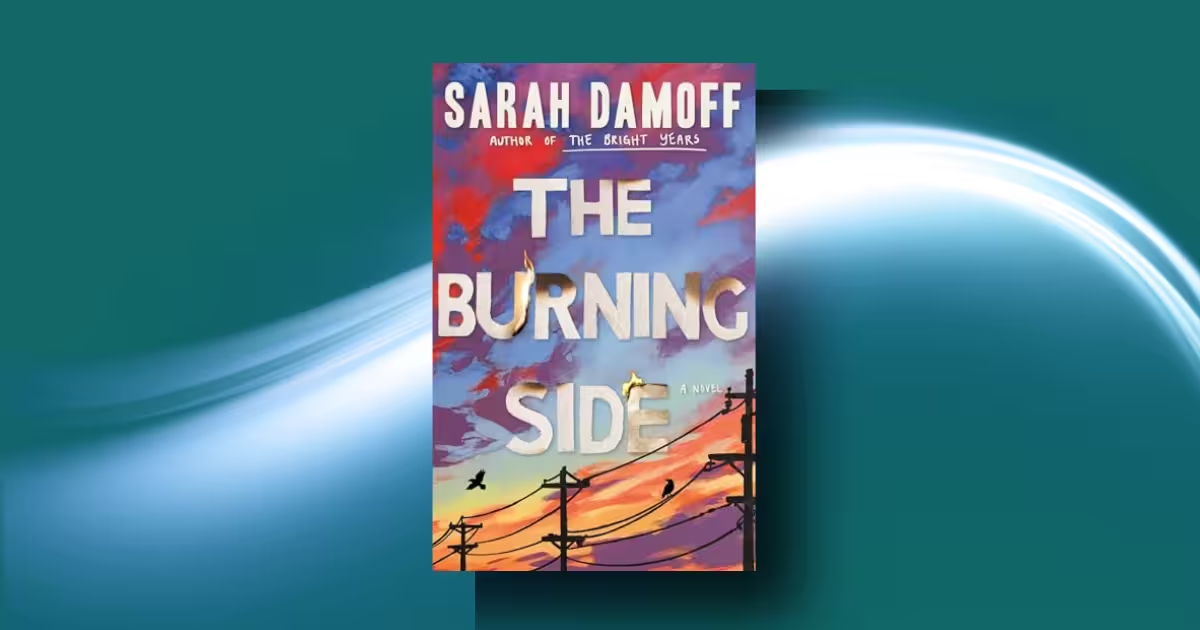

Why do we wait for our physical walls to burn to ash before we finally look into the eyes of the person we once promised to love forever? Sarah Damoff’s The Burning Side is an emotionally piercing domestic saga that uses a devastating house fire as a physical crucible to expose the silent betrayals, maternal exhaustion, and unresolved childhood traumas tearing two generations of a family apart.
The Burning Side is best for devotees of slow-burn, deeply character-driven domestic realism, readers fascinated by the psychological intersection of motherhood burnout and childhood abandonment, and anyone seeking a raw, beautifully written exploration of modern caregiving and Alzheimer’s disease.
Not for thriller enthusiasts looking for a fast-paced arson mystery or readers who prefer lighthearted, clean-cut romances with effortless resolutions.
Table of Contents
1. Introduction
When Sarah Damoff’s second novel, The Burning Side, landed on my desk via Simon & Schuster, I wondered if she could match the lyrical intensity of her celebrated debut, The Bright Years.
Published on May 19, 2026, this 336-page contemporary fiction masterpiece proves that Damoff is not a one-hit wonder. Instead, she has cemented her status as an elite cartographer of the human heart, taking readers on a harrowing journey through the wreckage of a nine-year marriage on the absolute brink of collapse.
2. Background
To truly appreciate the texture of The Burning Side, one must understand the unique lens of its creator. Before turning to long-form fiction, Sarah Damoff worked extensively as a social worker.
Armed with a degree in Family Studies and a prestigious Child Protection Certification from Harvard University, her technical understanding of systemic familial trauma and interpersonal psychology bleeds into every single page.
Set against the distinct cultural backdrop of Dallas, Texas, the novel steps away from traditional plot-driven suspense to explore contemporary themes: the invisible crisis of modern maternal burnout, the multi-generational echoes of parental abandonment, and the devastating societal reality of early-onset Alzheimer’s disease.
Damoff channels these heavy themes not through clinical detachment, but through deeply intimate prose that functions as a mirror for the quiet struggles occurring behind the closed doors of millions of suburban homes.
3. The Burning Side Summary
The Midnight Inferno and the Unspoken Rupture
The narrative ignites on June 10, 2022, with a terrifying physical catastrophe.
The fire does not begin with an explosive roar, but with a quiet, creeping density of smoke sliding through the hallways of April and Leo Torres’s home of nearly a decade. April stumbles out of the front door into the midnight air, clutching her infant son, Otto, in one arm and a single book in her other hand.
Behind her, the house is being consumed by a bright and beautiful terror. Her husband, Leo, a high school history teacher, undergoes a frantic scramble, waking up from the floor of Otto’s bedroom where he had been sleeping for weeks, to pull their young daughter, Sadie, from her bed. Leo busts through the front door just as a deafening crack signals the structural collapse of the building’s front corner.
As firefighters pop windows from their frames and hoses snake across the flower beds, a secondary, far more corrosive truth emerges.
Hours earlier, while April spooned buttered noodles onto plates for the children, Leo had quietly told her that he wanted a divorce. In her subsequent state of shock and emotional paralysis, April had left a burner lit on the kitchen stove.
The physical inferno is a direct manifestation of their smoldering domestic ruin. Standing on the grass, April notes with chilling clarity that while the kitchen side of the house screams in flames, the other side stands unbothered—smug, almost. It is an immediate structural representation of a partnership severed into isolated halves.
The Paradox of the Russo Sanctuary
Left with nothing but the clothes on their backs—Otto’s duck onesie, Sadie’s ruffled nightgown, and April’s beige sweats—the displaced family is forced to evacuate.
They retreat directly to April’s childhood home in Dallas, managed by her spirited, no-nonsense mother, Deb, and her father, Billy Russo.
The Russo household is a swirling environment of energy and life, populated intermittently by April’s adult siblings: Josie, a drama major navigating her own chaotic schedule, and Cameron, a practical young man who brings along his fiancé, Rachel.
To an outside observer, Deb and Billy provide a picture-perfect ideal of stable, middle-class suburban bliss—the exact kind of secure foundational environment that Leo, an immigrant who carved out a life through sheer determination, never experienced.
Yet, this domestic refuge quickly morphs into an emotional pressure cooker. April and Leo are forced to construct shaky masks of unity to avoid alarming the family, hiding the fact that they are sleeping in separate quarters and harbor a cold, agonizing chasm between them.
The intense warmth of the Russo family does not heal the couple’s fractures; instead, it highlights the profound, claustrophobic isolation of their private marital decay.
The 2011 Genesis – Classrooms and Broken Radios
To illuminate the path to this contemporary breakdown, Damoff masterfully folds the timeline back to 2011, detailing the origins of April and Leo’s romance. They met as young educators at Argyle High School.
April, who historically struggled with severe dyslexia, worked as a deeply empathetic tutor, famously challenging her students with classics like The Count of Monte Cristo that other faculty members assumed were far beyond their capabilities. Leo was a passionate history teacher who viewed guiding teens as his ultimate life’s calling.
Their shared devotion to vulnerable students forged an instant, intense intellectual and romantic bond.
Leo, who had started community college with a mere ninety-four dollars, a face full of pimples, and a history of trading alcohol for intense exercise, found a psychological anchor in April.
By 2013, their love culminated in a deeply symbolic proposal: Leo carefully set a dining table with bowls of home-cooked pozole, white taper candles, and a simple engagement ring tucked neatly between the pages of a book.
This structural shift to the past makes the contemporary unraveling of their marriage all the more painful, proving that their relationship did not fail due to a lack of genuine devotion, but rather under the slow weight of unexpressed pain.
The Anatomy of Betrayal and Motherhood Burnout
As the days at the Russo homestead stretch into weeks, the narrative untangles the precise anatomy of their marital collapse. The book reveals that the rift is a complex web of mutual failures and internal crises rather than a simple case of one partner falling out of love.
April is drowning under the crushing, invisible weight of modern motherhood, severe postpartum fatigue, and a profound loss of self-worth.
In her state of total exhaustion, she committed an act of betrayal—a sharp, recent wound that Leo refers to with bitter clarity: “I force myself to remember how she hurt me. So recently. So sharply”.
However, Damoff refuses to let April be the sole villain of the piece. Leo carries deep, unyielding psychological scars from childhood abandonment; as a young boy, his immigrant parents left him behind, imprinting him with a structural inability to trust that any relationship can permanently survive.
His hyper-vigilance, emotional withdrawal, and subtle self-fulfilling prophecies of failure created a domestic environment where April felt entirely unseen.
The novel illustrates how maternal burnout and unresolved childhood trauma feed into each other, creating a silent war of attrition where love is replaced by defensive, icy indifference.
The Parallel Crucible – Deb, Billy, and the Fade of Memory
Simultaneously, the narrative expands through the perspective of Deb Russo, April’s mother, revealing that the “perfect” Russo marriage is itself an illusion built on years of quiet sacrifice.
Deb reveals that her marriage to Billy did not begin with romance; it started under the duress of an unwanted pregnancy and long years of emotional barrenness.
Yet, through daily consistency, showing up, and choosing commitment over convenience, they slowly forged a deep and enduring partnership. This historical contrast provides a profound mirror for April and Leo’s current plight.
But the Russos face a terrifying new crisis: Billy, the gentle giant of the family, is suffering from early-onset Alzheimer’s disease. Deb is caught in a harrowing emotional limbo, noting with devastating clarity that “the anticipation of grief is a grief itself”.
She wrestles with the heartbreaking decision of whether to move Billy into a specialized care facility or watch his identity slowly dissolve within the walls of their family home, noting that identity is deeply entangled with place.
This subplot adds an extraordinary layer of emotional depth, illustrating that every generation must face its own version of a domestic fire.
The Resolution and the Final Ember
The climax and resolution of the novel bring these intersecting lines to an unforgettable head.
As Billy’s cognitive decline accelerates, the family is forced to confront the fluid nature of memory, love, and identity. Watching her father slowly lose his grasp on his own history forces April to stop hiding behind her defensive shield of guilt and self-blame.
Similarly, Leo is forced to see that his hyper-fixation on past abandonment is preventing him from showing up for the family he built.
In a series of raw, tear-filled confrontations amidst the logistical chaos of rebuilding their physical lives, April and Leo finally speak the truths they had buried beneath dinner dishes and children’s routines. The novel concludes not with a magical, flawless reconciliation, but with a tentative, realistic choice to stay.
They realize that their old marriage did indeed die in the kitchen fire, and that it cannot—and should not—be salvaged. Instead, they choose to build something entirely new out of the ashes.
The ending beautifully mirrors Deb’s hard-won wisdom: home is not a static physical structure immune to damage, but an ongoing choice to stand together on the burning side of life, finding redemption not in perfection, but in the brave act of being truly known.
4. The Burning Side Analysis
4.1 Characters
April Torres: The beating, bruised heart of the novel.
April represents the silent crisis of modern women who lose their identities to the all-consuming demands of motherhood and domestic life. Her severe dyslexia serves as an internal metaphor for her struggle to “read” the changing dynamics of her own life and marriage.
Her arc is one of reclaiming her voice and learning that self-preservation is not synonymous with selfishness.
Leonardo “Leo” Torres: A deeply complex, beautifully flawed protagonist. As a high school history teacher, Leo can analyze the macroscopic failures of nations but remains blind to the micro-fractures in his own living room.
His background as an immigrant abandoned by his parents makes his hyper-vigilance both empathetic and tragic. He is a textbook study in how childhood trauma manifests as adults sabotaging their own happiness out of a fear of inevitable loss.
Deb Russo: April’s fierce, five-foot-two mother. Deb provides the grounding moral philosophy of the book. She is the bridge between traditional notions of marital duty and the modern realities of psychological boundaries.
Her internal monologues regarding her husband’s cognitive decline offer some of the most philosophically profound writing in the entire novel.
Billy Russo: The gentle giant whose fading mind becomes the emotional anchor for the entire family. Billy’s steady descent into Alzheimer’s serves as a ticking clock for the narrative, reminding every character that time is finite and memories are a fragile currency.
4.2 The Burning Side Themes and Symbolism
The Psychogeography of the Home: Damoff relies heavily on the physical structure of the house as an explicit extension of the psyche. The house fire is not just a plot device; it is a literal clearing of the slate.
The “burning side” represents the volatile, exposed truths of resentment and betrayal, while the “unbothered side” represents the carefully curated, smug facades families present to the outside world.
Inheritance vs. Choice: A central question echoes throughout the text: Are we doomed to repeat the marital failures and psychological scripts of our parents, or can we consciously choose a different path? Leo inherits abandonment; Deb inherits a loveless early marriage.
Both must learn that true maturity lies in deciding what to carry forward and what to let burn to ash.
The Ache of Being Known: Damoff explores the terrifying vulnerability required to maintain long-term intimacy.
The characters discover that true love hurts far more than indifference, because to be truly known means allowing someone to see the exact places where you are broken.
5. Evaluation
The Burning Side is an outstanding, masterfully crafted examination of domestic wreckage that forces us to look directly into the embers of our own long-term commitments to discover what remains when our illusions are stripped away.
Strengths: Damoff’s greatest triumph is her uncanny ability to capture micro-moments of domestic life with poetic precision.
The sequence where Leo recalls throwing a bag of Sadie’s favorite pretzels into a grocery cart just hours before the fire destroyed them is a devastating look at how ordinary objects become sacred in the wake of sudden loss.
Her dialogue avoids artificial melodrama, opting instead for the heavy, parsing silences that characterize real-world marital strife.
Weaknesses: The middle section of the novel, particularly during the transition into the Russo household, occasionally suffers from pacing slowdowns.
The narrative de-accelerates significantly to accommodate the domestic routines of the large extended family, which may test the patience of readers looking for immediate narrative progression.
Impact: Emotionally, the book left me completely hollowed out yet strangely comforted. The parallel tracking of Billy’s Alzheimer’s disease alongside the death of April and Leo’s early marriage creates a symphonic exploration of grief that lingers long after the final page is turned.
Comparison with Similar Works: The book shares a clear creative DNA with Celeste Ng’s Little Fires Everywhere in its deployment of domestic fire as a structural metaphor, and possesses the rich, multi-perspective family intimacy found in Cynthia D’Aprix Sweeney’s Good Company.
6. Personal Insight with Contemporary Educational Relevance
Reading The Burning Side forced me to look beyond the fictional narrative to examine the silent, systemic pressures facing modern families.
According to the Alzheimer’s Association, millions of individuals are currently living with Alzheimer’s disease, a statistic that underlines the caregiving crisis highlighted by Deb and Billy’s narrative arc.
Furthermore, modern sociological data tracking parental burnout reveals that mothers experience an alarming rate of severe mental exhaustion due to unequal distributions of domestic labor.
Damoff’s background as a social worker allows her fiction to serve as a vital case study for five profound life lessons:
- Trauma is a Silent Copilot: Unresolved childhood wounds do not disappear; they simply masquerade as personality traits or defensive boundaries in adult relationships.
- The Illusion of the Perfect Family: Every seemingly stable domestic facade has its own hidden history of sacrifice, barrenness, and hard-won compromise.
- Anticipatory Grief is Real: Caring for a loved one with a terminal cognitive illness requires navigating a unique, ongoing mourning process that occurs while the person is still physically present.
- Motherhood Requires Structural Support: Maternal burnout is not an individual failure of stamina, but a systemic consequence of a culture that expects women to parent as if they have no careers, and work as if they have no children.
- Rebuilding Demands Total Demolition: Sometimes, a broken relationship cannot be repaired; it must be completely let go so that an entirely new, honest framework can be built from the ground up.
7. The Burning Side Quotable Lines & Passages
“The night their house goes up in flames, April stumbles out the front door with her baby in one arm and a book in the other… Otto points his little finger over her shoulder at the house, yelling unintelligible warnings.”
“But surrounding this inferno, it’s dark. And unlike the kitchen side, the other side of the house stands unbothered. Smug, almost.”
“I force myself to remember how she hurt me. So recently. So sharply. I open my eyes and drop her hand.”
“The anticipation of grief is a grief itself… Identity is so entangled with place. But I have just as many concerns about who I would be while isolated at our house, with Billy becoming increasingly confused and dependent.”
“We live in homes until we leave them, and then they live in us.”
8. Conclusion
Ultimately, The Burning Side is a triumphant, emotionally resonant exploration of family dynamics that firmly establishes Sarah Damoff as a definitive voice in contemporary literary fiction.
It is a book that refuses to offer easy answers, insisting instead that the most beautiful things in life are often the ones we must painstakingly rebuild after a total loss.
I recommend this novel to book clubs, fans of deep psychological realism, and anyone who has ever looked at their own home and wondered what is truly worth saving when everything goes up in smoke.