
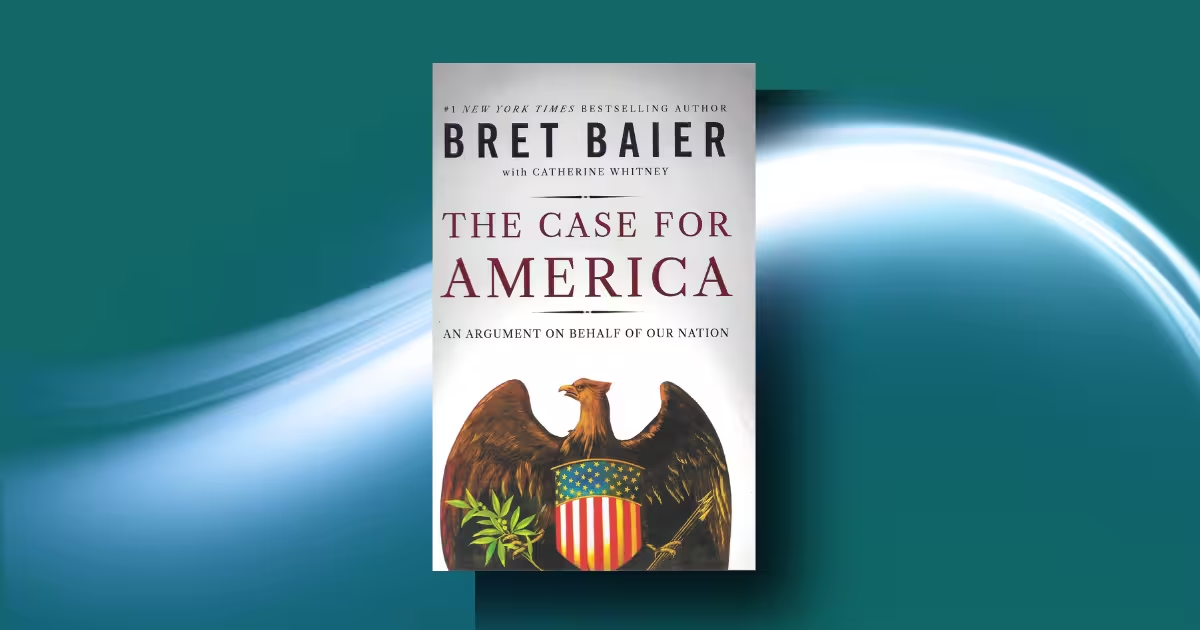
Why does America still matter when so many people feel exhausted by politics, distrust, division, and civic confusion? Bret Baier’s The Case for America matters because it does not ask me to worship America blindly; it asks me to look at the evidence, face the flaws, and still decide whether the American experiment is worth defending.
Best for: readers interested in American history, democracy, civics, patriotism, the Declaration of Independence, America 250, political division, leadership, public service, and the American Dream.
Not for: readers who want a sharply anti-American critique, a purely academic monograph, or a book that treats patriotism as embarrassing. Also, readers looking for a neutral “both-sides-at-equal-distance” textbook may find Baier’s tone openly patriotic, though not uncritical.
Table of Contents
1. Introduction
The Case for America: An Argument on Behalf of Our Nation is a 2026 nonfiction book by Bret Baier, written with Catherine Whitney and published in May 2026 by Mariner Books / HarperCollins.
Baier’s credentials matter here because the book is not written as a detached academic survey. Fox News identifies him as chief political anchor and anchor/executive editor of Special Report with Bret Baier; it also notes that he joined Fox News Channel in 1998 and later covered the White House, the Pentagon, Iraq, Afghanistan, and presidential politics.
The book itself describes him as a chief political anchor, former White House correspondent, former Pentagon-based national security correspondent, Sol Taishoff Award recipient, and author of multiple New York Times bestsellers.
Briefly, The Case for America is a patriotic civic argument written in courtroom form. Baier imagines America “on trial” as it approaches the 250th anniversary of the Declaration of Independence.
However, his central question is simple but heavy: can America still justify itself—historically, morally, politically, and spiritually—at a time when many Americans seem angry with one another and unsure of their own national story?
In other words, The Case for America is not just about America’s past. It is about whether Americans can inherit that past responsibly.
The Case for America’s answer is yes, but not cheaply. Baier rejects two extremes: a history that sees only darkness, and a sanitized patriotism that refuses self-examination. In the introduction, he says the greatest honor one can do the nation is “to tell the truth about it,” and he frames the American story through “life, liberty, and the pursuit of happiness.” That is the book’s moral hinge.
The structure is unusually clear. The contents divide the book into an “Opening Argument,” “Testimony,” “Closing Argument,” and “Verdict.” The major chapters move from the Declaration of Independence to unity, freedom, resilience, opportunity, civics, the American Dream, and finally Baier’s verdict on the American case.
This makes The Case for America useful for readers who want an accessible civic roadmap rather than a narrow political polemic.
2. Background
Initially, it may seem that another book defending America is unnecessary. America has had countless patriotic histories, presidential biographies, Fourth of July speeches, and civics textbooks. Yet The Case for America arrives at a specific cultural moment: the approach to America’s 250th anniversary in 2026.
The timing matters. Baier’s premise is that celebration alone is not enough. A birthday can become empty pageantry if the celebrants no longer understand what they are celebrating. Accordingly, the book treats America 250 not merely as a commemorative date, but as a civic examination.
The National Archives’ transcription of the Declaration of Independence begins with “In Congress, July 4, 1776,” and preserves the language that governments derive “their just powers from the consent of the governed.”
Baier builds his book around that inheritance. He argues that the Declaration was not just a political break with Britain; it was the beginning of a moral vocabulary that later generations would fight to expand.
This leads to the book’s strongest thematic move: Baier does not say America has always lived up to its ideals. In contrast, he says America’s greatness lies in the recurring struggle to return to those ideals after failure. That is why the book’s tone is hopeful but not naïve.
The civic background is also urgent because Americans’ civic knowledge remains uneven. A 2024 Guardian report citing the Annenberg Constitution Day Civics Survey said 65% of Americans could name all three branches of government, 15% could name none, and one in five could not name a single First Amendment right.
That statistic supports Baier’s concern that civics is not a decorative subject; it is the operating manual of self-government.
3. The Case for America Summary
The opening argument: America begins with a declaration, not a victory
Baier starts with a deceptively simple question: why do Americans treat July 4, 1776, as the country’s beginning? The war was not won then. The Constitution had not yet been ratified. George Washington had not yet been inaugurated. Yet Baier argues that the Declaration matters because it gave America its first shared moral identity.
The National Archives preserves the Declaration’s core claim: all men are created equal, rights are unalienable, and governments exist to secure those rights. Baier’s point is that America began as an assertion before it became an institution. The country was born in language before it was secured by law.
This is why the first chapter spends so much time in Philadelphia in June and July 1776. The Founders were not marble statues. They were frightened, divided, overheated, argumentative men risking their lives against the most powerful empire of the age. Baier emphasizes the uncertainty of the moment: reconciliation or independence, submission or war, caution or treason.
A major trait of The Case for America is that Baier keeps returning to the cost of belief. The Declaration is not treated as a museum object. It is treated as a wager. The signers did not know the ending. That makes the founding more impressive, not less.
250 years later: democracy is messy, diverse, and young
Next, Baier turns from 1776 to 2026. The second chapter argues that America at 250 is still strong but deeply restless. He presents three core understandings: democracy is messy, America is diverse, and America is young.
This is one of the book’s most useful interpretive frames. Traditionally, patriotic writing can become too polished; it can make democracy sound harmonious. Baier does the opposite. He insists that democratic conflict is not proof of failure by itself. Generally, free societies argue because they are free.
The Case for America’s idea of diversity is also not merely demographic. It is historical, regional, cultural, religious, ideological, and experiential. Condoleezza Rice becomes a crucial witness here. Baier uses her life story—from segregated Birmingham to secretary of state sworn in by Ruth Bader Ginsburg—as evidence that America’s case is not perfection but striving.
This is where I felt the book’s emotional force most clearly. Baier’s America is not innocent. It is aspirational. That distinction saves the book from becoming simplistic.
Testimony one: America chooses unity despite dissent
The first major testimony chapter is about unity. Notably, Baier does not define unity as agreement. He defines it as the ability to remain one people while disagreeing fiercely.
Lincoln is the central figure. The chapter begins with March 4, 1865, Lincoln’s second inauguration, when the Civil War was nearing its end. Baier uses Lincoln’s humility, humor, and refusal of vengeance to show that unity requires moral discipline.
The chapter then moves into modern examples: Baier’s Common Ground podcast, bipartisan legislation, Washington’s warning against excessive partisanship, the Hatch-Kennedy partnership, Reagan and Tip O’Neill, Joe Lieberman’s “Kosher-Cajun Caucus,”
Arthur Brooks on contempt, Tim Shriver on dignity, Robert F. Kennedy’s Indianapolis speech after Martin Luther King Jr.’s assassination, and Governor Spencer Cox’s “Disagree Better” approach.
The statistical detail that stands out is Baier’s reference to GovTrack’s analysis of fifty-six bills passed in Congress in 2024, with two-thirds passing with bipartisan support; he specifies thirty-three as “very bipartisan” and sixteen as “slightly bipartisan.” Whether a reader agrees with Baier’s optimism or not, this example supports his argument that the public sees more conflict than cooperation because conflict is louder.
Nevertheless, a weakness appears here too. Baier is persuasive when he gives stories of personal friendship across party lines. Yet the book sometimes underplays structural incentives that reward polarization: gerrymandering, fundraising ecosystems, social media outrage loops, primary-election dynamics, and cable-news economics. He mentions social media and contempt, but the argument is more moral than institutional.
Testimony two: America is a beacon of freedom
The freedom chapter is one of the book’s strongest because it connects 1776 to World War II, the Cold War, journalism, and contemporary geopolitics. Baier moves from D-Day to Franklin Roosevelt’s Four Freedoms, Patrick Henry’s “liberty or death” spirit, Reagan’s anti-Soviet freedom rhetoric, Ukraine, and freedom of the press.
Importantly, Baier treats freedom as both personal and public. Freedom of speech, religion, press, assembly, due process, elections, and peaceful transfers of power are not abstractions. They are habits and protections that allow people to live without fearing the state as master.
His discussion of the press is especially interesting because it is personal. Baier remembers seeing White House reporters shout questions in the Rose Garden when he was a teenager and initially thinking they were rude. Later, as a White House correspondent himself, he understood the function of that pressure.
This chapter is also where Baier’s professional life gives the book texture. A historian could summarize freedom; a working journalist can describe the discomfort of it. In fact, the discomfort is the point. A free press is not always polite, but it is indispensable.
Testimony three: America has the gift of resilience
The resilience chapter argues that America’s history is not a smooth upward line. Instead, it is a pattern of trauma, error, recovery, and renewal. Baier’s examples include the Great Depression, Pearl Harbor, World War II, 9/11, the COVID pandemic, and other national crises.
The emotional center is the Greatest Generation. Baier shows how the children of Depression hardship became the soldiers and builders of the postwar world. He uses figures such as presidents, veterans, and ordinary families to demonstrate how suffering was converted into duty.
This leads to one of the book’s broader philosophical claims: adversity does not automatically ennoble a nation, but it can reveal and strengthen civic character. In other words, resilience is not denial. It is the willingness to keep building after devastation.
Yet this chapter can feel selective. Baier’s emphasis on resilience is inspiring, but the language of “we came through” can occasionally pass too quickly over those who bore disproportionate costs—enslaved people, Native Americans, Japanese Americans interned during World War II, working-class communities harmed by deindustrialization, and families permanently damaged by war.
To his credit, Baier does acknowledge shameful chapters and national mistakes, but his book’s forward momentum sometimes gives less space to unresolved wounds than a more critical history would.
Testimony four: America is the land of opportunity
Baier’s opportunity chapter expands the American Dream beyond simple wealth. It includes work, innovation, entrepreneurship, immigration, education, family, dignity, and the possibility of self-making.
The immigration section is one of the most informative parts of the book.
Baier discusses different immigration waves, including the 1880–1917 period, Ellis Island from 1892 to 1954, the Immigration and Nationality Act of 1965, and modern immigration debates. He also highlights innovators with immigrant roots, from Levi Strauss and Boeing to Google, Yahoo, eBay, Tesla/X, and PayPal-linked founders.
Steve Case, cofounder of America Online, becomes Baier’s major witness for opportunity and innovation. Case’s story is useful because it turns the American Dream away from nostalgia and toward technology.
When AOL began in 1985, Case says only 3% of Americans were online; Baier uses that fact to show how quickly possibility can become infrastructure.
In contrast, Baier does not ignore economic anxiety. He discusses doubts over whether younger generations will be better off than their parents and points to factors such as the pandemic, student loans, cost of living, and housing. E
xternal polling supports the complexity: a 2025 AP-NORC poll found about 6 in 10 teens viewed graduating from college as extremely or very important, while about 7 in 10 believed homeownership had become harder for their generation than for their parents.
This is where the book becomes most relevant to younger readers. The American Dream is no longer simply a house, a stable job, and a pension. Increasingly, it includes flexibility, meaningful work, dignity, mobility, and control over one’s life. Baier sees this shift but still grounds opportunity in freedom.
Testimony five: America strives for a civic ideal
The civics chapter may be the quiet heart of the book. Baier argues that citizenship is not merely legal status or sentimental pride. It is knowledge, participation, responsibility, and virtue.
The chapter begins with Baier’s memory of the 1976 Bicentennial, then moves toward civic virtue, patriotism, education, law, courts, and public service. Justice Anthony Kennedy becomes a major voice. Kennedy argues that young people should learn liberty, democracy, the value of being American, and history from early grades, not as an afterthought.
This is one of Baier’s best arguments because it avoids empty nostalgia. He is not simply saying, “People used to love America more.” He is saying people cannot responsibly love, criticize, preserve, or reform what they do not understand.
In truth, civics is where patriotism becomes practical. A person can wave a flag and still misunderstand the Constitution. A person can criticize America and still be performing a patriotic duty. Baier’s better insight is that real civic life requires both attachment and knowledge.
Closing argument: The American Dream 2026
The closing argument revisits the American Dream. Baier traces the idea to James Truslow Adams’s The Epic of America in 1931, during the Great Depression, and emphasizes that the dream was never only about cars, wages, or money.
For Baier, the American Dream is a composite: unity, freedom, resilience, opportunity, dignity, meaningful work, family, friends, and public virtue. This broader definition is one of the book’s most important contributions. It prevents the American Dream from shrinking into consumerism.
Baier’s conversation with Condoleezza Rice adds an important criticism: opportunity is not real if education fails poor children. Rice worries that the education system has not kept pace with a more sophisticated economy and argues that a child’s zip code should not determine educational destiny.
This is where Baier’s patriotism becomes more demanding. It is easy to say America is the land of opportunity. It is harder to ask whether every child has a fair route to that opportunity.
Verdict: Has the case for America been made?
In the final verdict, Baier says the case has been made. His reasons are fourfold: America is unique; America remains young through opportunity and innovation; America has the courage to change; and American freedom creates vigilance through speech, press, and civic participation.
The final claim is not that America is flawless. It is that America contains within itself the tools of repair. Freedom allows criticism. Democracy allows correction. Civic memory allows renewal. Opportunity allows reinvention. That is the book’s deepest thesis.
4. Analysis: My Opinion on The Case for America
The Case for America is a moving, accessible, and unapologetically hopeful civic defense of the United States. It is not groundbreaking as political theory, but it is poignant as public argument: it reminds readers that patriotism can be serious, informed, humble, and morally demanding.
What I liked most is that Baier does not treat love of country as childish. In modern discourse, especially online, patriotism is often flattened into either propaganda or cringe sentimentality.
Baier offers a more mature version. He says, in effect: love the country enough to tell the truth about it; tell the truth enough to preserve it; preserve it enough to improve it.
The courtroom structure works well. The “Opening Argument” gives us the Declaration; the “Testimony” chapters bring witnesses; the “Closing Argument” asks what the American Dream means now; the “Verdict” tells us whether the evidence holds. Because of this structure, the book feels teachable. A teacher could assign chapters on freedom, unity, civics, or opportunity separately. A book club could debate whether Baier’s witnesses are representative enough.
A politically mixed family could use the book as a safer way to talk about America without starting with party labels.
However, the book’s strength is also its limitation. Baier is a patriotic advocate. He is not pretending to be a prosecutor of America. Consequently, the evidence is selected to make a case. That does not make it dishonest, but it means readers should recognize the genre. This is an argument on behalf of the nation, not a comprehensive indictment of its failures.
Still, I found the book valuable because the best passages do not say “America is great because we say so.” They say America is worth defending because it has built mechanisms for self-correction. That is a deeper and more durable claim.
5. Evaluation of Content: Does Baier Support His Argument?
Baier supports his argument through three methods: historical narrative, contemporary interviews, and symbolic case studies.
First, the historical narrative is strong when it deals with familiar national turning points: the Declaration, the Civil War, D-Day, the Great Depression, immigration, the Cold War, 9/11, and the presidency. These examples are accessible and emotionally resonant.
Second, the contemporary interviews add freshness. Instead of relying only on dead presidents, Baier brings in Condoleezza Rice, Douglas Brinkley, Arthur Brooks, Steve Case, Brit Hume, Justice Anthony Kennedy, Tim Shriver, and others. He acknowledges this collaborative method in the acknowledgments, naming a wide range of contributors whose reflections shaped the book.
Third, the case-study approach makes the book readable. Hatch and Kennedy represent bipartisan friendship. Steve Case represents innovation. Condoleezza Rice represents striving. Anthony Kennedy represents civic education. Lincoln represents healing. D-Day veterans represent sacrifice. The Declaration represents founding ideals.
Does the book fulfill its stated purpose?
Yes, mostly. It makes a persuasive “case for America” as a living experiment grounded in freedom, civic repair, and generational responsibility. It contributes meaningfully not by uncovering unknown archival material, but by assembling a usable civic story for readers who feel politically tired.
Nevertheless, readers seeking more sustained engagement with systemic injustice may find the book too optimistic. Baier acknowledges slavery, segregation, internment, economic exclusion, and political division, but he usually returns quickly to resilience. That is consistent with his purpose, but it can leave some harder questions underdeveloped.
6. Strengths and Weaknesses
Strengths
The first strength is clarity. The structure is clean, memorable: Declaration, unity, freedom, resilience, opportunity, civics, American Dream, verdict.
The second strength is emotional balance. Baier’s book is hopeful without being entirely sentimental. He knows the country is troubled, but he does not confuse trouble with collapse.
The third strength is civic usefulness. The book can help readers understand why the Declaration still matters, why dissent is not disloyalty, why freedom requires vigilance, and why civics education is not optional.
The fourth strength is voice. Baier writes as a journalist, father, interviewer, and reader of history. That combination gives the book warmth.
Weaknesses
The first weakness is selection bias. Because Baier is making a defense, the witnesses generally support the verdict. A more adversarial book would include stronger counter-witnesses.
The second weakness is institutional under-analysis. The book is excellent on virtue, character, and civic spirit, but less detailed on structural causes of polarization and inequality.
The third weakness is that some readers may want more space for Native American history, racial injustice, labor history, and foreign-policy mistakes. Those issues appear, but they are not the book’s center of gravity.
The fourth weakness is tone. Readers allergic to patriotic language may bounce early. Yet for readers open to a serious defense of national ideals, that tone is the point.
7. Comparison with Similar Books
The Case for America sits beside several books in Baier’s own American reading ecosystem. The book’s reading list includes James Truslow Adams’s The Epic of America, Doris Kearns Goodwin’s Team of Rivals, Arthur C. Brooks’s Love Your Enemies, David Rubenstein’s The American Experiment, Steve Case’s The Rise of the Rest, and Jeffrey Rosen’s The Pursuit of Happiness.
Compared with Team of Rivals, Baier’s book is broader but less deep. Goodwin focuses intensely on Lincoln’s leadership circle; Baier uses Lincoln as one witness among many.
Compared with Love Your Enemies, Baier is more historical and national; Brooks is more psychological and moral, especially on contempt and disagreement.
Compared with The American Experiment, Baier is more personal and argumentative. Rubenstein’s work is more dialogic; Baier’s is more like a closing statement to a jury.
Compared with The Epic of America, Baier inherits the American Dream tradition but updates it for 2026: innovation, immigration, social media, civic literacy, education, and generational anxiety.
In short, The Case for America is best understood as a civic-patriotic synthesis rather than a specialist history.
8. Conclusion
I recommend The Case for America to general readers, teachers, students, book clubs, politically exhausted families, and anyone interested in America 250. It is especially useful for readers who want to defend America without denying its failures.
The book is not perfect, and it should not be the only book one reads about American history. But as a civic review of American ideals—unity, freedom, resilience, opportunity, civics, and the American Dream—it is thoughtful, readable, and emotionally effective.
Ultimately, Baier’s strongest message is that America is not defended by nostalgia alone. It is defended by memory, honesty, participation, courage, and the willingness to keep striving. For this reason, The Case for America is not just a book about the past. It is a book about what kind of citizens readers want to become.







