
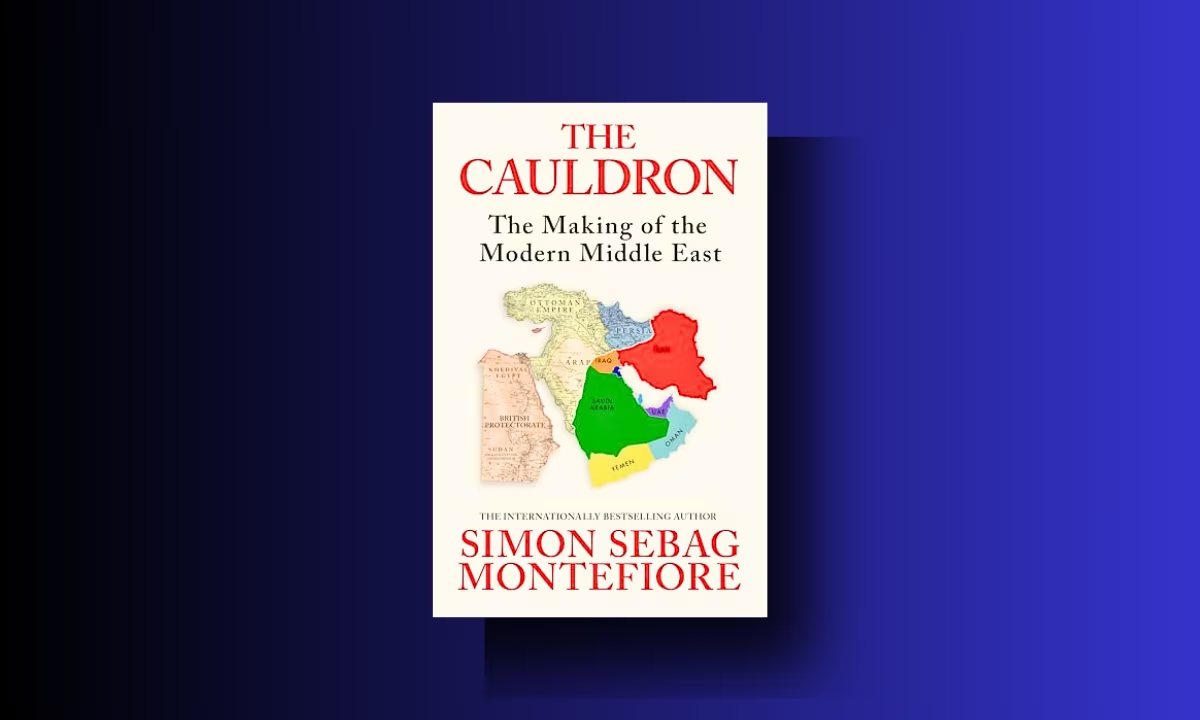

The Cauldron: The Making of the Modern Middle East by Simon Sebag Montefiore is a sweeping narrative history covering 1900 to 2026 across nineteen states. The book argues that the Middle East’s volatility stems from its geography as a tri-continental bridge, its role as the birthplace of three Abrahamic religions, and its oil reserves that made it a perpetual prize for empires.
Montefiore traces four distinct phases: the fall of the Ottoman Empire (1900-1918), the Mandate era (1918-1945), the age of independent states and pan-Arabism (1945-1979), and the era of revolutionary Islamism and American unipolarity (1979-2026).
The central thesis holds that the 1979 Iranian Revolution was as world-changing as 1789 or 1917, and that the region’s future will be shaped by the contest between the radical Islamism of Tehran and the liberal Islam of the Gulf monarchies.
Who will love this book: Readers who want a single-volume narrative that connects the Armenian genocide to October 7, the Balfour Declaration to the Abraham Accords, and Nasser’s rise to Khamenei’s fall. It suits general readers who enjoy narrative history in the style of Barbara Tuchman or Antony Beevor, as well as students and journalists seeking a comprehensive framework.
Who might bounce: Specialists looking for deep archival footnotes may find the pace too brisk, and readers seeking a purely academic tone will find Montefiore’s approach more journalistic than scholarly. Those uncomfortable with graphic descriptions of violence should be warned.
Table of Contents
Introduction: What Is The Cauldron Actually About?
The Cauldron: The Making of the Modern Middle East by Simon Sebag Montefiore was published by Alfred A. Knopf in 2026. Montefiore is the bestselling author of Jerusalem: The Biography and The Romanovs: 1613-1918, and his credentials as a narrative historian of empires are well established.
This book represents his most ambitious project: a single-volume history of the entire Middle East from Morocco to Iran, spanning 126 years and nineteen countries.
The central argument, stated clearly in the introduction, is that the Middle East’s particular volatility results from what Montefiore calls its “tri-continental location as bridge and seaway, thoroughfare and crossroads” which makes it “unavoidable for every local power that aspires to intercontinental influence and every planetary hegemon that seeks multi-domain power”.
The region is not uniquely violent because of Islam or Arab culture, he argues, but because of geography, resources, and the perpetual competition of external empires.
Montefiore structures The Cauldron in four acts. Act One covers the Ottoman Empire’s collapse and the First World War. Act Two examines the Mandate period and the Second World War.
Act Three traces independence and the Nasser era. Act Four brings the story to the present with revolutionary Islamism, the Arab Spring, and the October 7 Wars.
The Cauldron concludes with a meditation on whether the “Middle East” as a concept has outlived its usefulness, proposing that the region is now part of a wider “Greater Middle East” stretching from Africa to Central Asia.
The Cauldron Summary
Part One: The Empire That Fell – Ottomans, Arabs, and the First World War
How did the Ottoman Empire lose the Middle East?
The Ottoman Empire entered the twentieth century as the dominant power from the Balkans to Yemen. Sultan-Caliph Abdulhamid II, described by Montefiore as “a part-time carpenter and operatic lyricist, theatrical impresario and Sherlock Holmes fan,” ruled an empire of 18 million people, of whom 13 million were Muslims.
His rule combined modernization with brutal repression, particularly against Armenians, whose massacres in the 1890s earned him the nickname “the Bloody Sultan”.
The Young Turk Revolution of 1908 initially promised liberal reform. Instead, as Montefiore writes, “a darker era was opening”. The Committee of Union and Progress, led by Talaat, Enver, and Jemal, embraced “ultra-nationalism and Social Darwinism, which argued that the strong, martial Turkish race was engaged in a purifying war with weaker, parasitic ethnicities who had to be destroyed”.
The First World War provided the opportunity. In 1915, the Three Pashas ordered the Armenian genocide, killing approximately 1.1 million people. Montefiore quotes Talaat’s infamous declaration to the German ambassador: “The Armenian Question no longer exists”.
The same period saw mass starvation deliberately imposed on Mount Lebanon, killing 200,000 Maronite Christians in what became known as the Kafno.
What promises did Britain make during World War One?
The war transformed the Middle East through a tangle of contradictory British promises. The Hussein-McMahon correspondence of 1915-16 promised Sharif Hussein of Mecca an Arab empire.
The Sykes-Picot-Sazonov agreement of 1916 divided the Ottoman provinces between Britain, France, and Russia. The Balfour Declaration of November 1917 promised “a national home for the Jewish people” in Palestine.
Montefiore argues these promises were not simply perfidy.
They reflected “a particular circumstance in the moment of their promulgation, as the Russian front collapsed in the east and a grinding bloodbath took place at Passchendaele on the Western Front”. The British needed Jewish support to keep America and Russia in the war. They also wanted to outflank French ambitions in the Levant.
The actual carve-up happened at San Remo in April 1920, not at Sykes-Picot. France received a Mandate for Greater Syria, Britain for Mesopotamia and Palestine. As Montefiore writes: “It was this astonishing creation of a new Middle East, organised at San Remo and Sevres, not the notorious Sykes-Picot-Sazonov, that formed the region that we know today”.
Part Two: The Mandate Era and the Making of New States
How did Britain create Iraq and Jordan?
Winston Churchill, as colonial secretary in 1921, convened what he called his “Forty Thieves” at the Semiramis Hotel in Cairo to settle the Middle East.
The Hashemite Prince Faisal was offered the throne of Iraq, his brother Abdullah given Transjordan. Gertrude Bell, the remarkable Arabist who helped design the new state, wrote of the Iraqi officer Nuri al-Said: “Everyone holds Nuri to be an imp of mischief… of all the people from the king downwards there is no one I love as I love Nuri”.
Iraq was “a fragile, fissile creation, dominated by perennial potentates… and characterised by royal meddling, personal rivalries, sectarian feuding and hatred for British hegemony”. King Faisal I himself warned: “It is my belief there are no Iraqi people in Iraq… only diverse groups with no patriotic sentiments”.
What happened in Palestine during the Mandate?
The 1929 Hebron massacre killed sixty Jews, many of them ancient community members who had lived in Palestine for centuries.
Montefiore describes the violence with characteristic detail: victims were “often beheaded or mutilated, with some of the women raped first,” though he notes that “over 400 Jews in Hebron were sheltered and saved by the kindness of Arab neighbours”.
The Arab Revolt of 1936-1939 was crushed by British forces under General Montgomery, who declared: “I’ll be sorry to leave Palestine as I’ve enjoyed the war out here”. The mufti of Jerusalem, Amin al-Husseini, allied with Nazi Germany, meeting Hitler in Berlin in 1941. Hitler told him that “Germany’s objective would be the extermination of the Jewish presence in the Arab sphere”.
The White Paper of 1939 reversed the Balfour Declaration, promising an independent Palestinian state within ten years and no Jewish state. Montefiore notes this was a missed opportunity: “Had Husseini cooperated with Churchill’s Legislative Council, it would probably have led to an independent Palestine since the Arabs would have possessed an instant majority”.
Instead, the mufti rejected the offer, and the path to partition and war was set.
Part Three: Independence, Nasser, and the Arab-Israeli Wars
Who was the greatest Arab leader of the twentieth century?
Montefiore argues that alongside King Abdulaziz of Saudi Arabia, Gamal Abdel Nasser was “the greatest Arab leader of the century”.
Nasser’s coup in 1952 ended the monarchy and the old pasha class. His nationalization of the Suez Canal in 1956 was a triumph over the imperial powers.
He was wounded in Palestine in 1948 and later said: “As I lay in hospital I wondered if I had been spared to achieve some special purpose; it was crystal clear that the real battle was in Egypt”.
But Nasser’s rule was also despotic. He created the Mukhabarat state, arrested thousands of Muslim Brothers, and ordered the planting of bombs to justify crackdowns. His security chief Abdel Hakim Amer became a rival who eventually died in suspicious circumstances after the 1967 defeat.
Montefiore quotes Nasser’s own admission: “I want to press one button so that Egypt moves forward… and another so that Egypt moves backward”.
What caused the Six-Day War of 1967?
The war resulted from “a crisis slide that neither Israel nor her enemies were able to control,” according to historian Avi Shlaim, quoted by Montefiore. Nasser closed the Straits of Tiran on May 22, 1967, making war “100 per cent certain” as he told Amer. Israel launched a preemptive strike on June 5, destroying 388 Egyptian aircraft on the ground. The war ended with Israel controlling the West Bank, Gaza, Sinai, and the Golan Heights.
Montefiore is particularly good on the human cost. After the defeat, Nasser told King Hussein: “We’ve been purely and simply crushed by the enemy”. Sadat later wrote that Nasser “did not die in 1970 but on 5 June 1967… That was how he looked… a live corpse”.
Part Four: Islamist Revolution and American Hegemony
How did the 1979 Iranian Revolution change everything?
Montefiore identifies 1979 as an epochal year comparable to 1789 and 1917. Ayatollah Khomeini, who appeared to Western observers as a “medieval fanatic,” was actually “the future”. His revolution combined Shiite messianism with anti-imperialist ideology and created a template for Islamist movements across the region.
The shah’s fall resulted from a series of unforced errors. His half-hearted liberalization in 1977-78 opened space for opposition without satisfying demands for change. Montefiore quotes the shah’s court minister Alam: “We claim to have brought Iran to a Great Civilisation but… we can’t even guarantee water in the capital”. When the shah left Iran in January 1979, he “refused to allow the monarchy to be besmirched with blood, while Khomeini craved as many martyrs as possible”.
Khomeini’s reign of terror killed over 100,000 Iranians. His henchman Sadegh Khalkhali boasted: “I killed over 500 criminals close to the royal family… I feel no regret”. The revolution also inspired Sunni Islamists, from the Muslim Brotherhood to al-Qaeda.
How did Saddam Hussein rise to power?
Saddam Hussein attempted to assassinate President Qasim in 1959, escaping on foot through Syria to Egypt. In Cairo he “received an allowance from Egyptian intelligence while studying and hanging out in the Indiana Café, where he occasionally became involved in knife fights”. He became president in July 1979 after forcing his cousin Bakr to retire.
Montefiore describes Saddam as “a second-rate Nasser who aspired to be the great Arab leader of his generation”. His invasion of Iran in 1980 aimed to seize oilfields and Arab lands. Instead, it led to eight years of war and 700,000 deaths.
His use of chemical weapons against Kurds in the Anfal campaign killed 180,000 people. His cousin Ali Hassan al-Majid earned the nickname “Chemical Ali”.
The 1980s and 1990s: Lebanon, Intifada, and Peace Attempts
How was Hezbollah created?
Iranian Revolutionary Guard officers arrived in Lebanon’s Bekaa Valley in 1982 to train Shiite militias. Imad Mughniyeh, who had been an Arafat bodyguard, became Hezbollah’s military operations chief.
The bombing of the US Marine barracks in Beirut in October 1983 killed 241 Americans. Montefiore quotes a witness who saw the truck driver “was smiling as he drove past” and Hezbollah’s boast: “We are the soldiers of god, and we are fond of death”.
What was the Intifada?
The First Intifada began in December 1987 after an Israeli truck killed four Palestinians in Gaza. Sheikh Ahmed Yassin, a paraplegic teacher, founded Hamas, whose charter fused Islamism with European antisemitism, claiming “the Zionists aspire to expand from the Nile to the Euphrates… Their plan is embodied in The Protocols of the Elders of Zion“.
The Oslo Accords of 1993 brought Rabin and Arafat together at the White House, but Rabin’s assassination in 1995 by a Jewish extremist and Hamas suicide bombings undermined the peace.
The Twenty-First Century: 9/11, Iraq, and the Arab Spring
How did 9/11 change the Middle East?
The al-Qaeda attacks on September 11, 2001 killed 2,977 people. President Bush declared a “War on Terror” and invaded Afghanistan. The invasion of Iraq in 2003, based on false intelligence about weapons of mass destruction, destroyed the Iraqi state.
Paul Bremer’s de-Baathification order “instantly converted the entire Sunni establishment (150,000 people) into unemployed and discontented rebels”.
Montefiore quotes Bremer’s own emails: “I am now officially the government of Iraq” and “We are not ready for empire”. The insurgency that followed killed 150,000 Iraqis.
Qasem Soleimani, commander of Iran’s Quds Force, boasted: “You should know that I, Qasem Soleimani, control the policy of Iran for Iraq, and also for Syria, Lebanon, Gaza and Afghanistan”.
What caused the Arab Spring?
The self-immolation of Mohamed Bouazizi in Tunisia in December 2010 sparked protests that toppled dictators in Tunisia, Egypt, Libya, and Yemen. In Egypt, the Battle of the Camel on February 2, 2011, when pro-Mubarak thugs on horses and camels attacked protesters in Tahrir Square, “emboldened the protesters” and sealed the regime’s fate.
But the revolution’s promise faded. In Egypt, General el-Sisi overthrew the elected Muslim Brotherhood president Morsi in 2013, killing 900 protesters and arresting 20,000.
In Syria, Assad’s crackdown on peaceful protests led to a civil war that killed 600,000 people. ISIS emerged from the chaos, declaring a caliphate in 2014. The group’s genocide against Yazidis killed 12,000 and enslaved 6,000 women.
The October 7 Wars and the Third Gulf War
What happened on October 7, 2023?
Hamas launched a surprise invasion of Israel, killing 1,139 people and taking 251 hostages. Montefiore describes the attack in harrowing detail: “The attackers killed 1,139 people, mostly civilians (including 38 children). There were many cases of rape as well as mutilation and the parading of dead bodies through ecstatic crowds”.
The Israeli response was the largest war in its history. Gaza was devastated: “Israel announced 25,000 Hamas militants had been killed; Hamas declared a total of 70,000 deaths without differentiating between military and civilians”.
Montefiore notes that both sides claimed victory: Israel won on the battlefield, Hamas won “in the West” through media and protests.
What is the Third Gulf War?
In February 2026, the US and Israel launched Operation Epic Fury against Iran’s nuclear facilities. The first strike assassinated Ayatollah Khamenei, who had ruled for thirty-seven years. His son Mojtaba was chosen as successor by the Revolutionary Guards. Montefiore describes the war as “a new bout of the October 7 Wars and the opening of a Third Gulf War”.
The war’s outcome remains uncertain, but Montefiore’s conclusion offers a framework: “The question is whether to live in war or peace, blood or honey”.
He quotes the mystic Ibn Arabi, who travelled through the war-torn Middle East of the thirteenth century and developed a philosophy of tolerance and unity. “Knowledge is an elixir, the antidote to the poisons of supremacy, bigotry and ignorance,” Montefiore writes. “Peace is only possible when a majority in any society hears and accepts the narrative of the others”.
The Cauldron Critical Analysis: Strengths and Weaknesses
Strengths
Montefiore’s narrative gifts are on full display. He has a novelist’s eye for character and a journalist’s instinct for the telling anecdote. The Cauldron is filled with unforgettable portraits: King Farouk pickpocketing Churchill, Qaddafi’s female bodyguards, the Iranian judge who shot defendants himself.
The integration of poetry, from the pre-Islamic “Suspended Odes” to Nizar Qabbani and Mahmoud Darwish, enriches the narrative without becoming decorative.
The Cauldron‘s geographic scope is genuinely impressive. Montefiore gives serious attention to Sudan, Yemen, and the Maghreb, regions often neglected in histories that focus on the Levant and Gulf. His treatment of the Armenian genocide is unflinching, and his account of the 1979 revolution is the best short treatment I have read.
Weaknesses
The pace can be breathless. Some episodes receive only a paragraph when they deserve a chapter. The 1948 Arab-Israeli war, for instance, is covered in a few pages, while the 1956 Suez crisis gets barely more. The Cauldron structure, with brief chapters jumping between countries and decades, sometimes creates a kaleidoscopic effect that makes it hard to follow chronological developments.
Montefiore’s sympathies are clear.
He is critical of Arab nationalism and Islamism, sympathetic to Israel and the Gulf monarchies. He acknowledges this in the introduction, noting that “the follies of foreign meddlers and homegrown malefactors are, I hope, equitably chronicled”.
But readers looking for a more critical perspective on Western intervention or Israeli policy may find the balance tilted.
The claim that the Middle East is not uniquely violent compared to other regions is asserted but not fully demonstrated. Montefiore notes that “the worst crimes of modern times did not take place in the Middle East but in East Asia and the slaughterlands of Eastern Europe”.
This is true, but the comparison feels like it is answering a different question than the one the book raises. The Middle East’s particular combination of external intervention, sectarian division, and resource wealth does produce distinct patterns of conflict.
Comparison with Similar Works
Montefiore’s The Cauldron invites comparison with several other recent histories. Eugene Rogan’s The Arabs: A History (2009) covers similar ground with more emphasis on Arab perspectives but ends around 2008. Rashid Khalidi’s The Hundred Years’ War on Palestine (2020) is more focused and more critical of Zionism.
Avi Shlaim’s The Iron Wall remains the standard work on Israel and the Arab world but does not attempt Montefiore’s geographic breadth.
What distinguishes The Cauldron is its integration of the entire region, from Morocco to Iran, and its willingness to tell the story through characters. Montefiore’s closest model is probably John Keay’s India: A History or Simon Schama’s The Story of the Jews, narrative histories that prioritise storytelling over academic argument.
Conclusion: Who Should Read The Cauldron?
The Cauldron is an outstanding achievement in narrative history. It is not the final word on any of its subjects, but it is the best single-volume introduction to the modern Middle East that I have encountered. Montefiore’s prose is vivid, his research is thorough, and his judgment is generally sound.
The book will most benefit general readers seeking a comprehensive framework for understanding headlines from Gaza, Tehran, and Riyadh. It is also valuable for students and journalists who need a quick reference on any country or episode. Specialists will find little new in their areas of expertise, but they may profit from Montefiore’s connections across regions and centuries.
The Cauldron fulfills its stated purpose: to explain how the Middle East became what it is. In a region where history “seems more alive than anywhere else, the past less dead,” Montefiore has written a book that brings that past vividly into the present.
Whether you agree with his conclusions or not, you will finish it with a deeper understanding of why this region matters, and why it remains, as he writes, “the epicentre of our tumultuous, rushing, interconnected world”.
The Cauldron
The Cauldron: The Making of the Modern Middle East by Simon Sebag Montefiore is a sweeping narrative history covering 1900 to 2026 across nineteen states. The book argues that the Middle East's volatility stems from its geography as a tri-continental bridge, its role as the birthplace of three Abrahamic religions, and its oil reserves that made it a perpetual prize for empires.
URL: https://www.sopranu.com/the-cauldron-simon-sebag-montefiore/
Author: Simon Sebag Montefiore
4.5
Pros
- Vivid, novelistic prose and a journalist's instinct for compelling anecdotes.
- Impressive geographic scope, covering often-neglected regions like Sudan, Yemen, and the Maghreb.
- Provides a comprehensive single-volume framework for understanding the modern Middle East.
- Valuable for general readers, students, and journalists seeking a quick reference.
- Unflinching treatment of the Armenian genocide and an excellent account of the 1979 Iranian Revolution
Cons
- The pace can be breathless, with some significant episodes (e.g., the 1948 Arab-Israeli war) covered too briefly.
- The structure, with brief chapters jumping between countries and decades, can create a kaleidoscopic effect that makes chronological developments hard to follow.
- The author's sympathies (critical of Arab nationalism and Islamism, sympathetic to Israel and the Gulf monarchies) are clear and may tilt the balance for some readers.
- The claim that the Middle East is not uniquely violent is asserted but not fully demonstrated




