

Do you constantly apologize for things that aren’t your fault? Does your partner, parent, or boss appear amazing to everyone else, yet leave you feeling exhausted, confused, and questioning your own sanity?
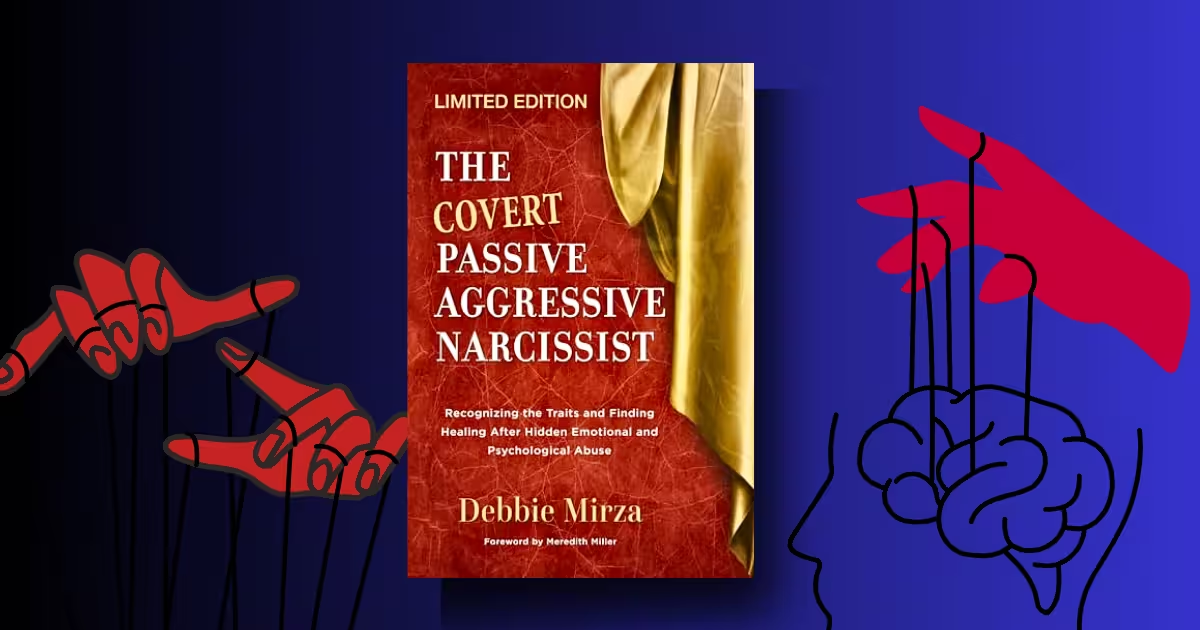
If you’ve searched for answers and found descriptions of narcissists that don’t quite fit, you’re not alone. The Covert Passive-Aggressive Narcissist: Recognizing the Traits and Finding Healing After Hidden Emotional and Psychological Abuse by Debbie Mirza is the book that finally names the invisible torment.
Overview
This book is a lifeline for anyone trapped in the bewildering fog of covert narcissistic abuse. Mirza, a restorative coach who has personally survived these relationships, clearly defines what a covert passive-aggressive narcissist (CPAN) is, how they operate through the three phases of love bombing, devaluing, and discard, and the subtle manipulation tactics they use.
More importantly, she provides a roadmap for healing. This isn’t just another book on narcissism; it specifically addresses the most insidious and difficult-to-spot type, validating the experiences of countless victims who have been told they’re “too sensitive” or “crazy.”
Reader recommendation
The Covert Passive-Aggressive Narcissist is best for:
- Individuals who feel confused and depleted in a relationship with someone who seems “nice” to everyone else.
- Adult children of parents who appeared perfect to the outside world but left them feeling unseen and worthless.
- Anyone who has been told they are “too sensitive” or “overreacting” when expressing pain about a loved one’s behavior.
- Survivors looking for validation and a clear path to healing after emotional and psychological abuse.
- Therapists and coaches seeking to understand a personality type that is often missed in traditional training.
Not For:
- Readers looking for a clinical, academic textbook on personality disorders.
- Those who are not ready to confront the painful reality of their relationship dynamics.
- Individuals who are seeking to diagnose or “fix” the narcissist in their life—this book is for the survivor’s healing, not the narcissist’s.
- Someone who has experienced overt, physical abuse and is looking for resources on that specific type of trauma, though they may still find the emotional abuse aspects relevant.
Table of Contents
Introduction
The Covert Passive-Aggressive Narcissist: Recognizing the Traits and Finding Healing After Hidden Emotional and Psychological Abuse was written by Debbie Mirza and published in 2017 (updated in 2019) by Safe Place Publishing. Mirza is a restorative coach, author, and singer-songwriter who specializes in helping survivors of covert narcissistic abuse.
Her work has been endorsed by numerous licensed therapists and has been voted one of the Best Books on Narcissism.
Context of The Covert Passive-Aggressive Narcissist
This book addresses the most confusing and damaging type of narcissism: the covert kind. As Mirza explains, the term “covert” means “not openly shown”. Covert narcissists are not the arrogant, flashy, in-your-face individuals we typically picture. Instead, they are often well-liked, appear humble and empathetic, and can be good listeners.
However, beneath this charming exterior lies a person devoid of empathy who uses subtle, cloaked tactics to control and devalue their targets.
The abuse is so hidden that most victims don’t even realize it’s happening. This book is the guide for those who feel like they’re losing their minds because the abuse is invisible to everyone but them.
Purpose: The Central Message
The primary argument of The Covert Passive-Aggressive Narcissist is that profound healing and freedom are absolutely possible after experiencing this hidden form of abuse. Mirza’s purpose is to validate the survivor’s experience, educate them on the specific traits and manipulation tactics of a covert narcissist, and provide a compassionate, practical path to recovery.
She writes, “Profound healing and freedom are absolutely possible. I, along with so many others, am proof of this. There is hope.”
The book aims to bring the survivor back to their “stunning self” by helping them recognize the illusion of love they were trapped in.
Background
Debbie Mirza’s motivation to write this book came from her own painful experiences. She has been involved with several covert narcissists in her life and spent years in confusion and cognitive dissonance. When she searched for answers, she found plenty of books on overt narcissism but nothing that fully captured the subtle, insidious nature of the covert type.
This personal understanding is what makes the book so powerful. Mirza isn’t just a theorist; she has walked the same bewildering path.
To ensure the book was comprehensive and accurate, she interviewed more than 100 survivors from around the world and conducted in-depth research.
Her work fills a critical gap in the literature, as most therapists are not educated about covert narcissism in their formal training, leading to victims being re-traumatized by professionals who don’t recognize the signs. The book was born from a necessity to provide a single, comprehensive resource for survivors who were left in the dark.
The Covert Passive-Aggressive Narcissist Summary
Mirza’s book is structured to first illuminate the darkness, then guide the reader toward the light. It’s a journey from confusion to clarity, and finally, to healing.
What Exactly Is a Covert Passive-Aggressive Narcissist?
The book begins by distinguishing the covert narcissist from the more recognizable overt type. While both share the core traits of narcissistic personality disorder (NPD) as listed in the DSM-IV—such as a grandiose sense of self-importance, a need for excessive admiration, and a lack of empathy—the covert narcissist hides these dark attributes.
Mirza explains that overt narcissists are “showy” and “annoying” people who love to talk about their achievements.
They are usually disliked. In contrast, covert narcissists are “well-liked” and “charming”. They appear humble because they know that being overtly arrogant would turn people off. Their reputation is their top priority. As the foreword by Meredith Miller states, “Plausible deniability is the covert narcissist’s greatest weapon in their arsenal of gaslighting tools.”
The book clarifies that covert and passive-aggressive behaviors are both descriptive of a CN. Passive-aggression is aggressing through passivity, while covert aggression is active but underhanded. A CPAN will let you know they are angry not by yelling, but through the silent treatment, subtle putdowns, and a quiet, simmering rage that makes you feel like you’re walking on eggshells.
The Three Phases: Love Bombing, Devaluing, and the Discard
A significant portion of the book is dedicated to explaining the cyclical pattern of abuse that is typical of narcissistic relationships.
Mirza outlines these three stages:
Love Bombing/Idealization Phase: This is the “trap.” The CN mirrors you, becoming everything you’ve ever wanted. They are kind, attentive, and make you feel like you’ve found your soulmate.
As the book quotes Jackson MacKenzie, “They set a trap, and it’s a trap no unsuspecting victim could hope to escape from.” This phase lays the groundwork for you to trust them implicitly for years to come. Mirza warns that taking a CN to therapy during this phase is dangerous, as it becomes a “training ground” for them to learn your vulnerabilities and how to better manipulate you.
The Devaluing Phase: This is when the subtle destruction begins. The CN doesn’t call when they say they will, they “forget” to do things for you, and they start making indirect, demeaning comments.
Their actions are mixed with intermittent kindness, which creates the confusing cognitive dissonance that keeps you hooked. You start to feel depressed, tired, and less confident, but you attribute these feelings to other things, not the relationship. “The devaluing stage comes on subtly,” Mirza writes.
“They don’t call when they said they would… Little acts that always come with excuses and send the target the message that they don’t matter.” Your self-worth slowly declines without you even noticing.
The Discard: This is the most devastating and confusing phase. The CN suddenly ends the relationship, often in a cruel and heartless way, blaming you for everything.
The “nice guy/gal” you thought you knew is replaced by a cold, aggressive stranger who hurls insults and bizarre accusations.
Mirza notes that the CN often moves on quickly to a new target, leaving you to pick up the pieces of your shattered life. “The CN will blame you for just about anything and everything,” she writes. “Most of what they say about you is actually a projection of what is true of them.”
The Traits of a Target: Why You Were Chosen
One of the most validating parts of the book is the chapter on the traits of targets. Mirza explains that CNs don’t just pick anyone; they seek out specific types of people who will be good “energy supplies.”
These are individuals who are:
Empathetic and Compassionate: They have a nurturing heart and can be easily manipulated through pity and guilt.
Self-Reflective: They are willing to look at their own behavior and take responsibility, which makes them susceptible to blame-shifting.
Trusting and Loyal: They believe the word of others because they themselves are trustworthy and find it hard to believe someone they love would lie to them.
Optimistic and See the Best in Others: They give the CN the benefit of the doubt over and over again.
Responsible and Resilient: They hold things together, often doing the lion’s share of the work in the home and relationship.
Mirza emphasizes that these are beautiful, valuable traits, not weaknesses. They were simply exploited by someone who lacks a conscience. “You were manipulated, insulted, degraded, belittled, and neglected. Full responsibility for this goes to the psychopath. It does not matter if you were vulnerable or insecure; no decent human being should ever take advantage of another. None of this was your fault.”
Traits and Manipulation Tactics of a Covert Narcissist
The book provides an exhaustive list of traits and manipulation tactics, making it a vital tool for recognition. Some key traits include:
Lack of a Strong Sense of Self: They are chameleons who mirror the people they are around.
Silent Rage: They control the climate of the home with their quiet, simmering anger.
Lying and Hoovering: They are expert liars and use “hoovering” (like the vacuum) to suck you back into the relationship when you try to leave.
Projection: They accuse you of the very things they are guilty of themselves. “If you think about all the things the CN in your life has told you are wrong with you, my hunch is if you really look at the list, most of the statements are actually true of them.”
Flying Monkeys: They surround themselves with enablers who do their bidding and further the smear campaign against you.
Sabotage: They ruin birthdays, holidays, and vacations, as they cannot stand the attention being on you.
Emotional Immaturity: They are self-focused and act like children, demanding that others cater to their feelings.
The manipulation tactics are equally insidious:
Gaslighting: The primary tactic to make you question your reality. It is “a tactic in which a person or entity, in order to gain more power, makes a victim question their reality.”
Triangulation: The CN pits two people against each other by acting as a messenger, creating drama while appearing innocent.
Intermittent Reinforcement: This is the most powerful motivator. The CN’s love and kindness are given unpredictably, which actually increases your dopamine levels and makes you work harder for their affection.
As Mirza explains, quoting Dr. Robert Sapolsky, “You never get more behavior out of an organism than when you have introduced a maybe into it.”
Covert Narcissistic Parents and the Workplace
Mirza dedicates entire chapters to the unique pain of having a CN parent and working with a CN boss. The dynamics are the same—subtle manipulation and devaluation—but the context makes it even more confusing and damaging.
Covert Narcissistic Parents: These parents often appear perfect to the outside world. Children of CN parents frequently hear how lucky they are.
However, at home, they feel unseen, responsible for their parent’s feelings, and constantly criticized. The parent may favor a “golden child” and be distant or cruel to others. Mirza notes that most children of CN parents don’t realize the truth until their thirties.
One survivor described the mixed message as, “You are so beautiful, you are better than all the other kids, and you are shit.”
In the Workplace: CN bosses are charismatic and well-liked initially. They love bomb you with promises and then subtly devalue you through gaslighting, taking credit for your ideas, and minimizing your feelings. The abuse can be so extreme that victims start to question their own mental health. One survivor, John, was gaslit so badly by his boss that he went to see a neurologist, convinced he had early-onset dementia.
Sex with a Covert Narcissist
Perhaps the most vulnerable and powerful chapter is on sex. Mirza reveals that sex with a CN is one of the most common methods of gaslighting and control. It is a one-sided experience where the CN’s pleasure is paramount. Victims often lose their desire for sex and blame themselves, believing something is wrong with them. They may never experience an orgasm and feel a deep sense of shame.
Mirza explains this is the body’s way of saying it doesn’t feel safe. “When your body doesn’t feel safe with someone, it can’t relax and have its natural release.
Your body knows way before your mind figures things out.” She provides a powerful exercise where the survivor describes their sex life, and then each description is translated to reveal the truth of the entire relationship: “It felt one-sided… The relationship was one-sided. It was up to her to bring life to it, or there would be none.”
The Covert Passive-Aggressive Narcissist Analysis
The book is nothing short of a revelation for those who have been living in the fog of covert abuse. It is an “outstanding” and “effective tool” as noted by psychotherapist Pam Hauke. Its greatest strength is its ability to provide a name for the “crazy-making” behaviors that victims can’t explain.
Mirza’s writing is compassionate and validating, always reminding the reader that they are not to blame. She blends personal anecdotes, survivor stories, and clear explanations of psychological concepts in a way that is accessible and deeply moving. The book’s structure–starting with recognition, moving through education, and ending with healing–provides a clear path forward.
The section on healing is particularly valuable.
Mirza doesn’t just leave the reader with a diagnosis; she offers practical advice on everything from no-contact rules and setting boundaries to physical nurturing exercises like TRE (Trauma Release Exercises) and reiki. She emphasizes the importance of trusting your body and your intuition, which the CN has systematically destroyed.
If the book has a weakness, it is that it is not a clinical textbook. It is written from a survivor’s perspective for survivors. While this is its greatest strength, a clinical reader might find the analysis somewhat less rigorous than a purely academic text. However, for its intended purpose—helping victims heal—it is exceptionally well-executed.
Strengths and Weaknesses
Strengths:
Unmatched Validation: The book provides the single most important thing a survivor needs: validation. It confirms that the confusion, exhaustion, and self-doubt are not signs of weakness but are the natural results of insidious abuse.
Clarity and Accessibility: Mirza takes complex psychological concepts and explains them in a clear, relatable way with numerous real-life examples. The “Traits of a Covert Narcissist Checklist” at the end is an invaluable resource.
Comprehensive Focus: It specifically addresses the covert type, filling a gap in the existing literature. It covers all facets of the relationship, from love bombing to the discard, including difficult topics like sex and divorce.
Actionable Healing Roadmap: The final chapters are dedicated to practical, gentle steps for healing, covering emotional, physical, and relational recovery.
Empathetic and Human Tone: Mirza writes with the voice of someone who has been there. She doesn’t just lecture; she empathizes. Her love for the survivors she interviews is palpable.
Weaknesses:
Not a Clinical Diagnosis Tool: The book is not intended to be a diagnostic manual. It’s a self-help guide, and while it references the DSM-IV, it does not provide a clinical evaluation of NPD.
Emotionally Heavy: The subject matter is deeply painful. Readers who are not yet ready to face the truth about their abuser may find the book overwhelming.
Limited Exploration of NPD Etiology: While Mirza discusses why CNs abuse, she ultimately concludes that “we don’t really know for sure why they abuse, and it doesn’t really matter”.
This is a practical stance for healing but may leave some readers wanting a deeper exploration of the psychological origins of the disorder.
Comparison with Similar Works
The Covert Passive-Aggressive Narcissist fits within a growing body of literature on narcissistic abuse, but it occupies a unique and crucial niche.
Compared to Psychopath Free by Jackson MacKenzie: Both books are written from a survivor perspective and are deeply validating. However, MacKenzie’s book is broader, covering psychopaths and sociopaths, while Mirza’s is laser-focused on the covert narcissist.
Mirza’s book provides more specific, granular detail on the subtle tactics of this particular type, making it the go-to resource for anyone who feels their experience doesn’t fit the “grandiose” stereotype.
Compared to In Sheep’s Clothing by George K. Simon: Simon’s book is a classic work on manipulation and covert-aggression, written from a clinical perspective. It provides the theoretical framework for understanding these behaviors.
Mirza’s book builds on this by applying it specifically to the context of a romantic relationship, parental abuse, and the workplace, and by adding the crucial component of healing for the survivor. Mirza even quotes Simon, showing she is building upon this foundational work.
Compared to Will I Ever Be Good Enough? by Karyl McBride: McBride’s book is a seminal work on daughters of narcissistic mothers. Mirza covers this topic as well, but her book is more comprehensive, addressing romantic partners, fathers, and bosses, making it applicable to a wider audience.
Conclusion
The Covert Passive-Aggressive Narcissist is more than just a book; it is a gentle hand reaching out to pull you from the abyss of confusion. It is a voice that says, “You are not crazy. You are not alone. You are not to blame.”
Debbie Mirza has created a vital resource for the millions of people who are suffering from an invisible abuse that slowly drains the life from them.
The book fulfills its stated purpose with grace and clarity.
It effectively supports its arguments with countless survivor stories, psychological explanations, and a deep well of personal understanding. Its contribution to the field of self-help and trauma recovery is significant because it shines a light on the most shadowy and difficult-to-recognize form of narcissism.
By doing so, it provides the clarity that is the first and most essential step toward healing.
This book is a must-read for anyone who has ever felt like they were “too much” or “not enough” for someone they loved, only to discover that the person they were trying to please was never capable of love in the first place. It is a guide back to yourself, a path to reclaiming your life, your sanity, and your stunning, magnificent self.
As Mirza writes, “You are not a mess. You have experienced evil. Your body is having a natural reaction to that.” It is time to heal.