
Last updated on August 30th, 2026 at 11:59 am
Do you remember the first time a movie made you feel genuinely uneasy, not just thrilled, but morally unsettled? The Dark Knight is not just a film you watch; it is a chaotic system that tests your own ethical code.
Table of Contents
Overview
A masterclass in tension that redefined superhero cinema, The Dark Knight is a dense, sometimes bloated crime epic. Its thematic ambition occasionally outpaces its narrative logic, yet the sheer force of Heath Ledger’s Joker and Christopher Nolan’s practical filmmaking makes it a mandatory viewing experience. If you crave tidy morals and light escapism, you will bounce off this hard. If you want art disguised as a blockbuster, you will study it.
Introduction
This is not just another review telling you The Dark Knight is good. You already know that. You have likely seen the IMDb ratings fluctuate, you have watched the “Best Villain of All Time” video essays, and you have probably argued about whether it deserved a Best Picture nomination. According to Box Office Mojo, the film grossed over $1 billion worldwide on a $185 million budget, a figure that, adjusted for ticket price inflation, makes it one of the most successful serious dramas ever made.
So, why are we here? We are here because I think we have lost the plot a little bit regarding what The Dark Knight actually is. We have reduced it to a meme, a collection of Joker quotes, or a simple “gritty reboot.”
Released on July 18, 2008, in the United States, this film by Christopher Nolan is not a superhero movie. It is a Michael Mann-style crime thriller that happens to have a man dressed as a bat in it.
My overall impression is complicated. I believe it is a masterpiece of technique and performance, but I also believe it is arguably the most overrated film of the 21st century in specific film circles. It is a film so dense that it trips over its own ambitious plot. Yet, I cannot look away. It is a paradox. Let me explain.
Background
To understand the weight of The Dark Knight, you have to remember the landscape of 2008. We were three years removed from Batman Begins (2005), which had already wiped away the neon embarrassment of Batman & Robin (1997). However, the genre was still defined by Spider-Man’s angst or X-Men’s leather suits. Iron Man had just come out in May 2008, but that was a party. Nolan’s promise was different.
He looked at post-9/11 America, the surveillance state debates, the Patriot Act, and the “War on Terror,” and he filtered it through the lens of a man in a Kevlar suit. The production itself was famously ambitious. The decision to shoot key sequences in IMAX was unprecedented for a narrative feature at that time.
Six major action sequences were shot using IMAX 70mm cameras, which is why the aspect ratio shifts on your Blu-ray. This wasn’t just marketing; it was a technical commitment to scale. The film had a cultural footprint before it even dropped, largely due to the untimely death of Heath Ledger on January 22, 2008, months before the release.
This created a macabre fascination, but once the film hit screens, the fascination turned to reverence.
The Dark Knight Plot
The film opens with a bank heist in Gotham City. A group of clowns robs a mob bank, but they have been instructed to kill each other during the heist to reduce the split of the money. The last one standing is the mastermind, the Joker (Heath Ledger). He escapes with the cash, leaving a grenade in the mouth of the bank manager, proving instantly that this is not a “tidy” villain.
Meanwhile, Batman (Christian Bale) has been effective. He has scared the traditional mobsters, but his presence has inadvertently escalated the violence. Copycat vigilantes are popping up, wearing hockey pads. Batman, Lieutenant James Gordon (Gary Oldman), and the new District Attorney, Harvey Dent (Aaron Eckhart), form a fragile alliance.
Dent is the “White Knight” of Gotham, a man who can fight crime in the light without a mask. He is dating Rachel Dawes (Maggie Gyllenhaal), Bruce Wayne’s childhood friend and former love.
The Joker approaches the mob with a proposition: kill Batman, and he will stop the chaos. He tells them, “It’s simple. We kill the Batman.” The mob agrees, but the Joker is playing them. He wants to destroy the soul of the city, not just its crime lords.
The escalation is brutal. The Joker murders high-ranking officials, including a judge, and tries to kill the mayor. He targets Harvey Dent by name, forcing the city into a panic. To force Batman to reveal his identity, the Joker threatens to kill people every day until Batman takes off the mask. He specifically targets the people Bruce Wayne cares about, confirming the Joker suspects his secret.
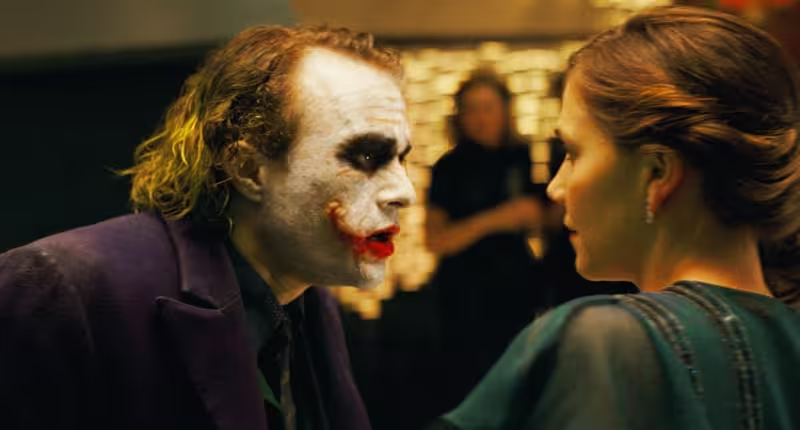
The tension peaks when the Joker engineers a situation where Bruce has to choose between saving Rachel and Harvey Dent. The Joker gives him the addresses, but he swaps them. Bruce goes to save Rachel, intending to let Harvey die, but he arrives to find Harvey instead because the Joker lied about the locations. Rachel dies in an explosion, and Harvey is horribly disfigured. This is the turning point. Harvey loses his mind, becoming the vengeful “Two-Face.”
The Joker then unleashes a social experiment. He puts bombs on two ferry boats leaving Gotham: one carrying civilians, the other carrying prisoners. He gives each boat the detonator to the other boat’s bomb.
He says that if one group does not blow up the other by midnight, he will destroy both. It is a test of the collective soul of Gotham. Surprisingly, neither boat acts. The prisoners throw their detonator out the window, and the civilians hesitate. This is a rare moment of optimism in a dark film.
Batman uses a sonar device (essentially a mass surveillance machine) to find the Joker. This is a controversial plot point, ethically gray, showing how far Batman is willing to go. He captures the Joker, but the Joker reveals his final trick: he has corrupted Harvey Dent. Harvey has gone on a killing spree, murdering the corrupt cops and mobsters involved in Rachel’s death, deciding their fates with a coin flip.
The final act takes place at the ruins of the building where Rachel died. Harvey holds Gordon’s family hostage, blaming Gordon for the corruption in his unit that led to the kidnapping. Batman arrives. Harvey flips the coin for himself, Batman, and Gordon’s son. Batman tackles Harvey off the ledge, killing him (accidentally or intentionally is left ambiguous), but saving the boy.
Now, we arrive at the ending. Harvey Dent was the face of hope in Gotham. If the public learns that the “White Knight” became a murderer, the mob will go free, and the city will lose hope. Batman convinces Gordon to let him take the blame for the murders. “Sometimes people deserve more than the truth,” Gordon narrates. “Sometimes they deserve to have their faith rewarded.” Batman becomes the villain, the hunted outlaw. He runs.
This ending is devastating. Batman is not a hero; he is a tragic figure. He is the “Dark Knight” who absorbs the punishment because he can take it. He is not just a man in a suit; he is a scapegoat.
The Dark Knight Analysis
1. Direction and Cinematography
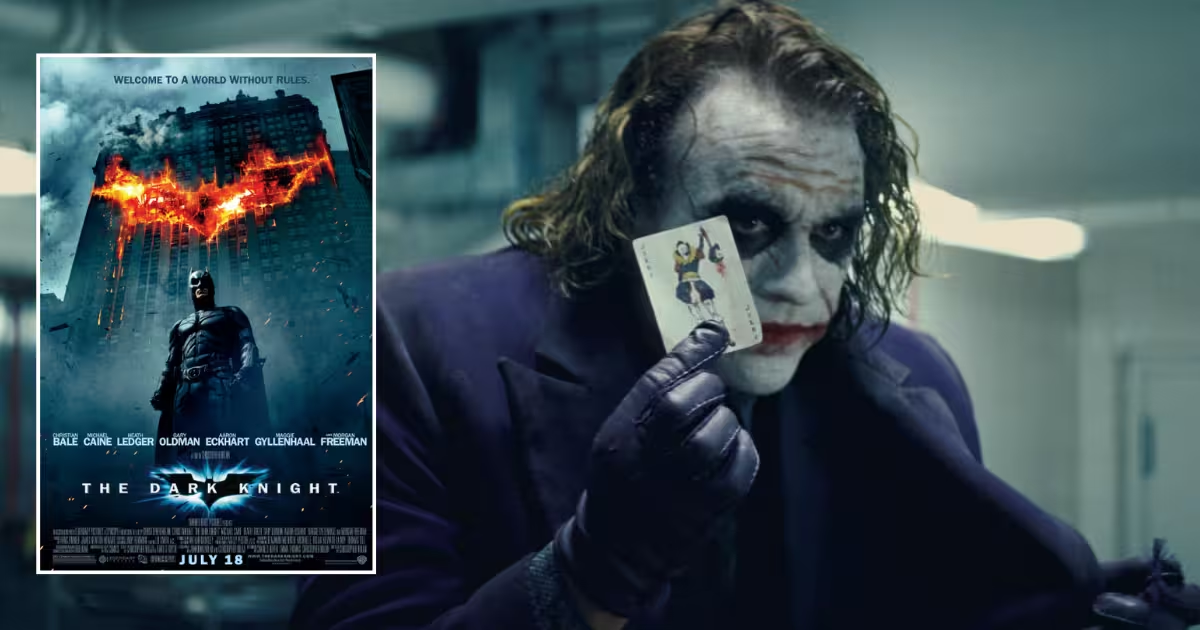
Nolan’s direction here is about control. Unlike the frantic editing of many modern action films, Nolan lets scenes breathe. The use of IMAX cameras for the aerial shots of Hong Kong and the chase scenes gives the film a scale that is still impressive in 2026. The cinematography by Wally Pfister uses cool blues and grays for the city, emphasizing the coldness of the environment, contrasted with the chaotic greens and purples of the Joker’s wardrobe.
2. Acting Performances
Heath Ledger’s performance is the anchor. He is not just a giggling clown; he is a force of nature. His tics, his lip-licking, and his shifting stories about his scars create a sense of unpredictability.
Christian Bale is sometimes criticized for the gruff voice, but his physicality is solid. However, the heart of the film is Aaron Eckhart. His transition from idealist to nihilist is terrifying because it is believable. Gary Oldman’s Gordon is the quiet moral center, a man trying to hold the line without superpowers.
3. Script and Dialogue
The screenplay, written by Christopher and Jonathan Nolan, is dense. The dialogue is quotable without feeling like a “meme factory.” Lines like “You either die a hero, or you live long enough to see yourself become the villain,” are thematic thesis statements, not just throwaways.
The pacing is relentless in the second act, though it is true that the third act, involving the sonar technology, feels slightly rushed to tie up the philosophical loose ends.
4. Music and Sound Design
Hans Zimmer and James Newton Howard created the score. The Joker’s theme is a masterpiece of sound design: a rising, tense note that sounds like a razor blade being drawn across a wire. There are no sweeping orchestral themes for the Joker; it is noise, reflecting his philosophy.
5. The Dark Knight Themes and Messages
The themes are heavy. The film grapples with the loss of privacy (the sonar machine), the justification of torture (Batman’s interrogation of the Joker), and the lie that underpins society. It asks: Is it okay to suppress the truth if the truth is too damaging? The Joker is a stand-in for modern terrorism: he cannot be bought, reasoned with, or deterred by threats. He just wants to burn the world down.
Comparison
When you compare The Dark Knight to similar films, you have to look at Heat (1995). Nolan has admitted the influence. Both films feature a cop and a criminal locked in a war that destroys their personal lives. But The Dark Knight surpasses Heat in its scope. It is a blockbuster, but a grim one.
Compared to Nolan’s later works like Tenet or Oppenheimer, The Dark Knight is more emotionally grounded. It is not about time inversion or science; it is about a man making an impossible choice. Compared to modern Marvel films like Spider-Man: No Way Home, which rely on fan service, The Dark Knight feels fresh because it refuses to please the audience. It challenges them.
Audience Appeal / Reception
This film is for cinephiles and action fans. It is the bridge between “high art” and “popcorn movies.” It is not suitable for young children, not just because of the violence, but because of the moral ambiguity. Critics praised it universally at the time.
According to Rotten Tomatoes, it holds an approval rating of 94% based on hundreds of reviews. Roger Ebert gave it four stars, noting its depth. It won two Academy Awards: Best Supporting Actor for Heath Ledger (posthumously) and Best Sound Editing. It was nominated for eight.
Personal Insight
Watching The Dark Knight in 2026 feels different than it did in 2008. Back then, it was a warning. Today, it feels like a mirror. We live in an age of mass surveillance (the Edward Snowden revelations happened after this film, but the sonar machine predicted the debate). The film’s depiction of a society willing to give up its freedom for security is no longer fiction; it is our reality.
The lesson I take from it today is about the danger of binary thinking. We want our leaders to be perfect. We want our institutions to be pure. But The Dark Knight argues that sometimes, you have to support the lie to preserve the order.
That is a bitter pill to swallow. Is it better to know the truth that your hero is flawed, or to live in peace under a false idol? The film suggests the latter is sometimes necessary, but it feels sad about it. It makes me question the “cancel culture” era.
We demand perfection, but if we found out every politician was a “Harvey Dent,” would we burn it all down? The Joker says, “I’m not a monster. I’m just ahead of the curve.” That line chills me more now than it did then.
The Dark Knight Quotations
These are the lines that define the movie for me:
“I believe whatever doesn’t kill you simply makes you… stranger.” — The Joker
“You either die a hero, or you live long enough to see yourself become the villain.” — Harvey Dent
“Because he’s the hero Gotham deserves, but not the one it needs right now. So we’ll hunt him. Because he can take it. Because he’s not our hero. He’s a silent guardian, a watchful protector. A dark knight.” — Jim Gordon
“Madness, as you know, is like gravity. All it takes is a little push.” — The Joker
Pros and Cons
Pros:
- The Joker’s chaotic energy makes the film unpredictable and genuinely thrilling.
- Stunning IMAX visuals that still hold up on a 4K screen.
- The moral complexity of the final act is unforgettable.
- Hans Zimmer’s score adds unbearable tension without relying on drums.
- The ferry scene remains one of the best social experiments ever put on film.
Cons:
- The action scenes involving Batman’s fighting are occasionally stiff and hard to follow.
- The sonar subplot feels slightly “tech-heavy” compared to the raw emotion of the Joker’s plot.
- The absence of Katie Holmes is noticeable to some fans who preferred her Rachel Dawes.
Conclusion
The Dark Knight is a masterpiece because it was made by someone who respected the concept. It is not just the best Batman film; it is one of the best films about morality ever made. It leaves you feeling bruised but thoughtful.
Rating: 5/5 Stars