
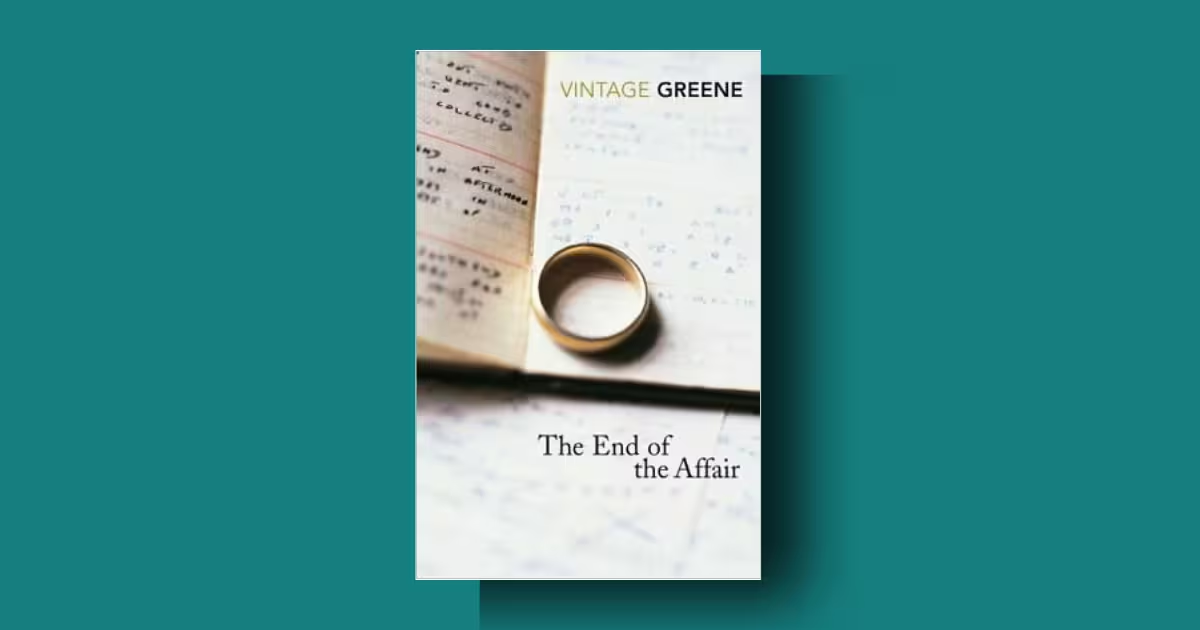
Did you ever love someone so completely that it turned into its opposite, a consuming hatred that you couldn’t escape? That’s the uncomfortable territory Graham Greene explores in The End of the Affair. This isn’t a love story in any conventional sense. From the very first page, the narrator, Maurice Bendrix, tells us plainly: “So this is a record of hate far more than of love.” Yet, reading it, you realise that his hatred is simply love that has curdled, a passion that refuses to die.
It’s this brutal honesty that makes the novel so compelling, even seventy years after it was first published.
Table of Contents
Overview
Set in London during and just after World War II, The End of the Affair is the story of Maurice Bendrix, a novelist, and his obsessive, five-year affair with Sarah Miles, the wife of a dull but decent civil servant, Henry. The affair ends abruptly and inexplicably in 1944 when a V1 bomb nearly kills Bendrix.
Two years later, a chance meeting with Henry rekindles Bendrix’s jealousy, leading him to hire a private detective to uncover the truth about Sarah’s life. What he discovers, through her stolen diary, is far more shocking than a simple affair: Sarah made a desperate vow to God, promising to give up Bendrix if He would spare his life.
The novel is a profound and often painful meditation on the nature of love, the destructiveness of jealousy, and the search for faith in a world that seems to offer none.
Reader Recommendation for The End of the Affair
Let’s be honest: this book is not for everyone. If you’re looking for a light, escapist romance, look elsewhere. But if you’re the kind of reader who craves emotional complexity and psychological depth, The End of the Affair will stay with you long after you’ve turned the last page.
You will likely love The End of the Affair if:
- You appreciate literary fiction that prioritises character study over plot.
- You’re fascinated by the darker, more obsessive sides of human emotion.
- You enjoy novels that grapple with big questions about faith, doubt, and the meaning of love.
- You’re a fan of Graham Greene’s other work, or writers like F. Scott Fitzgerald, Ian McEwan, or Kazuo Ishiguro.
You might want to give The End of the Affair a pass if:
- You prefer stories with likeable, sympathetic protagonists (Bendrix is deeply flawed).
- You dislike narratives that are heavily introspective or philosophical.
- You’re put off by the religious themes that dominate the second half of the book.
The End of the Affair Plot Summary
Book One: The Record of Hate
The novel opens in January 1946. On a rainy night, narrator Maurice Bendrix runs into Henry Miles, the husband of his former mistress, Sarah. Their affair had ended abruptly and without explanation in June 1944. Bendrix, still seething with jealousy and resentment, is drawn back into their orbit. Henry, unaware of his wife’s past with Bendrix, confides that he suspects Sarah of having an affair with another man.
Seeing an opportunity to satisfy his obsessive curiosity, Bendrix offers to hire a private detective on Henry’s behalf. He visits Mr. Savage’s agency and employs a bumbling but earnest detective, Mr. Parkis, who uses his young son, Lance, as an assistant. The detective work begins, and soon Parkis is reporting Sarah’s movements, which include regular, secretive visits to a house in Cedar Road.
Book Two: The Affair (Flashback)
The narrative shifts back in time to the beginning of the affair. Bendrix, researching a novel about a civil servant, becomes friends with Henry and, in turn, meets Sarah. They are drawn to each other and begin a passionate, secret affair. However, Bendrix’s intense jealousy and insecurity poison the relationship from the start.
He is jealous of Henry, of Sarah’s past lovers, and of any potential future rival. He constantly accuses her and picks fights, pushing her away even as he craves her presence.
In June 1944, during a V1 flying bomb attack on London, Bendrix and Sarah are together in his flat. When a bomb lands nearby, Bendrix goes to investigate and is knocked unconscious by a falling door. Sarah finds him, believes he is dead, and in a moment of desperate hysteria, makes a vow to God: if He will let Bendrix live, she will end the affair and believe in Him.
At that exact moment, Bendrix walks back into the room, alive but bleeding. True to her word, Sarah leaves him, telling him that “love doesn’t end just because we don’t see each other”.
Book Three: The Diary and the Truth
Back in 1946, Parkis manages to steal Sarah’s diary. Through its pages, Bendrix finally learns the truth about the end of their affair. He reads Sarah’s account of the night of the bombing, her desperate prayer, and her subsequent struggle to keep her vow. She writes of her love for Bendrix, but also her growing, unwanted belief in God.
She describes her visits to Cedar Road, which were not to see a lover, but to meet a rationalist speaker named Richard Smythe, who she hoped would talk her out of her newfound faith.
He fails, and Sarah, now convinced of God’s existence, seeks out a Catholic priest, Father Crompton, to begin instruction.
Armed with the knowledge that Sarah still loves him, Bendrix is elated. He calls her, demanding to see her, but she refuses, still bound by her vow. She flees into the rain, worsening a severe cold that soon develops into pneumonia. Henry, oblivious to the real reason for her illness, calls Bendrix to tell him that Sarah is dead.
The Aftermath
Bendrix moves into Henry’s house, and the two men, united in their grief, form an unlikely companionship. Bendrix struggles with his hatred for the God that he now, unwillingly, believes exists.
He sees Sarah’s faith as a victory for God and a theft of his own happiness. A series of events- the mysterious healing of Richard Smythe’s skin condition, a dream in which the dying Sarah touches Parkis’s sick son- suggests to those around him that Sarah has become a channel for divine grace. Bendrix, however, remains defiant, his final plea to God a bitter one: “leave me alone for ever.”
The End of the Affair Analysis
4.1. Characters
Greene’s characters are not merely players in a plot; they are complex, flawed individuals whose internal conflicts are the very engine of the story.
Maurice Bendrix: The narrator and protagonist, Bendrix is a deeply unlikeable but utterly compelling figure.
He is selfish, jealous, and possessive. His love for Sarah is less about her as a person and more about his own need to possess her completely. He admits: “If hate is not too large a term to use in relation to any human being, I hated Henry, I hated his wife Sarah too.” This self-awareness doesn’t make him a better person; it simply makes his torment more acute. His journey is not one of redemption but of a painful, angry awakening to a faith he despises.
Sarah Miles: Sarah is the emotional and spiritual heart of the novel. She is torn between her passionate, “ordinary corrupt human love” for Bendrix and her growing, almost reluctant belief in God. Her diary reveals a woman of profound honesty and deep feeling. She doesn’t choose God over Bendrix out of simple piety; she does it because she has “caught belief like a disease”.
Her tragedy is that her faith, the very thing that gives her peace, is the instrument of her separation from the man she loves.
Henry Miles: Henry is the cuckolded husband, but Greene refuses to make him a villain. He is kind, gentle, and deeply conventional. He is a man who loves Sarah in his own quiet way, a love that is “never noticed” by her. He is the victim of both his wife’s infidelity and his own emotional blindness. After Sarah’s death, he becomes a poignant figure of grief, his security shattered.
Richard Smythe: The rationalist speaker on Clapham Common, Smythe is a fascinating minor character. He is physically marked by his disfiguring skin condition, a symbol of his own, perhaps, hatred of the physical world.
He tries to convince Sarah that God is a fiction, but his own passionate hatred of that fiction hints at a belief he cannot admit. His mysterious healing at the end of the novel serves as a troubling, miraculous sign that challenges Bendrix’s worldview.
4.2. The End of the Affair Themes and Symbolism
Greene weaves a rich tapestry of themes and symbols, making the novel a profound meditation on the human condition.
Love and Hatred: The novel’s central theme is the inextricable link between love and hatred. Bendrix’s obsession with Sarah is a perfect example: his love for her is so intense that it curdles into a venomous jealousy and hatred the moment he feels he might lose her. The novel argues that these two emotions are not opposites but two sides of the same coin.
Faith, Doubt, and the Divine: This is perhaps the most dominant theme, marking The End of the Affair as the final book in Greene’s “Catholic” tetralogy. The novel explores the painful, often unwanted, nature of belief. Sarah doesn’t choose God; God chooses her. Bendrix rails against this God, but his very hatred is a form of acknowledgment.
Greene doesn’t offer easy answers; he presents faith as a difficult, demanding, and sometimes devastating force.
Jealousy and Possession: Bendrix’s jealousy is the primary destructive force in the novel. It drives him to spy on Sarah, to pick fights with her, and ultimately to push her away. For Bendrix, love is equated with possession.
He cannot bear the thought of Sarah having any independent existence outside of him. As Sarah writes in her diary, “His love is like a medieval chastity belt: only when he is there, with me, in me, does he feel safe.”
Time and Eternity: Greene plays with the novel’s structure to explore the nature of time. The story jumps back and forth, showing how past events (the affair) are always present in memory. Sarah’s diary suggests a different kind of time, an eternal “now” that exists in the mind of God. The novel’s non-linear structure itself mirrors the way memory and faith can collapse the boundaries of past, present, and future.
Symbolism:
The Desert: In Sarah’s diary, the desert represents a life without love, a barren emotional landscape she fears she will be condemned to wander forever. She hopes God might “fill the desert,” but she also knows that without Bendrix, it may always be a place of isolation.
The Stained Glass Window: The old Victorian stained glass in Bendrix’s door survives a bomb blast that destroys much of the rest of the house. This symbolises the endurance of traditional marriage (Henry and Sarah’s bond) which, while battered, remains intact, in contrast to the passionate but ultimately fragile love affair.
The End of the Affair Evaluation
Reading The End of the Affair is an experience that leaves you feeling emotionally bruised, yet oddly grateful for the honesty of it. It is a masterful and important work of literary fiction. Greene’s ability to strip away the romantic veneer of love and expose its raw, jealous, and obsessive core is unparalleled. The novel’s emotional power lies in its unflinching portrayal of human weakness.
Strengths
Unforgettable Narrative Voice: Bendrix’s voice is one of the most distinctive in 20th-century literature. His bitterness, his self-loathing, and his desperate attempts at honesty are utterly compelling.
Psychological Depth: Greene’s exploration of the psychology of love and jealousy is remarkable. He gets under the skin of his characters, showing us their motivations, their fears, and their self-deceptions.
The Power of the Diary: The insertion of Sarah’s diary is a masterstroke. It provides a necessary second perspective on the affair, transforming our understanding of everything that has come before.
Atmosphere: Greene’s depiction of wartime London is superb. The Blitz becomes a character in itself, a backdrop of chaos and death that mirrors the emotional turmoil of the characters.
Weaknesses
The Shift in Tone: Some readers find the novel’s shift from a searing study of sexual jealousy to a theological meditation jarring. The last fifty pages are heavily concerned with questions of faith and miracles, which can feel like a departure from the more grounded psychological drama of the earlier sections.
An Unsympathetic Protagonist: While Bendrix is fascinating, he is not easy to like. His constant jealousy and possessiveness can be exhausting, and some readers may find it difficult to invest in his emotional journey.
The Ending: The novel’s ending, with its hints of miracles and divine intervention, can feel ambiguous and even unsatisfying for readers who prefer a more secular resolution.
Impact and Controversy
Upon its publication in 1951, The End of the Affair was both praised and criticised. William Faulkner, for instance, called it “one of the best, most true and moving novels of my time, in anybody’s language.”
However, many critics, like Evelyn Waugh, found the overtly Catholic themes troubling. The novel’s power lies in its ability to provoke such strong reactions, forcing readers to confront their own beliefs about love, faith, and the nature of reality. It continues to be a source of fascination and debate.
Comparison with Similar Works
The Heart of the Matter (also by Graham Greene): Both novels are part of Greene’s “Catholic” tetralogy and explore the conflict between earthly love and divine will. However, The End of the Affair is a more intimate, personal story, while The Heart of the Matter is a broader, more political novel.
Brief Encounter (Noël Coward): Both stories deal with a passionate but doomed love affair in a restrained, wartime British setting. However, Greene’s novel is far darker and more psychologically complex than Coward’s bittersweet romance.
The Remains of the Day (Kazuo Ishiguro): Both novels feature an unreliable narrator looking back on a lost love and a life of missed opportunities. However, Ishiguro’s tone is one of quiet, melancholy regret, while Greene’s is one of raw, almost violent emotion.
Adaptations
The novel has been adapted for the screen twice.
1955 Film: Starring Deborah Kerr and Van Johnson, this version was a more conventional Hollywood adaptation, which softened the novel’s more controversial religious themes.
1999 Film: Directed by Neil Jordan, this version is much more faithful to the novel. It features Ralph Fiennes as Bendrix, Julianne Moore as Sarah, and Stephen Rea as Henry. Jordan’s film captures the novel’s bleak, obsessive atmosphere and its complex emotional and spiritual conflicts. Filmed on a budget of $23 million, it grossed just over $10.8 million at the box office.
Personal Insight with Contemporary Educational Relevance
One of the most powerful lessons from The End of the Affair is its unflinching portrayal of obsession.
In our modern world, dominated by social media and the constant pressure to curate a perfect life, the novel’s depiction of raw, undignified longing feels more relevant than ever. Bendrix’s jealousy isn’t a simple emotion; it’s a consuming force that twists his perception of reality. In the novel, he says, “Insecurity is the worst sense that lovers feel: sometimes the most humdrum desireless marriage seems better. Insecurity twists meanings and poisons trust.”
This is a profound truth that extends far beyond romantic relationships. The insecurity and jealousy we experience today, often fuelled by the curated lives we see on our screens, can poison friendships, careers, and our sense of self.
Another vital lesson is the complexity of honesty. The novel challenges the idea that love is always a force for good.
It shows us that love can be selfish, possessive, and destructive. It forces us to question what we want from love and what we are willing to sacrifice for it. The themes of The End of the Affair remain deeply relevant to anyone who has ever grappled with the pain of lost love, the search for meaning, or the challenge of reconciling our desires with our beliefs.
Five Key Lessons from the Novel:
- Love and hatred are not opposites; they are often two sides of the same intense emotional coin.
- Jealousy is a self-destructive force that poisons the very thing it wishes to possess.
- Belief, whether in God or in another person, can be a painful and unwanted burden as much as a source of comfort.
- True honesty with oneself is a difficult and often painful process, but it is the only path to genuine understanding.
- The end of a love affair is often not an end at all, but a transformation into something else, be it hatred, memory, or a new kind of faith.
The End of the Affair Top Quotes
“A story has no beginning or end: arbitrarily one chooses that moment of experience from which to look back or from which to look ahead.”
“So this is a record of hate far more than of love.”
“I became aware that our love was doomed; love had turned into a love-affair with a beginning and an end. I could name the very moment when it had begun, and one day I knew I should be able to name the final hour.”
“Insecurity is the worst sense that lovers feel: sometimes the most humdrum desireless marriage seems better. Insecurity twists meanings and poisons trust.”
“I’ve caught belief like a disease.”
“When you are miserable, you envy other people’s happiness.”
“If I could I would write with love, but if I could write with love I would be another man; I would never have lost love.”
Conclusion
The End of the Affair is a challenging, thought-provoking, and deeply moving novel. It is not a book that offers easy comfort or simple resolutions. Instead, it forces the reader to sit with discomfort, to confront the darker aspects of human nature, and to grapple with questions that have no easy answers.
Greene’s prose is sharp, his characters are unforgettable, and his exploration of love, jealousy, and faith is both profound and unsettling.
It is a novel that will stay with you, not because it makes you feel good, but because it makes you think and feel more deeply about the messy, complicated reality of the human heart.
Who should read this book? Fans of literary fiction, psychological drama, and those who appreciate a story that challenges as much as it entertains will find this a rewarding read. It is a classic for a reason, and its themes are as relevant today as they were in 1951.







