
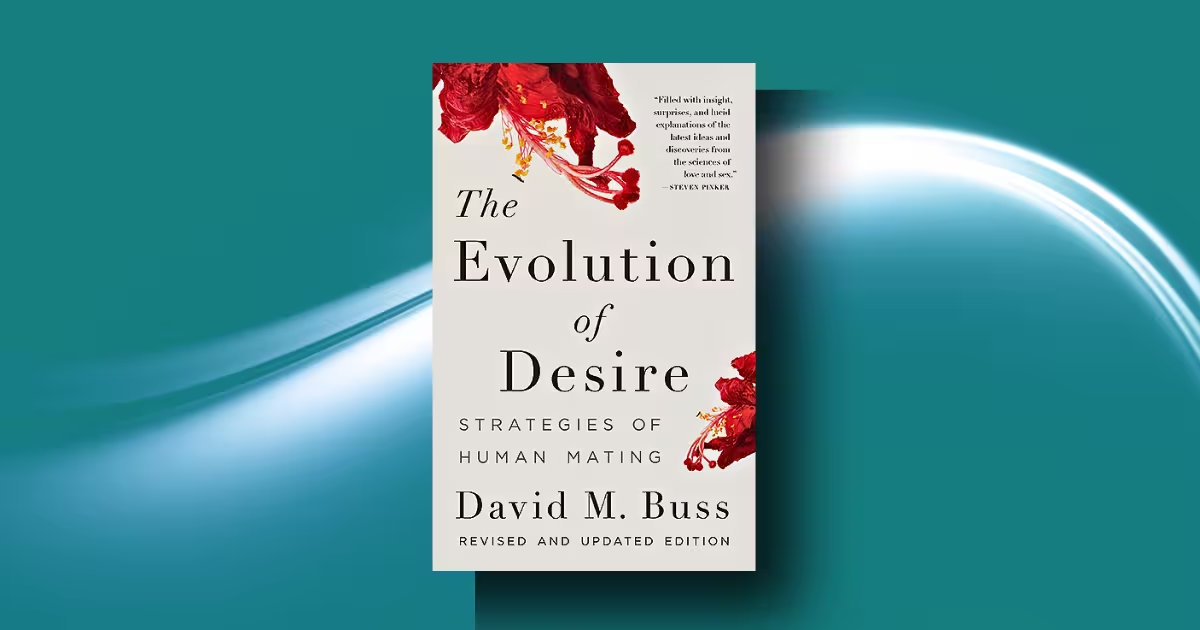
Why do we fall for one person, distrust another, crave commitment one year and novelty the next? The Evolution of Desire made me feel that romance is not random chaos at all, but a deep human pattern written across biology, culture, conflict, and longing.
The Evolution of Desire is a good read for readers interested in evolutionary psychology, relationships, dating behavior, sex differences, jealousy, marriage, divorce, mate choice, and the hidden logic behind attraction. It is especially rewarding for readers who like big-thesis nonfiction that connects science with everyday life.
Not for: readers who want a purely romantic, purely literary, or purely culture-only account of love; readers who dislike adaptationist explanations; and readers who prefer the language of contemporary gender studies over the vocabulary of sexual selection and evolved strategies. Buss’s lens is powerful, but it is unapologetically evolutionary, and some readers will find that provocative or reductive.
Table of Contents
1. Introduction
The Evolution of Desire: Strategies of Human Mating is by David M. Buss, an American evolutionary psychologist whose work has focused on human mating strategies, sex differences, jealousy, sexual conflict, prestige, status, and related topics.
Buss is not writing from the margins of the field. He is one of the most visible scholars associated with evolutionary psychology, and the University of Texas at Austin lists his interests as evolutionary psychology, human mating strategies, conflict between the sexes, sexual victimization, prestige, status, jealousy, stalking, and murder.
That matters because this book is not a stray pop-science opinion piece; it is a synthesis by someone whose career has revolved around these questions.
This is nonfiction, specifically evolutionary psychology/popular science/social psychology. But it is also, in a strange way, a book about ordinary heartbreak. Buss does not start from abstract theory alone. He starts from the mess that people actually live through: attraction, rejection, jealousy, infidelity, sexual conflict, commitment, divorce, remating, and the recurring fact that love can be ecstatic and brutal at the same time.
In the opening chapter he insists that conflict in mating is not an occasional failure but often “the norm and not the exception,” and he frames the whole book as an attempt to reconcile profound love with the conflict built into human pair-bonding.
The structure of the book reflects that ambition. The 2016 edition contains chapters on origins, women’s desires, men’s desires, casual sex, attracting a partner, staying together, sexual conflict, breaking up, changes over time, and harmony between the sexes. In other words, Buss tries to cover the full arc of mating, not just attraction.
The book’s central thesis is that humans have evolved multiple mating strategies, not one single fixed script, and that many of the recurring patterns in love, courtship, jealousy, mate preference, conflict, infidelity, and divorce make better sense when viewed through sexual selection and evolved psychological adaptations.
Buss’s own encyclopedia summary of the book calls it “a unified theory of human mating strategies,” and in the book itself he says one of his aims is to formulate “a unified theory of human mating” based on current evidence rather than romantic myth or outdated social-science dogma.
That is the animating claim: desire is not random, not purely cultural improvisation, and not simply private taste. It is patterned, strategic, and historically shaped. Whether one agrees fully or not, that thesis gives the book its force.
2. Background
David Buss first published The Evolution of Desire in 1994. By the time of the 2016 revised and updated edition, the book had been substantially reworked to reflect more than two decades of newer theory and research.
Buss notes in the preface that the field had seen an “explosion” of scientific work since the first edition and that the new version integrates material that had been added or expanded after the original release.
One of the strongest foundations of the book is the famous cross-cultural mate-preference project associated with Buss and his collaborators. In the opening chapter, Buss says he expanded his international study to include fifty collaborators across thirty-seven cultures on six continents and five islands, eventually sampling 10,047 people worldwide.
He presents this as the largest study ever undertaken on human mating desires, and the book repeatedly returns to that dataset as a spine for broader claims about universals and sex differences.
The book also arrived in a climate of controversy. Buss explicitly says the first edition provoked strong emotions because many readers resisted the idea that women and men differ in basic mating psychology or that such differences might have evolutionary roots. That context matters because the book is not merely descriptive; it is interventionist.
It is arguing against older assumptions that gendered mating behavior is either trivial, purely cultural, or too morally uncomfortable to examine honestly.
Public reception reflected that mix of influence and friction. Google Books describes it as a “stunning study” and quotes the Washington Post Book World calling it “A drop-dead shocker.”
Buss’s later encyclopedia entry states that the book had accumulated more than 2,000 scholarly citations by 2016 and had become widely used in college courses.
I also checked Probinism, as you asked. Your site already has adjacent work in the territory of biology, taboo, sexuality, and evolutionary framing, especially the review of Inbreeding, Incest and the Incest Taboo, which uses a thesis-first hook, “Best for / Not for,” a sectioned deep summary, and a reader-to-reader voice.
Your Richard Dawkins piece on The Genetic Book of the Dead likewise shows that your readers respond to chapter-aware, idea-heavy, interpretation-forward reviews of evolutionary thought. That makes The Evolution of Desire a natural fit for your existing editorial ecosystem.
3. The Evolution of Desire Summary
This is the sort of book that tries to explain almost everything people do before, during, and after pair-bonding. It opens from a blunt premise: human mating is full of contradiction.
We want love, but we also compete. We idealize fidelity, but infidelity persists. We dream of harmony, yet conflict recurs. Buss argues that this contradiction is not evidence that human mating is meaningless. It is evidence that mating problems were recurrent enough over evolutionary time to shape psychological solutions.
One of the best short lines in the book is: “Conflict in mating is the norm and not the exception.” That line matters because it resets the whole conversation. Buss is not telling a fairy tale about romance. He is telling a strategic story about selection, desire, risk, trade-offs, and competition.
He grounds this in Darwin’s theory of sexual selection. Sexual selection, as he presents it, works through two broad channels: same-sex competition and mate choice. Some traits help you beat rivals; other traits help you get chosen.
From that frame, Buss moves to humans and argues that our mate preferences, jealousies, anxieties, and attractions are not arbitrary quirks. They are psychological mechanisms that helped ancestors solve recurring reproductive problems.
He then maps the full mating cycle as a set of adaptive problems: selecting a mate, attracting a mate, keeping a mate, replacing a mate, and managing conflict between the sexes.
That architecture is one of the book’s biggest strengths. It lets Buss cover not just why people find one another attractive but also why they guard mates, leave mates, cheat, resent, strategize, and fight. Jealousy, for example, is framed not as random pathology but as one possible evolved response to threats of infidelity or defection.
Buss says jealousy can express itself through vigilance or violence, and he emphasizes that it is sensitive to context rather than being a rigid automatic instinct.
The chapter “What Women Want” is arguably the book’s most famous section.
Buss starts from parental investment logic: because women historically bore the heavy costs of internal fertilization, gestation, and lactation, they evolved to be more selective in mate choice. He draws this argument all the way down to gamete size and reproductive asymmetry. He notes that women produce a fixed lifetime supply of ova while men produce millions of sperm at a replenishing rate, and he uses that asymmetry to explain why indiscriminate mating would have been costlier for women.
From there, he details the qualities women tend to value in long-term mates: resources, status, ambition, dependability, emotional stability, intelligence, health, commitment, kindness, and sometimes physical formidability. Buss repeatedly argues that women are not simply seeking “money” in a crude sense.
They are tracking cues to present and future resource acquisition, reliable investment, and protection. This is where the famous statistics appear. In the thirty-seven-culture study of 10,047 individuals, women across cultures valued good financial prospects more than men did, “about 100 percent more,” or roughly twice as much overall.
In Japan, he says, women valued financial prospects roughly 150 percent more than men, while in the Netherlands the gap was smaller but still present.
He gives similar emphasis to social status. In the same cross-cultural work, women in many countries valued status more than men did; the examples he cites include Taiwan, Zambia, Germany, and Brazil. Age also enters as a cue to resources and maturity: women across all thirty-seven cultures preferred men older than themselves, averaging roughly three and a half years older.
Yet Buss does not stop at resources. He argues that women also place a premium on love, commitment, kindness, and sincerity because possession of resources is not the same thing as willingness to invest them in one woman.
This is one of the book’s more human sections. Buss reports that in a study of acts of love, behaviors signaling commitment topped the list, including exclusivity, discussion of marriage, and desire for children together. He also cites cross-cultural evidence suggesting that mutual attraction or love was among the highest-rated characteristics in a potential mate for both sexes.
This is important because it complicates the caricature of evolutionary psychology as saying women want wallets and men want bodies. Buss’s actual argument is more layered. Women, in his telling, want a bundle: resource potential, commitment, emotional reliability, kindness, health, compatibility, and in many cases physical protection. Even when he is reductionist, he is rarely simplistic.
The chapter “What Men Want,” though only partly visible in the supplied excerpts, advances the paired claim that men, on average, place greater emphasis on youth and physical attractiveness because these historically tracked fertility and reproductive value. Elsewhere in the book Buss discusses how men who have the most status and resources are often best able to realize those preferences in actual mating patterns.
He cites cases from historical elites and modern high-status men marrying younger, more attractive women, and he extends the argument to homosexual male preference patterns, which he says also heavily privilege appearance and youth.
The casual-sex chapter expands the asymmetry.
Buss argues that men on average show stronger desire for sexual variety and lower thresholds for sex without commitment.
He cites studies in which men were more willing than women to pursue extramarital or opportunistic sex, including figures such as 48 percent of American men versus 5 percent of American women expressing desire for extramarital sex in one study, and 46 percent of married working-class German men versus 6 percent of women saying they would take an attractive casual opportunity if available.
That is one of the book’s recurring themes: male and female strategies are not mirror images, and those asymmetries create conflict. Buss names this “strategic interference.” A man seeking quick sex without investment can interfere with a woman’s long-term strategy of extracting commitment and investment first; a woman delaying sex can interfere with a man’s short-term sexual aims. The point is not that one side is morally pure and the other corrupt. The point is that clashing reproductive incentives produce recurring friction.
The sections on attracting and retaining mates are some of the most revealing because they show Buss at his most strategic.
Attracting a mate is not just about being desirable; it is about signaling the specific qualities the other sex wants. Men display resources, status, gifts, and confidence. Women may signal desirability and selective availability. Buss even discusses the effectiveness of “playing hard to get” when used selectively, because it can signal both mate value and likely fidelity.
Retention introduces jealousy, vigilance, and mate guarding. Buss’s treatment here is memorable but also disturbing.
He is candid that evolved mechanisms can have ugly social consequences. Jealousy may have adaptive roots, but it can fuel stalking, coercion, and violence. He explicitly warns against the naturalistic fallacy, arguing that explaining a trait evolutionarily does not morally justify it. That matters because Buss repeatedly tries to separate explanation from endorsement.
The breakup chapter is especially strong because it is less cited yet deeply useful.
Buss frames mate ejection as its own adaptive problem. Sometimes the best strategy is not retention but exit: when a mate stops investing, becomes abusive, cheats, or imposes more costs than benefits. He discusses how people assess alternatives, weigh the costs of leaving, and reenter the mating market with changed assets and liabilities. Notably, he argues that women with children often face greater remating penalties than men do.
Finally, the book closes by trying to recover some hope.
Despite all the manipulation, competition, and strategic interference, Buss insists that harmony is possible and that evolved psychology does not doom us to fixed behavior. In the final section, he argues that human mating strategies are flexible, contingent, and context-sensitive.
One of the most important lines near the end says that no behavior is inevitable or genetically preordained—“neither infidelity nor monogamy,” “neither sexual violence nor sexual tranquility.” That matters because without it the book would read as fatalism. With it, the book becomes an explanatory map rather than a prison sentence.
4. The Evolution of Desire analysis
My own reaction is that The Evolution of Desire is one of those rare books that can make you feel both enlightened and slightly exposed. It is brilliant in the way it keeps translating ordinary relational drama into structured recurring problems. Even when I disagreed with it, I never felt it was dull. It is a deeply ambitious, often unsettling, often persuasive book.
What Buss does extraordinarily well is scale. He moves from gametes to marriage, from elephant seals to singles bars, from reproductive logic to texting, jealousy, courtship, and divorce.
And unlike many pop-science books, he keeps returning to data: his 37-culture study, later studies of personal ads, surveys of newlyweds, diary studies of couples, and work on jealousy, love, and mate preferences. The result is that the book feels cumulative. It is trying to build a system, not just throw out clever anecdotes.
It also fulfills its purpose in a major way. If the purpose is to offer a unified theory of human mating grounded in evolutionary psychology, then yes, Buss succeeds. The theory may not satisfy every critic, but it is coherent, memorable, portable, and empirically scaffolded. Even critics of evolutionary psychology often end up arguing with Buss on his turf, which is a mark of intellectual influence.
The book’s later encyclopedia entry describes it as a “citation classic,” and that is believable because so many contemporary conversations about mating strategies still move through frames that Buss helped popularize.
Where the book becomes controversial is in the gap between explanatory power and explanatory overreach. Buss is strongest when he explains broad statistical regularities: why resources matter, why commitment matters, why sex differences in average preferences might recur cross-culturally, why jealousy and conflict track asymmetrical risks, why mate value and context shape behavior.
He is less convincing when adaptationist reasoning starts to feel too totalizing, as though every persistent pattern must be an evolved strategy rather than a mixed outcome of biology, culture, institutions, history, and contingency.
To his credit, he sometimes anticipates that criticism. In the first chapter he insists that context matters, that human behavior is not mechanically preordained, and that evolved mechanisms are activated differently depending on environment and culture.
He also rejects the idea that an evolutionary account implies immutability. Those clarifications save the book from the crudest biologism. Still, there are stretches where the prose creates an impression of more certainty than the social world usually deserves.
A second tension lies in its handling of modernity.
Buss does try to connect ancestral mechanisms to online dating, urban mate pools, sex ratios, and birth control, and those passages are often prescient. But the framework remains anchored in ancestral reproductive logic, which can leave some contemporary readers feeling that lived complexity gets folded too quickly into reproductive explanation. People do not only seek mates for reproduction, status, genes, or provisioning.
They also seek narrative coherence, trauma repair, spiritual recognition, erotic experimentation, class aspiration, and emotional refuge. Buss touches some of this indirectly, but his framework often turns rich experience into functional logic. That is both the book’s strength and its limit.
Still, I think it would be unfair to dismiss the book as cold. Buss repeatedly returns to love as real, universal, and central. In the opening chapter, he writes that love is not a recent Western invention and that its key components—commitment, idealization, empathy, passion—are part of the human experience.
Later, he notes that mutual attraction or love ranks at the top of mate preferences across cultures. In other words, the book does not deny romance; it anatomizes it.
If I had to summarize my feeling in one sentence, it would be this: The Evolution of Desire is a groundbreaking, provocative, and still startlingly readable book that makes the hidden structure of love visible, even when that structure is uncomfortable.
5. Strengths and weaknesses
Strengths
The biggest strength is synthesis. Buss organizes an enormous amount of evidence into a framework ordinary readers can actually remember: choose, attract, keep, replace, conflict, adapt. That architecture gives the book durability.
Second, the book is rich in memorable evidence.
The number that stays with most readers is the 10,047 participants across 37 cultures.
But it is not just one big statistic. Buss fills the book with figures, comparisons, and patterned findings: women valuing financial prospects roughly twice as much as men on average in his cross-cultural dataset; women preferring slightly older men across all 37 cultures; women’s minimum acceptable earning-capacity percentile for a husband at 70th versus men’s 40th for a wife in one study; and large sex differences in willingness for extramarital or opportunistic sex in several studies.
These numbers give the book a concrete backbone.
Third, Buss is unusually candid about the ugly parts of mating: deception, mate guarding, jealousy, coercion, infidelity, strategic withholding, and conflict. He does not sentimentalize relationships, and that honesty is part of what gives the book its charge.
Fourth, it is still readable. Some scientific books die under their own seriousness. This one doesn’t. The prose is clear, often vivid, and packed with analogies from birds, insects, primates, and human social life.
Weaknesses
The main weakness is that the book can at times feel too confident in adaptationist inference. There are moments where correlation, pattern, and plausibility slide too easily into evolutionary explanation. Even when the evidence is strong, the jump from “this recurring preference exists” to “this is why it evolved” is not always airtight.
Another weakness is ideological reception, some of which Buss discusses himself. Because the subject is sex differences, the book can be misread by people wanting simple justifications for gender stereotypes. Buss explicitly argues against that misuse, but the risk remains.
A third weakness is representational flattening. Real men and women are internally diverse; sexual orientation, culture, class, trauma, religion, and personal history all shape desire. Buss acknowledges context-dependence and variability, yet the force of his framework can still make averages feel like destinies if a reader is not careful.
And finally, some claims now feel dated in tone even when not fully obsolete in argument.
The 2016 revision updates the science, but the conceptual center of gravity remains rooted in late-20th-century evolutionary psychology. That is not a fatal flaw, but it means readers should pair this book with later work in feminist theory, queer theory, cultural sociology, and contemporary relationship science.
6. Comparison with similar works
The closest intellectual predecessor is Donald Symons’s The Evolution of Human Sexuality, which Buss himself implicitly positions as a major antecedent. But Buss is broader, more systematic about mate selection and conflict, and much more accessible to general readers.
Compared with Richard Dawkins’s more conceptual evolutionary books, The Evolution of Desire is less metaphysical and more directly tied to human behavior. Dawkins often teaches you how to think evolutionarily; Buss teaches you how to apply that thinking to courtship, jealousy, marriage, and divorce.
Compared with Simone de Beauvoir’s The Second Sex or Foucault’s History of Sexuality, Buss is almost the opposite kind of thinker.
Beauvoir foregrounds social construction, subject formation, and historical oppression; Foucault foregrounds discourse, power, institutions, and regimes of sexuality; Buss foregrounds evolved strategy and mating logic. They are not substitutes.
They are rival lenses. Readers who already know Beauvoir or Foucault may find Buss bracing because he explains patterns they would rather interpret culturally, while Buss’s readers may find Beauvoir and Foucault indispensable for everything his framework leaves out.
7. Important quotations and passages from the book
Here are a few brief, review-safe quotations that capture the book’s core:
“Conflict in mating is the norm and not the exception.” This line, from the opening chapter, is almost the thesis in miniature: Buss wants us to stop treating relational conflict as an accidental deviation from some pure state of romantic harmony.
“We need to reconcile the profound love that humans seek with the conflict that permeates our most cherished relationships.” This is one of the book’s most elegant formulations of its project. It tells you that the book is not anti-love; it is trying to explain why love and conflict coexist so persistently.
“This study, the largest ever undertaken on human mating desires… included 10,047 people worldwide.” That passage matters because it underwrites Buss’s confidence that some mate preferences are not local quirks but large-scale patterns.
“Women valued financial resources about 100 percent more than men did, or roughly twice as much.” Whether one agrees with every interpretation or not, this is one of the book’s headline findings.
“Mutual attraction or love proved to be the most highly valued in a potential mate by both sexes.” This quote is crucial because it counters the lazy caricature that the book reduces everything to greed and lust. Love is not incidental in Buss’s account; it is central.
“No behavior is inevitable or genetically preordained—neither infidelity nor monogamy…” This closing note is one of the book’s most necessary clarifications. It prevents the evolutionary explanation from hardening into fatalism.
8. Conclusion
I came away from The Evolution of Desire thinking two things at once.
First, Buss explains an astonishing amount. He helps make sense of why mate preferences cluster the way they do, why jealousy feels so explosive, why sexual conflict repeats, why commitment matters, why resource displays work, and why people often hurt each other not because love is fake, but because desire is strategic as well as emotional. Second, no single framework should be allowed to own human intimacy completely.
That is why I would recommend this book strongly, but not blindly. Read it for its explanatory power, its memorable data, and its ability to make romance feel historically and biologically legible.
Read it especially if you are tired of fluffy relationship writing and want a book willing to say that attraction is not innocent, that love does not erase strategy, and that conflict is built into mating far more than popular culture admits.
For general readers, this is absolutely suitable, provided they are comfortable with argument-heavy nonfiction and some uncomfortable claims. For specialists, it remains essential as a landmark text, whether as a foundational statement to build on or a major target to argue against. Either way, it still matters.
My personal recommendation: read this if you want one book that can change the way you interpret dating, commitment, infidelity, jealousy, divorce, and sexual misunderstanding. You may not agree with every claim. I certainly don’t. But you will not look at human desire the same way afterward.







