
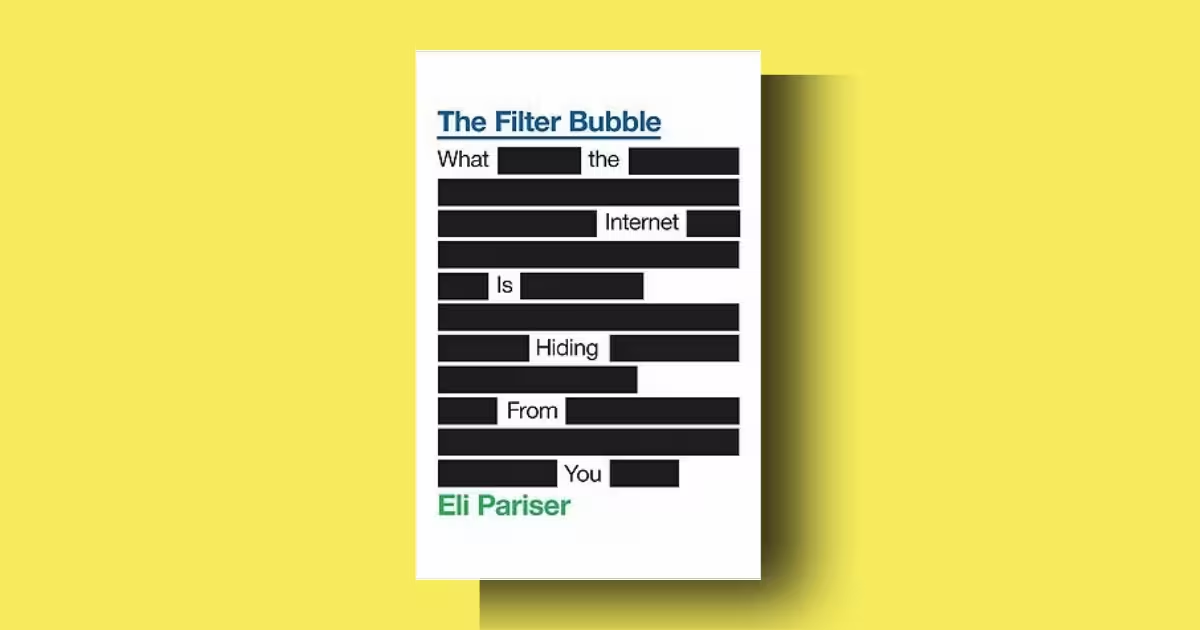

Can you really trust what shows up in your Google search results? Or has the internet quietly built a personalized cage around your worldview?
Overview
If you’ve ever wondered why your Facebook feed seems to confirm everything you already believe, or why your Google searches never show you the perspectives you disagree with, Eli Pariser’s The Filter Bubble (2011) explains exactly what’s happening, and why it’s a bigger problem than most of us realize.
Pariser, the former executive director of MoveOn.org and co-founder of Avaaz.org, argues that we’re living through an invisible revolution. Starting in December 2009, when Google began personalizing search results for everyone, the internet quietly stopped showing us the same thing. Instead, algorithms now construct a unique information universe for each of us, what Pariser calls the “filter bubble”.
The book traces how this happened: the economic incentives driving Google, Facebook, Amazon, and a shadowy industry of data brokers like Acxiom to collect as much personal data as possible. It explores how personalization affects not just what we buy, but how we think, learn, and participate in democracy.
The Filter Bubble isn’t a technical manual. It’s an accessible, alarming wake-up call about the hidden architecture shaping our digital lives, and a roadmap for what we can do about it.
The Filter Bubble Recommendation
Read The Filter Bubble if:
- You’re a regular internet user who’s ever felt like your online world is getting smaller, not bigger
- You care about democracy, civic discourse, or how technology shapes society
- You work in media, marketing, technology, or policy
- You’re curious about why political polarization seems to be getting worse
- You want to understand the invisible forces shaping what you see, read, and believe online
Skip The Filter Bubble if:
- You’re looking for a deep technical explanation of how recommendation algorithms work (this isn’t that book)
- You believe personalization is entirely benign and have no concerns about privacy or filter bubbles
- You prefer pure optimism about technology without any critical examination
Table of Contents
1. Introduction
The Filter Bubble: What the Internet Is Hiding from You by Eli Pariser
Published: May 12, 2011, by Penguin Press
Pages: 294 (hardcover), 304 (paperback)
Author: Eli Pariser, board president and former executive director of MoveOn.org, co-founder of Avaaz.org and Upworthy. At age 23, he became Executive Director of MoveOn, helping pioneer online citizen engagement. He’s written for The Washington Post and The Wall Street Journal and appeared on The Colbert Report, Good Morning America, and Fresh Air.
Context: What The Filter Bubble Is About
The Filter Bubble is a work of investigative journalism and social criticism that sits at the intersection of technology, media studies, and political science. Pariser examines how the rise of personalization algorithms, the code that decides what you see on Google, Facebook, YouTube, and countless other sites, is fundamentally changing how we consume information.
The book argues that the internet, once celebrated as an open platform for democratic exchange, is quietly closing in on itself. Instead of connecting us to a broader world, personalization is walling us into isolated information universes where we mainly encounter what confirms our existing beliefs.
Purpose: The Central Thesis
Pariser’s central argument is stark and urgent: The rise of invisible, algorithmic personalization is undermining the internet’s original promise as a tool for democratic engagement, creative discovery, and shared understanding.
The filter bubble has three defining characteristics that make it uniquely dangerous:
- You’re alone in it: unlike watching a cable news channel with other viewers, your personalized information universe is unique to you
- It’s invisible: you don’t know what’s being filtered out or why
- You didn’t choose it: these filters come to you automatically, driven by profit motives, not your conscious decisions
Pariser warns that this isn’t just about seeing different ads or product recommendations. It’s about democracy itself. As he writes, “Democracy requires citizens to see things from one another’s point of view, but instead we’re more and more enclosed in our own bubbles. Democracy requires a reliance on shared facts; instead we’re being offered parallel but separate universes”.
2. Background
To understand why The Filter Bubble matters, it helps to know where the idea came from. Pariser didn’t invent the concept of personalized media out of thin air, he was responding to a trend that had been building for decades.
In 1994, MIT Media Lab founder Nicholas Negroponte envisioned a future where intelligent software agents would curate a personalized “Daily Me” for each user. Virtual reality pioneer Jaron Lanier immediately warned that such agents would be “bribable,” serving advertisers as much as users. Lanier wrote: “An agent’s model of what you are interested in will be a cartoon model, and you will see a cartoon version of the world through the agent’s eyes”.
That same year, Jeff Bezos founded Amazon with the vision of replicating the personal touch of a small bookstore at mass scale. Amazon’s recommendation engine became a key driver of its success.
Meanwhile, at Stanford, Larry Page and Sergey Brin developed Google’s PageRank algorithm. Their deeper insight was that ever more user data could continuously improve relevance; they launched services like Gmail partly to keep users logged in and generating personal data.
Mark Zuckerberg created Facebook in 2004 to map people’s real-world social connections. The introduction of the News Feed in September 2005, powered by EdgeRank—an algorithm based on affinity, content type, and recency- transformed the site into a personalized newspaper.
Facebook’s 2010 “Facebook Everywhere” initiative extended personalization across the Web through the Like button, generating 1 billion Likes in its first 24 hours.
Behind these giants lies a vast personal data market. Acxiom, a data company Pariser profiles, maintains roughly 1,500 data points on 96 percent of American households. Intermediaries like BlueKai auction off users’ browsing data in milliseconds to advertisers.
This is the world Pariser stepped into, a world where the race to collect personal data had become “the central battle of the era for Internet giants like Google, Facebook, Apple, and Microsoft”.
3. The Filter Bubble Summary
What follows is a comprehensive summary of the book’s core arguments, organized thematically. After reading this, you’ll understand the key ideas without needing to read the original, though I’d still recommend it.
The Tipping Point: December 4, 2009
The book opens with an event few people noticed at the time. On December 4, 2009, Google announced “Personalized search for everyone”. Starting that morning, Google would use fifty-seven signals—location, browser type, search history, and more—to customize results for each user. Even if you were logged out, your results would be different from someone else’s.
Pariser illustrates this with a vivid example. In spring 2010, during the Deepwater Horizon oil spill, he asked two friends: both educated, left-leaning women in the Northeast, to search for “BP”.
One saw investment information; the other saw news about the oil spill. One got 180 million results; the other got 139 million. As Pariser writes: “In other words, there is no standard Google anymore”.
How Personalization Works: The Three-Step Model
Most personalized filters operate on a simple three-step model:
- Figure out who you are and what you like
- Provide content and services that best fit you
- Tune to get the fit just right
The problem is that this loop can become self-reinforcing. As Pariser explains: “Your identity shapes your media, and your media then shapes what you believe and what you care about. You click on a link, which signals an interest in something, which means you’re more likely to see articles about that topic in the future, which in turn prime the topic for you. You become trapped in a you loop”.
The Economics Behind the Bubble
Pariser traces the economic forces driving personalization. If you’re not paying for something, you’re not the customer—you’re the product being sold. This insight, from a comment on MetaFilter, captures the core dynamic.
Google and Facebook offer free services in exchange for data about you. As Chris Palmer of the Electronic Frontier Foundation explained to Pariser: “You’re getting a free service, and the cost is information about you. And Google and Facebook translate that pretty directly into money”.
The data market is vast and largely invisible. Acxiom alone has accumulated an average of 1,500 pieces of data on each person in its database, which includes 96 percent of Americans. These data points cover everything from credit scores to whether you’ve bought medication for incontinence.
Behavioral retargeting means your behavior is now a commodity. When you browse a pair of shoes and leave the site, ads for those exact shoes follow you around the internet. As Pariser writes: “Every ‘click signal’ you create is a commodity, and every move of your mouse can be auctioned off within microseconds to the highest commercial bidder”.
How Personalization Is Reshaping News
Pariser devotes significant attention to how personalization is restructuring the news industry. Advertisers no longer need premium publishers like the New York Times to reach elite audiences, they can target those readers wherever they go online.
This has devastated traditional journalism’s business model. In 2003, publishers received most of each dollar advertisers spent on their sites. By 2010, they only received $0.20. As one executive at the Social Graph Symposium bluntly put it: “The publishers are losing, and they will lose, because they just don’t get it”.
Pariser challenges the popular narrative of “disintermediation”, the idea that the Internet eliminated middlemen. Instead, new intermediaries like Google and Facebook operate without the ethical framework that evolved in traditional journalism.
He invokes journalist Walter Lippmann’s assertion that democracy depends on trustworthy news and traces the 1920s debate between Lippmann (who argued citizens were too easily manipulated for self-governance) and philosopher John Dewey (who countered that journalism could cultivate democratic participation).
The Cognitive Consequences: How Filter Bubbles Change How We Think
One of the book’s most compelling sections explores how personalization affects cognition and creativity. Pariser draws on psychology research to show that filter bubbles amplify what psychologists call confirmation bias, our tendency to believe things that reinforce our existing views.
He cites the famous 1951 Princeton-Dartmouth football study, where Princeton students saw 9.8 infractions by Dartmouth while Dartmouth students saw only 4.3. Each side saw what they wanted to see, not what was actually on the film.
Pariser argues that filter bubbles dramatically amplify this effect: “Consuming information that conforms to our ideas of the world is easy and pleasurable; consuming information that challenges us to think in new ways or question our assumptions is frustrating and difficult”.
The book also explores how personalization can dampen creativity. Pariser cites psychologist Hans Eysenck’s research showing that creativity involves searching for the right set of ideas to combine. When your “solution horizon” is narrowed by personalized filters, you’re less likely to encounter the random, unexpected ideas that spark breakthroughs.
As Pariser writes: “By definition, a world constructed from the familiar is a world in which there’s nothing to learn”.
The Public Is Irrelevant
Perhaps the book’s most alarming section examines how filter bubbles undermine democracy. Pariser argues that the filter bubble makes the public sphere, the realm where common problems are identified and addressed, “just less relevant”.
He introduces the concept of the friendly world syndrome, the opposite of the “mean world syndrome” identified by communications researcher George Gerbner. While television’s “if it bleeds, it leads” approach made viewers overestimate violence, personalized filtering makes important but unpleasant issues disappear.
Pariser points to Facebook’s decision to name its engagement button “Like” instead of “Important” as a small design choice with far-reaching consequences. Stories that get the most Likes are, well, more likable, not necessarily more important.
The book also explores how political campaigns are increasingly microtargeting voters, creating a situation where different people see completely different campaign messages. Pariser asks: “In a filtered world, with candidates microtargeting the few persuadables, would you know that the campaign was happening at all?”.
The You Loop: Identity and Personalization
Pariser examines how personalization affects identity. Facebook founder Mark Zuckerberg famously said: “You have one identity. The days of you having a different image for your work friends or coworkers and for the other people you know are probably coming to an end pretty quickly”.
Pariser pushes back hard. Psychologists call this fundamental attribution error, we tend to attribute people’s behavior to their inner traits rather than the situations they’re placed in. In reality, our characteristics are fluid. Someone who’s aggressive at work may be a doormat at home.
The problem is that personalization algorithms don’t capture this nuance. Google’s filtering systems rely heavily on what you click on (click signals) to infer what you like. Facebook’s approach is different, it looks at what you share and with whom you interact. As Pariser notes: “There’s a big difference between ‘you are what you click’ and ‘you are what you share’”.
Both approaches are incomplete. As privacy expert Daniel Solove puts it: “Information about our property, our professions, our purchases, our finances, and our medical history does not tell the whole story. We are more than the bits of data we give off as we go about our lives”.
What Can Be Done
Despite the book’s alarming tone, Pariser ends on a note of cautious optimism. He outlines solutions at three levels:
Individual actions:
- Vary your information diet, don’t just visit the same three sites every day
- Erase your cookies regularly
- Use services like Twitter that are more transparent about how they filter information
Corporate responsibility:
- Companies should make their filtering systems more transparent
- They should appoint independent ombudsmen
- They should allow users to see and correct the data collected about them
- They should “solve for serendipity”, designing systems that expose people to topics outside their normal experience
Government regulation:
- Enforce Fair Information Practices: you should know who has your data, how it’s used, and be able to correct inaccuracies
- Think of personal data as a form of property with rights attached
- Create an agency to oversee the use of personal information
4. The Filter Bubble Analysis
Reading The Filter Bubble in 2026 feels both familiar and unsettling. Familiar because the book’s core insights have become part of our cultural vocabulary, the term “filter bubble” is now widely used. Unsettling because, fifteen years after Pariser first sounded the alarm, the problems he identified have only grown more acute.
What the Book Gets Right
Pariser’s central diagnosis is remarkably prescient. In 2017, The Guardian ran a profile titled “Eli Pariser: activist whose filter bubble warnings presaged Trump and Brexit”.
Five years before those shocks, Pariser had predicted exactly how personalized information environments would leave people surprised when “someone very unlike you wins the presidency”.
His analysis of the economics driving personalization remains accurate. The data market has only grown. Acxiom and its competitors now have even more data on more people. Behavioral retargeting is more sophisticated. The incentives for companies to personalize are stronger than ever.
His critique of Facebook’s design choices, particularly the “Like” button, has been validated by subsequent research showing how engagement-optimized systems narrow informational exposure over time.
Where the Book Falls Short
That said, The Filter Bubble has limitations. Some critics have argued that the filter bubble metaphor oversimplifies a more complex reality. Research published in 2025 found that short-term exposure to filter-bubble recommendation systems has “limited polarization effects”.
The evidence doesn’t consistently support the idea that algorithms are radicalizing users en masse.
Pariser’s proposed solutions also seem somewhat naive in retrospect. The idea that companies would voluntarily appoint ombudsmen or prioritize serendipity over engagement has not materialized. And government regulation has been slow and piecemeal.
The book also doesn’t fully grapple with the fact that people actively choose much of their own filtering. As Pariser himself acknowledges: “Of course, to some extent we’ve always consumed media that appealed to our interests”. The filter bubble isn’t just something done to us, it’s something we participate in.
5. Strengths and Weaknesses
Strengths
Accessible writing. Pariser explains complex technical and sociological concepts in clear, engaging prose. As one reviewer noted, the book is “not very technical, so there is not a deep discussion of the nature of recommendation systems”—which is actually a strength for general readers.
Powerful framing. The term “filter bubble” itself is a brilliant piece of communication. It captures a complex phenomenon in a memorable, intuitive metaphor.
Compelling examples. The BP search experiment, the Princeton-Dartmouth study, the story of Yuri Nosenko, Pariser uses vivid examples to make abstract concepts concrete.
Balanced perspective. Pariser doesn’t reject personalization entirely. He acknowledges its benefits: “I enjoy using Pandora, Netflix, and Facebook as much as the next person”.
Calls to action. The book doesn’t just diagnose problems, it offers concrete solutions at multiple levels.
Weaknesses
Somewhat dated. The book was published in 2011, before many of the phenomena it discusses (fake news, the 2016 election, the rise of TikTok) had fully emerged. Pariser has acknowledged that “the more you look at it, the more complicated it gets”.
Overreliance on anecdote. Some critics have noted that Pariser draws on “gross generalizations about psychology and other more technical fields with which he is not that familiar”.
Solutions feel insufficient. As one reviewer put it, “Pariser is almost as persuasive at describing potential solutions as he is at finding problems”, but the solutions he proposes haven’t been widely adopted.
The metaphor may be too simplistic. Some scholars argue that the “filter bubble” and “echo chamber” metaphors “imply that… it is well past time that these metaphors were retired from scholarly and everyday use”.
6. Comparison with Similar Works
The Filter Bubble belongs to a genre of books examining technology’s unintended consequences. Here’s how it compares to similar works:
| Book | Author | Year | Focus | Key Difference |
|---|---|---|---|---|
| The Filter Bubble | Eli Pariser | 2011 | Algorithmic personalization | Focuses on how algorithms curate what we see |
| The Shallows | Nicholas Carr | 2010 | Internet and cognition | Argues the internet is making us stupid |
| Republic.com | Cass Sunstein | 2001 | Personalized news and democracy | Earlier exploration of similar themes |
| You Are Not a Gadget | Jaron Lanier | 2010 | Digital culture | More philosophical, less policy-focused |
| The Master Switch | Tim Wu | 2010 | Information empires | Historical perspective on media consolidation |
| The Future of the Internet | Jonathan Zittrain | 2008 | Generativity vs. control | Focuses on open vs. closed systems |
The Filter Bubble stands out for its focus on the invisible nature of algorithmic curation. While Sunstein worried about people choosing to consume only like-minded content, Pariser shows how personalization happens automatically, without our knowledge or consent.
7. Conclusion
Final Verdict
The Filter Bubble is an important book, not a perfect one, but a necessary one. It’s the kind of book that changes how you see the world. After reading it, you’ll never look at your Google search results or Facebook feed the same way again.
The book’s core insight, that invisible algorithms are quietly shaping what we see, think, and believe- has only become more relevant with time. As Pariser writes: “The filter bubble distorts our perception of what’s important, true, and real”.
Fifteen years after publication, The Filter Bubble remains one of the most important books about the internet ever written. It’s not the final word on the subject, the research has evolved, the technology has advanced, and the problems have grown more complex. But it’s the starting point for any serious conversation about how personalization is reshaping our world.
As Pariser warned: “The danger of these filters is that you think you are getting a representative view of the world and you are really, really not, and you don’t know it”. That warning is as urgent today as it was in 2011.