
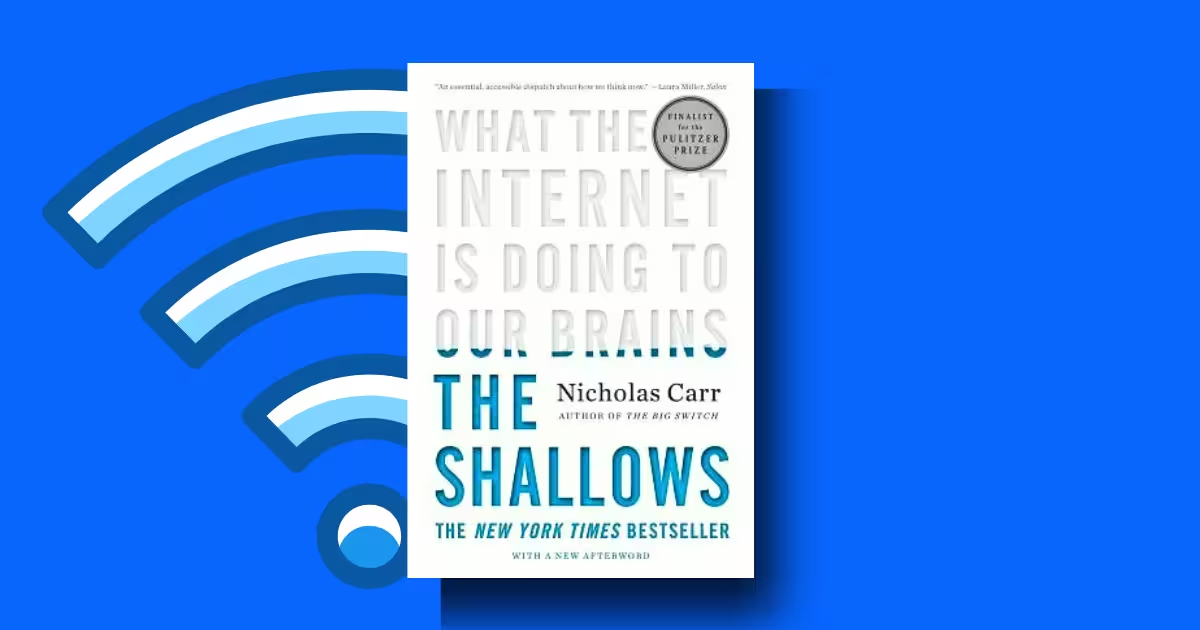

Ever wonder why you can’t finish a single article without checking your phone? Nicholas Carr’s The Shallows: What the Internet Is Doing to Our Brains might just explain why, and it’s more disturbing than you think.
Overview
The Shallows is not another “get off your phone” lecture. It’s a meticulously researched investigation into how the Internet is physically rewiring our brains, and not for the better.
For whom? This book is essential reading for anyone who:
- Has noticed their attention span shrinking
- Struggles to finish books they used to devour
- Feels a compulsive need to check their phone every few minutes
- Works in education, technology, or media
- Cares about the future of human cognition
Not for: People looking for a quick “digital detox” guide or those who believe technology is entirely neutral. Carr doesn’t offer easy solutions—he offers a diagnosis.
Table of Contents
1. Introduction
The Shallows: What the Internet Is Doing to Our Brains by Nicholas Carr was first published on June 7, 2010, by W. W. Norton & Company. The book runs approximately 276 pages and was a finalist for the 2011 Pulitzer Prize in General Nonfiction.
Carr is an American journalist and writer who has contributed to The Atlantic, The New York Times, The Wall Street Journal, Wired, and The Guardian. He was formerly the executive editor of the Harvard Business Review and is the author of several acclaimed books on technology and culture, including The Big Switch and The Glass Cage.
Slate’s Michael Agger called The Shallows “a Silent Spring for the literary mind”, a fitting comparison, given how the book sounds an alarm about an environmental crisis of the mind.
Context
The Shallows grew out of Carr’s 2008 Atlantic cover story, “Is Google Making Us Stupid?”, an article that sparked fierce debate worldwide. The book expands that argument into a sweeping exploration of how digital technology affects our cognition, drawing on neuroscience, history, philosophy, and personal experience.
Purpose
The book’s central thesis is both simple and profound: the Internet is not just changing how we access information—it’s physically rewiring our brains, sacrificing our capacity for deep, contemplative thought in favor of rapid, shallow information processing. Carr writes:
“What the Net seems to be doing is chipping away my capacity for concentration and contemplation. Whether I’m online or not, my mind now expects to take in information the way the Net distributes it: in a swiftly moving stream of particles.”
2. Background
To understand The Shallows, you need to understand neuroplasticity—the brain’s ability to change its physical structure in response to experience. For most of history, scientists believed the adult brain was fixed and unchangeable. As Carr documents, we now know this is false.
Carr builds on the work of pioneering neuroscientists like Michael Merzenich, who demonstrated that monkey brains reorganize themselves after nerve damage, and Eric Kandel, a Nobel laureate who showed that “the number of synapses in the brain is not fixed—it changes with learning”.
This matters because it means our habits literally shape our brains. If we spend hours each day skimming, clicking, and multitasking, our brains adapt to that mode of thinking—and lose the ability for deep focus.
3. The Shallows Summary
Prologue: The Watchdog and The Thief
Carr opens with Marshall McLuhan’s famous insight: “The medium is the message.” McLuhan argued that we focus on media content while ignoring how the medium itself changes us. Carr warns that the Internet is our latest medium—and its effects are already visible:
“The content of a medium is just ‘the juicy piece of meat carried by the burglar to distract the watchdog of the mind.'”
Chapter 1: Hal and Me
Carr begins with a deeply personal confession. He notices he can no longer read long texts the way he used to:
“Once I was a scuba diver in the sea of words. Now I zip along the surface like a guy on a Jet Ski.”
He discovers he’s not alone. Friends, colleagues, and even Rhodes Scholars admit they’ve stopped reading books entirely. One philosophy major explains: “I don’t read books… I go to Google, and I can absorb relevant information quickly”.
Carr traces his own journey from analogue youth to digital adulthood, from the Macintosh Plus he bought in 1986 to the Web 2.0 world of blogs, social media, and constant connectivity. He confesses:
“I missed my old brain.”
Chapter 2: The Vital Paths
This chapter provides the neuroscientific foundation for Carr’s argument. He tells the story of Friedrich Nietzsche, who bought a typewriter when his eyesight failed and noticed his prose style had changed:
“Our writing equipment takes part in the forming of our thoughts.”
Carr then traces the history of neuroplasticity research—from William James and Sigmund Freud to Michael Merzenich’s groundbreaking monkey experiments. The key insight: “Cells that fire together wire together.” Our repeated activities strengthen some neural pathways while allowing others to atrophy.
“If we stop exercising our mental skills, we do not just forget them: the brain map space for those skills is turned over to the skills we practice instead.”
Chapter 3: Tools of the Mind
Carr argues that every intellectual technology carries an “intellectual ethic” —a set of assumptions about how the mind should work. The map changed how we think about space; the clock changed how we think about time.
“The intellectual ethic of a technology is rarely recognized by its inventors. They are usually so intent on solving a particular problem… that they don’t see the broader implications of their work.”
Chapter 4: The Deepening Page
This chapter is a history of reading—from clay tablets to scrolls to codices to Gutenberg’s printing press. Carr shows how word spacing (introduced around the 13th century) made silent reading possible and transformed human consciousness.
“To read a book was to practice an unnatural process of thought, one that demanded sustained, unbroken attention to a single, static object.”
The printing press made books cheap and abundant, fostering an “intellectual ethic of the book” : solitary, deep, linear thinking. This ethic became the foundation of Western culture—from science to philosophy to literature.
Chapter 5: A Medium of the Most General Nature
Carr explains how the Internet, as Alan Turing’s “universal machine,” is subsuming all other media. It’s becoming our typewriter, printing press, map, clock, calculator, telephone, post office, library, radio, and TV—all in one.
This has profound consequences:
“When the Net absorbs a medium, it re-creates that medium in its own image. It not only dissolves the medium’s physical form; it injects the medium’s content with hyperlinks, breaks up the content into searchable chunks, and surrounds the content with the content of all the other media it has absorbed.”
Carr cites statistics: by 2009, North American adults spent an average of 12 hours online per week—double the 2005 figure. By 2024, that figure has jumped to over 6 hours and 38 minutes per day globally. In the U.S., it’s over 7 hours daily.
Chapter 6: The Very Image of a Book
Carr examines the future of books in the digital age. He acknowledges the advantages of e-readers like the Kindle—convenience, portability, searchability—but warns:
“An e-book is no more a book than an online newspaper is a newspaper.”
He describes his own experience reading on a Kindle:
“Distractions abounded. I looked up Dickens on Wikipedia, then jumped straight down the Internet rabbit hole… Twenty minutes later I still hadn’t returned to my reading.”
Carr worries that the death of deep reading will lead to a death of deep writing—authors will tailor their work for skimmers and searchers.
“The practice of deep reading that became popular in the wake of Gutenberg’s invention… will continue to fade, in all likelihood becoming the province of a small and dwindling elite.”
Chapter 7: The Juggler’s Brain
This is the book’s most alarming chapter. Carr synthesizes dozens of studies showing that the Internet promotes cursory reading, hurried thinking, and superficial learning.
Key findings include:
- Hypertext increases cognitive load, impairing comprehension and retention.
- Multimedia—multiple simultaneous inputs—limits rather than enhances information acquisition.
- Constant interruptions scatter our thoughts, weaken our memory, and make us tense and anxious.
“The influx of competing messages that we receive whenever we go online not only overloads our working memory; it makes it much harder for our frontal lobes to concentrate our attention on any one thing. The process of memory consolidation can’t even get started.”
Carr cites the work of John Sweller, who explains that working memory can hold only two to four elements at a time. When we’re online, multiple information faucets overflow our “thimble” of working memory, preventing deep learning.
Eye-tracking studies reveal that most people read Web pages in an F-shaped pattern—skimming the first few lines, then scanning down the left side. Only 18% of the words on a typical page are read—and most pages are viewed for less than 10 seconds.
The result? We’re becoming “pancake people—spread wide and thin,” as playwright Richard Foreman put it.
Chapter 8: The Church of Google
Carr turns his attention to Google, which he portrays as the high priest of digital Taylorism.
Frederick Winslow Taylor pioneered “scientific management” in factories—breaking down every job into its most efficient steps. Google applies the same philosophy to the mind:
“Google’s profits are tied directly to the velocity of people’s information intake. The faster we surf across the surface of the Web—the more links we click and pages we view—the more opportunities Google gains to collect information about us and to feed us advertisements.”
Google’s founders, Larry Page and Sergey Brin, view the brain as a computer—and intelligence as “about overall computation” . Carr writes:
“What’s disturbing about the company’s founders is not their boyish desire to create an amazingly cool machine that will be able to outthink its creators, but the pinched conception of the human mind that gives rise to such a desire.”
Chapter 9: Search, Memory
Carr examines memory—how it works and how the Internet is changing it. He draws on Eric Kandel’s Nobel-winning research, which showed that long-term memory requires physical changes in the brain—the growth of new synaptic terminals.
“The key to memory consolidation is attentiveness.”
When we rely on Google as an “outboard brain,” we short-circuit the consolidation process:
“When we outsource our memory to a machine, we also outsource a very important part of our intellect and even our identity.”
Carr warns that cultural memory itself is at risk:
“Culture is more than what can be reduced to binary code and uploaded onto the Net. To remain vital, culture must be renewed in the minds of the members of every generation. Outsource memory, and culture withers.”
Chapter 10: A Thing Like Me
Carr tells the story of Joseph Weizenbaum’s ELIZA, a 1960s chatbot that simulated a psychotherapist. Users became emotionally attached to the program, even though they knew it was just software.
“We program our computers and thereafter they program us.”
Carr reflects on the deeper implications: our tools amplify some capacities while numbing others. The more we merge with our machines, the more we risk losing our humanity.
Epilogue: Human Elements
Carr ends on a somber but not entirely hopeless note. He recounts how he temporarily disconnected from the Internet to finish writing the book—and how his ability to concentrate returned. But he also admits:
“I’m already backsliding.”
He closes with a reflection on 2001: A Space Odyssey—where the most human character turns out to be the computer HAL. Carr writes:
“As we come to rely on computers to mediate our understanding of the world, it is our own intelligence that flattens into artificial intelligence.”
4. The Shallows Analysis
The Shallows is an important, sobering, and beautifully written book—one that deserves its status as a Pulitzer Prize finalist.
What works:
Carr’s use of history is masterful. By tracing the evolution of reading from oral culture to the printing press, he shows that our current moment is not unprecedented—but it is uniquely dangerous. The book’s neuroscience is accessible without being superficial, and Carr’s personal anecdotes make the argument feel urgent and real.
His metaphor of the “scuba diver” versus the “Jet Ski” is unforgettable. He doesn’t just tell us we’re becoming shallow; he makes us feel it.
What doesn’t work:
Critics have argued that Carr overstates the case. The Internet does offer cognitive benefits—improved visual-spatial skills, faster reaction times, better multitasking. Carr acknowledges this but doesn’t give it enough weight.
Some also find the book too long. The historical chapters, while fascinating, can feel like a detour from the central argument.
And Carr offers few solutions. He diagnoses the problem brilliantly but leaves readers wondering: What do we do about it?
5. Strengths and Weaknesses
Strengths
Meticulous research—Carr draws on neuroscience, psychology, history, and philosophy
Accessible writing—complex ideas explained clearly
Personal honesty—Carr admits his own struggles with distraction
Prophetic vision—written in 2010, the book predicted many of today’s digital dilemmas
Weaknesses
- Over-reliance on historical context; some chapters feel like tangents
- Lack of practical solutions; readers may feel helpless after finishing
- Underplays cognitive benefits; the Internet does make us faster at some tasks
- Dated in places; written before TikTok, Instagram Reels, and AI chatbots
6. Comparison with Similar Works
The Shallows sits alongside several important books about technology and cognition:
| Book | Author | Year | Focus |
|---|---|---|---|
| Amusing Ourselves to Death | Neil Postman | 1985 | Television’s effect on public discourse |
| You Are Not a Gadget | Jaron Lanier | 2010 | Digital culture and human dignity |
| The Glass Cage | Nicholas Carr | 2014 | Automation’s effect on skills |
| Digital Minimalism | Cal Newport | 2019 | Practical digital detox strategies |
| The Attention Merchants | Tim Wu | 2016 | The history of attention capture |
The Shallows is less practical than Newport’s work and less polemical than Lanier’s. It’s closest in spirit to Postman’s Amusing Ourselves to Death, a sweeping cultural critique rooted in media theory.
7. Conclusion
Who Should Read This Book?
The Shallows is for anyone who has ever felt their attention slipping away. It’s for parents worried about their children’s screen time. It’s for teachers watching students struggle to read whole books. It’s for professionals who feel constantly overwhelmed by email and notifications.
In 2024, the average person spends over 6 hours and 38 minutes online daily. We check our phones hundreds of times a day. We can barely sit through a two-hour movie without reaching for our devices.
Carr’s book is more relevant now than when it was published—and that’s precisely the problem. He warned us, and we didn’t listen.
Final Say
The Shallows is essential reading—a book that changes how you see yourself, your devices, and your culture. It won’t give you easy answers. But it will give you something more valuable: the awareness to ask the right questions.
“We shouldn’t allow the glories of technology to blind our inner watchdog to the possibility that we’ve numbed an essential part of our self.”