
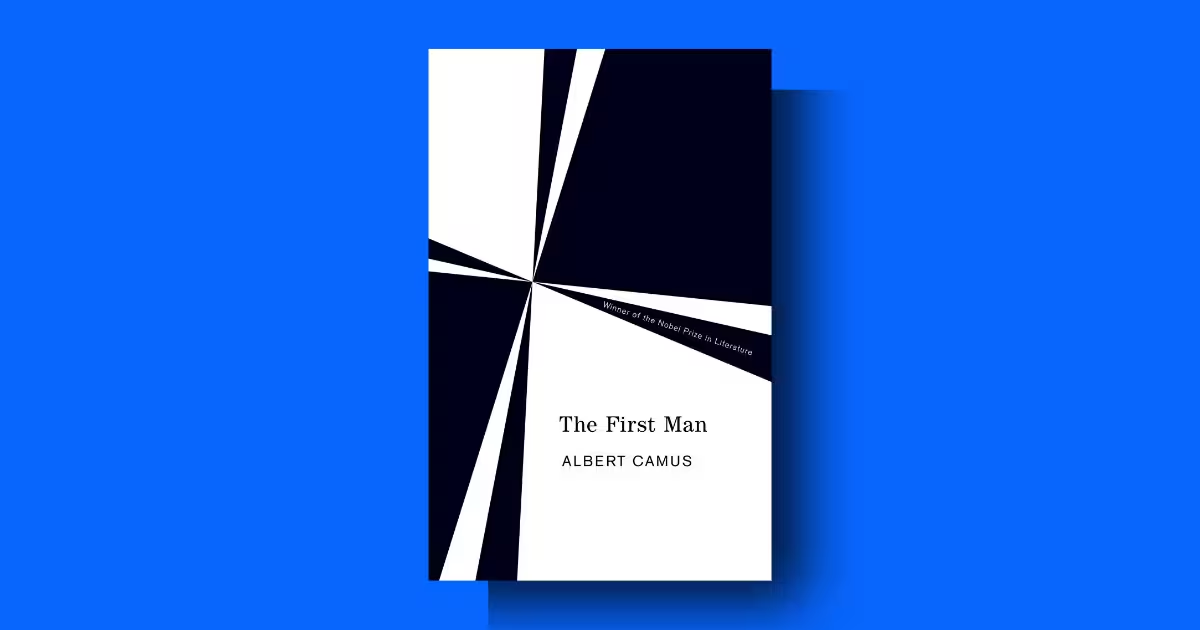
Did you know Albert Camus was carrying the manuscript of his most personal novel, The First Man, when he died in a car crash at age 46, and it sat unpublished for 34 years because his friends feared it would be used to attack him?
Overview
The First Man is Albert Camus’s unfinished autobiographical novel, published posthumously in 1994—34 years after his death. The manuscript was found in the mud at the crash site that killed him on January 4, 1960. It follows Jacques Cormery (Camus’s fictional double) from his birth in Algeria through his childhood and adolescence in a poor, fatherless household.
Unlike Camus’s philosophical works like The Stranger or The Plague, this novel is “heavy with things and flesh”—a visceral, sensory recreation of poverty, the Algerian landscape, and the painful love between a son and his illiterate, half-deaf mother.
It’s a search for a father the protagonist never knew and an exploration of what it means to be “the first man”—someone without roots, without a past, building himself from nothing.
Reader recommendation
The First Man is perfect for readers who want to understand Camus the man, not just Camus the philosopher. Fans of deeply sensory, atmospheric autobiographical fiction. Anyone interested in colonial Algeria, poverty, and the redemptive power of education.
The First Man may disappoint the readers seeking a polished, finished novel with a tight plot. Those who prefer Camus’s more philosophical, abstract works. Anyone put off by fragmented structure, inconsistencies, and unfinished passages.
Table of Contents
Background
The story of The First Man begins with its discovery. On January 4, 1960, Albert Camus died in a car accident in Villeblevin, France. He was 46 years old.
In the mud at the accident site, investigators found the briefcase he had been carrying. Inside was the handwritten manuscript of an unfinished novel he had been working on, Le Premier Homme.
Camus’s widow, Francine, and his friends made a difficult decision. They chose not to publish the manuscript. The political climate in 1960 was hostile to Camus.
He had condemned both the Soviet Gulag and the excesses of the Algerian independence movement, making enemies on both the left and the right.
Publishing an unfinished, unpolished manuscript would have given his critics ammunition to claim he was finished as a writer.
For 34 years, the manuscript sat untouched. It wasn’t until 1994 that Camus’s daughter, Catherine Camus, finally transcribed and published it. Using magnifying lenses and photographic enlargement, the family spent years deciphering Camus’s illegible scrawl, his deletions, and his margin notes. The English translation, by David Hapgood, appeared in 1995.
Camus had hoped this would be his masterpiece, his War and Peace. Even in its unfinished state, some critics agreed, citing its “physical intensity and uninhibited psychology of boyhood” as something absent from his more reserved earlier novels.
The First Man: Complete Plot Summary
Part One: Search for the Father
The novel opens in the fall of 1913. A young couple, Henri and Lucie Cormery, are traveling by wagon through the rain from the port of Bône to a farm near the village of Solferino in Algeria. Henri is taking over management of the Saint-Apôtre property. Lucie is heavily pregnant.
The journey is harsh. The roads are rough, the rain relentless. When they finally arrive at the small whitewashed farmhouse, Lucie goes into labor. Henri rides bareback through the night to fetch the doctor and a local woman to help. The baby is born—a boy. Henri names him Jacques, after the woman who helped deliver him.
Forty years later, Jacques Cormery is a successful man in his forties. He travels to Saint-Brieuc, France, to visit the grave of his father—a man he never knew. Henri Cormery was killed in the Battle of the Marne in 1914, when Jacques was less than a year old.
At the cemetery, Jacques reads the dates on the tombstone: “1885-1914.” He does the arithmetic. His father was 29 when he died. Jacques is 40. He is older than his own father.
“Something here was not in the natural order and, in truth, there was no order but only madness and chaos when the son was older than the father.”
This realization shatters him. He has spent his life building himself, creating his own identity, but he knows nothing about the man who gave him life. He decides to search for his father—to learn who this young, dead stranger really was.
Jacques visits his old friend Victor Malan in Saint-Brieuc. Malan is a retired customs official, a wise and melancholic man who had once been a mentor to the young Jacques. They discuss Jacques’s quest. Malan is skeptical—”an inquiry that is bound to be superficial forty years after a man’s death runs the risk of bringing you only limited information”. But Jacques insists. He needs to know.
Part Two: The Child’s Games
The narrative shifts into extended flashback. We see Jacques’s childhood in the poor Belcourt neighborhood of Algiers.
The family lives in a cramped apartment—three rooms shared by Jacques, his older brother, his mother, his grandmother, and his deaf-mute uncle. His father is dead. His mother, Catherine, is illiterate and half-deaf. She works as a domestic, cleaning other people’s houses. His grandmother, a stern Spanish woman, rules the household with an iron hand.
Jacques’s childhood is poor but not miserable. The neighborhood provides a world of sensory riches: the sea at Sablettes beach, the “green field” where boys fight ritual duels called donnades, the experimental garden where they steal “cocoses” (palm fruits) by throwing stones.
There are the movies with his grandmother, where Jacques has to read the subtitles aloud because she can’t read. There are the summer hunting trips with his uncle Ernest, a deaf-mute cooper who communicates through grunts and gestures but loves Jacques fiercely.
Poverty is a constant presence. Jacques wears raincoats that are too big because his grandmother buys them “to last.” His shoes have metal studs that his grandmother checks every day to make sure he hasn’t been playing soccer on the cement playground.
When a two-franc coin falls through a hole in his pocket, he lies about it—and watches in horror as his grandmother rolls up her sleeve and gropes through the toilet hole to find it.
“Poor people’s memory is less nourished than that of the rich… Remembrance of things past is just for the rich. For the poor it only marks the faint traces on the path to death.”
Part Three: The Father’s Death
Jacques visits his mother in Algiers. She is now in her seventies, still living in the same small apartment. A bomb explodes nearby—it’s the Algerian War, and violence is everywhere. Catherine is terrified but endures, as she has endured everything.
Jacques tries to question her about his father. She remembers little. Henri was born in 1885, the second child of Alsatian immigrants. His parents died when he was young, and his brothers put him in an orphanage. He never learned to read until a boss taught him. He was a hard worker, a man of few words. He married Catherine when he was 24 and she was 27.
The war came. Henri was mobilized in the Zouaves, the African infantry. He was sent to France—a country he had never seen. He died at the Battle of the Marne, killed by a shell fragment that split his skull. Catherine received his death notice on a Sunday morning, from the district mayor. She couldn’t read the letter. She just lay down in the dark and stared at the ceiling.
Jacques also learns from an old teacher that his father had served in Morocco in 1905.
There, he had witnessed the mutilated bodies of two sentinels—their throats cut, their sexual organs stuffed in their mouths. Henri had been horrified. “A man doesn’t do that,” he had shouted. “That’s what makes a man”. He had preserved some part of himself that no one could touch—a core of humanity that poverty and war couldn’t destroy.
Part Four: The Family
The novel delves deeper into Jacques’s family history. His grandmother, the tyrant, had raised nine children in the bush. His uncle Ernest is a deaf-mute cooper, full of animal vitality and sudden rages. His uncle Josephin is a calculating miser who trades eggs and chickens on the railroad.
There is a painful episode when Jacques’s mother cuts her hair short—a new fashion. His grandmother calls her a whore. Catherine weeps in her room, and Jacques, helpless, watches her from the doorway.
There is also a mysterious suitor, Antoine, whom Ernest beats up and drives away. Jacques never fully understands what happened.
The family is bound together by poverty and necessity, but they hurt each other without meaning to. They are “speechless ones”—people who live without words, without memories, without any legacy except survival.
Part Five: School
This is the emotional heart of the novel. Jacques is a bright child, and his teacher, M. Bernard (based on Camus’s real teacher, Louis Germain), recognizes his potential.
M. Bernard is a remarkable educator. He is strict—he uses a red ruler called the “sugar cane” for corporal punishment—but he is also fair and deeply committed to his students. He talks to them about the war he fought in, reads them excerpts from Les Croix de Bois, and treats them as human beings worthy of respect.
When Jacques and his friends are nominated for secondary school scholarships, Jacques’s grandmother refuses. They are too poor. He needs to go to work. M. Bernard comes to the apartment and argues with the grandmother. “He’s already paid me,” the teacher says, shaking Jacques by the shoulders.
The grandmother relents.
Jacques passes the scholarship exam. But as he watches M. Bernard walk away, he feels a child’s immense anguish:
“Instead of the joy of success, a child’s immense anguish wrung his heart, as if he knew in advance that this success had just uprooted him from the warm and innocent world of the poor—a world closed in on itself like an island in the society—to be hurtled into a strange world, one no longer his.”
Part Six: Mondovi and the Settlement
Jacques travels to Mondovi, the region where he was born. He meets a farmer named Veillard, whose family had settled there in 1848—Parisian workers fleeing unemployment, promised land and houses that didn’t exist.
Veillard tells the story of his father, an old settler who, when ordered to evacuate, spent three days on his tractor uprooting all his vines. “If what we did here is a crime, it has to be wiped out,” he said. The old man now walks in circles in his apartment in Marseilles.
Jacques visits the old settler cemetery. The graves are worn and illegible. Whole generations have come, worked, procreated, and disappeared without a trace. The history of Algeria, he realizes, is a history of oblivion.
“All those men come from so many nations, under this magnificent sky, had disappeared without a trace, locked within themselves. An enormous oblivion spread over them.”
Jacques understands that he is one of them—a man without roots, without a past, without faith. He is the first man, building himself from nothing.
The First Man Analysis
Characters
Jacques Cormery: The protagonist is Camus’s fictional double. He is intelligent, passionate, and driven—but also arrogant, restless, and self-critical.
He grows up without a father, raised by women in poverty. His defining trait is his hunger: for knowledge, for experience, for life itself. As an adult, he is successful but haunted by the absence of his father and the silence of his mother. His journey is an attempt to fill that void.
Catherine Cormery: Jacques’s mother is one of the most affecting characters in all of Camus’s work. She is illiterate, half-deaf, and inarticulate—but she possesses a kind of grace that Jacques can never fully reach. She endures everything: poverty, the death of her husband, the bombing of her neighborhood. She never complains. She never asks for anything. She simply is. Jacques loves her desperately, but he can never truly connect with her. She lives in a world of silence that he cannot enter.
“She was just as she had been thirty years ago… the same look she had thirty years ago when she watched without intervening while her mother beat Jacques with a whip.”
The Grandmother: The grandmother is a tyrant, but she is also a survivor. She raised nine children in the bush. She manages the household’s meager finances with ruthless efficiency.
She beats Jacques when he misbehaves, but she also sacrifices for him. She is the engine of the family—hard, practical, and unsentimental. She represents the old world of poverty and endurance.
Uncle Ernest: The deaf-mute cooper is one of the novel’s most memorable characters.
He lives entirely through his body—through sensation, appetite, and emotion. He is generous, loyal, and occasionally violent. His relationship with his dog Brillant is comic and touching. He represents a kind of pre-verbal innocence that Jacques both loves and fears.
M. Bernard: Based on Camus’s real teacher Louis Germain, M. Bernard is the novel’s hero. He sees something in Jacques and takes the trouble to save him. He argues with Jacques’s grandmother, gives him extra lessons, and buys him croissants on the day of the scholarship exam.
He is the father Jacques never had. The novel ends with the actual letters exchanged between Camus and Germain after Camus won the Nobel Prize—a testament to the power of a single teacher to change a life.
Pierre: Jacques’s childhood friend, Pierre is steady, reliable, and loyal. He is everything Jacques is not—patient, discreet, unflashy. Their friendship endures through school and into adulthood. Pierre represents the stability and continuity that Jacques lacks.
The First Man Themes and Symbolism
The Search for the Father: This is the novel’s central theme. Jacques’s father is a ghost—a man he never knew, who died young and left no legacy. Jacques’s journey to Saint-Brieuc and Mondovi is an attempt to conjure this ghost, to give it substance. But he fails. His father remains a mystery. The search, however, is what matters. It forces Jacques to confront his own identity and his place in the world.
Poverty and Memory: Camus makes a striking observation: poor people have less memory than the rich. They have fewer landmarks in space and time. Their lives are “gray and featureless.”
Remembrance of things past is a luxury. For the poor, memory is just “the faint traces on the path to death”. This is a profound insight into the psychology of poverty—how it erases not just material wealth but also identity and history.
The Body and the Senses: Camus wanted this novel to be “heavy with things and flesh”. And it is.
The novel is filled with sensory details: the smell of the cooperage, the taste of fried potatoes, the feel of the sun on the beach, the sound of rain on a canvas roof. Jacques’s world is a physical one. He experiences life through his body.
This is a deliberate contrast to Camus’s more abstract philosophical works.
Colonialism and Oblivion: The novel is set against the backdrop of colonial Algeria. The settlers came from France, Spain, and elsewhere, fleeing poverty and persecution. They built villages, planted vineyards, and then disappeared. Their graves are worn and illegible. The novel suggests that colonialism is a history of forgetting—of people who came, worked, and died without leaving any trace.
Education as Salvation: M. Bernard is the novel’s savior. He rescues Jacques from the “fortress without drawbridges” of poverty. Education is the only way out. But it comes at a cost: it uproots Jacques from his family and his community. He becomes a stranger in his own home.
The Mother as Absolute Love: Jacques’s mother is the novel’s moral center. She cannot read, she cannot hear, she cannot speak. But she loves absolutely. Jacques, who has challenged everything and questioned everything, has “never loved anything except what was inevitable”. His mother is the one thing he never chose—and the one thing he cannot live without.
The First Man Evaluation
My Verdict
The First Man is an extraordinary, deeply moving, and profoundly human book. It is not a finished novel. It is a fragment, a rough draft, a collection of notes and sketches. But in its rawness, it reveals more about Camus than any of his polished works. This is the man behind the myth—the poor Algerian boy who made himself into a writer, who never forgot where he came from, who loved his mother with a hopeless love.
Strengths
The sensory richness. Camus’s prose is vivid and immediate. You can feel the heat, smell the dust, taste the salt. The novel is a physical experience.
The emotional honesty. Camus does not sentimentalize poverty. He shows its harshness—the beatings, the hunger, the humiliation. But he also shows its compensations: the freedom of the streets, the beauty of the sea, the warmth of family.
The character of Catherine. The mother is one of the most affecting figures in literature. Her silence is not emptiness; it is a presence. She embodies a kind of grace that Jacques can never fully understand.
The relationship with M. Bernard. The teacher-student relationship is beautifully rendered. It is a testament to the power of education to change lives.
The historical dimension. The novel gives us a vivid picture of colonial Algeria—the settlers, the Arabs, the violence, the forgetting. It is a valuable historical document as well as a literary one.
Weaknesses
The unfinished state. The novel is fragmented, inconsistent, and sometimes confusing. Characters change names. Plot threads are dropped. The appendix of notes and sketches is fascinating but also frustrating.
The lack of plot. This is not a novel in the conventional sense. It is a series of scenes and memories, loosely connected. Some readers will find it formless.
The occasional monotony. Some passages are overly detailed and repetitive. The long paragraphs can be exhausting.
The treatment of Arabs. Camus’s portrayal of Arabs is limited. They are present but mostly silent. They are objects of the narrative, not subjects. This reflects Camus’s own limitations as a colonial writer.
Impact and Controversy
The First Man was published 34 years after Camus’s death, at a time when his reputation was being rehabilitated. The collapse of ideological certitudes meant that Camus was no longer “persona non grata”. He could be read afresh as “a philosopher of our times”.
The novel also reignited debates about Camus and colonialism. Edward Said accused Camus of having “a colonial mentality”. Others defended him, pointing to his calls for a multicultural, democratic Algeria. The novel itself is ambivalent. It shows the violence and injustice of colonialism, but it also shows the deep attachment of the pieds-noirs to the land.
Comparison with Similar Works
The First Man is often compared to Proust’s In Search of Lost Time and Joyce’s A Portrait of the Artist as a Young Man. Like those works, it is a novel of memory and self-discovery. But it is more visceral, more physical, less intellectual.
It is also similar to Camus’s earlier works. The Stranger is about a man disconnected from his emotions. The First Man is about a man desperate to connect. The two novels are mirror images.
Adaptation
A film adaptation of The First Man, directed by Gianni Amelio, was released in 2011. It stars Jacques Gamblin as Jacques Cormery and Catherine Sola as his mother.
The film premiered at the Toronto International Film Festival and won a FIPRESCI critics’ prize. Reviews were mixed. Some praised its “ambitious, poetic and moving” qualities. Others found it “excessively subdued” and “less than the sum of its select, often beautiful passages”.
The film is a faithful adaptation, but it lacks the novel’s sensory intensity. It is worth watching for fans of Camus, but it does not replace the book.
Personal Insight: The Power of a Teacher
The most important theme in The First Man—and the one with the most contemporary relevance—is the power of education to change a life.
Jacques Cormery is born into poverty. His mother is illiterate. His grandmother can barely sign her name. His uncle is deaf and mute. There are no books in the house, no newspapers, no radio. Poverty is “a fortress without drawbridges”.
But Jacques has one thing: a teacher who believes in him. M. Bernard sees something in the boy and decides to save him. He argues with Jacques’s grandmother. He gives him extra lessons. He buys him croissants on the day of the scholarship exam.
Without M. Bernard, Jacques would have become a laborer, like his uncle. Instead, he becomes a writer. He wins the Nobel Prize. He changes the world.
This is not just a story about one boy. It is a story about the transformative power of education. It is a story about what happens when a teacher takes a child seriously.
In 1957, after winning the Nobel Prize, Camus wrote to his real teacher, Louis Germain:
“Without you, without the affectionate hand you extended to the small poor child that I was, without your teaching and your example, none of all this would have happened.”
This is a reminder that education is not just about test scores and rankings. It is about human connection. It is about seeing the potential in another person and helping them realize it. It is about opening doors that would otherwise remain closed.
In a world where educational inequality is still rampant, The First Man is a powerful testament to what is possible. It is a reminder that poverty does not have to be destiny. It is a celebration of the teachers who change lives, one student at a time.
5 Lessons from The First Man
Poverty erases memory. Poor people have fewer landmarks in space and time. Their lives are “gray and featureless.” Remembrance of things past is a luxury. This is not a judgment; it is an observation. Poverty is not just a lack of money; it is a lack of history.
The search for a father is the search for yourself. Jacques never knew his father. His quest to learn about him is really a quest to understand himself. Who are we without our parents? What do we inherit besides biology?
Education is the only way out. M. Bernard saves Jacques from poverty. But education comes at a cost: it uproots him from his family and his community. He becomes a stranger in his own home.
Love is what we do not choose. Jacques has challenged everything and questioned everything. But he has “never loved anything except what was inevitable”—his mother, his child, his fate. The heart is not free. It is bound to what is given.
We are all the first man. Jacques is someone without roots, without a past, without faith. He has to build himself from nothing. This is the condition of modernity. We are all the first man, trying to find our way in a world without guarantees.
The First Man Quotes
“Poor people’s memory is less nourished than that of the rich; it has fewer landmarks in space because they seldom leave the place where they live, and fewer reference points in time throughout lives that are grey and featureless. Remembrance of things past is just for the rich. For the poor it only marks the faint traces on the path to death.”
“Something here was not in the natural order and, in truth, there was no order but only madness and chaos when the son was older than the father.”
“There are people who vindicate the world, who help others live just by their presence.”
“He had never loved anything except what was inevitable. The people fate had imposed on him, the world as it appeared to him, everything in his life he had not been able to avoid… For the rest, for everything he had to choose, he made himself love, which is not the same thing.”
“And then he knew that war is no good, because vanquishing a man is as bitter as being vanquished.”
Conclusion
The First Man is not a perfect novel. It is unfinished, fragmented, inconsistent. But it is also one of the most honest and moving books Camus ever wrote. It is the story of a boy who made himself from nothing—and the story of the people who made him possible.
This is a book for anyone who has ever wondered where they came from. It is for anyone who has ever felt rootless, alone, or uncertain of their place in the world. It is for anyone who believes in the power of education, the importance of memory, and the redemptive power of love.
Camus died before he could finish this book. But in its unfinished state, it tells us more about him than any finished work could.
It reveals the man behind the myth—the poor Algerian boy who never forgot where he came from, who loved his mother with a hopeless love, and who spent his life searching for a father he never knew.
“He was the prince of the world, with a crown of shining talent, of passions, of strength, of joy, and it was from all that that he was coming to beg her forgiveness, she who had been a submissive slave to life and the passing days, who knew nothing, desired nothing, and did not dare to desire, and who nonetheless had preserved intact a truth he had lost and that was all that justified our existence.”







