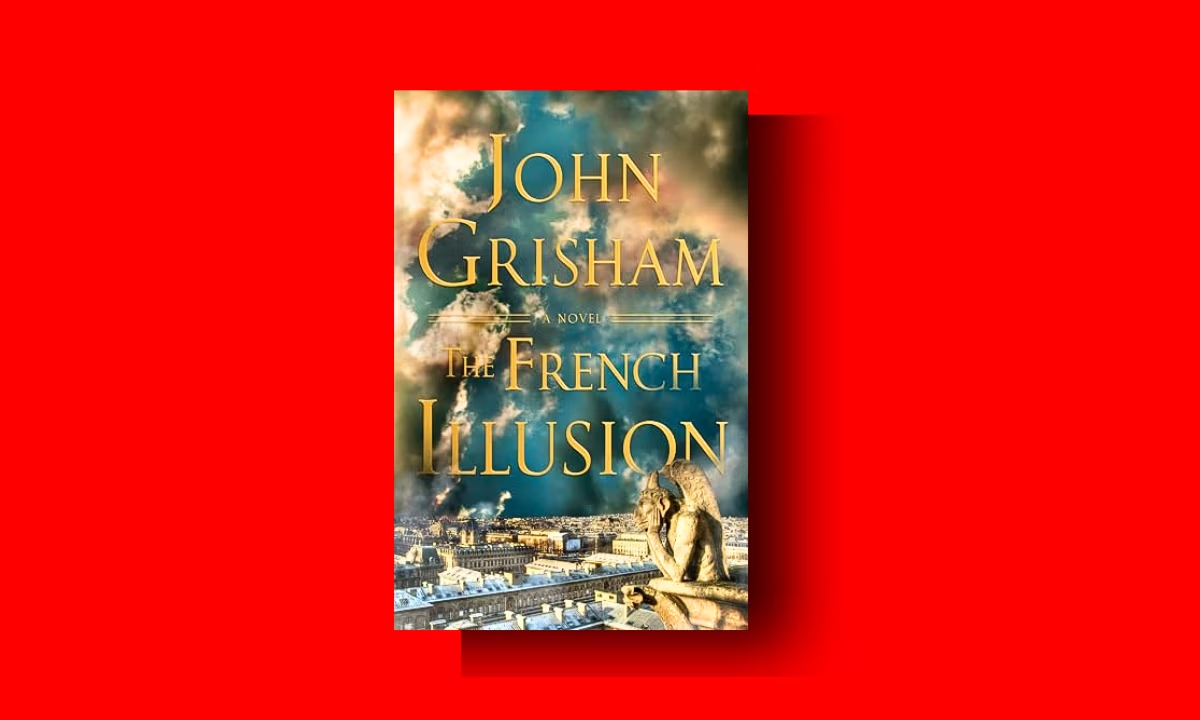

The French Illusion is John Grisham’s 2026 legal thriller that trades courtroom drama for international kidnapping and hostage rescue. The novel follows three American couples abducted during Paris honeymoons over a three-year span, with the kidnappers releasing the brides after ransom payments but keeping the grooms captive.
When Chelsea Tanner is released but her husband Paul remains missing, the CIA launches a risky infiltration operation using a fake honeymoon couple as bait.
Table of Contents
The French Illusion explores terrorism, government secrecy, and the moral compromises made in the name of national security. It’s a departure from Grisham’s typical legal procedurals, leaning heavily into espionage and geopolitical territory.
Quick Verdict: A gripping, morally complex thriller that trades legal maneuvering for international intrigue. Recommended for fans of espionage fiction and hostage dramas, though longtime Grisham readers may miss the courtroom battles.
Should You Read It?
| Pros | Cons |
|---|---|
| Relentless pacing that keeps you turning pages | Less legal drama than typical Grisham |
| Complex antagonist with understandable motivations | Some plot threads feel rushed in final act |
| Authentic-feeling intelligence community details | Graphic torture scenes may disturb some readers |
| Thoughtful exploration of post-9/11 justice | Secondary characters could use more development |
What Is It About? Three American couples are kidnapped during Paris honeymoons by a former Guantanamo detainee seeking revenge and ransom. After the brides are released and the grooms remain captive, the CIA recruits a fake newlywed couple to infiltrate the gang and lead rescuers to the hostages.
Rating: 4.5/5
Introduction
John Grisham has built a career on legal thrillers that expose the seams in American justice. His 2026 novel, The French Illusion, takes a sharp turn into darker territory. Published by Doubleday on an unspecified date in 2026, the book arrives at a moment when questions about surveillance, government overreach, and the aftermath of the war on terror remain painfully relevant.
The copyright page notes a first printing by Belfry Holdings, Inc., with the LCCN 2026942261 and ISBN 9780385550543 for the hardcover edition.
This isn’t the Grisham of A Time to Kill or The Firm. There are no Mississippi courtrooms, no scrappy lawyers fighting corporate giants. Instead, The French Illusion drops readers into the City of Light, where romantic getaways become traps and the machinery of American intelligence grinds against the trauma of innocent lives caught in the gears.
I approached this book expecting the familiar comfort of a legal procedural. What I found was something rawer, angrier, and more unsettling than anything Grisham has written in years.
Background: Why This Story Matters Now
The novel’s premise draws from real-world anxieties about foreign kidnappings and the murky ethics of hostage negotiation. Since the early 2000s, the United States has grappled with how to respond when citizens are taken abroad.
The policy of not negotiating with terrorists has always existed in tension with the practical reality that families will do anything to bring loved ones home.
According to The French Illusion, at least twenty Americans were kidnapped while traveling internationally in 2015 alone, though the text notes this number is likely low because many families pay ransoms quietly and stay silent. The FBI’s Hostage Rescue Team and the CIA’s counterterrorism operations have been involved in numerous such cases, though details rarely surface publicly.
What makes The French Illusion particularly timely is its antagonist’s backstory. Nabeed, the mastermind behind the kidnappings, spent eight years at Guantanamo Bay after being captured in Afghanistan. He was never charged with a crime.
The novel explicitly references the CIA’s extraordinary rendition program, the Abu Ghraib prison scandal, and the waterboarding of detainees. These aren’t fictional inventions. They’re documented chapters in recent American history.
The French Illusion also touches on the bureaucratic rivalries between the FBI and CIA, the complications of operating on foreign soil, and the way political considerations can override humanitarian imperatives. For anyone who followed the debates over Guantanamo’s closure or the Senate’s torture report, these themes will feel uncomfortably familiar.
The French Illusion Plot Summary
Part One opens on the third day of Paul and Chelsea Tanner’s Paris honeymoon. Chelsea, an art history graduate who studied at the Sorbonne, has been posting their itinerary on social media for her select group of followers. What she doesn’t know is that a mole inside their Left Bank hotel has sold them out.
For a year’s wages in euros, he’s provided their schedule to a surveillance network that’s been tracking American newlyweds.
The kidnapping unfolds with clinical precision. On April 28, Paul and Chelsea hire a private car for a day trip to Normandy. Their driver, Malik, is a Senegalese immigrant who’s been with the company for seven years. At lunch in Bayeux, a young woman with red curls approaches him asking for directions to Paris. Seconds later, a cyclist crashes into a nearby table, creating chaos.
The woman slips chloral hydrate into Malik’s water. He collapses, and the kidnappers have their opening.
A replacement driver named Laurent arrives at 1:50 PM, claiming Malik was called away for a family emergency. He wears a surgical mask and explains he’s getting over the flu. Paul and Chelsea, trusting and oblivious, get into the car.
On the outskirts of Bayeux, Laurent releases nitrous oxide into the back seat. By the time they reach a farm outside town, both are unconscious.
Chelsea wakes in pitch darkness. Her wrists and ankles are bound, and a coarse hood covers her head. A male voice with accented English tells her she’s in a room with no windows. He removes her cuffs, leaves fruit and water, and vanishes. She spends three days in this black void, eating grapes and plums, sleeping on a narrow cot, and trying not to lose her mind.
The kidnappers force Chelsea to make video messages for her parents. The first shows her with a hood being yanked off, a masked gunman behind her. “What is your name?” a voice demands. “Chelsea Tanner.” “And what is the date?” “It’s Thursday, I think. I was married last Saturday, April twenty-third.”
The ransom demand arrives at 8:04 PM Eastern Time. Justine Clayburn, Chelsea’s mother, is in her basement doing yoga when her phone buzzes. The message instructs her to check her email. There, she and her husband Lowell watch their daughter’s terrified face on video. The demand: two million dollars for Chelsea’s release. Paul is mentioned only as being “safe.” The message warns against contacting the FBI, CIA, or any law enforcement.
Meanwhile, Paul’s parents, Fritz and Linzy Tanner, learn of the kidnapping through Sam Clayburn, Chelsea’s younger brother. Sam drives to Fritz’s office in Pentagon City and breaks the news in a food court. The Tanners are instructed not to contact the Clayburns, but Sam ignores this. The families decide to cooperate with the kidnappers, fearing publicity will endanger the hostages.
Lowell flies to Paris on April 30. He checks into the Hotel Mercure near Gare de Lyon and waits for instructions. On May 2, the Clayburns wire two million dollars through their bank. Chelsea is released in Chantilly, a town north of Paris, and reunites with her father in a church.
The Tanners, however, struggle to raise their own two-million-dollar ransom. They sell their home in Old Town Alexandria for $1.5 million, drain their retirement accounts, and accept a $250,000 loan from the Clayburns. On May 4, they wire the money.
But Paul isn’t released. A video sent to the Tanners on May 5 shows Paul, thinner and unshaven, reading a statement that his release has been “delayed for security reasons.” The families are devastated.
The FBI and CIA become involved. Chelsea and her father meet with agents at Dulles Airport and learn that this is the third such kidnapping in three years. Alan Stockman was taken near Bordeaux in 2013. Jason Snyder was abducted near Giverny in 2015. Both brides were released after ransoms were paid. Neither groom has been seen since.
The investigation reveals that all three grooms were military lawyers who worked for the federal government. Stockman was with Customs in Portland. Snyder was a federal prosecutor in Tampa. Paul was at the Department of Justice in Washington. The kidnappers appear to have a specific grudge against American military personnel.
The trail leads to North Africa. A smuggler named Benoit confesses that he transported two crates containing sedated Americans from France to Algeria. The CIA and French intelligence services begin searching for the hostages in the Algerian desert.
In October, a video arrives showing Paul in a monk-like robe, pale and gaunt, with two armed guards behind him. He says he’s being fed enough to survive and urges his family to keep quiet. The video was mailed from Hartford, Connecticut, to Justine Clayburn’s home, demonstrating that the kidnappers have a presence in the United States.
The CIA decides to launch an operation. The plan involves planting a fake newlywed couple who will be so attractive to the kidnappers that they’ll be abducted. The CIA will track the groom to the other hostages and then rescue everyone.
Rae Claire Russo, a CIA officer embedded at the Smithsonian’s publishing division, recruits Stuart Nash, a former military prosecutor who worked at Guantanamo Bay, to play her husband.
Stuart is a 31-year-old assistant U.S. attorney from North Carolina with a military background and a connection to Gitmo that will make him irresistible to the kidnappers. After extensive training at Camp Peary (The Farm), including a brutal hostile interrogation simulation, Stuart and Rae Claire stage a fake wedding in Georgetown on December 10.
They honeymoon in Paris, staying at the Hotel Danube, and deliberately make themselves visible and vulnerable. They post their itinerary on social media. They take a day trip to Burgundy. They wait to be kidnapped.
On December 14, their fifth day in Paris, the kidnappers strike. They use nitrous oxide to knock the couple unconscious in their hotel room, then smuggle them out in housekeeping carts. Stuart is transported by boat toward Algeria. Rae Claire is taken to a location outside Dijon.
Stuart’s CIA handlers have implanted tiny transmitters in his teeth that emit signals when clicked together. These signals are tracked by drones and satellites. The CIA follows Stuart’s trail across the Mediterranean.
Back in Algeria, Paul has been held at a compound called Camp Echo. He’s been tortured, waterboarded, and kept in a cage. He’s lost significant weight and suffers from isolation. But he’s alive. He meets Jason Snyder and Alan Stockman, the other hostages, and they communicate through their prison fences when guards aren’t watching.
Nabeed, the leader of the kidnappers, is revealed to be a former Guantanamo detainee who was captured in Afghanistan in 2002 and held for eight years without charge. His younger brother, Yusuf, was beaten to death by American soldiers at Kandahar prison. Nabeed has been seeking revenge and funding his operations through kidnappings.
The ransom demand is increased to $200 million for all five hostages, with a threat to execute Rae Claire if not paid. The White House initially refuses to negotiate, but pressure mounts. Meanwhile, SEAL Team 7 is positioned to attempt a rescue.
On December 17, Stuart is loaded onto a boat with other hostages and driven into the desert. The SEALs track his signals and prepare to strike. But when they reach Camp Echo, they find it abandoned. The hostages have been moved.
Nabeed orders the hostages to be released. Alfie, a young guard who has been learning English from Paul, cuts their bonds and drives them to a remote location. The SEALs find them walking through the desert and rescue all four.
Rae Claire is released separately in France. The kidnappers abandon their camp and disappear. Nabeed and his team relocate to a villa on the Turkish island of Bozcaada, where they plan to live quietly with their fortune.
The novel ends with Stuart and Rae Claire having dinner in Washington. They discuss whether to stay married. They decide to take a vacation together to figure things out. The implication is that their fake marriage might become real.
The French Illusion Analysis
Characters
Paul Tanner is the central hostage and the novel’s emotional anchor. A Naval Academy graduate who served in the JAG Corps, Paul is physically tough and mentally resilient.
His chapters in captivity are the novel’s most harrowing, depicting the psychological toll of isolation, torture, and uncertainty.
He survives through routine, mental exercises, and a stubborn refusal to give up hope. His relationship with Alfie, the young guard who becomes his English student, provides one of the book’s few moments of genuine human connection across enemy lines.
Chelsea Tanner begins as a social media enthusiast whose enthusiasm for documenting her honeymoon inadvertently makes her a target. After her release, she becomes a fierce advocate for Paul’s rescue, refusing to leave Paris until he’s found. Her journey from carefree bride to traumatized survivor to determined spouse is handled with sensitivity.
The scene where she waits in the Church of Saint-Sulpice, expecting Paul to appear, only to be told the church is closing, is devastating.
Nabeed is the novel’s most complex figure. He’s a former Arizona State University student who studied botany and floriculture before returning to Algeria after his father’s death.
His capture in Afghanistan and subsequent eight years at Guantanamo without charge or trial are presented as the origin of his radicalization. He’s not a cartoon villain. He’s a man who was tortured, whose brother was killed, and who believes he’s seeking justice.
His internal monologue about not wanting to kill, about preferring a quiet life with his flowers, adds moral ambiguity that elevates The French Illusionl.
Stuart Nash is the volunteer hostage, a former military lawyer who worked at Gitmo and quit in disgust. He’s recruited by the CIA because of his combination of physical fitness, military background, and moral compass. His relationship with Rae Claire is complicated by their fake marriage and the growing attraction between them.
The scene where he endures waterboarding during training, mentally escaping to his childhood Little League games, is a standout.
Rae Claire Russo is the architect of the rescue operation. She’s a career intelligence officer who has spent years behind a desk and sees this mission as her chance for real action.
She’s pragmatic to the point of coldness, viewing her marriage to Stuart as a necessary sacrifice. Her character arc involves learning to see Stuart as more than an asset.
The French Illusion Themes and Symbolism
The Illusion of Safety is the novel’s central theme. Honeymoons are supposed to be carefree celebrations of love. Paris is supposed to be the most romantic city in the world. The novel systematically dismantles these assumptions, showing how quickly joy can turn to terror. The title itself refers to the false sense of security Americans feel when traveling abroad.
The Cost of Justice is explored through Nabeed’s backstory. The French Illusion doesn’t excuse his crimes, but it explains them. He was an innocent man who was captured, tortured, and imprisoned for eight years. His brother was murdered.
The American soldiers responsible received light sentences and were later pardoned. Nabeed’s quest for revenge is horrifying, but it’s not incomprehensible. Grisham forces readers to sit with the uncomfortable reality that American foreign policy has consequences.
Government Secrets and Lies runs throughout the novel. The families are instructed to lie about Paul’s disappearance, claiming he has food poisoning.
The CIA lies to the public about not negotiating with terrorists while secretly paying a $200 million ransom. The operation to rescue the hostages involves multiple layers of deception. The novel suggests that in the war on terror, truth is often the first casualty.
Sacrifice and Commitment is embodied by the fake marriage between Stuart and Rae Claire. They’re asked to sacrifice their personal lives, their futures, and potentially their safety for a mission neither of them fully controls. Their relationship becomes real in ways neither expected, suggesting that commitment can grow from shared purpose.
Isolation and Survival is the theme of Paul’s captivity chapters. Stripped of everything, held in darkness, subjected to torture, Paul survives through mental discipline. He counts, he remembers, he teaches Alfie English. He creates meaning in a meaningless situation. His journey is a testament to human resilience.
Evaluation
The French Illusion is an outstanding addition to Grisham’s bibliography, though it’s a significant departure from his usual territory.
The French Illusion‘s emotional core, the terror of the hostages and the desperation of their families, is rendered with genuine feeling.
I found myself holding my breath during the waterboarding scenes and tearing up during Chelsea’s reunion with her father. Grisham has always been a skilled storyteller, but here he adds a layer of visceral horror that makes the stakes feel personal.
Strengths
The pacing is relentless. Once the kidnapping occurs in the early chapters, the novel doesn’t let up. Each section ends with a hook that makes it nearly impossible to stop reading.
The alternation between hostage perspectives, family members, and intelligence operatives creates a mosaic of trauma and response that feels authentic.
The antagonist is one of Grisham’s best creations. Nabeed is sympathetic without being excused, terrifying without being cartoonish. His motivation is clear, his methods are brutal, and his eventual escape feels both frustrating and earned. The novel resists the easy satisfaction of a villain getting what he deserves.
The technical details about intelligence operations feel well-researched. The use of drones, satellites, tooth transmitters, and surveillance techniques adds verisimilitude. The bureaucratic rivalries between the FBI and CIA, and the complications of operating without host country cooperation, are handled with nuance.
Weaknesses
The final act feels rushed. The rescue operation, which the entire novel has been building toward, is over in a few pages. The hostages are freed, the camp is abandoned, and Nabeed escapes without any real confrontation. Given the hours of setup, the payoff feels anticlimactic.
Some characters are underdeveloped. Rae Claire’s CIA colleagues, the other hostages’ wives, and the French intelligence officers exist primarily as plot devices. Their motivations and personalities are sketched rather than fully drawn.
The novel’s treatment of torture is graphic. The waterboarding scenes are detailed and difficult to read. While this serves the narrative’s purpose of emphasizing the horror of such practices, some readers may find it overwhelming.
Impact
The scenes of Paul’s captivity, particularly his attempts to maintain his sanity through mental exercises and his tentative friendship with Alfie, stayed with me for days. The moral complexity of Nabeed’s character forced me to confront uncomfortable questions about American foreign policy and the consequences of the war on terror.
Intellectually, the novel raises important questions about the value of a single life versus the principles of a nation. Is $200 million too much to pay for hostages? Is it worth compromising the policy of not negotiating with terrorists?
The French Illusion doesn’t provide easy answers, which is to its credit.
Comparison with Similar Works
Fans of espionage fiction will find similarities to John le Carré’s work, particularly in the moral ambiguity of the intelligence operatives.
The hostage rescue plot echoes films like Argo and Captain Phillips, though with less triumphant conclusions. The legal elements, though less prominent than in typical Grisham novels, recall Scott Turow’s explorations of justice and its limitations.
Personal Insight with Contemporary Educational Relevance
The most important theme in The French Illusion is the cyclical nature of violence. Nabeed is created by American foreign policy. He was an innocent man who was tortured and imprisoned. His brother was killed by American soldiers. His quest for revenge, while morally reprehensible, is a direct consequence of actions taken in the name of fighting terrorism.
This theme has profound contemporary relevance. The United States continues to grapple with the legacy of Guantanamo Bay. As of 2023, approximately 30 detainees remain at the facility, many of whom have been held for over two decades without charge. The moral and legal questions raised by these detentions remain unresolved.
Lesson 1: The policies we pursue in the name of security have consequences that extend far beyond their immediate targets. Nabeed’s radicalization is not an isolated phenomenon. According to a 2016 report by the Soufan Group, foreign fighter recruitment often correlates with perceived injustices against Muslim populations.
Lesson 2: Torture doesn’t work. The French Illusion makes this explicit. Nabeed was waterboarded fourteen times and confessed to nothing because he knew nothing. The CIA’s own Senate report on torture concluded that the enhanced interrogation techniques were ineffective. This is not just a moral failure but a practical one.
Lesson 3: Rescue missions are dangerous and rare. The novel’s happy ending is the exception, not the rule. Real-world hostage rescues often end in tragedy. The 1980 Operation Eagle Claw in Iran resulted in eight American deaths and failed to rescue the hostages.
Lesson 4: Families of hostages are victims too. The French Illusion shows the financial and emotional devastation experienced by the Tanners and Clayburns. In real life, families of hostages often face bankruptcy, divorce, and long-term psychological trauma.
Lesson 5: Governments lie. The United States officially does not negotiate with terrorists. In practice, ransoms are paid, and deals are made. The discrepancy between public policy and private action creates a credibility gap that undermines trust in institutions.
For further reading on these topics, the Senate Select Committee on Intelligence’s Study of the CIA’s Detention and Interrogation Program (2014) provides a comprehensive overview of the issues raised in the novel.
The French Illusion Quotes
On the illusion of safety:
“So far in their short happy lives they had committed no felonies, breached no contracts, sued no one or been sued, joined no subversive groups, offended no foreign governments, defamed not a soul, listened to their parents when it mattered, and for the past two years had been thoroughly faithful to each other in every conceivable way.” (Chapter 1)
On captivity:
“She had read that solitary confinement was a form of torture, and now she believed it. But being alone in a tiny room that was almost pitch-black was even worse.” (Chapter 11)
On Nabeed’s motivation:
“The skinny kid was me, twelve years ago.” (Chapter 37)
On government deception:
“We’re going to tell a fib or two. The story is that Paul fell ill with severe food poisoning and is still hospitalized in Paris.” (Chapter 22)
On Paul’s survival:
“To survive in this little corner of hell, he could not afford to hate. He could not waste the emotional energy needed to properly hate Ninja and Franco for their cruelties.” (Chapter 39)
Conclusion
The French Illusion is a significant achievement in John Grisham’s career. It’s a departure from his legal thrillers, but it’s not a complete break. The novel retains Grisham’s focus on ordinary people caught in extraordinary circumstances and his interest in the mechanisms of power and justice.
What’s new is the international scope, the espionage elements, and the willingness to sit with moral ambiguity rather than resolving it.
I recommend The French Illusion to readers who enjoy espionage fiction with a conscience. Fans of John le Carré, Alan Furst, and Daniel Silva will find much to appreciate.
Grisham’s longtime readers should approach it with an open mind, understanding that the courtroom is replaced by the desert, and the lawyers are replaced by intelligence operatives. The result is a novel that’s both entertaining and unsettling, which is exactly what good thrillers should be.
The novel’s ultimate message, that cycles of violence perpetuate themselves, is one that deserves serious consideration. In a world where terrorism and counterterrorism feed each other in endless loops, The French Illusion offers a sobering reminder that the line between victim and perpetrator is often thinner than we’d like to believe.
The French Illusion

The French Illusion is John Grisham's 2026 legal thriller that trades courtroom drama for international kidnapping and hostage rescue. The novel follows three American couples abducted during Paris honeymoons over a three-year span, with the kidnappers releasing the brides after ransom payments but keeping the grooms captive.
URL: https://www.sopranu.com/the-french-illusion-john-grisham-review/
Author: John Grisham
4.5
Pros
- Relentless pacing that keeps you turning pages
- Complex antagonist with understandable motivations
- Authentic-feeling intelligence community details
- Thoughtful exploration of post-9/11 justice
Cons
- Less legal drama than typical Grisham
- Some plot threads feel rushed in the final act
- Graphic torture scenes may disturb some readers
- Secondary characters could use more development