
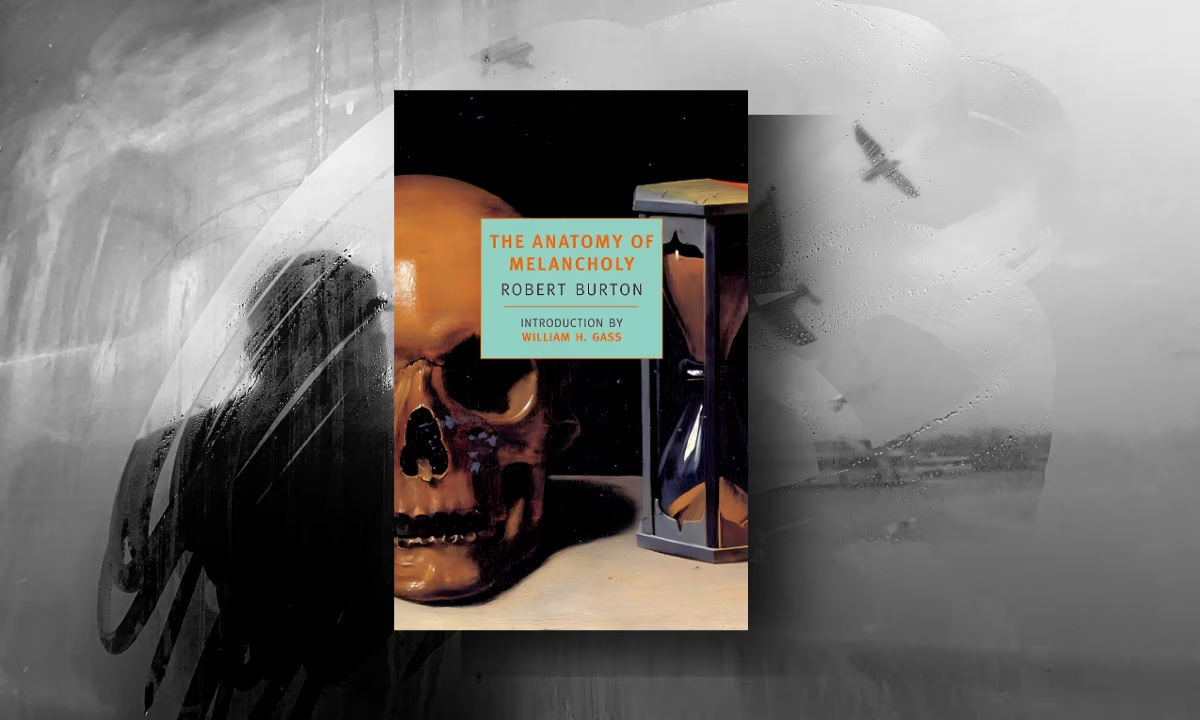

The Anatomy of Melancholy is a 1621 book by Robert Burton, an Oxford scholar and clergyman, that tries to explain every cause, symptom and cure of melancholy, the word his age used for what we would now split into depression, anxiety, grief and obsessive worry.
It is huge, chaotic, stuffed with Latin and quite often wrong about the body. Yet the same messy book describes overthinking more precisely than most self-help titles on my shelf, and it ends with a six-word prescription I have not been able to shake: “Be not solitary, be not idle.”
I read the whole thing in a 1,678-page digital edition so you can decide whether you need to.
Table of Contents
What Are the Key Takeaways From The Anatomy of Melancholy?
The Anatomy of Melancholy argues that sadness is universal, that it has many causes at once, and that the best cures are ordinary: work, company, movement, music, talk and hope. Here is the book at a glance.
It is a medical encyclopedia written by a priest. Burton was a divine, not a doctor, and he admits it. He reads almost everyone who wrote on the mind before him and arranges them into three “Partitions”: causes and symptoms, cures, and two special kinds (love melancholy and religious melancholy).
Everyone gets “melancholy in disposition.” Passing low moods are, in his words, “the character of mortality.” The real disease is when those moods harden into a habit.
The core definition is fear and sorrow without a cause. Burton quotes the standard medical view of his day: a kind of “dotage without a fever” with fear and sadness as companions, “without any apparent occasion.”
Idleness and solitude are the big triggers. He describes rumination with startling accuracy: pleasant daydreaming (“castles in the air”) that suddenly turns into dread.
Talking helps. “Grief concealed strangles the soul,” he writes, so tell a trusted friend.
Mirth, music, exercise and study are medicine. He names three doctors: Dr. Merryman, Dr. Diet and Dr. Quiet.
Much of the science is obsolete. Black bile, astrology, devils and purges fill hundreds of pages, and some of his views on women and other faiths have aged badly.
The closing rule is the whole book in miniature: “Be not solitary, be not idle.”
Reader recommendation for The Anatomy of Melancholy
You will love it if:
- You enjoy Montaigne, Sir Thomas Browne, or any writer who wanders off topic and comes back wiser.
- You live with low mood or anxiety and want company from someone who clearly felt it too (“Experto crede Roberto,” he jokes: trust Robert, he has been there).
- You study the history of psychiatry, early modern literature, or Milton, Keats and Sterne, all of whom borrowed from Burton.
- You like dipping into a book for twenty minutes rather than racing to the end.
You will probably bounce if:
- You want a clinical guide to treating depression today. This is not one, and Burton’s drug advice (hellebore, purges, bloodletting) should never be tried.
- Latin tags and lists of 30 authors in one sentence make you want to throw the book.
- You need a clear argument from page one to the last. Burton circles, digresses and contradicts himself, and he knows it.
What Is The Anatomy of Melancholy About?
Title and author: The Anatomy of Melancholy by Robert Burton (1577 to 1640), first published in 1621 under the pen name “Democritus Junior.” According to Britannica, it was “published in 1621 and expanded and altered in five subsequent editions (1624, 1628, 1632, 1638, 1651/52).” The final, posthumous edition carried Burton’s own last corrections, entrusted to his publisher Henry Cripps, as the “To the Reader” note in my edition confirms.
The full original title tells you what to expect: The Anatomy of Melancholy, What It Is, With All the Kinds, Causes, Symptoms, Prognostics, and Several Cures of It. In Three Partitions… Philosophically, Medically, Historically Opened and Cut Up.
Context: The book belongs to no single genre. It is part medical textbook, part anthology, part satire, part sermon and part memoir. Its subject is melancholy, which in Burton’s day meant both a passing sad mood and a serious, lasting illness thought to come from an excess of “black choler” (black bile), one of the four humours of Galenic medicine. Burton spent his adult life at Christ Church, Oxford.
Wikipedia‘s biography records that he took his BA in 1602, MA in 1605 and BD in 1614, and served as Christ Church’s librarian from 1624 until his death. He was vicar of St Thomas’s in Oxford from 1616 and, later, rector of Seagrave in Leicestershire.
He never practised medicine, but he read nearly all of it.
Purpose: Burton states his aim plainly in the preface: “I write of melancholy, by being busy to avoid melancholy.” The book is his own therapy and an attempt to help others “out of a fellow-feeling.”
His central thesis is that melancholy is so common that “all the world is mad,” that it has bodily, mental, social and spiritual causes all tangled together, and that it can be eased, if rarely cured, by changing how you live.
As he puts it at the start of the cure section: “Nil desperandum. It may be hard to cure, but not impossible.”
What Background Do You Need Before Reading Burton?
You need just three ideas, and then the book opens up.
1. The four humours. Renaissance medicine, inherited from Hippocrates and Galen, held that the body contains blood, phlegm, yellow bile (choler) and black bile (melancholy).
Too much black bile, or bile “adust” (burnt), made you fearful, sad and prone to strange fixed ideas. Burton reports these theories in detail while admitting that doctors disagreed about almost all of them.
2. The “six non-natural things.” These were the six areas of life a physician could adjust: diet, retention and evacuation, air, exercise and rest, sleep and waking, and the “passions and perturbations of the mind.”
Burton organises his causes and his cures around this list, which is why so much of his advice still reads like modern lifestyle medicine.
3. Who “Democritus Junior” is. Democritus was the Greek philosopher who, according to a letter attributed to Hippocrates, was found in his garden at Abdera cutting up animals to find “the seat of this atra bilis, or melancholy.” The townspeople thought he was mad; Hippocrates decided Democritus was the sane one and the townspeople were the fools.
Burton borrows his name, says Democritus left his work “imperfect, and it is now lost,” and sets out to finish it.
A few numbers help you grasp the scale. The Royal College of Physicians of Edinburgh notes that the first edition contained 353,369 words and the sixth had grown to 516,384, roughly the length of Les Misérables.
Mary Ann Lund, writing in Aeon (2020), records that Burton owned about 1,700 books, later split between the Bodleian Library and Christ Church. Burton was not exaggerating when he called his work a “cento” collected “out of divers writers.”
The Anatomy of Melancholy Summary
The Anatomy of Melancholy moves in four stages: a long satirical preface, a First Partition on causes and symptoms, a Second Partition on cures, and a Third Partition on love and religion. I will take them in order and give you the arguments, the examples and the lines worth remembering, so that you come away with the book’s content and not just its reputation.
What Happens in the Preface, “Democritus Junior to the Reader”?
Burton opens by teasing you for wanting to know who he is, then tells you anyway: a bachelor scholar who has “lived a silent, sedentary, solitary, private life” in Oxford, “a mere spectator of other men’s fortunes.” He lists the daily news of his age, “war, plagues, fires, inundations, thefts, murders,” new books, new heresies, weddings, funerals, bankruptcies, and you realise he is describing an information overload very close to a modern news feed.
He then explains his method with surprising honesty.
He admits that his material is “stolen, from others,” that writers “lard their lean books with the fat of others’ works,” and that he is no better. His defence is that he cites every source (“I have wronged no authors, but given every man his own”) and that only the arrangement is his.
He borrows a famous image from Didacus Stella: “A dwarf standing on the shoulders of a giant may see farther than a giant himself.” Isaac Newton made a version of this phrase famous half a century later, but here it is in 1621, cheerfully quoted by an Oxford vicar.
Next he answers the obvious objection: why is a clergyman writing about medicine?
His reply is one of the book’s best ideas. Melancholy is “a disease of the soul” and of the body at once, so “a divine in this compound mixed malady can do little alone, a physician in some kinds of melancholy much less, both make an absolute cure.” In other words, mind and body need treating together.
Then comes the satire. If you could climb a high mountain and look down, Burton says, “thou shalt soon perceive that all the world is mad, that it is melancholy, dotes.” He marches through kingdoms, cities, families, lawyers, soldiers, lovers, scholars and churchmen, showing each to be foolish in its own way.
Unjust wars, he argues, are madness on the grandest scale (though he says not all wars are to be condemned); greed and ambition are madness in private.
Halfway through, he decides to “make an Utopia of mine own, a new Atlantis,” a fantasy state with 12 or 13 provinces, straight streets, fair laws, public granaries, hospitals and offices given on merit rather than by bribes. It is a political essay smuggled into a medical book.
Two details from the preface stayed with me.
First, he warns any reader who is “actually melancholy” not to read his section on symptoms, because sad people apply everything they read to themselves. I have never seen a medical author give that warning so kindly. Second, he ends the preface by suddenly retracting it all: “I have overshot myself… I have anatomised mine own folly.”
The mood swing is deliberate. He is performing melancholy as well as describing it.
How Does Burton Define Melancholy in the First Partition?
Burton defines melancholy as a lasting disorder of the mind, usually marked by fear and sorrow without an obvious cause, and he separates it sharply from ordinary sadness.
Before he gets there, he gives you a short course in anatomy and psychology as his age understood it: the parts of the body, the humours, the spirits, and the three-part soul (vegetal, sensible and rational, with faculties such as imagination, memory, reason and will).
Disposition versus habit (Partition 1, Section 1, Member 1, Subsection 5). This is the passage that explains the whole book. Melancholy “in disposition” is “that transitory melancholy which goes and comes upon every small occasion of sorrow, need, sickness, trouble, fear, grief.” Nobody escapes it: “no man living is free, no stoic, none so wise, none so happy.”
Hence his famous line: “Melancholy in this sense is the character of mortality.” Life, he says, is “a chequer table black and white.” The trouble starts when we give in to these moods, and “these dispositions become habits.” He compares it to a cough that, left alone, turns into consumption. The melancholy he wants to anatomise is the habit, “a chronic or continuate disease, a settled humour… not errant, but fixed.”
I found this distinction more useful than almost anything else in the book. It says you are not ill because you feel low, and it also says that repeated, unchallenged low moods can harden into something serious.
The definition (Partition 1, Section 1, Member 3, Subsection 1). After reviewing a crowd of authorities, Burton settles on the common definition: melancholy is “a kind of dotage without a fever, having for his ordinary companions, fear and sadness, without any apparent occasion.”
He explains each part. “Dotage” means one faculty, imagination or reason, is corrupted. “Without a fever” separates it from frenzy. “Fear and sadness” separate it from madness. “Without a cause” separates it from ordinary grief.
Where it sits. Most doctors placed it in the brain, with the heart affected by sympathy. Burton’s comparison is lovely: “our body is like a clock, if one wheel be amiss, all the rest are disordered.” He concludes that the fault begins in the imagination and, if the illness lasts, spreads to reason.
Who gets it. Almost anyone, he says, though some more than others: the solitary, “great students,” people born to melancholy parents, those of middle age, and, quoting the Persian physician Rhazes, “the finest wits and most generous spirits.” Even the seasons matter: “the autumn is most melancholy.”
Three kinds. The most accepted division, which he adopts, sorts melancholy by its seat: head melancholy (from the brain), melancholy of the whole body, and “hypochondriacal or windy melancholy” from the bowels, liver and spleen. Love melancholy and religious melancholy he saves for Part Three. He then admits that real patients rarely fit the boxes.
He tells of three famous Italian doctors who examined one patient “at the same time” and “gave three different opinions.” I laughed at that, and then I thought about how often modern diagnoses overlap too.
What Causes Melancholy, According to Burton?
Burton’s answer is that melancholy has dozens of causes, often working together: supernatural, inherited, bodily, emotional and social.
Section 2 of the First Partition is one of the longest stretches of the book, and it reads like a catalogue of everything that can go wrong with a human life.
Supernatural causes. He begins with God, then devils, witches and the stars. He spends many pages on the nature of spirits and how they might trouble the mind. Modern readers will skim these chapters, and I did too, though they show how seriously his culture took such ideas.
Inherited and natural causes. Old age, melancholy parents (“parents a cause by propagation”) and, above all, the six non-natural things.
Diet. He lists meats, fish, fruit, drinks and spices that “breed” melancholy, with a lot of contradictory expert opinion.
Air. Thick, foggy, marshy air is bad; clear air is good.
Idleness and solitude. This is the heart of the causes, and the passage I would make every overthinker read. Idleness is “the badge of gentry,” “the bane of body and mind,” “the devil’s cushion.” The mind, quoting another writer, “can never rest, but still meditates on one thing or other,” and if it has no “honest business” it “rusheth into melancholy.”
For people prone to the illness, “one day’s solitariness, one hour’s sometimes, doth them more harm, than a week’s physic, labour, and company can do good.” He compares an idle mind to “a standing pool” in which “worms and filthy creepers increase.”
Voluntary solitude. Then comes his description of rumination, which I think is the most modern page in the book. At first, he says, it is “a most incomparable delight… to melancholise, and build castles in the air,” to walk alone by a brook and replay pleasant scenes.
These daydreams become so absorbing that people neglect their work. Then “the scene is turned upon a sudden,” and the same habit of private brooding produces “fear, sorrow, suspicion… discontent, cares, and weariness of life.”
You cannot stop, because you have trained yourself to think this way. Psychologists now call this rumination; Susan Nolen-Hoeksema and colleagues summarised decades of research on it in “Rethinking Rumination” (Perspectives on Psychological Science, 2008).
Burton described the trap 387 years earlier without the word.
Sleep. Too much or too little both do harm.
Passions of the mind. Burton treats emotions as causes in their own right. Sorrow comes first: “the mother and daughter of melancholy,” both cause and symptom, so they “tread in a ring.”
Then fear, shame, envy, hatred, anger, ambition, covetousness, gambling, self-love, vainglory and pride, each with a chapter of examples.
Too much study. The subsection on “the misery of scholars” is the most personal. Scholars, he says, look after everything except their own minds: a painter washes his brushes, a smith minds his hammer, but “only scholars neglect that instrument, their brain and spirits.”
They sit too long, sleep too little, earn too little and are mocked by people who can ride a horse and flatter a patron. “Go to Bedlam and ask,” he says of scholars who have lost their wits. You can feel the author’s own life in these pages.
Outward accidents. Last come “adventitious” causes: a bad nurse, harsh education (“terrors and affrights”), scoffs and slanders, loss of liberty, imprisonment, poverty, and “a heap of other accidents,” especially the death of friends.
What Are the Symptoms of Melancholy in the Book?
The main symptoms, Burton says, are fear and sorrow, usually “without a cause.” Section 3 of the First Partition describes bodily signs (leanness, hollow eyes, wind, bad digestion, poor sleep) and then the mental ones, which are where the book feels uncanny.
He lists sufferers who fear “that heaven will fall on their heads,” that they are damned, or that they are made of glass and must not be touched. That sounds quaint.
Then he describes a man who “durst not walk alone from home, for fear he should swoon or die”; one who, in a quiet church, is “afraid he shall speak aloud at unawares, something indecent”; one who, “locked in a close room,” fears suffocation and carries strong waters in case he faints; one who, “in a throng,” feels trapped even though he “sit at ease.”
He describes people who fear every disease they read about, and young physicians who catch the symptoms they study. A modern reader may recognise what we would now call panic, agoraphobia, intrusive thoughts and health anxiety.
I want to be careful here: Burton did not know those categories, and I am drawing the comparison, not him. Still, the observations are exact.
His summary of the sufferer’s state is short and sad: “they complain of toys, and fear without a cause.” And of sorrow: they keep “grieving still, but why they cannot tell.” He also notes something sufferers will recognise: outside their particular fear, such people are often “wise, staid, discreet.” The illness is narrow and stubborn, not a total loss of reason.
Section 4 covers prognosis. If the illness is “not hereditary, and taken at the beginning, there is good hope of cure”; if it is long-standing, it is “hard to be cured” and may return. Some cases end in death, a subject Burton handles with more compassion than many writers of his century. People should not be “so rash and rigorous in our censures,” he writes: “charity will judge and hope the best.”
How Does Burton Say Melancholy Can Be Cured?
Burton’s cure, set out in the Second Partition, is a mix of faith, medicine and, above all, lifestyle: rectify the six non-naturals, calm the passions, talk to friends, find work, music and mirth, and only then turn to drugs. He opens with hope: “Nil desperandum.
It may be hard to cure, but not impossible for him that is most grievously affected, if he but willing to be helped.”
Unlawful and lawful cures (Section 1). He rejects magic, charms and wizards, even though “‘Tis a common practice of some men to go first to a witch, and then to a physician.” Lawful cures begin with prayer, then a good physician, and a patient who cooperates. He criticises greedy doctors who prolong treatment “so long as there is any hope of pay.”
Diet, air and the famous digression (Section 2). He corrects diet and then reaches “air,” which launches the “Digression of the Air,” one of the strangest and most enjoyable chapters in English.
Burton imagines flying like a hawk round the world, asking why compass needles vary, whether a Northwest Passage exists, whether China and Cathay are the same place, and how the planets move, weighing Copernicus against older systems.
It has almost nothing to do with melancholy, and that is the point: curiosity itself is a cure. Back on earth, he recommends clear air, pleasant walks, gardens, travel and change of scene.
Exercise of body and mind. Here Burton gives the advice he repeats most: “there can be no better cure than continual business,” as Rhazes held. He prescribes walking in orchards and gardens, riding, hawking, hunting, fishing and digging in the garden.
Chess is “a good and witty exercise of the mind” for idle worriers but bad for the overworked, since it is “a testy choleric game” (he reminds us that the young William the Conqueror once hit a French prince over the head with the board after losing). Above all, he prescribes study for those who are idle.
He tells how King James I visited the Bodleian Library in 1605 and said, “If I were not a king, I would be a university man.”
He adds a sensible warning: study cures the idle, but a scholar made ill by books must not “overstretch his wits, and make a skeleton of himself.” Readers of nothing but romances “many times prove in the end as mad as Don Quixote.”
Sleep and dreams. Burton calls sleep “an especial help” and says “seven or eight hours is a competent time for a melancholy man to rest.” What he warns against is lying in bed awake for half a day “to give assent to pleasing conceits and vain imaginations.” Anyone who has scrolled in bed at noon on a bad day will feel seen.
The passions rectified. This is the most humane part of the book. “The chiefest cure consists in” calming fear and sorrow. The patient must first want to get better and resist the start of a dark train of thought: “Principiis obsta,” resist the beginnings.
Then comes the passage I underlined twice: “the best way for ease is to impart our misery to some friend, not to smother it up in our own breast… grief concealed strangles the soul.” A trusted friend, he says, “sees that which we cannot see for passion and discontent.”
He quotes Cicero’s lonely letter to Atticus, a man surrounded by acquaintances with no one he can “freely jest” with.
Music and mirth. Music is “a roaring-meg against melancholy,” a cannon fired at sadness, that can “expel grief with mirth.” Mirth and merry company come next, summed up in the old Salerno rhyme: “Dr. Merryman, Dr. Diet, Dr. Quiet.” He also recommends “a cup of strong drink” among his remedies, a line no modern reader should take as health advice.
A consolatory digression (Section 3). Burton then collects comforts for every kind of discontent: ugliness, illness, low birth, poverty, imprisonment, exile, the death of friends, envy, insult and failure. He knows clichés rarely help, and he quotes Pliny begging a friend to say “something that I never read nor heard of before, or else hold thy peace.”
Even so, he keeps going, on the theory that kind words “cannot choose but do some good.” In the chapter “Against Melancholy itself,” he offers small mercies: melancholy “is not catching,” and it is “a more durable enemy than dangerous.”
Melancholy people, he adds, are rarely bullies, cheats or drunkards, because fear keeps them sober.
Medicine (Sections 4 and 5). The rest of the Second Partition lists herbs, stones, purges, compounds and surgery, including bloodletting, then particular cures for each of the three kinds.
This is the part to skip. Borage, hellebore and purges were standard; they are not safe guides now. Burton’s verdict on tobacco is a fun aside: “divine, rare, superexcellent tobacco” when used as medicine, but “hellish, devilish and damned tobacco” as people commonly abuse it.
What Is Love Melancholy, and Why Does It Get a Whole Partition?
Love melancholy is Burton’s name for obsessive romantic and sexual passion, and he gives it most of the Third Partition because, as he says, “love is a species of melancholy.” He opens by defending himself against readers who think a clergyman should not write about love, arguing that an older, cooler head is the best judge of it.
He divides love into natural love, love of the pleasant, the profitable and the honest (with charity as its highest form), and then “heroical love,” the burning passion that sickens lovers.
Its causes include idleness, rich food, beauty, the eyes, clothes and make-up, dancing, music, amorous tales, kisses, go-betweens and love potions. Its symptoms are sleeplessness, sighing, pallor, foolish behaviour and an inability to think of anything else.
Here Burton tells the story, from Philostratus, of Menippus Lycius, a young philosopher who marries a beautiful woman near Corinth only for the sage Apollonius to expose her as a serpent, a “lamia.” Keats used this very passage as the source for his poem Lamia (1820), as the British Association for Romantic Studies notes.
His cures are practical: work hard, eat plainly, avoid the beloved, change place, listen to counsel, consider the “miseries of marriage.”
These chapters also contain some of the book’s most dated and unpleasant views about women. His final cure, though, is gentle and almost funny: “The last and best Cure of Love-Melancholy, is to let them have their Desire,” that is, let them marry.
Jealousy follows as “a bastard-branch or kind of love-melancholy,” defined as fear that the person you love will love another. Burton quotes Benedetto Varchi: “no love without a mixture of jealousy.” His cures include avoiding idleness, not spying, not locking a partner up, and choosing an equal match in the first place.
What Does Burton Say About Religious Melancholy and Despair?
Religious melancholy is love melancholy whose object is God, and Burton claims, with some justice, to be first to treat it as a separate kind: “I have no pattern to follow.” He splits it into excess and defect. Excess covers superstition, fanaticism, false prophets and people who predict the end of the world “to a day almost.” Defect covers atheists, Epicureans, hypocrites and the carelessly secure.
His sharpest pages attack those who exploit belief, though his strong Protestant bias against Catholics colours much of this section.
The last chapters deal with despair, the terror of being damned. Burton writes them with real tenderness. He insists that “multitudes” do recover, that both medicine and good counsel are needed (“they must go hand in hand to this disease”), and that sufferers “must not be left solitary, or to themselves, never idle, never out of company.”
He piles up Bible passages and arguments for God’s mercy, and tells the despairing to stop reading frightening books, avoid harsh preachers and open themselves to good physicians and divines.
How Does The Anatomy of Melancholy End?
The Anatomy of Melancholy ends with one rule that sums up the entire half-million-word argument: “Be not solitary, be not idle.” After all the humours, planets, herbs and theology, Burton boils his advice down to company and occupation.
Then he adds two Latin lines: Sperate miseri, cavete felices, “Hope, you wretched; beware, you happy.” Sadness can pass, and good fortune can turn.
Burton died in Oxford in January 1640. The epitaph he wrote for his monument in Christ Church Cathedral calls him “Democritus Junior,” known to few and unknown to fewer, to whom melancholy gave both life and death.
Rumours that he took his own life circulated after his death, but, as his Wikipedia biography notes, biographers have largely rejected them, and his burial inside the cathedral argues against them.
Is The Anatomy of Melancholy Still Worth Reading? My Analysis
Yes, The Anatomy of Melancholy is still worth reading, though not cover to cover in one go, and not as a medical manual. It is a maddening, generous, very funny book, and I came away from it feeling less alone, which is more than I can say for most modern books on mood.
Samuel Johnson, according to Boswell, called it “the only book that ever took him out of bed two hours sooner than he wished to rise.” I understand why. You can open it anywhere and find a story, a joke or a line that sticks.
Does Burton support his arguments with evidence? By the standards of 1621, overwhelmingly. He cites hundreds of physicians, philosophers and church fathers, and he gives case histories from Montanus, Plater, Trincavellius and others. The weakness is that he rarely weighs this evidence.
Contradictory authorities sit side by side, and he often says “I will not contend about it.” As Samuel Johnson put it, quoted in my edition from Boswell’s Life, the book is “perhaps, overloaded with quotation. But there is great spirit and great power in what Burton says when he writes from his own mind.”
That is exactly my experience. The borrowed physiology is dead; the observed human behaviour is alive.
Does it fulfil its purpose? Mostly. Burton set out to show that melancholy is universal, to map its causes and to offer help, and he does all three.
His lifestyle advice lines up surprisingly well with current evidence. The World Health Organization‘s depression fact sheet (updated 11 September 2026) estimates that 5.2% of adults worldwide live with depression and advises people to “stay connected to friends and family” and “exercise regularly, even if it’s just a short walk.”
In June 2025 the WHO Commission on Social Connection reported that 1 in 6 people worldwide is affected by loneliness, linked to more than 871,000 deaths a year.
A 2024 BMJ network meta-analysis by Noetel and colleagues, covering 218 studies and 14,170 participants, found walking or jogging, yoga and strength training all effective treatments for depression. Burton’s “be not solitary, be not idle” was not a scientific finding, of course.
It was a hunch built on hundreds of case histories. But it has aged far better than his purges. (One gap is worth flagging: Burton recommends “a cup of strong drink” among his remedies, while the WHO’s list tells people to “avoid or cut down on alcohol.”)
What Are the Strengths of The Anatomy of Melancholy?
Its honesty about the author’s own illness. “They get their knowledge by books, I mine by melancholising,” he says. Burton never pretends to stand above his subject.
The disposition-versus-habit distinction. It normalises ordinary sadness while taking chronic suffering seriously, a balance many modern conversations about mental health still struggle with.
The portrait of rumination. The “castles in the air” passage is the best description of overthinking I have read in any century.
The case for talking. “Grief concealed strangles the soul” could hang in any therapist’s waiting room.
Humour. Burton jokes about his own plagiarism, his chaotic style, his inability to finish (in the preface he swears he is “resolved never to put this treatise out again… I have done,” yet his publisher later reports that he left a copy “with several considerable Additions by his own hand”), and his fellow scholars. The comedy is part of the cure.
Its influence. The critic Thomas Warton, quoted in my edition, argued that Milton took the contrast behind L’Allegro and Il Penseroso from Burton’s opening poem, and Sterne lifted passages for Tristram Shandy. Keats named Burton as his source for Lamia.
The Royal College of Physicians of Edinburgh notes that, on publication history alone, the book was arguably more popular in the 17th century than Shakespeare.
What Are Its Weaknesses?
Bloat. The structure promises order (partitions, sections, members, subsections) and delivers sprawl. Several chapters are lists of authorities with little argument.
Obsolete science. Humours, astrology, demons and witches take up a great deal of space. Burton is often sceptical, but he rarely rejects these ideas outright.
Dangerous remedies. Hellebore, purges, bloodletting and “a cup of strong drink” belong to medical history, not to your medicine cabinet.
Prejudice. The love chapters contain harsh, sweeping claims about women and marriage, and the religious chapters carry a strong anti-Catholic bias. He also condemns same-sex love in the language of his time. These passages are part of the record and should be read as such, not excused.
Latin. Unless you have an edition with translations, as mine does (the 19th-century editor, “Democritus Minor,” added English versions of the classical extracts), whole pages are hard going.
My negative experience was mostly fatigue. Around the herbs and purges of the Second Partition, I started skimming, and I did the same in the long lists of lovers in Part Three.
My positive experience was that, every 30 pages or so, Burton would say something so exact about how a sad mind works that I had to put the book down. The Anatomy of Melancholy is a magnificent, exhausting and oddly consoling book, a mess that somehow becomes a friend.
Which Books Are Like The Anatomy of Melancholy?
If The Anatomy of Melancholy appeals to you, these books sit closest to it, either as sources, rivals or descendants.
Timothy Bright, A Treatise of Melancholie (1586). One of the English sources Burton cites by name (“T. Bright”). It is shorter, drier and more strictly medical, without Burton’s jokes or personal voice.
Michel de Montaigne, Essays (1580). Burton quotes Montaigne several times. Both writers wander, confess and quote endlessly, but Montaigne is calmer and more sceptical, while Burton is more anxious and encyclopedic.
Sir Thomas Browne, Religio Medici (1643). Another learned English physician-philosopher with a gorgeous style, though far more serene than Burton.
Laurence Sterne, Tristram Shandy (1759 to 1767). A novel that borrows from Burton and inherits his love of digression. Read them together and you will spot the theft.
Miguel de Cervantes, Don Quixote. Burton warns that readers of nothing but romances “many times prove in the end as mad as Don Quixote.” Our Don Quixote review and summary shows why that joke still lands.
Andrew Solomon, The Noonday Demon (2001). The closest modern equivalent: a vast, personal, research-heavy “atlas of depression” that won the National Book Award. Solomon has what Burton lacked, modern science; Burton has what Solomon only partly allows himself, comedy.
Mary Ann Lund, A User’s Guide to Melancholy (Cambridge University Press, 2021). The best short guide to Burton for modern readers, written by a Professor of Renaissance English Literature at the University of Leicester to mark the book’s 400th anniversary.
Fyodor Dostoevsky, White Nights. For Burton’s warnings about solitude and daydreaming in fiction form, see our White Nights analysis, a story about a dreamer who builds his own castles in the air.
For a broader reading list on the mind, try our 100 Best Psychology Books of All Time. And for a gentle counterpoint to Burton’s war on idleness, read Dolce Far Niente: What It Means and How to Actually Enjoy Doing Nothing.
Burton himself admits that the right kind of solitude, used well, can be “a paradise, a heaven on earth.”
FAQs About The Anatomy of Melancholy
What is the main message of The Anatomy of Melancholy?
The main message is that melancholy touches everyone, that it has many causes at once, and that it is best eased by company, work, exercise, good counsel and hope. Burton sums it up as “Be not solitary, be not idle.”
How long is The Anatomy of Melancholy?
Very long. The Royal College of Physicians of Edinburgh puts the first edition at 353,369 words and the sixth (1651) at 516,384.
Who was Democritus Junior?
Democritus Junior was Robert Burton’s pen name. He took it from the Greek philosopher Democritus of Abdera, who, according to legend, laughed at human folly and dissected animals to find the seat of black bile.
Is Burton’s medical advice safe to follow today?
No, not his drugs or surgery. His general advice about sleep, exercise, friendship and occupation broadly matches what the WHO recommends today, but anyone struggling with low mood or anxiety should speak to a doctor or qualified mental health professional.
What does “Be not solitary, be not idle” mean?
It is Burton’s final rule: do not isolate yourself, and do not leave your mind without useful work, because solitude and idleness feed melancholy. It appears in the last subsection of the book, on the cure of despair.
Which edition of The Anatomy of Melancholy should I read?
For a free, searchable text with English translations of the Latin, Project Gutenberg’s eBook 10800 works well. For a print copy, the NYRB Classics edition, introduced by the novelist William H. Gass, is widely available.
Conclusio
The Anatomy of Melancholy is not a book for everyone, and Burton would be the first to agree: “if you like not my writing, go read something else.”
It is best suited to patient general readers who enjoy essays and digressions, to students of literature, history and the history of medicine, and to anyone who has lived with low mood and wants a companion rather than a lecture.
Specialists will find a mine of early modern medical thought; general readers will find a funny, sad, wise friend buried under the Latin.
My advice is simple.
Read the preface in full. Read the First Partition’s chapters on disposition, idleness, solitude and symptoms. Read the Second Partition on exercise, friends, music and mirth, and the “Digression of the Air” for pure pleasure.
Skim the herbs, purges and demons. Then read the last page, and take Burton’s six words with you. Four centuries after 1621, they are still the shortest useful thing anyone has written about sadness.
The Anatomy of Melancholy
The Anatomy of Melancholy is a 1621 book by Robert Burton, an Oxford scholar and clergyman, that tries to explain every cause, symptom and cure of melancholy, the word his age used for what we would now split into depression, anxiety, grief and obsessive worry.
URL: https://www.sopranu.com/the-anatomy-of-melancholy-robert-burton-summary/
Author: Robert Burton
4.5
Pros
- Honest self-disclosure: Burton openly discusses his own melancholy, making the book feel personal and relatable.
- Disposition vs. habit distinction: offers a useful way to think about melancholy as both temperament and learned pattern.
- Vivid portrait of rumination: captures the experience of overthinking and mental spiraling.
- Case for talking: argues for conversation and social connection as a remedy.
- Humour: uses wit and digressions to keep a heavy subject engaging.
- Lasting influence: influenced later writers, thinkers, and literary works.
Cons
- Bloat: extremely long, digressive, and difficult to read straight through.
- Obsolete science: relies on outdated medical theories, such as the humors.
- Dangerous remedies: some historical treatments described are harmful by modern standards.
- Prejudice: reflects the biases and discriminatory attitudes of its time.





