
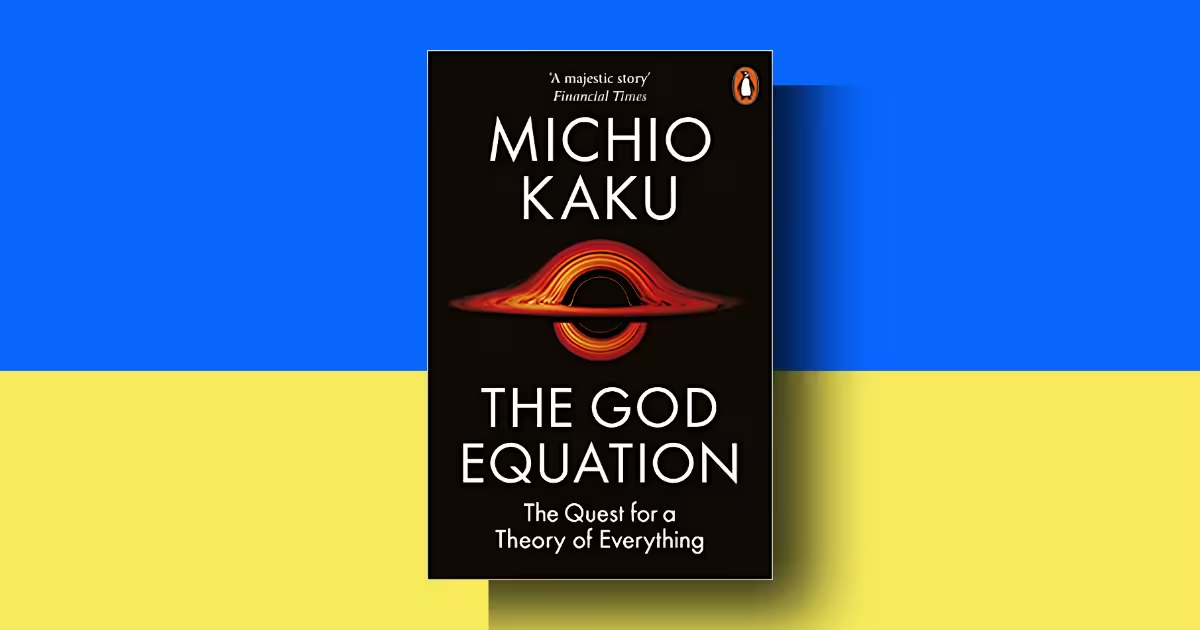

The God Equation is Michio Kaku’s 2021 book chronicling humanity’s 2,000-year quest to unify all the forces of nature into a single equation. The book traces this dream from Newton through Einstein, quantum mechanics, and finally to string theory, which Kaku has worked on since 1968.
String theory posits that the universe is made of tiny vibrating strings, not point particles, and it naturally includes gravity, which no other quantum theory can do.
However, the theory remains untested because it requires energies a quadrillion times greater than the Large Hadron Collider produces. Kaku admits string theory predicts a multiverse of potentially infinite universes, raising the question of whether it’s truly a “theory of everything” or a “theory of anything.”
The God Equation is essential reading for anyone wanting to understand modern physics’ biggest unresolved problem, even if the final answer remains elusive.
Table of Contents
Introduction
The God Equation is theoretical physicist Michio Kaku’s 2021 exploration of physics’ most ambitious dream: finding a single equation that explains everything in the universe. Published by Doubleday, the book runs about 200 pages and sits comfortably in the popular science genre, similar to works by Brian Greene and Stephen Hawking.
Kaku isn’t just any physicist writing about this quest. He’s a professor of theoretical physics at City University of New York who has been working on string theory since 1968, ever since it emerged “accidentally, unannounced, and totally unexpected”. Along with his colleague Keiji Kikkawa, he developed string field theory, which expresses all of string theory in the language of fields, creating “a simple equation a bit over one inch long”.
The God Equation‘s central thesis is straightforward: physics has two great pillars, Einstein’s theory of gravity and quantum mechanics, and they contradict each other.
Unifying them into a single theory has been the holy grail for a century. Kaku argues string theory is the only candidate that works, even as he honestly acknowledges its problems.
Background
For over 2,000 years, humans have asked the same question: What is the world made of? The Greeks proposed two answers that still echo today. Democritus believed everything could be reduced to tiny, invisible, indestructible particles he called atoms. Pythagoras thought the diversity of nature could be described by the mathematics of vibrations.
Surprisingly, both ideas survived, and modern physics is essentially an attempt to reconcile them. Atoms became quarks and electrons. Vibrations became quantum fields. String theory is the latest attempt to merge these two visions into one.
Each time physicists unified a force, civilization transformed. Newton’s laws of motion and gravity enabled the Industrial Revolution. Faraday and Maxwell’s understanding of electricity and magnetism lit our cities and gave us electric motors and instant communication.
Einstein’s E=mc² explained how stars shine and led to nuclear power. Quantum mechanics gave us transistors, lasers, and the entire digital age.
Now physicists are chasing the ultimate prize: a theory that unifies gravity, electromagnetism, and the strong and weak nuclear forces. Kaku believes this theory exists. The question is whether we’ll ever prove it.
The God Equation Summary
Part 1: Unification, The Ancient Dream
Kaku opens with Newton, who in 1666, at age 23, watched an apple fall and asked a question that changed history: If an apple falls, does the moon also fall?
Before Newton, the church taught that earthly laws were corrupted by sin while heavenly laws were pure and perfect. Newton demolished that division. He showed that the same force, gravity, governs both the fall of an apple and the orbit of the moon. This was the first great unification.
The book explains Newton’s concept of fields and symmetry with accessible examples. A sphere looks the same no matter how you rotate it. An equation is beautiful, in physics terms, when its components can be rearranged without changing the result.
Newton’s laws proved spectacularly successful. When Uranus deviated from its predicted orbit, astronomers used Newton’s equations to calculate where an undiscovered planet must be. In 1846, they found Neptune within one degree of the prediction. Pure mathematics discovered a major celestial body.
Next came Faraday and Maxwell. Faraday, a self-taught scientist with no formal education, discovered that moving a magnet inside a hoop of wire generates electricity. Maxwell then wrote equations that unified electricity and magnetism into a single force: electromagnetism.
He calculated the speed of these waves at 310,740 kilometers per second, remarkably close to the speed of light. Maxwell then made a bold claim: light is an electromagnetic wave.
Maxwell’s equations contained a symmetry called duality. The equations remain the same when you swap electric and magnetic fields. This symmetry revealed that electricity and magnetism are two sides of the same coin.
By 1900, physicists thought they had it all figured out. They were wrong. Newton’s and Maxwell’s equations were actually incompatible. One had to fall.
Part 2: Einstein’s Quest for Unification
As a teenager, Einstein asked himself: Can you outrace a light beam? If you could, Maxwell’s equations would predict a frozen light beam, something no one had ever seen.
This question haunted him for a decade. Working as a patent clerk in Bern, he finally cracked it in 1905. His insight: since the speed of light is constant no matter how fast you move, space and time must distort to keep it constant.
Special relativity was born. Moving clocks tick slower. Moving objects compress. Moving objects get heavier. The relationship between matter and energy was captured in E=mc². This equation answered why the sun shines: hydrogen atoms fuse into helium, and the missing mass becomes energy.
But Einstein wasn’t satisfied. Special relativity said nothing about gravity. He spent another decade developing general relativity.
The key insight came while he was sitting in a chair. If he fell backward, he’d be weightless, at least momentarily. This became the equivalence principle: acceleration in one frame is indistinguishable from gravity in another.
Einstein’s conclusion was radical. Gravity isn’t a force pulling objects together. It’s the curvature of space-time. The Earth orbits the sun because the sun warps the space around it. As Kaku puts it: “gravity does not pull; space pushes”.
General relativity made testable predictions. It explained Mercury’s wobbly orbit. It predicted that starlight would bend around the sun, confirmed during the 1919 solar eclipse by Arthur Eddington. Einstein became a global celebrity.
But he wasn’t finished. He wanted to unify gravity with electromagnetism. He failed. As Princeton physicist Freeman Dyson said, the road to unified field theory is “littered with the corpses of failed attempts”.
Part 3: Rise of the Quantum
While Einstein was revolutionizing gravity, another revolution was brewing. In 1900, Max Planck asked: Why do objects glow when hot?
The answer defied classical physics. Planck proposed that energy comes in discrete packets he called quanta. The energy of each packet is determined by Planck’s constant, a tiny number: 6.6 × 10⁻³⁴ Joule-seconds. If you set this constant to zero, quantum mechanics reduces to Newton’s laws. That’s why we don’t see quantum weirdness in daily life.
Then came Schrödinger’s equation in 1925, which described electrons as waves. Only certain wavelengths fit around a nucleus, explaining why atoms have discrete energy levels and why the periodic table works.
Paul Dirac went further, creating an equation that merged quantum mechanics with special relativity. His equation predicted antimatter and electron spin, discoveries that stunned physicists. Symmetry wasn’t just pretty. It predicted new particles.
But there was a problem. What was waving? Max Born proposed that the electron wave represented probability, not a physical medium. You can’t know both an electron’s position and velocity precisely. This was Heisenberg’s uncertainty principle.
Einstein hated it. “God does not play dice with the universe,” he protested. Niels Bohr reportedly replied, “Stop telling God what to do”. Their debate at the 1930 Solvay Conference became legendary.
Schrödinger’s cat thought experiment captured the absurdity. A cat in a box with a radioactive trigger exists as a mixture of dead and alive states until observed. To Einstein, this was preposterous. To Bohr, it was reality.
Part 4: Theory of Almost Everything
After World War II, physicists built quantum electrodynamics (QED), combining Dirac’s electron theory with Maxwell’s light theory. But calculations produced infinite results.
Richard Feynman, Julian Schwinger, and Shin’Ichiro Tomonaga found a workaround called renormalization. Assume the original values were infinite, calculate infinite corrections, and the infinities cancel. It worked spectacularly. QED predicts the electron’s magnetic strength to one part in one hundred billion, what Steven Weinberg called “the most impressive” agreement between theory and experiment in all science.
Next came the nuclear forces. Murray Gell-Mann proposed that protons and neutrons contain three smaller particles called quarks. This explained the zoo of subatomic particles that had baffled physicists. The quark model was based on symmetry: interchange the three quarks, and the equation remains the same.
The weak nuclear force got its own symmetry, pairing electrons with neutrinos. Combined with electromagnetism, this became the electroweak theory, winning the Nobel Prize in 1979 for Steven Weinberg, Sheldon Glashow, and Abdus Salam.
The strong force needed a new field called the gluon, based on Yang-Mills equations. When Gerard ‘t Hooft showed these equations could be renormalized, a new theory emerged: quantum chromodynamics (QCD).
All these pieces came together in the Standard Model. But it was ugly, patched together by hand. As Kaku notes, one physicist compared it to “taping a platypus, an aardvark, and a whale together” and declaring it nature’s most elegant creature.
The Standard Model also had about twenty free parameters that had to be inserted by hand, with no understanding of where they came from. And it said nothing about gravity.
Part 5: The Dark Universe
In 2019, astronomers photographed a black hole for the first time. The image showed a monster five billion times the mass of our sun, located 53 million light-years away in galaxy M87. They achieved this by linking radio telescopes around the world into a single instrument the size of Earth.
Black holes were first proposed by John Michell in 1783, who asked: What if a star’s escape velocity equals the speed of light?. Karl Schwarzschild found an exact solution to Einstein’s equations in 1916, while serving on the Russian front during World War I.
Stephen Hawking made a shocking discovery: black holes aren’t completely black. Quantum effects cause them to emit radiation and slowly evaporate. Even blackness must be uncertain.
Hawking also stirred controversy by claiming information is lost in black holes, violating quantum mechanics. He later conceded, proposing that information escapes in the Hawking radiation.
Roy Kerr found that rotating black holes don’t collapse to a point. They form a spinning ring that might allow passage to other universes through wormholes. These solutions to Einstein’s equations suggest time travel and parallel universes might be possible.
The universe itself is stranger than expected. In 1998, astronomers discovered that cosmic expansion is accelerating, not slowing down. Something called dark energy, comprising 68.3 percent of all matter and energy, is driving this acceleration. But calculations predict dark energy should be 10¹²⁰ times larger than observed, the worst mismatch in scientific history.
Part 6: Rise of String Theory
In 1968, two physicists found an obscure 18th-century formula by Leonhard Euler that seemed to describe particle scattering. This formula became the foundation of string theory.
The idea: particles aren’t points but tiny vibrating strings. Each vibration corresponds to a different particle. Electrons, quarks, and neutrinos are just different notes on the same string.
String theory has a remarkable feature: gravity is included automatically. The graviton emerges as one of the lowest vibrations. As Edward Witten said, “String theory is extremely attractive because gravity is forced upon us”.
But there’s a catch. String theory only works in ten dimensions. When John Schwarz was at Caltech, Richard Feynman would tease him in the elevator: “Well, John, and how many dimensions are you in today?”.
Supersymmetry, a symmetry between fermions (matter) and bosons (forces), eliminates the infinities that plague quantum gravity. Every particle has a superpartner. The electron has a selectron. The quark has a squark.
In 1995, Witten proposed M-theory, an eleven-dimensional framework unifying five different string theories. Think of blind men examining an elephant. One touches the ear, another the tail, another the leg. Each describes something different. M-theory is the whole elephant.
Juan Maldacena then discovered a duality between string theory in ten dimensions and Yang-Mills theory in four dimensions. This suggests gravity and nuclear forces are deeply connected, and that our three-dimensional world might be a hologram projected from higher dimensions.
Part 7: Finding Meaning
Kaku concludes by asking what it all means. He notes that Einstein believed in Spinoza’s God: not a personal deity who answers prayers, but the God of order in a beautiful, elegant universe.
Saint Thomas Aquinas proposed five proofs of God’s existence. Three are redundant, leaving three main arguments: the cosmological proof (there must be a First Mover), the teleological proof (design requires a designer), and the ontological proof (God is the most perfect being, so must exist).
Kaku finds the teleological proof weakened by evolution. Complexity can arise from random variation and natural selection. But the cosmological proof remains relevant. Where did the universe come from? Even if we accept the Big Bang, what caused it?
Kaku’s answer: The universe came from a quantum fluctuation in Nothing. In quantum mechanics, absolute nothing doesn’t exist. The vacuum is constantly bubbling with particles jumping in and out of existence. Our universe is one bubble that didn’t collapse back.
The multiverse reconciles Christianity and Buddhism, Kaku suggests. Our universe had a beginning, but Big Bangs happen all the time, creating a bubble bath of universes in a larger arena, a “Nirvana of hyperspace”.
The God Equation Analysis
The God Equation is an outstanding overview of physics’ greatest unsolved problem. Kaku’s writing is accessible without being condescending. He explains complex ideas like Yang-Mills fields and supersymmetry with clear analogies that don’t sacrifice accuracy.
The book’s greatest strength is its honesty. Kaku has worked on string theory for over 50 years, yet he openly admits its problems. He devotes significant space to the “army of critics” who point out that string theory has produced no testable predictions.
He quotes Sheldon Glashow, a Nobel laureate, saying: “Years of intense effort by dozens of the best and the brightest have yielded not one verifiable prediction, nor should any soon be expected”.
Kaku also acknowledges the landscape problem: string theory seems to have an infinite number of solutions, each describing a different universe. If our universe is one of many, what’s the theory’s predictive power? Is it a theory of everything or a theory of anything?.
WhereThe God Equation stumbles is in its resolution. Kaku believes the theory’s mathematical consistency will eventually prove it correct, that all other formulations lead to contradictions like 2+2=5. This is a faith-based argument dressed in mathematics. No amount of elegance can substitute for experimental evidence.
The chapter on finding meaning feels rushed. Kaku’s reconciliation of Christianity and Buddhism through the multiverse is clever but speculative. His claim that we create our own meaning is fine as philosophy but doesn’t follow from physics.
Strengths and Weaknesses
What I found compelling:
The historical narrative is excellent. Kaku traces the thread of unification from Newton’s apple to string theory, showing how each discovery built on the last. The human stories, Einstein’s despair at being unemployable, Schrödinger witnessing Nazi violence, Hawking’s diagnosis at 21, make the science feel alive.
The explanation of why unification matters is practical. Each unified force transformed civilization. If we unify gravity with quantum mechanics, who knows what technologies might follow?
What frustrated me:
The lack of experimental evidence. String theory’s predictions require energies a quadrillion times greater than the LHC produces. Kaku’s suggestion that we might find evidence in dark matter or gravitational waves feels like grasping at straws.
The book’s optimism sometimes feels forced. Kaku has dedicated his career to string theory. That commitment makes him both an expert guide and a potentially biased one. He presents criticisms fairly but always finds reasons for hope.
Comparison with Similar Works
Brian Greene’s The Elegant Universe covers similar ground but is more technical and detailed. Greene focuses on explaining string theory’s mathematics; Kaku focuses on the historical quest.
Lee Smolin’s The Trouble with Physics is the necessary counterpoint. Smolin, also a physicist, argues string theory has failed and has damaged physics by drawing talent away from other approaches. Reading both Kaku and Smolin gives you the full debate.
Stephen Hawking’s A Brief History of Time remains the classic introduction to cosmology. Kaku’s book is more focused on the unification problem specifically.
For a purely historical perspective, Steven Weinberg’s Dreams of a Final Theory is excellent. Weinberg, who won the Nobel Prize for electroweak theory, writes with deep authority about what a final theory would mean.
Who Will Love The God Equation
You’ll love The God Equation if:
You’re curious about what physicists actually do all day. Kaku takes you inside the quest for unification, showing how theories develop, compete, and sometimes fail.
You want a balanced view of string theory. Kaku is a believer, but he doesn’t hide the problems. You’ll finish the book understanding both why physicists are excited and why critics are skeptical.
You enjoy history of science. The book is as much about Newton, Faraday, Einstein, and Hawking as it is about equations.
You won’t finish The God Equation if:
You want definitive answers. String theory remains unproven. If you need closure, this book won’t provide it.
You prefer books that challenge consensus. Kaku is making the case for string theory. For the prosecution, read Smolin or Peter Woit’s Not Even Wrong.
You want practical applications. The theory of everything won’t improve your phone or cure diseases, at least not soon. This is pure physics.
Conclusion
The God Equation is a marvelous introduction to physics’ greatest unfinished story. Kaku writes with the authority of someone who has been in the trenches for over five decades, yet he never loses sight of the wonder that drew him to physics as a child.
The book’s central question remains unanswered: Is string theory correct? We don’t know. The LHC found the Higgs boson but nothing beyond the Standard Model. Supersymmetry, a key prediction, hasn’t appeared. The theory’s energies are far beyond our reach.
But Kaku’s argument is worth hearing. String theory is the only framework that successfully combines gravity and quantum mechanics. It naturally includes all the forces and particles we observe. Its mathematics is elegant and consistent.
Maybe that’s enough for now. Maybe the final equation will be found not in an accelerator but on a chalkboard. As Kaku writes, “The theory is smarter than we are”.
I believe him. The universe has surprised us before. It will surprise us again.





