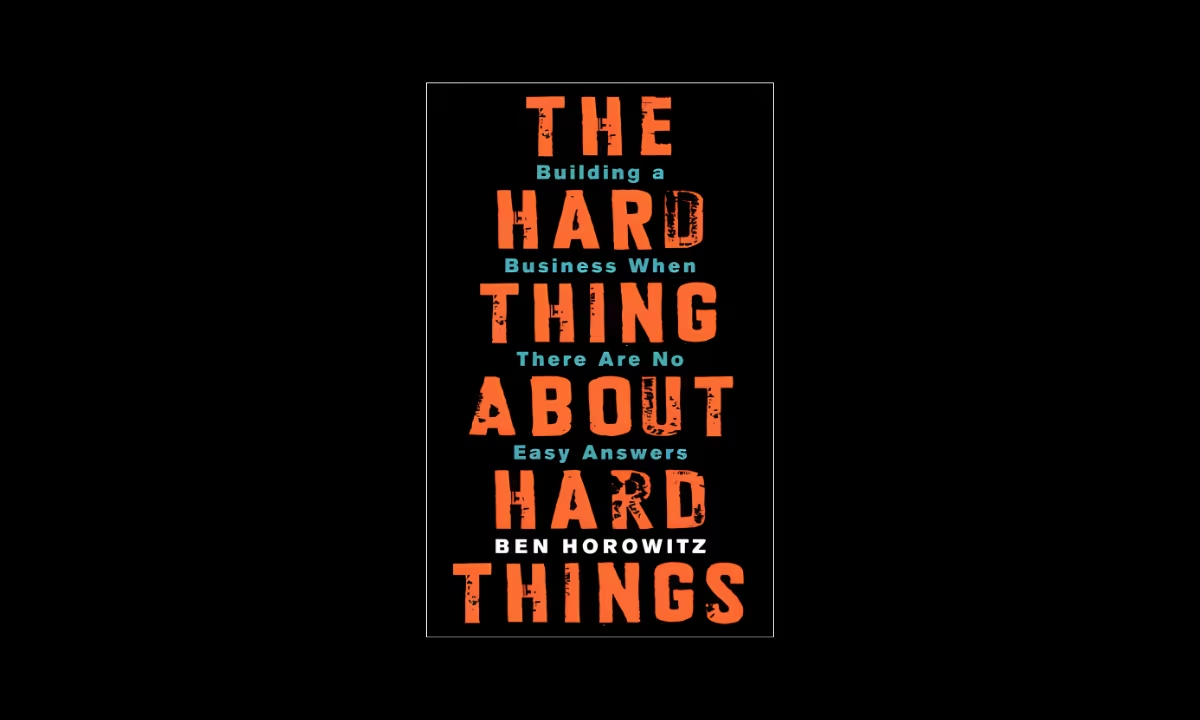
The Hard Thing About Hard Things is worth reading if you want a candid account of leading a business when the available choices are painful. Ben Horowitz puts hiring mistakes, layoffs, product problems, and the pressure of responsibility at the centre of his management advice.
My strongest takeaway after reading it is that courage deserves respect only when it comes with accountability. I recommend the book, but I would question any reading that turns permanent crisis into a badge of good leadership.
The Hard Thing About Hard Things is one of the 10 best books for CEOs.
Table of Contents
At a glance
My verdict: 4 out of 5 stars. I found this an absorbing, useful management memoir with a narrow vantage point and some advice that needs careful limits.
The most useful lesson: Say what is wrong early enough for other people to help solve it. Horowitz makes this argument in his discussion of honest communication.
The most transferable idea: Management debt describes the future cost of avoiding an uncomfortable decision today.
The most easily misused idea: Wartime leadership calls for a different approach during a threat to the company’s survival. I would apply that distinction with an explicit end condition.
My main reservation: A successful founder’s account can show how he understood his decisions. I do not treat that account as proof that those decisions will work elsewhere.
My reading of The Hard Thing About Hard Things is organised around one question: Does a difficult decision repair the organisation, or merely make its people absorb another avoidable cost? That question helped me connect the dramatic survival stories with the quieter passages about training, communication, and respect.
Who should read The Hard Thing About Hard Things?
I would recommend it most strongly to founders, new managers, and readers who want to think seriously about responsibility when a plan fails. Its practical discussions include dismissing an executive, training employees, hiring for an unfamiliar function, managing politics, and communicating through uncertainty.
You do not need to be a CEO to consider those questions. You do need an interest in the uncomfortable side of managing other people.

I would be more cautious recommending it to someone seeking a research-led textbook, a complete guide to starting a small business, or a gentle introduction to workplace leadership. The book moves between personal narrative and management essays, and Horowitz’s introduction explicitly rejects the idea of a universal formula.
I appreciate that honesty. Still, a reader who wants comparative evidence for every recommendation may find the author’s confidence greater than the evidence provided.
The language also matters. Profanity and military comparisons are recurring features of the text.
I sometimes found the bluntness refreshing; at other moments, it made a complicated management problem sound more like a test of personal toughness than I wanted it to be. Your response to that voice will influence how much you enjoy the book.
The book and the experience behind it
The Hard Thing About Hard Things is a management memoir about making decisions without reliable recipes, written by someone who led a technology company through severe difficulties. The Hard Thing About Hard Things: Building a Business When There Are No Easy Answers was published by HarperBusiness on March 4, 2014. Horowitz was cofounder and CEO of Opsware, formerly Loudcloud, before cofounding the venture capital firm Andreessen Horowitz (author biography).
That background matters because the book’s authority comes largely from participation. He describes decisions he made, people he worked with, and situations for which he felt responsible. In the introduction, he states: “I do not attempt to present a formula in this book”.
I take that sentence seriously. It tells me to read for judgment, examples, and questions rather than guaranteed instructions.
The opening chapters establish the personal and business history behind the later advice. The middle chapters address employees, products, organisational problems, and leadership. Later discussions consider exceptions to rules and the decision to sell a company.
This structure gives the advice a narrative foundation, although it also produces a change in reading experience: the early story has momentum, while the later essays invite slower, selective attention.
For me, the central argument is that responsibility does not disappear when a situation becomes too complicated for a standard answer. That is my interpretation of the book’s purpose, rather than a promise that determination alone will deliver a good result.
Why does the Loudcloud and Opsware story matter to the review?
The business history matters because it explains both the force of Horowitz’s advice and the limits of generalising from it. His account follows Loudcloud’s difficulties, the sale of its services business to EDS, and the effort to build a software business around Opsware.
The eventual outcome is no secret: HP announced an agreement to buy Opsware on July 23, 2007, at $14.25 per share, with an enterprise value of approximately $1.6 billion.
I found the change of business more interesting than the size of the deal.
In Horowitz’s telling, saving the company required reconsidering what business it should be in. Persistence involved changing direction, rather than simply defending the original plan. That distinction is useful because “never give up” is an inadequate description of what the story actually contains.
The EDS transaction also brings the human consequences into focus. Horowitz recounts receiving advice from Bill Campbell to stay with employees and explain their situations rather than attend the deal announcement. My response was immediate: an event that looks like a corporate rescue from outside can feel like personal upheaval from inside. I would judge leadership partly by how it handles that difference.
Yet the successful ending cannot settle every argument.
I cannot use an acquisition announcement to prove that a particular speech, hiring choice, or working pattern caused the result. The transaction verifies an outcome. The memoir supplies Horowitz’s account of the route there.
Keeping those kinds of evidence separate makes the review fairer to the reader and to the book.
What does the book get right about difficult management?
The Hard Thing About Hard Things is strongest when it makes leaders examine the cost of their own avoidance. I found its discussions of honesty, training, hiring, and employee dignity more useful than any general instruction to become tougher.
Honest communication gives people something real to work on
Horowitz argues that excessive positivity can hide problems from the people best placed to solve them. He also challenges the instruction that employees should bring solutions whenever they report a problem, since they may recognise a serious issue outside their ability to fix it.
I like this argument because it changes what a manager should listen for. A warning can be useful before the person raising it has a finished proposal. If I were applying this lesson, I would ask what the employee observed, what remains uncertain, and who needs to investigate. That would let me take the concern seriously without treating every suspicion as an established fact.
Consider a hypothetical customer-service employee who notices that refund complaints cluster around one product. They may know nothing about manufacturing or supplier contracts. I would still want that pattern reported. Requiring a complete solution before accepting the warning would be a poor rule for this situation.
My practical adaptation is a short update with four parts: the observed problem, the evidence available, the next action, and the date of the next update. This is my suggested method, not a procedure quoted from Horowitz. It gives candour a useful shape without asking a leader to broadcast every anxious thought.
Training makes performance expectations more defensible
The training discussion asks an uncomfortable question: how can a manager fairly assess an employee who has never been taught what the job requires? Horowitz distinguishes functional training from management training and connects both with clearer expectations.
This was one of my favourite parts.
Training sounds less dramatic than making a difficult dismissal, but I would rather prevent an avoidable failure than become skilful at explaining it afterwards. Before accepting that someone is underperforming, I would want to know whether they understood the expected result, had a usable example, and received feedback early enough to respond.
The chapter includes an arithmetic illustration attributed to Andy Grove: a 1 percent improvement across 20,000 hours amounts to 200 hours of additional output. Those figures illustrate a possible return on training. They are not a measured finding that any particular course will produce that improvement.
My own small-scale application would be to identify one repeated error, teach the relevant task, and inspect later work for a change. For example, a team struggling with incomplete order records might benefit from a worked example and a shared definition of a complete record. I would measure the actual effect rather than assume the arithmetic guarantees it.
Hiring should begin with the work that needs doing
Horowitz warns against hiring an executive because they resemble an imagined ideal or have no obvious weaknesses. He recommends understanding the role and the particular strengths the company needs.
I found this more useful than advice to hire impressive people.
Impressive at what?
In which conditions? With what resources? A company that needs someone to build its first sales process has a different problem from one that needs a leader to manage an established department. I would want the interview process to reflect that difference.
For a hypothetical appointment, I would write down three results the person must help achieve, the constraints they will face, and the evidence I would accept that they can do the work. I would then ask candidates to discuss comparable decisions, including what went wrong. That seems a better starting point than a conversation dominated by confidence and employer names.
There is a limit I would add: hiring for strength should never mean excusing dishonesty or degrading treatment. A technical weakness and a pattern of mistreating colleagues are different kinds of concern. I would keep that distinction explicit when deciding which shortcomings are tolerable.
Dismissal does not remove the obligation to show respect
Horowitz separates layoffs caused by company performance from the dismissal of an individual executive. In both discussions, he stresses preparation, clear communication, and the importance of how departing people are treated.
The brief quotation that stayed with me is Bill Campbell’s advice, as Horowitz recalls it: “you absolutely can let him keep his respect”.The surrounding situation concerns an executive losing his job. I read the phrase as a demand to separate a business decision from the temptation to humiliate someone.
That does not make a dismissal painless. Nor would I treat the chapter as an employment procedure for every jurisdiction. What I take from it is a standard of conduct: prepare accurate information, say clearly what has been decided, and do not make the person receiving bad news manage the leader’s discomfort.
I also appreciated The Hard Thing About Hard Things‘ attention to remaining employees. Horowitz argues that they care about how departing colleagues are treated. My interpretation is that promises about company values deserve to be assessed at the point when keeping them becomes inconvenient.
How should you read the wartime CEO argument?
I would read it as a claim about exceptional circumstances that requires safeguards before application. Horowitz distinguishes a business with room to expand from one facing an imminent threat to survival, then argues that the two situations call for different leadership approaches.
I can accept the need to change priorities during a genuine emergency. A hypothetical business facing a near-term inability to pay essential bills may need faster decisions and fewer active projects. I would want everyone to understand which decisions have become urgent and why.
My concern begins when urgency becomes a permanent identity. Who decides that the emergency exists? What evidence can challenge that decision? What would allow ordinary processes to return? These are questions I bring to the framework, rather than safeguards I claim Horowitz fully develops.
Before using the wartime label, I would write a plain statement of the threat, identify the decisions that need temporary central control, and set a review date. I would also preserve a route for employees to report mistakes. The more concentrated the decision-making, the more seriously I would take information that contradicts the leader’s assumptions.
This is where I read The Hard Thing About Hard Things against itself. Its argument for candid communication asks leaders to hear bad news, while its wartime comparisons allow much less room for disagreement. I do not think that tension disappears because the situation is frightening.
My preferred test is simple: can someone still tell the leader that the plan is failing? If the answer is no, I would question whether the claimed decisiveness is helping the business learn.
I admire a willingness to decide. I am less persuaded by an atmosphere in which disagreement is treated as disloyalty.
What is management debt, and why did it change my reading?
Management debt is Horowitz’s term for a convenient short-term management choice with an expensive long-term consequence. His examples include unclear shared leadership, a reactive compensation decision, and postponing a feedback process
This became my organising idea for the review because it asks who pays for an avoided conversation. A leader may feel immediate relief after postponing a difficult role decision. In Horowitz’s example of two people sharing one leadership position, the unresolved authority creates difficulties for the people who need decisions from them.
I would apply the idea to a hypothetical operations team receiving conflicting instructions from two supervisors. Asking the team to communicate better might leave the actual problem untouched. I would first clarify who owns which decisions, how disagreements are resolved, and where employees should go when instructions conflict.
Here is a practical worksheet I would use. It is my adaptation, not a table from The Hard Thing About Hard Things.
| Decision being postponed | Possible cost to investigate | First repair I would try |
|---|---|---|
| Clarifying ownership of a task | Repeated approvals or conflicting instructions | Name an owner and define decision rights |
| Giving specific performance feedback | Uncertainty about acceptable work | Discuss an example and agree on the expected result |
| Teaching a recurring task | Repeated errors and corrections | Demonstrate the task and review later attempts |
| Explaining a pay decision | Questions about consistency | Review the criteria and explain the applicable process |
I would use the worksheet to identify questions, not to diagnose an organisation from a few symptoms. Some arrangements that look untidy may have good reasons behind them. The point is to make the trade-off visible rather than declare every temporary compromise a mistake.
This reading also changes my view of “hard things.” Sometimes the hard thing is a major restructuring. Sometimes it is a calm conversation that should have happened months earlier. I found the second possibility more relevant to everyday management and less likely to encourage a taste for drama.
When does persistence become an excuse to avoid changing course?
I would question persistence when it continues without a clear account of the problem, evidence of progress, or a condition for reconsidering the plan. Horowitz’s “Lead Bullets” discussion argues for fixing a product’s competitive weakness rather than searching for an escape through a clever alternative.
I found the distinction useful: a company may have customers buying the kind of product it sells, yet fail to win because its own product is inadequate. In the situation Horowitz describes, he argues for improving the product directly.
That is a more specific lesson than simply working harder.
However, I would not use it to justify every long struggle. Before asking people to persist, I would separate several possible problems. Do customers want the result? Can the business provide it at a workable cost? Is the current offer falling short? Does the team have a plausible route to improvement?
These questions could lead to different decisions.
My hypothetical review would use a defined period, such as six weeks, with named evidence to examine at the end. The period is an example, not a recommendation from The Hard Thing About Hard Things. I might look at customer objections, the completion of a repair, and the results of a limited test. I would decide in advance what would support continuing and what would trigger a change.
There is also a human question I would refuse to leave implicit: who is being asked to make the sacrifice? Horowitz’s account of the Darwin Project includes an employee’s recollection of very long hours over an extended period
I found the commitment moving, but one participant’s positive retrospective account would not be enough for me to prescribe the same working pattern elsewhere.
The strengths and weaknesses that shaped my verdict
I finished The Hard Thing About Hard Things impressed by its willingness to stay with uncomfortable decisions, and uneasy about the possibility of turning its tone into a management style. That combination is why my rating is four stars rather than an unqualified endorsement.
Its strongest contribution, in my view, is specificity. The discussions ask what to say, what to prepare, what the manager failed to understand, and what other people need to know. The sections on executive dismissal and hiring are examples of that practical attention. I found them more useful than statements that leaders should be brave or hire well.
I also liked the emotional candour. The passages on the psychological difficulty of being CEO describe the danger of both taking every problem too personally and distancing oneself from problems too much. My response was relief at seeing responsibility discussed without assuming that confidence makes it comfortable.
The principal weakness is the evidence base I would need for broader claims. The Hard Thing About Hard Things offers experience and argument, rather than a systematic comparison of organisations that tried different approaches. That does not make the experience unhelpful. It means I would test the recommendations against my circumstances instead of presenting them as established laws.
The CEO perspective is another limit. I wanted more sustained attention to how the same event might look to an employee with less financial upside or less freedom to leave. The Hard Thing About Hard Things includes other voices, including the Darwin Project recollection, but its central vantage point remains the leader’s.
Finally, I found the movement from memoir to advice uneven. Some essays have the force of an urgent conversation; others feel more dependent on whether I already care about that management problem. I would still call the book successful on its own stated terms. It offers difficult experiences to think with, without delivering the formula its introduction disclaims.
A practical way to use the book after reading
I would turn the reading into a short decision review rather than a list of slogans. The following exercise is my own application of the themes discussed above.
First, choose one current problem. Describe the observed facts in a paragraph before writing a judgment about anyone’s attitude or competence. If the evidence is incomplete, say what would help distinguish between the possible explanations.
Next, identify the decision you have been avoiding. Perhaps you need to narrow a project, clarify a role, correct an unrealistic promise, or admit that your instructions were inadequate. Write down why postponement feels easier. I would be particularly interested in any answer that protects the manager’s comfort while leaving someone else with the uncertainty.
Then ask who should contribute information. This is the point at which I would apply the book’s case for candid communication and employee-led one-on-ones. Horowitz describes those meetings as a way for concerns and ideas to move upwards, rather than simply as another status report.
Finally, choose a next action and a date to review it.
I would record what I expect the action to change and what outcome would show that my explanation was wrong. That last sentence matters to me. A review inspired by a confident business memoir should still leave room for the reader’s first answer to be mistaken.
For a small team, this exercise could fit on one page. I would not introduce a new reporting system just to demonstrate that I had read a management book. The useful result would be a clearer decision and a better account of its consequences.
Which books make useful companions to this one?
I would pair this book with High Output Management for everyday managerial practice and The Lean Startup for examining product and business assumptions. T
he publisher describes Andrew S. Grove’s book as a handbook for organising work and developing teams, while Eric Ries’s methodology centres on testing assumptions through building, measuring, and learning (Grove’s publisher; Ries’s methodology).
| Book | The question I would use it to consider | My suggested reading purpose |
|---|---|---|
| The Hard Thing About Hard Things byBen Horowitz | What responsibility remains when no option feels comfortable? | Examine judgment and leadership under pressure |
| High Output Management by Andrew S. Grove | How should I organise work and develop people? | Build a steadier approach to routine management |
| The Lean Startup by Eric Ries | What evidence would justify continuing or changing this idea? | Test assumptions before treating persistence as the answer |
These are complementary reading purposes, not a ranking of authors. The pairing interests me because it prevents one kind of management problem from swallowing the others. A business may need better execution, a revised assumption, or a difficult personnel decision.
I would want to ask which problem I actually have before choosing the language I use to describe it.
For a shorter companion, Horowitz’s own essay “A Good Place to Work” is especially relevant. It links the quality of an organisation with people’s ability to do useful work and argues that being a good company is worthwhile in itself.
I would read that alongside his wartime argument. It supplies a demanding question for any proposed emergency measure: what kind of place will this decision leave behind?
Is The Hard Thing About Hard Things worth reading?
Yes, I think it is worth reading, provided you bring judgment to its advice rather than borrow its confidence whole. I found it most persuasive when Horowitz asked leaders to tell the truth, teach people properly, face their own hiring mistakes, and preserve respect during painful decisions/
I would recommend it to a general reader interested in business as well as to someone already responsible for a team. Its value for me lies in the questions it makes difficult to avoid. Have I explained the problem honestly? Did I give someone a fair chance to understand the work? Am I fixing the organisation, or asking people to endure another problem I have postponed?
My final reservation is also the reason I would discuss the book with others. The willingness to make a painful decision deserves scrutiny as well as admiration. I would want a leader to explain the evidence, accept responsibility for the choice, and remain answerable for the result.
That is the standard I would carry from this reading into any conversation about doing the hard thing.
The Hard Thing About Hard Things: Building a Business When There Are No Easy Answers

The Hard Thing About Hard Things is worth reading if you want a candid account of leading a business when the available choices are painful. Ben Horowitz puts hiring mistakes, layoffs, product problems, and the pressure of responsibility at the centre of his management advice.
URL: #
Author: Ben Horowitz
4
Pros
- Specific discussion of difficult decisions; candid account of leadership pressure; useful attention to training and communication
Cons
- Limited basis for generalising from one leader's account; narrow CEO perspective; wartime framing needs safeguards