
Last updated on January 13th, 2026 at 05:12 am
Ever wonder why “quiet” neighborhoods can feel louder than cities—because somebody always seems to know when you come and go?
If you’ve ever lived behind blinds you don’t fully trust, The Housemaid Is Watching weaponizes that exact unease—then dares you to keep turning pages anyway.
A family’s “fresh start” in a suburban cul-de-sac turns into a paranoia-fueled mystery where being watched is only the beginning.
The Housemaid Is Watching is best for readers who love domestic thrillers where neighbors, marriages, and “perfect homes” hide rot under fresh paint.
Not for readers who dislike high-stakes suspicion inside family life or who prefer slow, literary ambiguity over page-turning reveals.
If you like your twists to come with a side of moral discomfort, you’re the target audience.
Table of Contents
1. Introduction
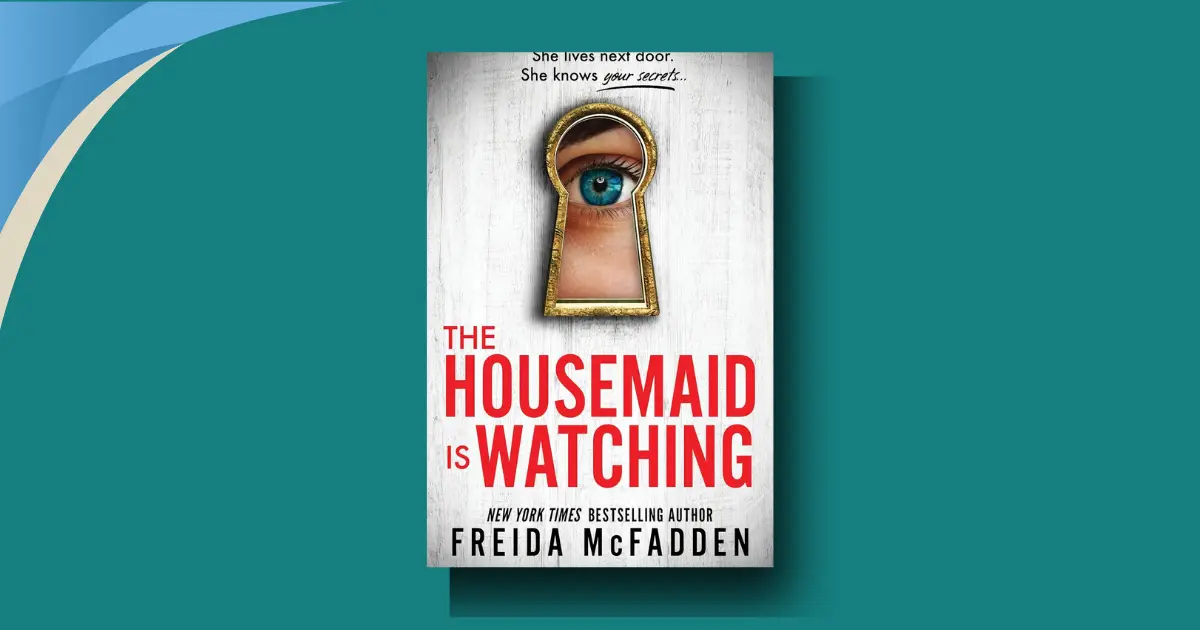
The Housemaid Is Watching by Freida McFadden, published by Bookouture (released in 2024).
It’s the third entry in The Housemaid series, but it’s written to be readable even if you’re coming in fresh—while still rewarding long-time readers with returning-history echoes.
What makes this one stick isn’t just suspense—it’s how the story turns everyday suburban details (windows, routines, “friendly” chats) into a pressure cooker.
And right from the start, the tone is bluntly ominous: “There’s blood everywhere.”
2. Background
Domestic suspense has always thrived on the fear that the safest-looking places are the easiest places to hide secrets.
But the modern twist is how real-world life has normalized constant watching—doorbell cameras, neighborhood groups, and the unspoken “I saw you” culture.
In the U.S., a large share of households now use video doorbells and security cameras (one widely cited industry estimate puts video doorbell adoption around ~20% of U.S. broadband households).
McFadden’s setup fits that contemporary anxiety: the “threat” doesn’t have to kick the door down—sometimes it just stands across the street and observes.
Even the book’s micro-social dynamics—parenting judgment, neighbor surveillance, reputation management—mirror how communities can become informal courtrooms.
And because the story brushes against crimes involving children, it also taps a real fear-world: U.S. missing-person reporting remains high year to year (the FBI’s NCIC reporting is often cited in discussions of volume and trends).
3. The Housemaid Is Watching Summary
Millie Accardi and her husband Enzo move their family into a house that feels like a hard-won miracle—space, schools, and that seductive promise of stability.
Millie even admits the emotional hook plainly: “I love this house.”
But suburban peace in this book is never quiet—it’s performative.
The cul-de-sac has its own ecosystem: polite smiles, silent comparisons, and a social hierarchy that punishes the “wrong” kind of mother, the “wrong” kind of family, the “wrong” kind of past.
Almost immediately, Millie senses a creepy imbalance in the neighborhood’s attention economy—who’s watching whom, and why. A neighbor’s warning lands like a pin dropping in a silent room: “Somebody should… You might be better off if you did the same.”
And the paranoia turns mutual: “After all… she’s watching too.”
Next door are Suzette and Jonathan Lowell—glamour and money on the surface, tension underneath.
Suzette’s friendliness reads like performance, and Jonathan’s vibe is… off—too controlled, too careful, like a man constantly adjusting a mask.
Meanwhile, another neighbor—Janice—acts like the cul-de-sac’s unofficial security system, collecting information the way some people collect coupons.
Millie’s family life, already strained by the pressure of mortgages and parenting, becomes vulnerable to outside suggestion: What if your husband isn’t telling you everything? The story tightens when suspicion starts circling around Enzo—his movements, his secrets, and the way the neighborhood interprets every coincidence as evidence.
Janice openly implies she sees more than she should: “I catch glimpses through the windows, Millie.”
Millie’s fear isn’t just “is my husband faithful”—it’s “am I about to be framed inside a narrative I didn’t write?”
That dread spikes when Miller learns of suggestive “evidence” the police might lean on, because it looks like motive and setup.
A detective ally lays it out: “Your neighbor has pictures…” and it’s enough to make a normal marriage start to feel like a crime scene in progress.
Then the plot detonates: Jonathan Lowell is found dead, and the neighborhood’s quiet tension becomes a loud, legal nightmare.
Millie’s mind can’t stop replaying how intimate the violence seems: “…slashed his throat from ear to ear.” The narrative pressure becomes two-layered: Who killed Jonathan? and Who benefits if Enzo takes the fall?
Enzo’s “suspicious” behavior gets reinterpreted through the worst possible lens—especially with rumor, surveillance, and selective photography involved.
Millie and Enzo scramble for legal help, and a crucial assist appears: a young public defender recruited through their detective contact—sharp, ambitious, and motivated.
At the same time, a seemingly secondary figure—Martha, their cleaning woman—starts to feel more important than Millie initially understands.
A late reveal about Enzo’s secrets reframes Martha from background labor into someone with bruises, fear, and motive for escape. Enzo admits the “motel” thread wasn’t an affair with Suzette at all: “It was Martha.”
And then he explains why: Martha was being beaten and trying to save money to leave.
That revelation is a hinge—because the book’s moral engine loves one question: Who gets believed, and who gets ignored, when danger hides in plain sight?
From here, the story escalates into a full spoiler endgame involving a hidden crime, an ugly secret room, and a decision that forces Millie into strategic ruthlessness.
The Housemaid Is Watching Summary ending explained
The “watching” motif stops being metaphor and becomes plot-mechanical.
Millie begins to suspect the Lowells’ home contains something worse than marital dysfunction—something criminal. Eventually, the investigation pivots toward a missing child case that the neighborhood once treated like gossip, but which turns out to be terrifyingly real. Suzette admits she stayed with Jonathan even after discovering what he’d done, because she feared the identity stain of being “the wife of a child murderer.”
That sentence isn’t just story—it’s the book’s thesis about reputation as a prison.
When the truth cracks open, it becomes clear Jonathan wasn’t simply an unpleasant husband—he was tied to a child’s death, and Suzette helped conceal it.
Ramirez and Millie confront Suzette over what she hid: “You knew what he did, and you didn’t call the police.”
Suzette’s defense is pure self-preservation—she frames silence as strategy, and strategy as morality.
But Millie (and the book) refuse that framing.
Now comes the nastiest strategic pivot: Enzo is at risk of being convicted for Jonathan’s murder, partly because evidence can be made to “look right.” So Millie and Ramirez offer Suzette an ultimatum that is ethically ugly but narratively consistent: confess to Jonathan’s murder as self-defense, or let Enzo go down—and then face prosecution for the child case.
Millie states it plainly: “You need to confess to your husband’s murder.”
Suzette protests: “But I didn’t kill Jonathan.”
Ramirez responds with the hammer: “…we prosecute you for conspiring to kill that little kid.”
Suzette, cornered by her own choices, caves.
And that’s the surface-ending most thrillers would stop at: bad neighbor punished, husband saved, cul-de-sac restored.
But McFadden adds a final twist: the person who actually killed Jonathan isn’t Millie or Enzo or Suzette.
It’s Martha.
Martha’s epilogue reveals she has a violent, interconnected past and recognized Millie’s earlier identity: “Wilhelmina Calloway… would become Millie Accardi.”
Martha admits she manipulated the housing sale to get Millie next door because it was her “ticket out.”
And she confesses the core fact outright: “…I was the one who killed Jonathan Lowell.”
Even worse, Enzo gets arrested before Suzette’s confession clears the path, meaning Martha’s freedom costs collateral damage.
Martha watches the news: “Enzo had been arrested…”
Then: “Suzette confessed to killing her husband.”
Martha’s final line hits like a mic drop on the book’s class-and-invisibility theme: “I suppose nobody ever suspects the housemaid.”
Ending explained in one breath: Martha orchestrates the setup, kills Jonathan, and escapes; Suzette takes the murder blame under pressure; Millie and Enzo survive—but the “justice” is messy, transactional, and morally compromised.
4. The Housemaid Is Watching Analysis
4.1 Characters
Millie is written as a woman whose instincts are sharp but whose life forces her into constant calculation.
She isn’t naïve—she’s exhausted, and that exhaustion is part of the tension: a tired protagonist can be gaslit faster, doubted quicker, and judged harder.
Enzo is the emotional counterweight—protective, proud, and so determined to provide that he becomes vulnerable to manipulation through money and reputation.
His kindness toward Martha (helping her escape abuse) is one of the few clearly “clean” moral acts in the book.
Suzette is a study in image-management as pathology.
She’s not just “mean rich neighbor”—she’s a woman who chooses social survival over moral responsibility, even when the cost is catastrophic.
Jonathan is the story’s darkest gravity well: his death creates the whodunit, but his secret life creates the true horror.
Janice functions like an invasive surveillance system—her watching feels comedic at first, until her photos and “glimpses” become legal threat.
And then there’s Martha—the quiet character whose “invisibility” becomes her weapon.
Her backstory ties her to Millie’s earlier identity, and her endgame is survival through other people’s assumptions.
4.2 The Housemaid Is Watching Themes & symbolism
Watching is the obvious theme, but the deeper theme is interpretation—how communities turn fragments into certainty.
Photos, glimpses through windows, perfume traces—tiny details become “truth” when the neighborhood wants a story.
The cul-de-sac symbolizes a controlled ecosystem: small enough for gossip to circulate instantly, closed enough for secrets to ferment.
The house itself becomes a moral stage: Millie’s dream home is also a trap where appearances matter more than facts.
Martha embodies a harsh class theme: domestic labor is often treated as background noise, and that societal habit becomes the exact camouflage she uses to escape consequences.
5. Evaluation
Strengths (what works)
The pacing is designed for “one more chapter” addiction—small suspicions stack into a collapse.
The neighborhood tension feels culturally current, especially in an era of informal surveillance and socially shared suspicion.
The Martha reveal is a strong thematic twist because it’s not random—it’s the book’s argument made flesh.
Weaknesses (what could be better)
The moral trade in the endgame (forcing Suzette to confess) is gripping, but some readers will find it ethically whiplash: it’s “satisfying” and “disturbing” at the same time.
A few plausibility hinges rely on people behaving in ways that serve momentum more than realism (classic thriller tradeoff).
And because the book is so twist-forward, quieter emotional aftermath sometimes gets compressed.
Impact (emotional + intellectual)
The lingering feeling isn’t “who did it?”—it’s “how easily would I believe the wrong story if my neighbors said it confidently?”
It’s also a gut-punch reminder that reputation can become a form of coercion powerful enough to silence people even after monstrous acts.
Comparison with similar works
If you like The Wife Between Us (unreliable domestic dynamics), Gone Girl (marriage as narrative warfare), or The Girl on the Train (observation-as-obsession), this lands in that psychological neighborhood—just with McFadden’s sharper “popcorn-thriller” rhythm.
Adaptation + box office (and what applies to this specific book)
As of early 2026, public reporting focuses on an adaptation of the first novel, The Housemaid—not specifically The Housemaid Is Watching. (Box Office Mojo)
The Lionsgate film adaptation of The Housemaid released in December 2025 and has widely reported box office totals (industry trackers report domestic and worldwide grosses; multiple outlets note it passed major milestones).
6. Personal insight with contemporary educational relevance
There’s a reason this story hits harder now than it would have a decade ago: we live inside a low-grade culture of surveillance, and most of it doesn’t come from police.
It comes from neighbors.
Real-world adoption of consumer security tech—video doorbells and home cameras—has helped normalize the idea that it’s reasonable to monitor “for safety,” even when it quietly turns into monitoring for social control.
In the book, Janice’s “glimpses through the windows” feel petty until they become evidence-adjacent pressure, the kind that can tilt an investigation even when it isn’t “proof.”
That’s the educational punch: information isn’t neutral just because it’s observed—context decides whether it becomes protection or persecution.
The other contemporary lesson is about silence and reputation.
Suzette’s logic—my life will be ruined if people know what my husband did—is horrifying, but it also mirrors how communities sometimes respond to scandal: protect the image first, address harm later (or never).
And while the book’s child-crime element is fiction, real reporting on missing persons and child-related cases remains a major public concern discussed in official and nonprofit reporting.
So the book becomes an uncomfortable classroom: it asks what we’re willing to overlook for comfort, and who pays when the neighborhood’s version of “peace” matters more than truth.
7. The Housemaid Is Watching Quotes
- “There’s blood everywhere.”
- “I love this house.”
- “I catch glimpses through the windows, Millie.”
- “After all… she’s watching too.”
- “You need to confess to your husband’s murder.”
- “But I didn’t kill Jonathan.”
- “I was the one who killed Jonathan Lowell.”
- “I suppose nobody ever suspects the housemaid.”
8. Conclusion
If you want a domestic thriller that turns suburbia into a pressure chamber, The Housemaid Is Watching delivers twists with teeth.
It’s best for readers who enjoy morally messy resolutions, shifting suspicion, and the dread of being observed.
And if you finish it and find yourself glancing at your neighbor’s windows a little differently—yeah, that’s the point.







