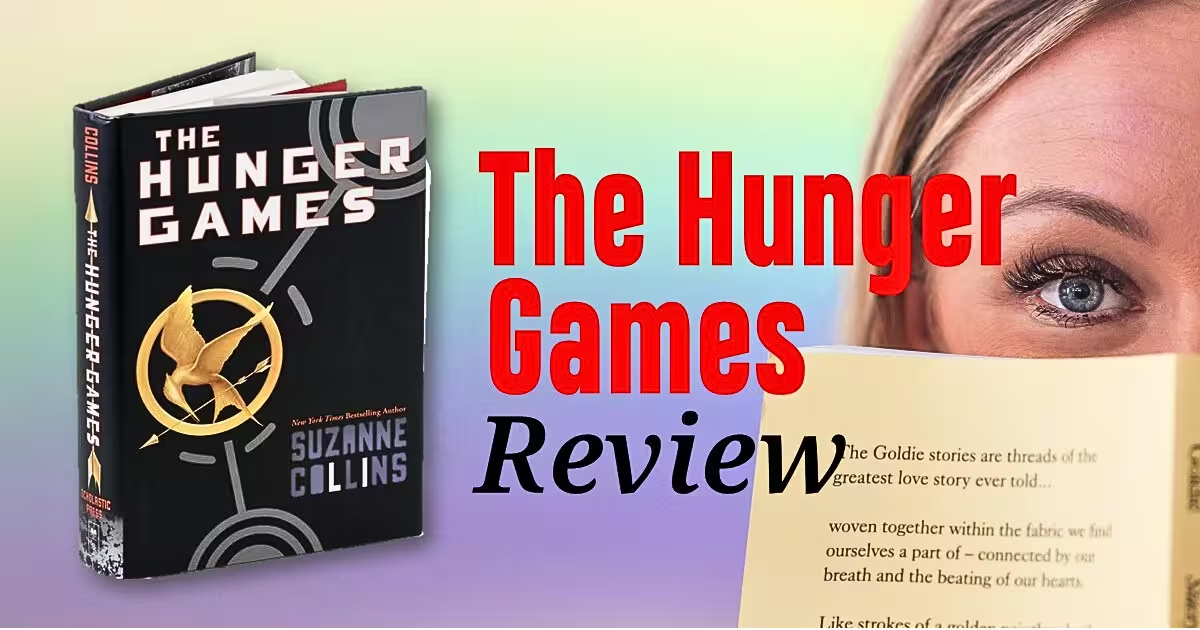

Did you ever wonder why The Hunger Games still feels uncomfortably real every time you see suffering turned into content? I’m Probin Islam, and I keep returning to Suzanne Collins’s book because it teaches—without preaching—how power works, how empathy survives, and how a single “no” can crack a system.
A teenage girl is forced into a state-run spectacle—and discovers that refusing to perform on the regime’s terms can become a political weapon.
The Hunger Games is best for readers who love dystopian YA with sharp social critique, moral gray zones, and psychological realism; educators using fiction to discuss media ethics, authoritarianism, and inequality.
The series’s core concerns—war, propaganda, and manipulation—are central to why it’s endured.
The Hunger Games is not for readers who want light escapism, low-violence stakes, or romance-first storytelling; Collins’s world is built around coerced violence and the trauma it leaves behind.
Table of Contents
1. Introduction
Title: The Hunger Games
Author: Suzanne Collins
Publication / Publisher: First novel in the trilogy; the series begins with The Hunger Games (2008) and was published by Scholastic.
Within the broader franchise, the original trilogy is The Hunger Games (2008), Catching Fire (2009), and Mockingjay (2010).
2. About the author
Early Life and Career

Suzanne Collins, born on August 10, 1962, in Hartford, Connecticut, has always been a storyteller at heart.
Before becoming a household name with The Hunger Games, Collins had a successful career in television, writing for children’s programs such as Clarissa Explains It All and The Mystery Files of Shelby Woo. Her transition from TV to novels began with the popular Underland Chronicles, a five-book series that laid the groundwork for her future success.
Inspiration for The Hunger Games
The inspiration for The Hunger Games came from a blend of sources. Collins has mentioned the influence of her father’s experience in the Vietnam War, her fascination with reality TV, and ancient Roman gladiatorial games.
The idea of a society entertained by violent spectacles while being controlled by a powerful government was born, leading to the creation of Panem and its notorious Hunger Games.
Setting the Stage: The World of Panem
Description of Panem and Its Districts
Panem, a post-apocalyptic nation located in what once was North America, is divided into the wealthy Capitol and twelve poorer districts, each specializing in a particular industry.
The disparity between the Capitol’s opulence and the districts’ poverty is stark, highlighting the severe economic and social inequalities that are central to the novel’s themes.
The Capitol’s Role in Society
The Capitol is the ruling city, where power, luxury, and control reside.
It is home to the elite who live in comfort and excess, in stark contrast to the districts that struggle to survive.
The Capitol’s control over the districts is maintained through oppression and fear, with the Hunger Games serving as a tool to remind the population of the Capitol’s dominance and the consequences of rebellion.
3. Background
Collins’s dystopia is not just “future America,” but a cautionary reconstruction: Panem rises after environmental and climate disasters, war over scarce resources, and a political order that formalizes extraction and control.
Historical / mythic context and inspirations: Britannica notes Collins has described flipping between reality TV and war footage (including Iraq War coverage) as a spark for her “just war” exploration, and also points to classical precedents like Theseus and the Minotaur, plus Spartacus and gladiatorial entertainment.
That blend—myth + modern media + war—helps explain why the story reads like both an ancient sacrifice ritual and a contemporary broadcast.
4. The Hunger Games Summary
The Hunger Games, the first novel in Suzanne Collins’s dystopian trilogy, is set in the nation of Panem, a post-apocalyptic society built on the ruins of what was once North America.
Panem consists of a wealthy, oppressive Capitol and twelve impoverished districts that provide resources and labor to sustain the Capitol’s luxurious lifestyle.
As punishment for a failed rebellion against the Capitol decades earlier—known as the Dark Days—the Capitol enforces an annual event called the Hunger Games.
In this brutal spectacle, one boy and one girl, aged 12 to 18, are selected from each district via a lottery called the reaping.
These “tributes” are forced to fight to the death in a massive, controlled arena until only one victor remains. The Games are televised across Panem, serving as entertainment for the Capitol’s citizens while reminding the districts of their subjugation and the futility of resistance.
The story is narrated in the first person by 16-year-old Katniss Everdeen, a resourceful and resilient girl from District 12, the poorest district focused on coal mining.
Through her eyes, the novel explores themes of survival, inequality, rebellion, and the dehumanizing effects of spectacle and power.
Part One: The Tributes
The story opens on the day of the reaping for the 74th Hunger Games in District 12. Katniss Everdeen wakes up in her modest home in the Seam, the rundown part of the district inhabited by coal miners and their families.
Her father died five years earlier in a mining explosion, leaving her mother emotionally broken and unable to provide for the family.
Since then, Katniss has become the primary provider, hunting illegally in the woods beyond the district’s electrified fence with her best friend, Gale Hawthorne. Gale, two years older than Katniss, shares her features—dark hair, olive skin, and gray eyes—and her resentment toward the Capitol.
They bond over their shared hardships, trading game and foraging for food to support their families.
On this reaping day, Katniss reflects on her deep love for her 12-year-old sister, Primrose (Prim), a gentle girl with fair hair like their mother, who contrasts sharply with the Seam’s typical residents.
As the reaping approaches, the district gathers in the square. The mayor recounts Panem’s history: the collapse of old governments due to natural disasters and wars, the rise of Panem, the districts’ rebellion, and the Capitol’s victory, which included the destruction of District 13 (believed obliterated, though later books reveal otherwise).
The Hunger Games were instituted as a perpetual reminder of the districts’ defeat. Effie Trinket, the Capitol’s flamboyant escort for District 12, draws the names.
To Katniss’s horror, Prim’s name is selected despite her having only one entry (entries increase with age and can be added for tesserae, government grain rations). Katniss immediately volunteers to take her sister’s place, becoming the first volunteer in District 12’s history.
The male tribute is Peeta Mellark, the baker’s son. Katniss recognizes him from a pivotal moment years ago: during a time of near-starvation after her father’s death, Peeta deliberately burned bread and gave it to her, risking punishment from his abusive mother.
This act saved her family, but Katniss has avoided him since, feeling indebted.
Katniss and Peeta are taken to the Justice Building for farewells. Katniss’s mother promises to care for Prim, and Prim begs Katniss to win. Gale visits, urging her to use her hunting skills and promising to protect her family.
Madge Undersee, the mayor’s daughter, gives Katniss a gold mockingjay pin—a symbol from her aunt who died in previous Games—as a token from the district. Peeta’s father, the baker, also visits Katniss, giving her cookies.
Haymitch Abernathy, District 12’s only living victor (from the 50th Games), stumbles in drunk but promises to help.
Katniss and Peeta board a luxurious train to the Capitol, their first taste of opulence. Haymitch, their mentor, is perpetually intoxicated, but after Katniss pins him down in frustration, he agrees to sober up and coach them.
He advises them to stay alive and secure sponsors—wealthy Capitol viewers who can send gifts into the arena.
During the journey, they watch replays of past reapings, noting the “Career Tributes” from wealthier Districts 1, 2, and 4, who train illegally for the Games.
Upon arriving in the Capitol, Katniss and Peeta undergo preparations. Katniss meets her stylist, Cinna, a subtle and innovative designer unlike the garish Capitol fashion.
For the opening ceremony chariot parade, Cinna dresses them in black outfits with synthetic flames, earning them the nickname “the girl and boy on fire.”
The crowd adores them, boosting their visibility for sponsors. They move to the Training Center, where all 24 tributes prepare. Katniss observes the Careers—Glimmer and Marvel from District 1, Cato and Clove from District 2, and the unnamed pair from District 4—who form an alliance and dominate.
She befriends Rue, the tiny 12-year-old from District 11, who reminds her of Prim.
In training, Katniss excels with a bow but hides her skills initially. Peeta requests separate coaching from Haymitch.
During private sessions with the Gamemakers (who score tributes to attract bets and sponsors), Katniss shoots an arrow at an apple in a roast pig’s mouth after they ignore her, earning an unprecedented 11 out of 12.
Peeta scores 8. In a pre-Games interview with host Caesar Flickerman, Peeta confesses his long-standing crush on Katniss, framing them as star-crossed lovers—a strategy Haymitch endorses to gain sympathy, though Katniss sees it as a ploy.
Part Two: The Games
The Games begin as tributes are lifted into the arena, a vast outdoor landscape designed by the Gamemakers, led by Seneca Crane.
The arena features a lake, woods, and a golden Cornucopia stocked with supplies, weapons, and food. Haymitch’s final advice to Katniss: run from the bloodbath at the Cornucopia and find water. Eleven tributes die in the initial frenzy, including the girl from District 9.
Katniss grabs a backpack and sheet, fleeing into the woods. She hears cannons signaling deaths and sees the Careers, now allied with Peeta, hunting others.
Dehydrated, Katniss searches for water, rationing supplies. She climbs a tree to sleep, spotting a fire nearby.
The Careers, including Peeta, kill the tribute who lit it. Katniss realizes Peeta’s alliance might be a betrayal. The next day, exhausted, she finds a pond but is driven by a Gamemaker-engineered wall of fire. Fireballs injure her calf and hands. Hallucinating from pain, she hides in mud.
Rue, from a nearby tree, alerts Katniss to a tracker jacker nest—genetically mutated wasps with hallucinogenic venom. Katniss drops the nest on the Careers, killing Glimmer and the girl from District 4.
Stung herself, Katniss hallucinates but grabs Glimmer’s bow and arrows. Peeta urges her to flee as Cato approaches, saving her life again. Katniss escapes, recovering with Rue’s help.
They form an alliance: Rue, agile and knowledgeable about plants, treats Katniss’s stings with leaves; Katniss shares food.
Rue explains the Careers guard supplies at the Cornucopia, rigged with mines. They plan to destroy it: Rue sets diversion fires while Katniss shoots apples to trigger explosions, demolishing the stockpile.
Katniss succeeds but is deafened in one ear. Returning, she finds Rue trapped in a net and speared by Marvel from District 1. Katniss kills Marvel, but Rue dies. In grief, Katniss covers Rue’s body in flowers—a defiant act broadcast nationwide—and salutes District 11. Sponsors send her medicine for her burns.
An announcement changes the rules: two winners allowed if from the same district. Katniss searches for Peeta, finding him camouflaged near a stream, his leg severely wounded by Cato’s sword and infected. She hides him in a cave, cleaning his wounds.
To secure sponsors, Katniss plays up their romance, kissing Peeta passionately. Haymitch sends sleep syrup; Katniss uses it to drug Peeta and risks the “feast” at the Cornucopia for his medicine.
Clove attacks her, taunting about Rue, but Thresh (Rue’s district partner) kills Clove and spares Katniss for honoring Rue.
Thresh takes District 2’s bag and flees. Katniss injects Peeta with the medicine, saving him, though she passes out from blood loss.
Recovering, they hunt together. Peeta accidentally gathers poisonous nightlock berries, killing Foxface (District 5’s sly tribute) who steals them. Only Cato remains. Gamemakers drain water sources, forcing them to the lake.
Mutant wolves—”muttations” resembling dead tributes—attack. Katniss, Peeta, and Cato climb the Cornucopia. Cato grabs Peeta in a headlock; Katniss shoots Cato’s hand, sending him to the mutts. They maul him for hours until Katniss mercy-kills him.
Part Three: The Victor
Announcers declare Katniss and Peeta victors, but revoke the rule change, demanding one kill the other.
Refusing, they decide on mutual suicide with nightlock berries. Panicking, the Capitol declares them both winners to avoid no victor. Rescued, Katniss awakens in medical care, her injuries healed, including her hearing.
Reunited with her team, Haymitch warns her: her berry stunt is seen as rebellion, endangering her family. She must convince everyone it was love-driven desperation.
In the victory interview, Katniss claims she couldn’t live without Peeta. President Snow crowns them, his glare ominous.
Peeta learns Katniss’s romance was strategic, heartbroken but agrees to maintain the facade. Returning to District 12, they hold hands for cameras. Katniss feels conflicted: grateful to Peeta, loyal to Gale, but aware her actions sparked unrest.
The novel ends with Katniss pondering the future, knowing the Capitol’s wrath looms, setting up the sequels where rebellion ignites.
Explaining the End
The ending underscores the novel’s themes of defiance and unintended consequences.
Katniss and Peeta’s dual victory is a hollow triumph; their berry gambit humiliates the Capitol, portraying it as manipulable. President Snow views Katniss as a threat, foreshadowing her role as the Mockingjay symbol in later books. Peeta’s genuine feelings contrast Katniss’s pragmatism, straining their relationship.
Back home, Katniss reunites with Prim and her mother, but senses change: Districts like 11 show subtle gratitude, hinting at brewing revolution.
The book closes on ambiguity—Katniss holds Peeta’s hand, unsure if it’s real or performative, emphasizing survival’s emotional toll in an oppressive system.
5. The Hunger Games Analysis
5.1 The Hunger Games Characters
1. Katniss Everdeen
Katniss starts as a provider shaped by deprivation and risk, but Collins refuses the “chosen one” fantasy. Her defining trait isn’t purity—it’s reluctant agency under coercion.
Her most consequential move is not tactical brilliance; it’s public defiance—the nightlock stunt that forces the regime to concede.
By the end of Mockingjay, Collins makes a harsher point: revolutions can reproduce the same machinery of spectacle and sacrifice.
Katniss kills President Coin during what should have been Snow’s execution, rejecting the “new Capitol” logic that proposes yet another Hunger Games—this time using Capitol children.
Her landing isn’t triumphant; it’s survival with lingering PTSD, and healing framed as an ongoing practice of remembering “kind deeds.”
2. Peeta Mellark
Peeta is Collins’s quiet subversion of dystopian masculinity: he weaponizes kindness, steadiness, and moral language rather than dominance.
Britannica underscores his “kindness and steadfastness” as central to how Collins writes him.
In the first book’s arc, the “star-crossed lovers” narrative is partly an imposed performance for sponsors—yet it also becomes a pressure-cooker where real attachment forms.
3. Gale Hawthorne
Gale embodies righteous anger and the seductive logic of total war—when you’re oppressed long enough, cruelty can start to feel like strategy. Britannica notes his anger and frustration “from the beginning.”
In the trilogy’s most morally devastating thread, Katniss breaks with Gale after learning the bombing that killed Prim matches a design he helped develop.
Gale isn’t “the villain”; he’s a study in how systems train victims into becoming efficient.
4. Haymitch Abernathy
Haymitch is the mentor figure stripped of glamor—traumatized, alcoholic, and brutally pragmatic. Britannica frames him as negatively viewed for alcohol use yet ultimately a guiding figure.
He also embodies the series’ ugliest truth: to keep children alive in a televised slaughterhouse, you must learn the entertainment rules.
Coriolanus Snow and Alma Coin
Snow is authoritarian cruelty refined into “order.” Coin is the sequel’s sharper warning: power doesn’t always arrive wearing evil’s costume.
The vote for a symbolic “final” Hunger Games, and Katniss’s assassination of Coin, is Collins’s thesis in action: ending tyranny isn’t the same as ending the appetite for tyranny.
5.2 The Hunger Games Themes and Symbolism
1. Media, violence, and the loss of humanity
Britannica explicitly frames Collins’s critique: when citizens treat the Games as entertainment, they “play into a corrupt system,” and repeated viewing can erode humanity.
This isn’t background texture—it’s the engine. The Capitol doesn’t only kill; it turns killing into programming, and forces the districts to watch.
2. Class, hunger, and manufactured scarcity
The Hunger Games is class analysis in YA clothing: the Capitol’s excess is not accidental; it’s the visible proof of extraction. Wikipedia’s theme summary highlights class discrimination, social inequality, and violence against children.
3. “Just war,” propaganda, and moral injury
Britannica ties Collins’s creative origin to “just war” theory—war’s supposed rules versus war’s reality.
Katniss becomes a propaganda symbol (“the Mockingjay”), and the trilogy keeps asking: What does it cost a person to become a message?
4. Symbolism: the Mockingjay, the three-finger salute, and nightlock
- Mockingjay: the unintended consequence the Capitol can’t fully control (a living symbol of rebellion).
- Three-finger salute: grief + solidarity turned into political language; it famously migrated into real-world protest culture.
- Nightlock berries: refusal as strategy—when the state demands a body, refusing the script becomes power.
6. Evaluation
The Hunger Games is a bracing, necessary book—not because it predicts the future, but because it exposes the present: the way spectacle can anesthetize conscience, and the way survival itself can be politicized. Britannica’s framing of empathy, community, and solidarity as counters to fascism captures why it still hits.
6.1 Strengths (what worked for me)
Katniss’s interiority feels lived-in, especially around fear, performance, and moral exhaustion. (The story’s viewpoint and structure are part of its grip.)
The social critique is integrated, not tacked on—economic control, media manipulation, and forced entertainment are inseparable.
Emotional defiance lands harder than action (Rue’s flowers, the berries, the refusal to keep sacrificing children).
6.2 Weaknesses (what I wished were stronger)
The love triangle discourse sometimes distracts from the sharper political questions; even Wikipedia notes criticisms that the romantic plotline was less convincing to some reviewers.
The trilogy’s endgame is intentionally bleak; if you expect clean catharsis, Mockingjay can feel emotionally scouring (and it drew critique from some reviewers).
6.3 Impact
What stayed with me is the idea that the most dangerous part of the Games is what happens after—how power retaliates, rewrites the story, and demands ongoing performance. (Collins makes that explicit through Katniss’s post-arena dread.)
6.4 Comparison with similar works
Wikipedia notes frequent comparisons and “death game” lineage discussions—Battle Royale, The Running Man, The Long Walk, and others—alongside praise for the series’ addictive propulsion and action.
My take: Collins’s differentiator is not the arena concept; it’s the ethical lens on spectatorship and the psychological cost of becoming a symbol.
6.5 Adaptation (book vs film) + box-office
Book vs film (what changes, what holds)
- The book’s first-person voice is the main loss on screen. Wikipedia summarizes a common critique: the film can’t replicate the novel’s first-person narration, which is part of why some argue the novel works better.
- The films sharpen the spectacle. Visually, the Capitol’s excess and the broadcast aesthetic land instantly—but the inner moral negotiation (Katniss parsing performance vs feeling) is more nuanced on the page.
- Collins had meaningful adaptation input. Britannica notes she wrote much of the screenplay for the 2012 film.
Box office (commercial impact)
Using The Numbers’ reported worldwide grosses:
- The Hunger Games (2012): $677,923,379 worldwide.
- Catching Fire (2013): $864,808,014 worldwide.
- Mockingjay – Part 1 (2014): $766,575,131 worldwide.
- Mockingjay – Part 2 (2015): $646,125,287 worldwide.
7. Personal insight with contemporary educational relevance
When I teach or write about The Hunger Games today, I don’t start with the arena—I start with the feed. Collins’s most durable warning is that spectatorship is never neutral: the moment violence becomes “content,” empathy becomes optional, and power gets to edit the meaning.
Collins’s critique—citizens who treat the Games as entertainment “play into a corrupt system”—could be a syllabus line for media literacy in 2026.
What makes this urgently educational is that our real world is also negotiating the ethics of constant exposure.
A longitudinal adolescent study found results consistent with the idea that media-violence exposure can negatively influence empathy and sympathy over time (a desensitization pathway).
Add to that, conflict’s impact on children reached devastating—and likely record—levels in 2024, with more children than ever estimated to be living in conflict zones or forcibly displaced.
In other words: the raw material of suffering is abundant, and the infrastructure for broadcasting it is frictionless.
Then there’s the Capitol’s other engine: inequality. The World Inequality Report 2022 summary highlights extreme concentration—globally, the bottom 50% holds about 2% of wealth, while the top 10% holds 76%.
That gap helps students see why Panem’s “hunger” is political design, not natural fate. Finally, even surveillance and control feel less speculative when Freedom House reports global internet freedom has declined for the 15th consecutive year.
So my contemporary lesson is simple: learn to recognize when a system is turning people into props—and practice refusing the script.
8. The Hunger Games Quotes
- Opening: Survival and Family (Page 4)
Shortened to key sensory and emotional details.
“When I wake up, the other side of the bed is cold. My fingers stretch out, seeking Prim’s warmth but finding only the rough canvas cover of the mattress. She must have had bad dreams and climbed in with our mother. Of course, she did. This is the day of the reaping.” - Sardonic View of District 12 (Page 6)
Core bitter line retained.
““District Twelve. Where you can starve to death in safety,” I mutter.” - Mocking the Capitol Slogan (Page 7)
Focused on the ironic exchange.
““I almost forgot! Happy Hunger Games!” He plucks a few blackberries from the bushes around us. “And may the odds —” He tosses a berry in a high arc toward me. I catch it in my mouth… “—be ever in your favor!” I finish with equal verve.” - Katniss Volunteers (Page 16)
Pivotal moment condensed.
“\”Prim!\” … I reach her just as she is about to mount the steps. With one sweep of my arm, I push her behind me. \”I volunteer!\” I gasp. \”I volunteer as tribute!\”” - The Bread of Hope (Page 23)
Shortened to the emotional debt.
“To this day, I can never shake the connection between this boy, Peeta Mellark, and the bread that gave me hope… I feel like I owe him something, and I hate owing people.” - Haymitch’s Advice (Page 38)
Blunt core line.
““Here’s some advice. Stay alive,” says Haymitch, and then bursts out laughing.” - Katniss as Radiant (Page 81)
Focused on self-realization.
“I am not pretty. I am not beautiful. I am as radiant as the sun.” - Destroying vs. Making (Page 140)
Key thematic line.
““Don’t worry, I’ll think of something. Destroying things is much easier than making them.”” - Lullaby for Rue (Page 155)
Shortened to the song’s essence (Rue’s death scene).
“Deep in the meadow, under the willow / A bed of grass, a soft green pillow / Lay down your head, and close your sleepy eyes / And when again they open, the sun will rise. / Here it’s safe, here it’s warm / Here the daisies guard you from every harm / Here your dreams are sweet and tomorrow brings them true / Here is the place where I love you.” - Madly in Love (Page 167)
Core whisper for the romance ploy.
““Remember, we’re madly in love, so it’s all right to kiss me anytime you feel like it.”” - Nightlock Berries (Page 210-211)
Condensed revelation (leading to Foxface’s death and the pact).
“My father’s voice comes back to me. “Not these, Katniss. Never these. They’re nightlock. You’ll be dead before they reach your stomach.” … In answer, I hold out the berries.” - Ambiguous Ending (Page 245)
Final uncertain line.
“I take his hand, holding on tightly, preparing for the cameras, and dreading the moment when I will finally have to let go.”
9. Conclusion
The Hunger Games endures because it’s not just a dystopian thriller—it’s a study of how systems manufacture obedience using fear, hunger, and entertainment.
In Panem, oppression isn’t only enforced by soldiers; it’s reinforced through spectacle, where suffering is packaged as a show and citizens are trained to watch instead of resist.
Although Katniss Everdeen becomes the story’s symbol, the book refuses simple hero worship. Instead, it shows how power manipulates narratives, turns human lives into propaganda, and pressures individuals to perform roles for survival.
Therefore, the novel’s emotional force comes from its realism: courage isn’t presented as fearless strength, but as desperate moral choice under control.
My overall impression is that Suzanne Collins created something both gripping and socially important—an accessible novel that still delivers sharp commentary on inequality, state violence, and media manipulation.
If you like dystopian fiction with real ethical bite, you’ll likely find it intense, fast-moving, and haunting in the best way. However, if you prefer comfort reads or stories that avoid brutality and trauma, this may feel too heavy.
Recommendation
- Recommended for: dystopian and YA readers, political-fiction fans, and anyone interested in media ethics, propaganda, and social inequality.
- Especially useful for educators: because it can spark meaningful discussions about power, consent, public spectacle, and civic resistance.
Final reflection
Why it matters is simple: it doesn’t flatter us with easy heroism. Instead, it asks a harder question—when the world demands you become entertainment, how do you stay human?