
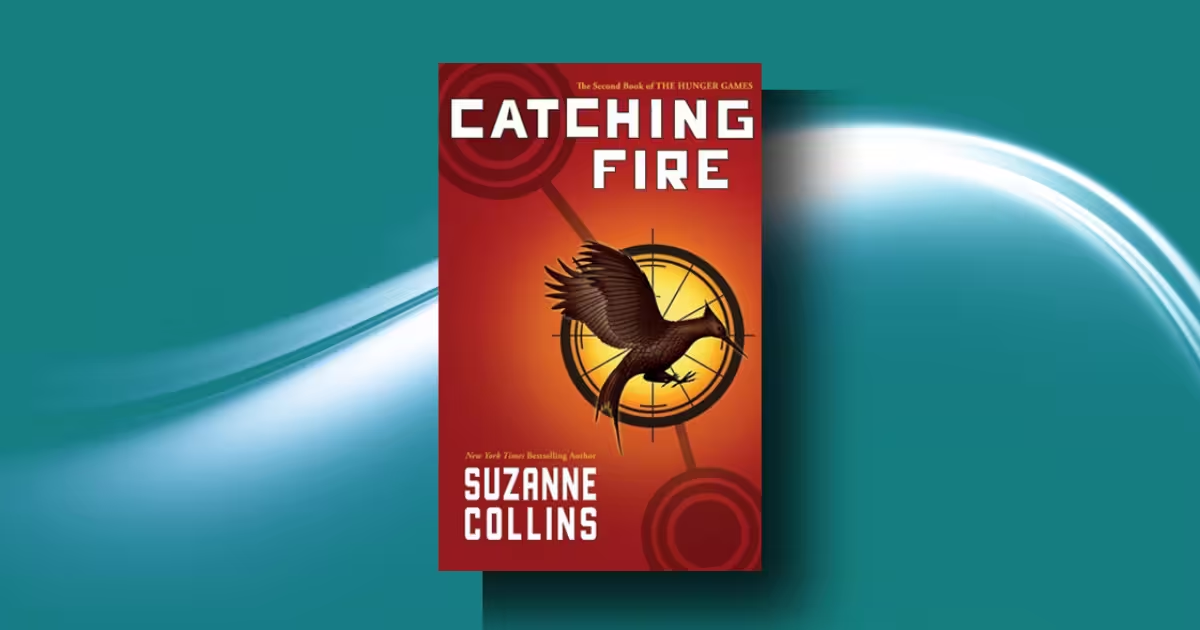
Do you ever finish a book and feel it still burning in your hands, its characters whispering in your ear long after the final page? That’s the indelible mark of Catching Fire, a novel that transforms a story of survival into a blazing anthem of rebellion.
Suzanne Collins masterfully escalates the stakes by demonstrating that winning a brutal game is only the beginning, as the real fight is against the oppressive system that created it.
The narrative of Catching Fire itself is the primary case study, showing how a single defiant act (Katniss’s berry stunt) ignites widespread unrest, a concept supported by historical and sociological research on how symbols can fuel revolutionary movements.
Catching Fire is best for readers who crave intense political drama, complex moral dilemmas, and strong character arcs will be captivated. Those seeking a straightforward adventure or a tidy, romantic conclusion may find the relentless tension and bleak moments challenging.
Table of Contents
1. Introduction
Catching Fire is the second installment in Suzanne Collins’s groundbreaking dystopian trilogy, The Hunger Games. Published in 2009 by Scholastic Press, it picks up several months after the events of the first book, plunging readers back into the grim world of Panem.
This volume shifts the lens from surviving a game to understanding its purpose, exploring the terrifying consequences of sparking hope in a society built on despair.
2. Background
Set in a post-apocalyptic North America, the nation of Panem is divided into twelve oppressed districts ruled by the wealthy, technologically advanced Capitol.
As punishment for a past rebellion, the Capitol enforces the annual Hunger Games, where a boy and girl from each district are forced to fight to the death.
Catching Fire builds on this foundation, drawing clear parallels to historical empires that used spectacle and fear (like Roman gladiatorial games) to subdue populations, and to modern realities of media manipulation and state-controlled narratives.
3. Catching Fire Summary
Part I: The Spark
The novel opens with Katniss Everdeen haunted and adrift. Despite her victory in the 74th Hunger Games, she finds no peace. Her survival, secured by a threat of dual suicide with fellow tribute Peeta Mellark, has been interpreted not as an act of desperate love for the Capitol, but as an act of defiance in the districts.
During the mandatory Victory Tour, the tension is palpable. In District 11, home of her fallen ally Rue, Katniss gives an impromptu, emotional speech.
The response is a silent, unified salute from the crowd—the same gesture she gave Rue in the arena. This act of solidarity is met with immediate, brutal violence from Peacekeepers, revealing the fragile, terrified state of the Capitol’s control.
The true catalyst comes with a surprise visit from President Snow himself. He makes it chillingly clear that Katniss is now a symbol of rebellion, a “spark” that could ignite an uprising. To quell the unrest, she must convincingly sell her love story with Peeta to the entire nation.
His threat extends beyond her: “Speak, Miss Everdeen. Him I can easily kill off if we don’t come to a happy resolution,” he says of Gale, demonstrating that her loved ones are now pawns (Page 18).
Part II: The Quarter Quell
Despite her efforts during the televised tour, rebellion is simmering. Katniss, Peeta, and their perpetually drunk mentor Haymitch Abernathy return to District 12, only to find it under the iron fist of a new Head Peacekeeper, Romulus Thread.
Life becomes harsher, punishments more cruel. Gale is publicly whipped for poaching, a scene that radicalizes Katniss further.
Just as she resolves to run away, the rules for the 75th Hunger Games—the third Quarter Quell—are announced. These Games occur every 25 years with a cruel twist. This year’s twist is designed to snuff out Katniss’s symbolic power: “On the seventy-fifth anniversary, as a reminder to the rebels that even the strongest among them cannot overcome the power of the Capitol, the male and female tributes will be reaped from their existing pool of victors” (Page 104).
As District 12’s only living female victor, Katniss’s return to the arena is guaranteed.
Part III: The Arena
The victors-turned-tributes are a mix of aging survivors, cunning veterans, and fresh scars. Alliances form quickly. Katniss and Peeta align with the charismatic Finnick Odair from District 4 and the intelligent, elderly Mags.
The arena itself is a masterpiece of terror: a tropical jungle arranged like a clock, with a different lethal horror—blood rain, monkey mutations, fog—unleashed in each section every hour.
The Games become a complex dance of survival and secret collaboration. Beetee, a victor from District 3, devises a plan to use the arena’s lightning-charged tree to electrocute the saltwater surrounding the Cornucopia, hoping to kill the remaining “Careers.” In the chaotic climax, Katniss, realizing a larger plot is at work, arrows the force field dome itself. The arena shatters.
The Ending: The Enemy Revealed
This act of destruction is not the end, but a beginning.
A hovercraft rescues Katniss, but she is knocked unconscious. She awakens to find Beetee, Finnick, and her mentor Haymitch, but Peeta and the victor Johanna Mason have been captured by the Capitol. She is informed that District 12 has been bombed into oblivion.
Most shockingly, the head Gamemaker, Plutarch Heavensbee, is revealed to be a leader of the long-rumored rebellion. The “arena” was just another layer of the game. The real enemy was always the Capitol, and the real goal was to extract the symbol of the rebellion—Katniss, the Mockingjay—alive.
The book ends with her devastation and fury: “My spirit. This is the thing that can never be manipulated by the Capitol. My spirit. My identity. My soul. I feel it now, a steady, steady rage. ‘I’m going to be the Mockingjay.’”
4. Catching Fire Analysis
4.1. Catching Fire Characters
Katniss Everdeen: Her development is central. She evolves from a survivor focused on protecting her immediate circle to an unwilling revolutionary. Her internal conflict—her authentic feelings for Gale versus her performed love for Peeta—mirrors her struggle between personal desire and public duty. Her PTSD is palpable, making her reactions brittle and real.
Peeta Mellark: Peeta’s strength lies in his emotional clarity and strategic use of perception. While Katniss acts, Peeta communicates. His public proposal and decision to sacrifice himself in the arena (“I lift my hand to my mouth and kiss the fingers that had held the berries.
Then I hold them out to him. ‘Good-bye, Peeta,’ I say. He takes my hand, holds it tightly. ‘You know I love you,’ he says. I nod.”) solidify his role as the heart of the rebellion and Katniss’s moral anchor.
Haymitch Abernathy: His cynical exterior cracks to reveal a strategic mastermind and a man deeply scarred by his own Games and the Capitol’s cruelty. His guidance shifts from keeping Katniss alive to positioning her as the rebellion’s figurehead.
President Snow: He moves from a distant threat to a intimately terrifying presence. His visit, smelling of “blood and roses,” establishes him as a predator who uses personal threats and psychological warfare as effectively as violence.
4.2. Themes and Symbolism
The Spectacle of Violence: The Games are a metaphor for reality TV and desensitization. Catching Fire shows how the Capitol’s spectacle backfires, as the districts learn to see through the narrative to the brutality beneath.
Symbolism of the Mockingjay: Born from the Capitol’s failed creation (the jabberjay), the mockingjay becomes the perfect symbol of rebellion—uncontrollable, adaptive, and resilient. Katniss’s pin evolves from a token to a beacon.
The Cost of Rebellion: The book doesn’t romanticize uprising. It shows the immediate cost: the whipping of Gale, the execution of the old man in District 11, the bombing of District 12. Rebellion is framed as necessary but devastating.
Real vs. Performed Emotion: The central love triangle is less about romance and more about authenticity under coercion. Katniss’s struggle to discern her real feelings highlights how the Capitol corrupts even personal truth.
5. Evaluation
Catching Fire is a superior sequel, a masterclass in escalating stakes that deepens the world and sharpens the political critique of its predecessor.
Strengths
The pacing is relentless and masterful. The expansion of the world—glimpses of other districts, the victors’ community—is rich and rewarding. The Quarter Quell is a brilliant narrative device that raises the stakes impossibly high. Character work, especially for Haymitch and Finnick, adds profound layers.
Weaknesses
The love triangle can feel like a narrative obligation at times, and some readers might find the middle section before the Games slightly slower. The large cast of new victor characters, while fascinating, isn’t given equal depth due to constraints.
Impact
It resonates intellectually with its sharp critique of media and power, and emotionally through its unflinching look at trauma and the personal cost of becoming a symbol.
Comparison
It stands taller than many YA dystopian sequels by avoiding the “middle-book slump.” It has the intricate plotting of The Empire Strikes Back—darkening the story, expanding the conflict, and ending on a game-changing cliffhanger.
Adaptation
The 2013 film adaptation, directed by Francis Lawrence, is largely faithful and visually stunning. It successfully conveys the emotional weight and political tension. Some character moments (like the development of the victors) are condensed for time.

The film was a major box office success, grossing over $865 million worldwide, proving the massive appeal of the story.
6. Personal Insight & Contemporary Relevance
Catching Fire is profoundly educational in its exploration of how symbols and narratives fuel political change. Katniss’s unintended rise as the Mockingjay mirrors how modern movements coalesce around figures or gestures—a raised fist, a particular hashtag—that come to represent a larger struggle.
The Capitol’s attempt to control the narrative through staged weddings and propaganda is chillingly reflective of state-controlled media and disinformation campaigns seen globally today. According to a 2023 Pew Research study, over 70% of adults in numerous countries believe their government spreads false information.
The book teaches a crucial lesson: in an age of curated realities, the most radical act can be to expose the truth, however messy and dangerous that may be.
It underscores that rebellion often begins not with armies, but with a shared glance of understanding, a silent salute—moments that affirm, “You are not alone.” This is why the story continues to burn brightly for new generations of readers.
7. Catching Fire Quotes
- “I am not pretty. I am not beautiful. I am as radiant as the sun.” – Katniss (Page 5, reflecting on her forced Capitol image).
- “Remember, we’re madly in love, so it’s all right to kiss me anytime you feel like it.” – Peeta (Page 35, highlighting the performance).
- “It takes ten times as long to put yourself back together as it does to fall apart.” – Finnick Odair (Page 254).
- “Fire is catching! And if we burn, you burn with us!” – Katniss (Page 386, her defiant message to Snow).
- “I wish I could freeze this moment, right here, right now, and live in it forever.” – Peeta (Page 387, a moment of peace before the storm).
8. Conclusion
Catching Fire is more than a bridge between books; it is the explosive heart of the trilogy. It takes the premise of The Hunger Games and transforms it into a complex, heartbreaking, and thrilling story about the birth of a revolution. Collins proves that the most compelling stories are not just about fighting to live, but about discovering what is worth fighting for.
Recommendation: A must-read for fans of dystopian fiction, political thrillers, and stories of resilience. It is ideal for readers who appreciate character-driven plots within high-stakes scenarios. While accessible to mature younger readers, its themes of war, trauma, and oppression resonate deeply with adults.
Final Reflection: This book stays with you because it dares to ask: What happens after you win the game, only to realize the game was never the point? The answer is a fiery, unforgettable journey.







