
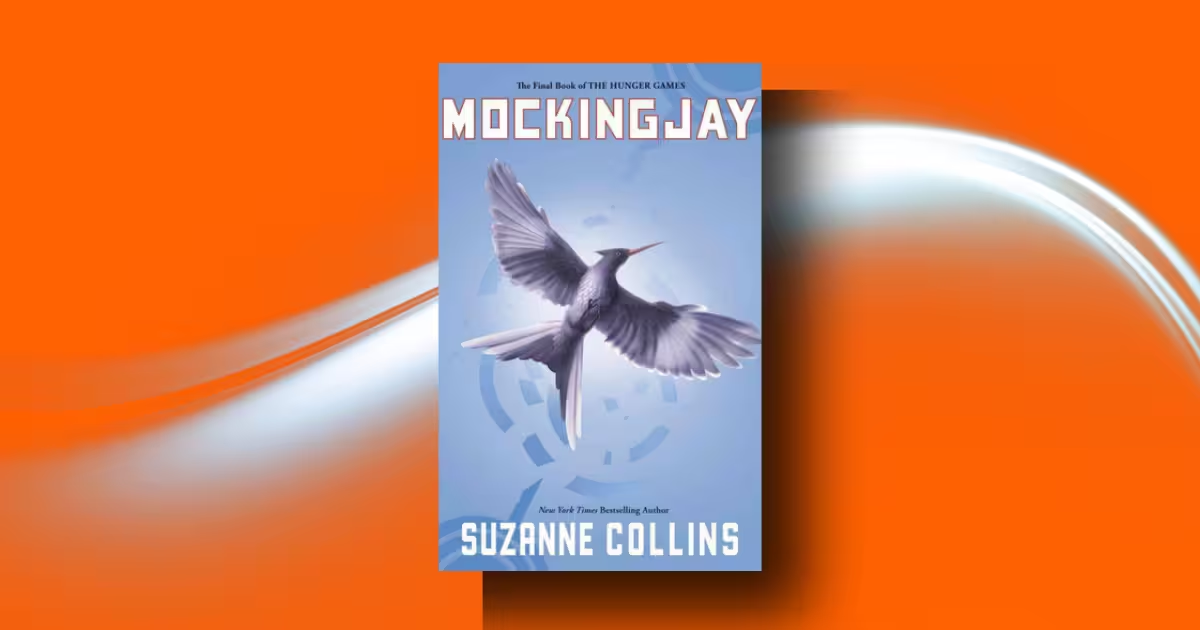
Have you ever finished a book and felt it linger in your bones—a story that questions not just a fictional world, but the very nature of your own conscience? Mockingjay isn’t just a conclusion to a trilogy; it’s a raw, unflinching interrogation of war, trauma, and what we sacrifice to become symbols.
Mockingjay masterfully argues that even righteous revolutions corrupt, and the true cost of war is measured not in territory gained, but in humanity lost.
Mockingjay is best for readers who crave morally complex narratives, political allegory, and character studies in trauma. Not for those seeking a tidy, heroic conclusion or pure escapist adventure.
Table of Contents
1. Introduction
Title: Mockingjay
Author: Suzanne Collins
Publication Details: Published on August 24, 2010, by Scholastic Press, Mockingjay is the third and final installment in the internationally bestselling Hunger Games trilogy.
The series has sold over 100 million copies worldwide and has been translated into 54 languages, cementing its place as a defining work of 21st-century young adult literature.
2. Background
The Hunger Games trilogy emerged in a post-9/11, media-saturated world where reality television, ongoing wars, and economic disparity were prominent cultural concerns.
Collins has cited the influence of channel-surfing between coverage of the Iraq War and reality TV competitions as a direct inspiration for the series’ core conceit.
Mockingjay, in particular, strips away the arena’s gladiatorial spectacle to expose the brutal, un-televised mechanics of civil war, rebellion, and the political machinations that survive regime change.
3. Mockingjay Summary
Part 1: The Ashes of District 12
The novel opens with a shattered Katniss Everdeen. District 12 has been firebombed into oblivion by the Capitol as retaliation for her act of defiance in the Quarter Quell arena.
She is now a refugee in the militaristic, underground District 13, which was believed destroyed 75 years earlier but survived by striking a secret bargain with the Capitol.
Physically and mentally scarred—haunted by headaches from a concussion and the psychological torture of not knowing Peeta’s fate—Katniss is a ghost of the “Girl on Fire.”
President Alma Coin of District 13 and the rebel leader Plutarch Heavensbee want to transform her from a survivor into a weapon: the Mockingjay, the symbolic leader of the rebellion. Katniss is reluctant, paralyzed by guilt over the destruction her actions have caused and fear for Peeta, who is captive in the Capitol being tortured for information he doesn’t have.
Her only condition for becoming their symbol is that Peeta and the other captured victors be granted full immunity when the rebels win.
Part 2: The Mockingjay Rises
After a harrowing visit to the ruins of her home, Katniss agrees. A propaganda team, including a director named Cressida, films her for “propos” (propaganda spots) to be broadcast across Panem. Initial studio attempts are stilted and false. It’s only when she is thrust into real combat in the bombed-out District 8 that the authentic, furious Mockingjay emerges.
After witnessing a Capitol bombing of a hospital full of wounded, she delivers an incendiary speech to the camera: “Fire is catching! And if we burn, you burn with us!” The clip galvanizes the districts.
Meanwhile, Peeta begins appearing in Capitol broadcasts. Initially, he seems unharmed and calls for a ceasefire, damaging rebel morale. Subsequent interviews show him deteriorating—gaunt, sweating, and gripped by a nervous tremor.
In a final, devastating broadcast, he warns District 13 of an imminent attack before being overwhelmed, screaming as he’s beaten off-screen. The warning saves lives, but the cost is revealed later.
Part 3: The Rescue and the Hijacking
A high-risk mission is launched to rescue Peeta and the other victors from the Capitol. It succeeds, but the Peeta who returns is horrifically altered. He is “hijacked”—a form of Capitol torture using tracker jacker venom to poison and distort his memories, particularly those of Katniss. The loving boy now sees her as a threat, a monster.
In a heart-stopping moment, he attacks her the instant they are reunited, nearly strangling her to death before being subdued.
While Katniss recovers from this physical and emotional devastation, the war advances. The rebels, with Katniss’s propos fueling their resolve, take district after district.
Gale Hawthorne, Katniss’s oldest friend, works with Beetee to design brutal, trap-based weapons that target rescue workers, showcasing a chilling moral descent.
Finnick Odair marries his rescued love, Annie Cresta, and in a powerful broadcast, exposes President Snow’s and the Capitol elite’s deepest secrets, including how victors were sold and Snow’s use of poison to eliminate rivals.
Part 4: The Assault on the Capitol and the Final Choice
The rebels prepare to take the Capitol itself. Katniss, Gale, Finnick, and a camera crew are embedded with a specialized soldier unit, Star Squad 451, intended to film more propos from the front lines.
Their mission spirals into a nightmare when their commander, Boggs, is killed and Katniss disobeys orders to pursue her own goal: assassinating President Snow.
The Capitol’s streets become a second, more horrific arena, rigged with “pods” that release mutts, traps, and horrors. Finnick dies heroically but brutally, torn apart by lizard-like mutts in the city’s sewers.
The team is whittled down. In the final push, as civilians including children are funneled towards Snow’s mansion, Capitol hovercraft drop silver parachutes—presumed aid packages. These instead detonate into bombs, massacring the children and Rebel medics, including Katniss’s sister, Primrose.
Part 5: The Execution and the New President
A devastated Katniss is taken to Snow’s mansion for his official surrender. In a private meeting, the captured and dying Snow tells her that the bombs were not his order—they were President Coin’s, a move to turn the Capitol’s final atrocity into a rallying cry and eliminate Snow in one stroke. He implies Coin sacrificed Prim to manipulate Katniss and remove a popular rival for power.
At Snow’s planned execution, Katniss is given the honor of firing the arrow. Instead, she turns and shoots President Coin dead. Chaos erupts. Snow is found dead in the crowd, apparently laughing himself to death or crushed. Katniss is tried but deemed mentally unfit, spared due to her symbolic value.
Epilogue: The Aftermath
Years later, Katniss lives back in a rebuilt District 12 with Peeta. Both are permanently scarred. Peeta fights daily to separate “real” memories from “not real” ones implanted by the hijacking.
He slowly regains himself. Katniss, haunted by grief and guilt over Prim’s death and her role in the war’s violence, initially believes she doesn’t deserve happiness or children.
The book concludes with a tentative, hard-won hope as she reflects on their recovery: “But there are much worse games to play.”
4. Mockingjay Analysis
4.1. Mockingjay Characters
Katniss Everdeen: Her arc is a deconstruction of the “chosen one” trope. She never wanted to lead; she wanted to survive and protect her family.
Mockingjay charts her complete breakdown under the weight of being used as a symbol by all sides (Capitol, rebels, District 13). Her PTSD is visceral: “My name is Katniss Everdeen. I am seventeen years old…” becomes a mantra to ground a shattered mind (p. 12).
Her final act—killing Coin instead of Snow—is not a hero’s move but a deeply personal, political, and moral choice to stop the cycle of tyrannical power. She ends not as a triumphant victor, but as a survivor learning to live with unhealable wounds.
Peeta Mellark: His torture and “hijacking” represent the ultimate Capitol violation: the destruction of self and love. The gentle baker who painted flowers in a book is weaponized against the person he cherished most.
His struggle to reclaim his identity through the “real or not real?” game is one of the trilogy’s most poignant narratives about the fragility of memory and the endurance of the core self.
Gale Hawthorne: Gale embodies the dangerous, corrosive nature of vengeance. His military ingenuity, once used for hunting, is channeled into designing horrific weapons. His statement, “If I could hit a button and kill every living soul working for the Capitol, I would do it. Without hesitation” (p. 22), marks his moral divergence from Katniss. His indirect role in Prim’s death (his bomb design was likely used) severs his final tie to her, showcasing how war destroys relationships as surely as cities.
President Alma Coin: A brilliant antagonist because she mirrors Snow in her cold, calculating pragmatism. She understands propaganda, sacrifice, and power consolidation.
Her gray hair and pale eyes are described as “the color of slush that you wish would melt away” (p. 14). She is the novel’s stark warning that revolution does not guarantee a better ruler, only a different one.
Finnick Odair: His heartbreaking backstory—sold into sexual slavery by Snow—reveals the Capitol’s hidden cruelty beyond the Games. His love for Annie and his marriage provide a fleeting moment of pure joy before his tragic death, underscoring the war’s wanton destruction of goodness.
4.2. Mockingjay Themes and Symbolism
The Corruption of Revolution: The novel meticulously asks: Are the rebels any better? District 13 is authoritarian, controlling schedules and food. Coin is willing to sacrifice children for political gain. Gale’s traps target compassion. The rebellion wins, but at the cost of its own soul. As Plutarch later tells Katniss, “We’re going to form a republic… but it’s sure to have its problems” (p. 45).
Trauma and PTSD: This is not a war story about glory, but about psychological ruin. Katniss’s dissociation, nightmares, and list-making; Peeta’s hijacking; Finnick’s knots; Johanna’s fear of water—all are detailed, unflinching portraits of trauma that continue long after the fighting stops.
Media, Propaganda, and Image: The “propos” are as central as the battles. Katniss learns her authentic rage is the best propaganda, but that authenticity is then carefully manufactured and broadcast by others. The war is fought on screens as much as in streets, questioning what is “real” in a mediated conflict.
Symbolism of the Mockingjay: The mockingjay began as a symbol of accidental survival (a bird that outsmarted the Capitol’s engineered jabberjays).
It becomes a symbol of rebellion, then a branded weapon for Coin’s army, and finally, for Katniss, a reminder of the unnatural roles she was forced to play. By the end, she hopes to let it fade back into the woods.
5. Evaluation
Mockingjay is a courageous and necessary conclusion—a bitter antidote to the fantasy of clean, righteous victory. It prioritizes psychological truth over wish-fulfillment.
Strengths
- Uncompromising Portrayal of War: It refuses to sanitize the cost, showing the bombing of hospitals, the death of children, and permanent psychological scars.
- Moral Complexity: It forces readers to sit with uncomfortable questions about vengeance, collateral damage, and new tyrannies.
- Character Arcs: Katniss and Peeta’s journeys are heartbreakingly authentic. Their healing is slow, non-linear, and never fully complete—a rare and respectful depiction of recovery.
Weaknesses
- Pacing in District 13: The middle section within the bunker can feel claustrophobic and slow, mirroring Katniss’s stagnation but potentially testing some readers’ patience.
- Underutilized Characters: Some beloved characters from previous books, like Haymitch, recede into the background, their potential arcs simplified.
Impact: This book stayed with me for weeks. It’s not an enjoyable read in the traditional sense; it’s a provoking, haunting, and emotionally devastating experience that reshapes how you view the entire trilogy and the stories we tell about war.
Comparison with Similar Works: It shares the grim war realism of Stephen King’s The Long Walk or Anthony Burgess’s A Clockwork Orange in its focus on psychological damage. It stands apart from more conventionally triumphant YA dystopian conclusions like Veronica Roth’s Allegiant (despite shared themes) by committing fully to its bleak, complex vision.
Adaptation
The film adaptation (The Hunger Games: Mockingjay – Part 1 & 2, 2014-2015) successfully captures the grim tone and key plot points. Jennifer Lawrence’s performance as a traumatized Katniss is powerful. However, the split into two films stretched thin material, leading to pacing issues, and some of the novel’s internal monologue and deeper moral ambiguity was inevitably lost.
Box Office: Combined, the two films grossed over $1.4 billion worldwide, proving the franchise’s massive commercial appeal even with its somber conclusion.
6. Personal Insight with Contemporary Relevance
One of Mockingjay’s most prescient themes is the weaponization of media and the image of the “revolutionary.” Katniss’s “propos” are eerily similar to the curated social media narratives, deepfakes, and viral propaganda that define modern conflicts and political movements.
A 2023 study by the Stanford Internet Observatory found that disinformation campaigns now consistently use emotionally charged, symbol-laden imagery to radicalize and mobilize—directly mirroring Plutarch and Coin’s crafting of the Mockingjay symbol.
We live in an age where symbols are routinely separated from their human origins and leveraged for agendas. Katniss’s struggle—to retain any autonomy when she is the “Mockingjay”—parallels the experience of individuals thrust into the spotlight of modern media cycles, their narratives co-opted by movements on all sides.
The book teaches a crucial lesson in media literacy: to look past the symbol to the complex, often suffering human being at its center, and to question who truly benefits from the stories being told. Explore more on media and modern conflict here.
7. Mockingjay Quotes
- “Fire is catching! And if we burn, you burn with us!” – Katniss’s defiant, game-changing propaganda speech (p. 51).
- “You’re still trying to protect me. Real or not real?” / “Real.” – The simple, devastating exchange that shows Peeta’s true self fighting its way back through the hijacking.
- “I have a kind of power I never knew I possessed.” – Katniss realizing the frightening weight of her symbolic influence (p. 48).
- “So after, when he whispers, ‘You love me. Real or not real?’ I tell him, ‘Real.’” – The final, hard-won affirmation of love in the epilogue.
- “That’s when I make a list in my head of every act of goodness I’ve seen someone do. It’s like a game. Repetitive. Even a little tedious after more than twenty years. But there are much worse games to play.” – The novel’s closing lines, embodying its theme of finding hope through daily choice in a broken world.
8. Conclusion
Mockingjay is not a comfortable book. It is, however, an essential and masterful one. Suzanne Collins bravely follows the darkness of her premise to its logical, devastating end, offering no easy answers but a profound commentary on war, trauma, and the fragile seeds of hope that grow in the aftermath. It transcends its YA genre classification to deliver a timeless, anti-war narrative.
Recommendation: A must-read for anyone who finished Catching Fire—not for closure, but for confrontation. Essential for readers interested in political philosophy, psychology, and stories that dare to prioritize truth over comfort.
Final Reflection: Years after reading it, the power of Mockingjay lies in its refusal to let you look away. It makes you complicit in the horror and demands you consider the price of the fire you so easily cheer to catch.







