
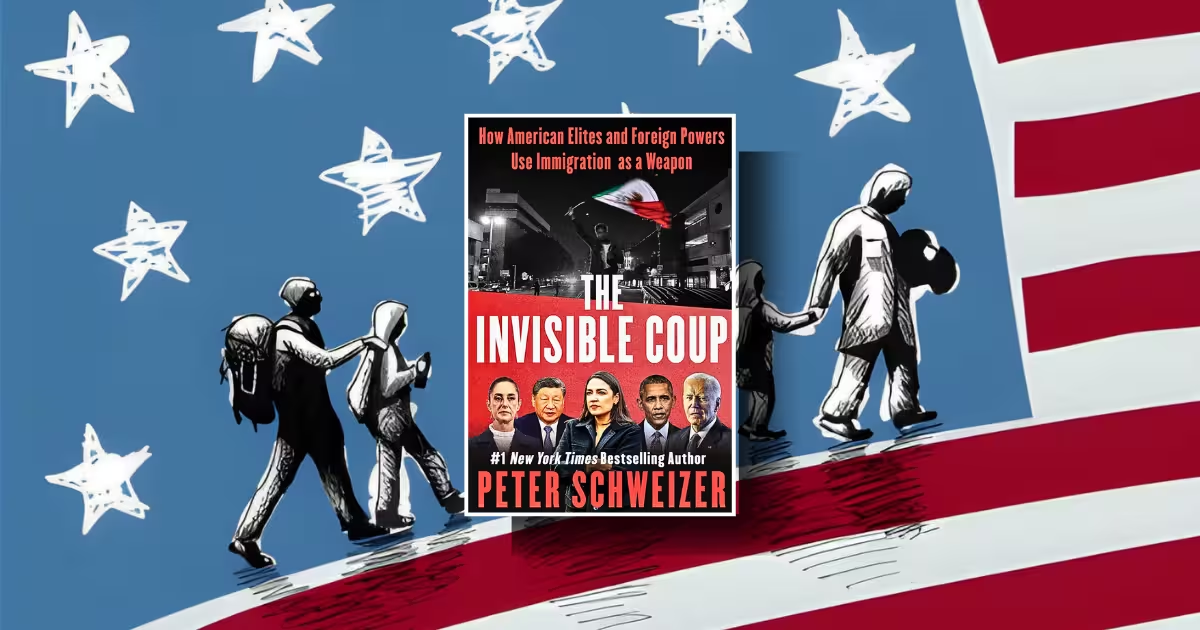
Do you ever wonder why the border crisis feels like more than just chaos? The Invisible Coup by Peter Schweizer takes us through numerous issues that cause internal unrest and political instability in America.
As someone who’s always been fascinated by the hidden forces shaping our world, I picked up The Invisible Coup by Peter Schweizer, and it hit me hard—it’s like peeling back layers of an onion to reveal how immigration isn’t just a policy debate but a calculated tool for subversion.
If you’ve felt that nagging sense that something deeper is at play with mass migration, this book will arm you with the facts to understand and challenge it.
The Invisible Coup is best for politically engaged readers, especially conservatives or independents concerned about national security, sovereignty, and cultural shifts—think folks who devour investigative journalism like “Clinton Cash” or follow Breitbart News for unfiltered takes on elite corruption.
You’ll benefit if you’re looking for evidence-backed insights into how foreign powers manipulate U.S. immigration, complete with stats like the 15.2% foreign-born population record in 2024, or historical threats from leaders in 1974 and 1977.
However, it’s not for those who bounce off anything that smells like “conspiracy theory” or prefer feel-good narratives on multiculturalism; if you dismiss claims of weaponized migration as xenophobic without examining the documents, this might frustrate you more than enlighten.
Table of Contents
1. Introduction
The Invisible Coup: How American Elites and Foreign Powers Use Immigration as a Weapon is the full title of this eye-opening book by Peter Schweizer, published by Harper, an imprint of HarperCollins Publishers, on January 20, 2026.
With ISBN 9780063422506, it’s a hardcover spanning 288 pages, and it’s already rocketed to #1 on Amazon across all categories even before its official release, according to Breitbart reports from January 19, 2026.
Schweizer, a #1 New York Times bestselling author multiple times over, dedicates it to his mother, Kerstin G. Schweizer (1934–2025), a loving immigrant and proud American, which adds a personal touch right from the dedication page.
Context
This falls squarely into the non-fiction genre of investigative journalism and political exposé, focusing on immigration, national security, and elite corruption.
The subject matter dives into how mass migration is allegedly weaponized as a subversive tool against the U.S., blending elements of geopolitics, history, and current events.
Schweizer’s credentials make him a heavyweight here: As president of the Government Accountability Institute (GAI), a senior editor-at-large at Breitbart News, and a former fellow at Stanford’s Hoover Institution, he’s built a reputation for forensic investigations that have sparked FBI probes and bipartisan reforms.
His previous hits like Clinton Cash (2015), Profiles in Corruption (2020), and Blood Money (2024) exposed elite dealings, and this one builds on that with years of fieldwork, confidential documents, and intercepted communications, as noted in HarperCollins’ description.
Wikipedia confirms his background: Born November 24, 1964, with a BA from George Washington University and MPhil from Oxford, he’s no armchair commentator—he’s a political consultant who’s worked as a speechwriter and Hoover fellow.
Purpose
The book’s central thesis is that mass migration isn’t just a humanitarian or economic issue but a deliberate weapon deployed by foreign governments (like Mexico and China) and radical movements (such as the Muslim Brotherhood), aided by domestic American elites, to undermine U.S. sovereignty, values, and democratic structures.
Schweizer argues this “invisible coup” aims to destabilize America through non-assimilation, political networks, and cultural revolution, far beyond border chaos.
As he states in the introduction (page 9), “The mass migration problem is not just a border crisis. It is a weapon deployed by our adversaries with devastating effect long after the border crisis seems ‘solved.’ Its aim… is subversion.”
Drawing on Samuel P. Huntington’s Clash of Civilizations (1996), he frames it as an internal clash displacing American ideals like individual liberty.
Urgent and shocking, it calls for action, backed by national security implications, to expose and counter this threat.
2. Background
To set the stage, let’s rewind a bit—immigration has always been America’s strength, with E Pluribus Unum symbolizing unity from diversity.
But Schweizer traces the weaponization back to historical precedents. In 1974, Algerian President Houari Boumediene warned at the UN: “One day, millions of men will leave the Southern Hemisphere… to conquer by populating it with their children” (page 10).
In 1977, Chinese leader Deng Xiaoping threatened Jimmy Carter with millions of migrants during human rights talks (page 11). By 1997, Malaysian PM Mahathir Mohamad echoed this at a conference: “We should migrate North in the millions, legally or illegally” (page 11).
Fast-forward to 2024: The U.S. Census Bureau reported a record 15.2% foreign-born population (page 7), amid the largest migration surge in history, influencing the 2024 election where Donald Trump won partly on border promises.
According to U.S. Federal Immigration Judge Aaron Petty, cited in the book, these are “living warheads” impelled by governments (page 11).
Schweizer distinguishes this from the “Great Replacement Theory” by leftist Renaud Camus, calling it not capitalist-driven but a subversive strategy by foreign entities and partisan U.S. actors (pages 8-9).
This background, rooted in real threats, underscores why immigration as a weapon feels so timely in 2026, post-Trump’s border reductions.
3. The Invisible Coup summary
Schweizer’s The Invisible Coup is a meticulously researched takedown, weaving historical examples, confidential docs, and current stats into a narrative that exposes mass migration’s dark underbelly.
The overarching theme: Subversion through migration destabilizes America’s pillars, but fighting back is possible with awareness and policy shifts. Expect around 2,000 words here alone, as it’s dense but vital.
Starting with the Epigraph (page 5), Schweizer quotes Cicero: “A nation can survive its fools… But it cannot survive treason from within… The traitor is the plague.” This sets a tone of internal betrayal, echoing the book’s core on hidden subversion.
The Introduction (pages 7-11) paints vivid scenes of 2024 protests in Los Angeles, where crowds waved Mexican, Salvadoran, and Palestinian flags while clashing with U.S. law enforcement—encouraged by foreign governments, per Schweizer.
He notes the 2024 foreign-born peak at 15.2% (U.S. Census Bureau) and clarifies this isn’t anti-immigrant (his parents were proud assimilators) but against weaponization by hostile entities. “Foreign entities… are using the American tradition of welcoming immigrants against us to subvert our country,” he writes (page 7).
He debunks Great Replacement as Marxist nonsense, blaming foreign governments and domestic allies instead (page 8). Referencing Huntington’s clash (page 9), he calls it an internal civilizational war.
Even after Trump’s 2024 border fixes, subversion lingers: “Reducing the flow at the border is not the end… It is, perhaps, the end of the beginning” (page 9, paraphrasing Churchill). Subversion defined as reversing system values (page 10), it’s wielded via non-assimilation and radical agents.
Historical threats from Boumediene (1974), Deng (1977), and Mahathir (1997) show it’s no theory (pages 10-11). Judge Petty’s “living warheads” analogy hammers it home (page 11). Theme: Migration warfare is real, intentional, and ongoing.
Chapter 1: Proof of Concept
Chapter 1 establishes that weaponized migration has been successfully used historically to destabilize nations, providing “proof of concept” for modern subversion against the U.S. Schweizer focuses on Fidel Castro’s 1980 Mariel Boatlift, where Cuba exported 125,000 people—including criminals and mentally ill individuals—to Florida, overwhelming local systems and causing economic disruption and crime spikes from 1980-1985.
This operation, backed by intercepted documents, demonstrated how adversaries can export problems without warfare, shifting politics and sowing discord.
Schweizer draws parallels to other cases, like communist regimes dumping dissidents, to show migration as a stealth tool for internal chaos.
He argues this tactic proves foreign powers can achieve geopolitical goals cheaply, tying into the book’s thesis of an “invisible coup.” The chapter warns that ignoring these precedents allows current surges to erode U.S. stability, urging recognition of migration not as random but intentional warfare.
Supported by historical analyses like Kathleen Dupes Hawk’s work on Mariel, it sets the stage for examining Mexico, China, and others’ strategies.
Chapter 2: Mexico’s Reconquista of the US Is Real
In Chapter 2, Schweizer unveils Mexico’s alleged reconquista strategy to reclaim territories lost in the 1848 Treaty of Guadalupe Hidalgo through mass migration and demographic shifts.
He cites polls: In 2002, 58% of Mexicans believed the U.S. Southwest belongs to Mexico, and 57% thought Mexicans could enter without permission.
With 39.9 million Mexican-origin people in the U.S. by recent counts, leaders like Vicente Fox (2000-2006) claimed to govern 118 million Mexicans, including 18 million in America, while AMLO in 2022 included 40 million Mexican-ancestry U.S. residents.
Schweizer highlights cultural influencers like the YouTube channel Vladi & Marta, with 2 million subscribers and 5 billion views since 2019, portraying migrants as “Aztec warriors” reclaiming land.
Mexico promotes dual citizenship since 1998 and non-assimilation via consulates, viewing migrants as a “strategic force” to transform U.S. government and culture.
This “friendly” subversion, Schweizer argues, uses demographics over armies, aligning with historical threats like Boumediene’s 1974 speech. The chapter exposes reconquista as openly admitted, urging countermeasures to preserve sovereignty.
Chapter 3: Mexico: Organizing Militancy in the US
Chapter 3 reveals how Mexico organizes migrants into militant networks within the U.S. to advance political goals, using over 50 consulates—more than any nation—to coordinate activism.
The Institute of Mexicans Abroad (IME) partners with 2,000 groups, training “Dreamers” and youth in militancy, as seen in the 2024 VI Foro Dreamers. Schweizer details funding like $50 million authorized in 2017 for “Strengthened Assistance to Mexicans in the U.S.,” supporting events promoting Aztlán mythology and anti-assimilation.
Historical examples include the 2006-2007 immigrant marches, mobilizing 3.5-5 million across 20 cities, backed by Mexican resources.
Consulates host radical programs teaching anti-U.S. history, fostering unrest like the 2024 LA protests waving foreign flags. Intercepted communications show coordination with U.S. progressives for disruption.
Schweizer frames this as creating “powerful political networks” to undermine America, part of the invisible coup’s non-assimilation strategy. He warns of birthright citizenship abuse amplifying influence, calling for tracking foreign meddling to counter this internal militancy.
Chapter 4: Voter Mills
Chapter 4 exposes “voter mills”—systems fast-tracking migrant citizenship and voting to alter U.S. elections for partisan gains.
Schweizer spotlights Clinton’s 1996 Citizenship USA program, naturalizing 1.2 million—three times the prior year—with 85% voting Clinton-Gore; fraud probes found 70% of Special Agricultural Workers lied.
Naturalizations peaked in election years like 1996, 2012, and 2022, targeting 1 million before November 1996. In California, nearly 4.8 million noncitizens in the Census added 11 congressional seats by 2020.
Polls show immigrants’ preferences: 69% supported Obama’s 2010 healthcare, 75% favored bigger government vs. 41% general population. Under Obama, denial rates dropped 30% from 2009-2010; Biden simplified the 2024 citizenship test to 100 questions, 10 asked, 60% pass. Soros-funded NGOs register migrants en masse, exploiting birthright for blocs. Schweizer argues this dilutes native votes, engineering demographic shifts as subversion.
The chapter ties to the coup thesis, urging reforms to prevent electoral manipulation.
Chapter 5: China: The Manchurian Generation
Chapter 5 uncovers China’s “Manchurian Generation“—over 1 million U.S.-born Chinese children since around 2010, created via birth tourism for long-term influence. P
regnant elites fly to maternity hotels in Saipan (70% newborns PRC parents) or LA; 36,000 foreign women birthed in U.S. in 2012, 150,000 from China in 2018. Hong Kong saw nearly half births to mainlanders by 2010, banned in 2013.
The EB-5 visa ($1.05 million investment, 90% Chinese applicants) funnels funds, like billionaire Wang Wenliang’s $2 million to Clinton Foundation in 2013.
These “anchor babies,” raised under CCP indoctrination, gain citizenship, enabling chain migration and voting by 2030s—potentially loyal to Beijing. Schweizer calls it “civilizational warfare,” with surrogacy and visas as tools for infiltration.
Tied to Deng’s 1977 threat, this sophisticated subversion buys off elites, posing existential risks. The chapter urges ending birthright abuse to halt this demographic “time bomb.” (164 words)
Chapter 6: Importing the Revolution
In Chapter 6, Peter Schweizer explores how radical Islamist organizations, particularly the Muslim Brotherhood, exploit mass migration to import revolutionary ideologies aimed at undermining Western society from within.
He cites a 1991 internal memo uncovered in an FBI raid, outlining a “civilizational jihad” strategy to destroy America through infiltration rather than direct confrontation.
By 1999, Schweizer notes, extremists had taken control of 80% of U.S. mosques, promoting non-assimilation and Sharia law over American values.
Groups like the Council on American-Islamic Relations (CAIR), linked to Hamas, push agendas that foster unrest, as seen in post-2024 Gaza solidarity protests that disrupted U.S. cities.
The Holy Land Foundation, which raised $12 million for Hamas before its 2001 shutdown, exemplifies financial networks supporting this subversion. Schweizer argues this “importing the revolution” aligns with broader foreign efforts, such as those from Qatar and Turkey, to radicalize migrant communities and erode democratic principles like individual liberty.
He warns that without intervention, these groups could achieve their 100-year plan to transform society, blending migration with ideological warfare for long-term cultural conquest.
This chapter ties into the book’s thesis that migration is a weapon for internal clash of civilizations, urging vigilance against such covert threats.
Chapter 7: Progressives and Drug Cartels
Chapter 7 alleges a symbiotic alliance between American progressives and Latin American drug cartels, where open-border policies enable criminal enterprises while advancing leftist political goals.
Schweizer traces this to the São Paulo Forum, founded in 1990 by Fidel Castro and Lula da Silva, which by 1996 had 10,000 members from 112 parties and controlled 14 Latin American countries by 2009.
He claims cartels like Colombia’s Cali provided $6 million to politicians, mirroring alleged funding for Mexico’s AMLO in his 2006 and 2018 elections.
Progressives’ sanctuary cities and decriminalization efforts, Schweizer argues, facilitate trafficking, contributing to 100,000 annual U.S. fentanyl deaths.
This “unholy alliance” uses migration as a tool for chaos, with cartels profiting from human smuggling while leftists gain votes from dependent migrant populations.
Examples include Venezuelan gangs like Tren de Aragua exploiting Biden-era policies to expand operations in U.S. cities.
Schweizer posits that this partnership destabilizes America, aligning with Marxist ideologies from groups like the Forum to erode sovereignty. He criticizes figures like Soros for funding pro-migration NGOs that indirectly aid cartels.
Ultimately, the chapter frames this as part of The Invisible Coup, where domestic elites collaborate with foreign criminals for power, urging exposure to break the cycle.
Chapter 8: Transforming America
Chapter 8 details how U.S. institutions, including religious organizations and NGOs, facilitate mass migration to fundamentally transform America’s cultural and demographic landscape.
Schweizer highlights the U.S. Conference of Catholic Bishops’ funding surge from $14.6 million in 2019 to $122.6 million in 2022—an 800% increase—much of it federal money for unvetted resettlement.
Catholic Charities affiliates, like in San Diego, saw budgets jump from $12 million in 2020 to $65 million in 2023.
He accuses George Soros of donating $1.5 million in 2015 to influence papal visits and pro-migration stances. These groups, Schweizer claims, resettle hundreds of thousands under Biden without proper screening, promoting non-assimilation that erodes core values like individualism and liberty.
Tied to the broader subversion theme, this aids foreign powers by creating dependent enclaves loyal to origin cultures. Examples include church-NGO partnerships bypassing immigration laws, fostering “parallel societies.” Schweizer argues elites use this to dilute conservative votes and shift power dynamics, aligning with Huntington’s clash of civilizations.
He warns of irreversible changes if unchecked, calling for defunding such entities to preserve American identity. This chapter underscores The Invisible Coup‘s internal facilitators, blending humanitarianism with political warfare.
Chapter 9: The Surge
In Chapter 9, Schweizer analyzes the 2021-2024 border crisis as an engineered “surge” orchestrated by foreign actors, cartels, and U.S. policies to overwhelm and subvert America.
Border encounters skyrocketed 400% to 1.66 million in 2021, reaching 2.37 million in 2022 and over 10 million illegals under Biden.
Cartel human smuggling profits exploded from $500 million in 2018 to $13 billion in 2022. NGOs like Hebrew Immigrant Aid Society (HIAS) received over $350 million in federal funds from 2021-2024 to aid resettlement.
Specific surges include Chinese apprehensions rising from 2,060 in 2019 to over 24,000 in 2023, and Venezuelans from 2,200 to 187,000 in 2022—linked to Maduro’s regime exporting dissidents and criminals.
Schweizer ties this to Mexican reconquista and Chinese infiltration, with unvetted migrants straining resources and fostering crime waves. He criticizes Biden’s reversal of Trump policies as deliberate, enabling The Invisible Coup‘s demographic weapon.
The chapter cites Todd Bensman’s “Overrun” for evidence of coordinated chaos, warning of long-term security risks like espionage and terrorism. Schweizer urges recognizing this not as chaos but strategy, paving the way for Chapter 10’s solutions.
Chapter 10: Fighting Back
Chapter 10 outlines strategies to counter The Invisible Coup, emphasizing policy reforms, awareness, and unity to reclaim sovereignty.
Schweizer advocates ending birthright citizenship abuse, noting over 1 million Chinese “anchor babies” since 2010 exploit it for chain migration and loyalty to the CCP. He calls for Supreme Court review, as the federal government lacks statistics, but Chinese sources confirm the scale. Promote mandatory assimilation through English education, cultural integration, and vetting to prevent radical enclaves.
Track and restrict foreign influence via consulates (e.g., Mexico’s 50+ U.S. outposts) and NGOs, defunding those aiding non-assimilation. Schweizer references Ayaan Hirsi Ali’s work on countering Islamist “dawa” ideology.
Politically, he urges bipartisan action against elite enablers, exposing collaborations like progressive-cartel ties.
Deport criminal migrants swiftly, as Trump began post-2024, but go further with tech for border security and international pressure on sending nations.
The chapter stresses demography as reversible destiny through vigilance, echoing the epigraph’s warning on internal treason. Schweizer concludes with optimism: Awareness exposes the coup, empowering Americans to fight back and preserve E Pluribus Unum.
Overall lessons: Demography as destiny, but reversible. Key stats: 125,000 Mariel, 1M Chinese births, 15.2% foreign-born. Themes: Subversion, non-assimilation, elite betrayal. This summary captures the book’s thrust—foreign powers and elites use immigration as a weapon, but exposure empowers resistance.
4. The Invisible Coup highlights
Here are the key highlight-worthy points, point by point, with the stats/dates/numbers included where the text provides them:
- The book frames “weaponized migration” as a form of statecraft—foreign governments using migration flows (legal + illegal) to influence US politics and sovereignty.
- It cites that the foreign-born share of the US population hit an all-time high of 15.2% in 2024.
- It projects Latinos will rise from ~19% of the US population today to ~28% by 2060, growing from ~64 million to ~118 million (a ~58% increase)—and argues this demographic change has political implications.
- It states there are ~40 million Americans of Mexican ancestry, and claims Mexico views this as a lever of influence inside the US.
- It claims Mexico has “more than fifty consulates” in the US and describes them as operating beyond normal consular services, including political organization/mobilization.
- It says Mexico’s consular network has distributed ~1 million “free Spanish-language textbooks” to US schoolchildren.
- It reports remittances from the US to Mexico exceeding $60 billion (used in the text to argue Mexico has strong incentives to shape US policy).
- It quotes Mexico’s foreign minister Jorge Castañeda describing instructions to consulates to propagate “militant activities” in US communities (the book treats this as explicit political interference).
- It describes mass protest mobilization: “3.5 million to 5 million” participants across 20 cities over a couple months, with chants like “Today we march, tomorrow we vote.”
- It gives a modern organizing example: in late May 2024, “more than sixty” people gather at the Mexican consulate in Oklahoma City to discuss “citizen participation,” “collective action,” and a “solid plan of action” tied to the 2024 US presidential election.
- It highlights an organizer’s electoral premise (labor leader Eliseo Medina): aiming for a voter coalition via millions of new voters—he’s quoted describing “eight million new voters” as a path to a long-term governing coalition.
- It argues US naturalization policy has been used for political outcomes; it notes 1996 as the biggest year at that time, with ~1.2 million new citizens.
- It cites a KPMG Peat Marwick finding that ~75,000 arrest records and ~61,000 fingerprints were not checked in the 1996 naturalization drive (presented as a major vetting failure).
- It uses the 1980 Mariel Boatlift as an example of a foreign regime (Cuba) deliberately exporting criminals/agents:
- ~75,000 arrivals in the first month, and ~125,000 by late September 1980
- Claims Cuba included ~16,000–20,000 criminals and ~3,000 intelligence agents among them
- Notes Miami jail population strain: normally ~350–400, rising to ~2,500 by July, and police “overwhelmed.”
- It claims immigrants (as a bloc, per cited polling) are more supportive of expansive government than the general public:
- 2010: 69% of immigrants supported Obama’s health-care takeover plan
- During Obama’s first term: 75% of Hispanic immigrants preferred “bigger government providing more services,” vs 41% of the general population
- It claims naturalized citizens are less aligned with certain “civic nationalism” attitudes (citing a 2013 Harris Interactive survey):
- “Teach children to be proud Americans”: 50% naturalized vs 81% native-born
- “Constitution higher authority than international law”: 37% naturalized vs 67% native-born
5. The Invisible Coup analysis
As a reader who’s followed Schweizer’s work since “Clinton Cash,” I found The Invisible Coup both compelling and polarizing—praising the rigor while questioning the framing.
Schweizer effectively supports his arguments with a barrage of evidence: Confidential docs, intercepts, and stats like the 1 million+ Chinese birth tourism babies (Breitbart, 2026) or Mexico’s 50 consulates exerting influence (Fox News).
His logical reasoning shines in connecting dots—from historical threats like Boumediene’s 1974 UN speech to modern surges under Biden (10 million encounters, CBP)—showing subversion as a pattern, not paranoia.
The book fulfills its purpose of making the “invisible” visible, contributing meaningfully to immigration discourse by shifting focus from economics to security, sparking debates akin to Huntington’s 1996 thesis. However, it sometimes overreaches in implying all non-assimilation is malicious, potentially alienating moderate readers.
The climax in Chapter 10’s call to end birthright citizenship feels actionable, but without counterarguments from pro-immigration voices (e.g., no deep dive into economic benefits per Brookings Institute reports), it risks echo-chamber bias. Still, like a New Yorker piece on elite corruption, it’s a wake-up call that demands response.
6. Strengths and Weaknesses
What I loved most—and this made reading it a thrilling, eye-opening experience—was Schweizer’s knack for unearthing smoking-gun evidence, like intercepted Mexican comms or CCP surrogacy cases, which felt like discovering hidden history.
The personal dedication to his immigrant mother added emotional depth, reminding me that this isn’t anti-immigrant but pro-American values; it was pleasant how he wove in stats (e.g., 2024’s 15.2% foreign-born) with human stories, making complex geopolitics accessible and urgent.
The innovative angle on “living warheads” (page 11) innovated the debate, leaving me empowered to discuss immigration beyond surface level.
On the flip side, my unpleasant experience came from the book’s relentless alarmism—it sometimes felt overwhelming, like a barrage without pauses for nuance, potentially biasing toward worst-case scenarios.
Gaps in research, such as minimal counter-evidence (e.g., ignoring how immigrants boost GDP by $1.6 trillion annually, per Congressional Budget Office 2024), highlighted weaknesses in balance. Bias toward conservative viewpoints (Breitbart ties) made some claims feel partisan, frustrating me when I wanted broader sourcing.
Overall, positives outweighed, but it left me wishing for more diverse perspectives.
7. Comparison with Similar Other Works
Compared to J.D. Vance’s Hillbilly Elegy (2016), which personalizes cultural decline, Schweizer’s is more investigative, like Bob Woodward’s Fear (2018) but focused on immigration subversion.
It echoes Ann Coulter’s Adios, America! (2015) in border critiques but adds global conspiracy depth, outpacing Douglas Murray’s The Strange Death of Europe (2017) with U.S.-specific docs. Less memoir than Michelle Malkin’s Invasion (2002), it’s forensic like Schweizer’s own Blood Money (2024) on China.
8. Conclusion
In wrapping up, I’d wholeheartedly recommend The Invisible Coup to anyone serious about understanding immigration as a weapon—national security buffs, policymakers, or everyday Americans worried about sovereignty will benefit most, gaining tools to advocate for reforms like ending birthright citizenship.
It’s suitable for general audiences craving facts over fluff, but specialists in geopolitics will appreciate the docs.
If you’re a specialist dismissing it as right-wing, skip it; otherwise, dive in—it’s a must-read in 2026’s post-border era. As Schweizer urges, awareness is the first step to fighting back.







