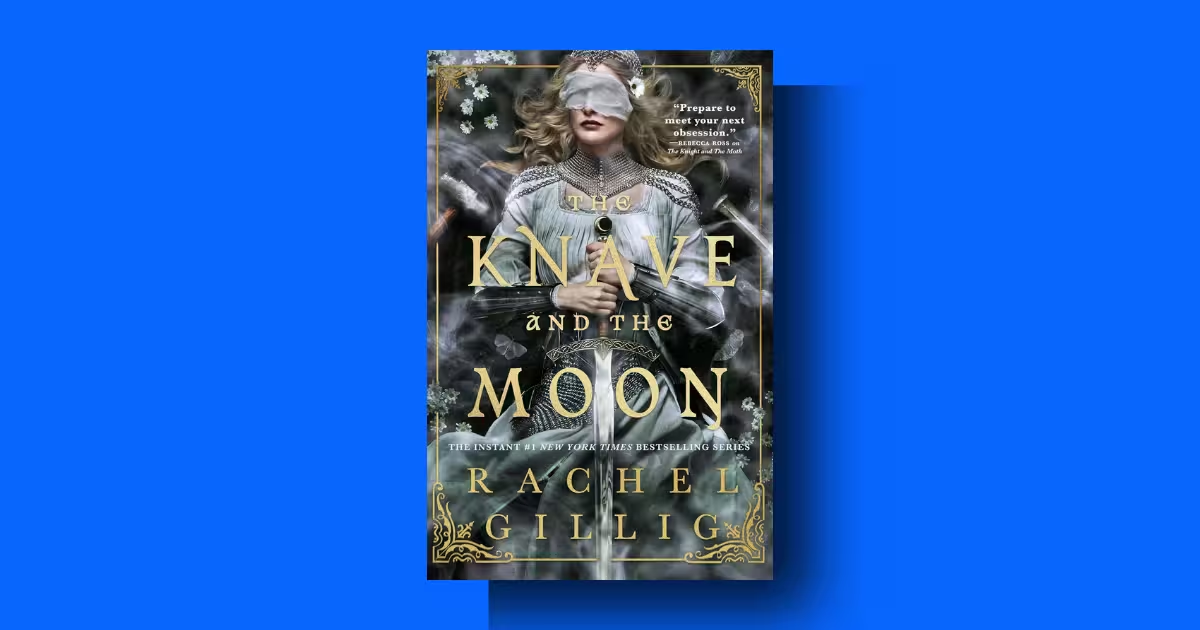

The Knave and the Moon is Rachel Gillig’s dark, strange, and deeply emotional return to the Stonewater Kingdom, and it wastes little time asking what happens when death is not the end. The story begins with a Diviner, a murdered king, a forgotten knight, a broken gargoyle, and a world trapped in repeating stories.
But The Knave and the Moon is ultimately about far more than magic and revenge: it explores memory, identity, love, death, power, belief, and whether people can break the stories that have controlled them.
Table of Contents
Summary
The Knave and the Moon by Rachel Gillig is a dark fantasy novel set in the Stonewater Kingdom, following characters caught between death, memory, prophecy, and repeating history. The story centers on Sybil Delling, Rodrick “Rory” Myndacious, Maude Bauer, the gargoyle Bartholomew, and King Benedict Castor III.
What is The Knave and the Moon about?
It follows a world where the old Omens have been destroyed, but their magic, stories, and influence continue to shape Traum. Rory awakens after death with no memory, while Sybil is trapped in the king’s political and religious machinery. Maude and the gargoyle help set events in motion against Benedict.
What makes the story unusual?
Death does not function as a simple ending. Rory is brought back through the tor’s spring water, while the novel repeatedly connects death with rebirth, memory, storytelling, and transformation.
Who are the main characters?
Sybil Delling is the Diviner; Rodrick Myndacious, Rory, is the knight who becomes a knave; Maude Bauer is a formidable knight who carries guilt over Rory’s death; and Bartholomew is the eccentric, increasingly fragile gargoyle who becomes central to the story’s emotional heart.
What is the central conflict?
The characters struggle against Benedict Castor III and the political/religious system he has constructed around the legacy of the Omens and the Diviners. The tournament becomes another expression of that unequal system: ordinary people are allowed to hope they can compete, while the structure makes genuine victory nearly impossible.
Is there romance?
Yes. The relationship between Sybil and Rory becomes an important emotional strand of the novel, developing alongside questions of memory, identity, death, and whether a life can have meaning after seemingly irreversible loss.
What are the major themes?
The novel repeatedly examines death and rebirth, memory and identity, love, political power, religious belief, superstition, storytelling, free will, and the possibility of changing history. Maude explicitly questions whether destroying the old system actually changed the kingdom or merely reproduced its underlying structures.
Does The Knave and the Moon have a happy ending?
The ending is bittersweet but ultimately hopeful. Bartholomew receives the happy ending Gillig promises in the acknowledgments, and the closing section jumps one hundred years later, showing that the story has become something that can be retold rather than merely repeated.
What is the ending’s biggest idea? The final movement transforms the meaning of “Bartholomew” from a fixed identity into something associated with possibility, second chances, and rebirth. The book deliberately ends where it began, reinforcing its circular structure while suggesting that repetition can contain change.
The Knave and the Moon is Rachel Gillig’s dark fantasy about Sybil, Rory, Maude, and Bartholomew confronting death, memory, political power, and an apparently repeating history while searching for a second chance to change Traum.
Reader Recommendation: If you loved The Knight and the Moth for its gothic atmosphere and Sybil’s fierce spirit, you will absolutely need to read this. However, be prepared for a shift in tone. This is a darker, more war-focused book where the romance takes a back seat to survival and strategy.
Readers who want more of Rory and Sybil’s banter will find it, but it’s filtered through the lens of trauma and separation. If you’re here for Bartholomew, the gargoyle, congratulations, you’re about to have your heart broken and put back together in the best possible way. If you wanted a simple, happy ending, this book will challenge you.
Who Will Love It: Fans of gothic romantasy, political intrigue, and character-driven stories about hope in the face of despair. If you enjoy themes of found family, sacrifice, and the idea that stories themselves can be a form of resistance, this is for you.
Who Might Bounce: Readers looking for a straightforward romance novel will find the central couple separated for much of the narrative. Those who struggle with heavy themes of trauma and bodily transformation might find parts of this difficult to read.
Key Facts:
- Author: Rachel Gillig
- Publisher: Orbit
- Publication Date: September 1, 2026
- Page Count: 368 pages (Hardcover)
- Audio Length: 12 hours, 18 minutes
- Series: The Stonewater Kingdom, Book 2
The Core Angle: The book is a masterclass in exploring “second chances.” This isn’t just a plot device; it’s a philosophical thesis. From Sybil and Rory’s literal rebirth to Benji’s desperate quest for a do-over, every major character is defined by how they grapple with their past and what they choose to do with their future. The book argues that a second chance isn’t a gift—it’s a responsibility.
Introduction
The Knave and the Moon is the second and final book in The Stonewater Kingdom duology by Rachel Gillig. It was published by Orbit on September 1, 2026. Gillig, who first made waves with her Shepherd King duology, has cemented her place as a modern master of gothic romantic fantasy, and this book is a testament to her growth as a storyteller.
Background
The Stonewater Kingdom has always felt like a place that exists somewhere between a dream and a nightmare. Rachel Gillig herself has cited her love for creating worlds that are malleable, where she can build everything exactly as she wants it.
This book, in particular, was inspired by the 2001 film A Knight’s Tale, which explains its tournament-centered structure and its focus on a “nobody” rising to prominence through skill and sheer will. The core of the duology, however, draws from the traditional folk ballad The Outlandish Knight, a dark tale about a woman lured away by a deceptive knight, which gave birth to the gothic, suspenseful tone of the series.
The Knave and the Moon Summary
The book picks up immediately after the catastrophic events at Aisling Cathedral. Sybil Delling, the last Diviner, is a prisoner in Castle Luricht. She is forced into a marriage with King Benedict Castor the Third (Benji), who has spun a web of lies, blaming the cathedral’s destruction on sprites and presenting himself as the kingdom’s savior with the “stone objects” he acquired.
Sybil, drugged with a sedative called ox-eye to dull her body and mind, still plots the king’s downfall, even if it means destroying the kingdom’s faith and herself in the process.
Meanwhile, the world believes Rodrick Myndacious (Rory), the gargoyle Bartholomew, and the knight Maude Bauer are dead. They are, in fact, alive. Maude plans to leverage her family name and the tournament to turn the nobles against Benji. Rory, having been resurrected by the tor’s spring water at the end of the previous book, is suffering from amnesia. His memory returns piece by piece, aided by the water’s lingering magic and Sybil’s blood.
The central plot device is a tournament that Benji has commissioned across the five hamlets. He intends to have his loyal knights win the events, gaining both wealth and public adoration, further cementing his power. Sybil sees this as an opportunity. If she can compete and win, she can destroy the remaining stone objects—the oar, inkwell, chime, and loom stone—which Benji has gifted to his knights.
The first event is the joust in Coulson Faire. Rory, under the guise of a mysterious “knave,” competes and wins the melee in the Seacht, destroying the inkwell in the process.
Sybil, in a moment of desperation, destroys the loom stone herself. The story then moves to the Fervent Peaks for the feats of strength. Here, the gargoyle Bartholomew competes and wins, snapping the oar. The narrative is punctuated by political maneuvering: Maude talks with nobles like Regius Ormsby and Otto Lange, turning them against Benji by highlighting his reckless use of their money.
The final event, the hunt, takes place in the Chiming Wood. The king’s plan goes horrifically wrong.
He attempts to martyr Sybil by leaving her to be killed by a birke (a tree sprite), but his knight Samuel Eichel rebels. In the ensuing chaos, a fire engulfs the sacred grove, destroying Eichel House. Samuel and another knight, Tory, are killed. The hunt is forfeit.
The climax occurs in the Cliffs of Bellidine. Here, Benji’s rule is formally challenged by the nobles, led by Maude. Sybil fights Benji in a duel. Just as she is about to be killed, Benji’s knife is stopped by the stone in her body. He is defeated. However, Benji makes one last desperate play for power: he uses the Artful Brigand’s coin to teleport to the tor, intending to drink the spring water and gain immortality.
In a final confrontation, Sybil kills him with her hammer.
During the struggle, Maude Bauer is fatally struck by the coin’s destructive magic, saving a sprite in the process. Rory, holding a dying Maude, refuses to bring her back, respecting her final wish.
The most devastating blow comes when the gargoyle Bartholomew, severely cracked and broken from his earlier heroics, walks to the spring, climbs over its lip, and lets himself fall in, shattering completely. In her grief, Sybil follows him into the water, which triggers a final, profound vision.
She meets the soul of the tor itself: Der ewige Mond, the Eternal Moon, a primordial sprite whose body forms the tor and whose blood is the spring. The ox explains the truth: the limestone and spring water are her remains, and her power is the source of all magic in Traum. Sybil is offered a choice. She is told that she and Rory will live long, stone-like lives. Her task is to use a chisel and hammer to carve a new body for Bartholomew from the tor’s limestone.
She does so. The gargoyle is reborn, entirely uncracked, and remembers everything. The story ends with a flash-forward to one hundred years later, where an aged Sybil, Rory, and Bartholomew tell their story to a new king, proving that they have kept their hope and their love alive.
The Knave and the Moon Analysis
The Knave and the Moon Characters
Sybil Delling: In this book, Sybil is transformed from a victim into a vessel of vengeance. She’s not just a grieving woman; she’s a strategist. The pain of her wound and the numbing effect of ox-eye make her a physical and emotional wreck, yet she keeps fighting. Her arc is about learning that destruction isn’t the only path to change. She wants to tear everything down, but her love for Rory and Bartholomew gives her a reason to build something up instead.
Rodrick “Rory” Myndacious: Rory’s journey is the heart of the book. He begins as a man with no memory, a “knave” who knows nothing but survival. As his memories return, he’s flooded with the pain of his past and the overwhelming love he feels for Sybil. His defining trait is his restraint.
He wants to kill Benji, but he holds back. He wants to protect Sybil, but he respects her autonomy. His most powerful moment is his refusal to bring Maude back from the dead, choosing to honor her sacrifice instead of his own grief.
This is a huge emotional moment, showcasing his growth from a hungry boy who would gorge himself on anything to a man who can accept loss.
Bartholomew (The Gargoyle): Bartholomew, or “Bartholomew,” is the emotional core of the series. He is the ancient, lovable, naive squire who has seen centuries pass. His arc is the most tragic and the most hopeful. He is literally falling apart throughout the book, sacrificing pieces of his own body to protect his friends. His ultimate act of sacrifice is falling into the spring. His rebirth, carved by Sybil’s hand, is a profound metaphor for legacy. He is “remade” by love and memory. His final lines in the epilogue, where he explains his tendency to call everyone “Bartholomew,” are tear-jerking: “Every day is a new flower, a second chance—a rebirth—when you are Bartholomew.”
Benedict Castor the Third (Benji): Benji is a tragic villain. He’s not evil for the sake of it; he’s a product of a system that valued spectacle over substance. He was a boy-king who was never allowed to be a person, only a symbol. His final quest for a “second chance” in the spring is pathetic but understandable. He is a brilliant antagonist because his motivations are so painfully human: he just wants to matter, to be remembered. His death is not a moment of triumph but a grim necessity.
Maude Bauer: Maude is the true hero of this story. She’s the one who organizes the political rebellion, and she is the one who makes the ultimate sacrifice. Her death is the catalyst for the final resolution. She represents the old guard, the knights who once killed the Omens, and her final act redefines the Bauer name. She doesn’t die a “sprite killer,” but as a savior. Her legacy is a forest of birch trees, a home for the sprites she once hunted.
Evaluation
The Knave and the Moon is a soul-stirring and audaciously hopeful conclusion to one of the best modern fantasy duologies. Rachel Gillig has done something remarkable: she has written a sequel that is darker than its predecessor but somehow more optimistic. It’s a book that understands that hope is not the absence of despair, but the stubborn refusal to give in to it.
Strengths / Pleasant Experiences with the Book
The character work is phenomenal. Bartholomew is, without a doubt, one of the most original and heartwarming characters in fantasy right now. His dialogue is a constant source of delight, even in the darkest moments. The pacing is addictive. Gillig’s prose is as atmospheric and gothic as ever, creating a world that feels both beautiful and deeply unsettling. The political maneuvering is smart and satisfying to read.
Weaknesses / Negative Experiences with the Book
Some of the conflicts resolve a bit too easily. The stake surrounding Benji as a villain occasionally lack the weight they promise, as he sometimes feels more like a petulant child than a formidable threat. The middle section, while well-paced, focuses heavily on the tournament events, which can make the central romance between Sybil and Rory feel like a subplot for a while. Some readers might find the supporting characters, like the various nobles, a bit hard to track.
Comparison with Similar Works
Fans of The Shepherd King duology will find familiar themes of magic, destiny, and morally complex characters. It shares DNA with works like Naomi Novik’s
for its gothic, fairy-tale atmosphere, and it will appeal to readers who enjoyed the political intrigue of The Queen’s Thief series by Megan Whalen Turner. The tournament structure is reminiscent of The Hunger Games, but used as a backdrop for political maneuvering rather than just survival.
The Knave and the Moon Quotes
“You look upon me, but you do not know me. I am older than the world, younger than time, permanent as the sky, and temporal as a dream. It is I who measures Traum’s portents. I who Divines what is to come, for naught but the past can foretell the future.” — This is the terrifying and beautiful voice of the tor speaking through Sybil. It sums up the entire thematic core of the book.
“History may be hewn of stone, but the future grows in its cracks. Not all that are lost are gone. A heretic can defend faith. The lowest creature can still reach the highest peak, and even death bears its flowers. A martyr might yet defeat a tyrant, but none shall overthrow a god without becoming one themselves.” — The full prophecy that Sybil delivers. It’s a roadmap for the entire story.
“Every day is a new flower, a second chance—a rebirth—when you are Bartholomew.” — Bartholomew’s explanation for his name is the most perfect encapsulation of the book’s themes.
“I’m in love with you, Sybil Delling. More than anything. And whatever becomes of this world, I’ll spend the time I’m afforded without an ounce of pride or disdain or godlessness. To know you is to forget all three.” — Rory’s love confession is raw, honest, and perfectly him.
“Would that things were different.” — This is the gargoyle’s refrain, a melancholic wish that echoes through the entire duology. It’s a phrase that captures both the sorrow of the past and the hope for a better future.
“Tell them I did not die a sprite killer. The name Bauer means something yet.” — Maude’s final words are a powerful statement of legacy and redemption.
Conclusion
The Knave and the Moon is not an easy book. It’s a story about trauma, sacrifice, and the often-painful work of healing. But it’s also one of the most hopeful books I’ve ever read. Rachel Gillig has crafted a finale that is as intellectually satisfying as it is emotionally devastating.
It’s a story that reminds us that even when the world is falling apart, there is always something worth fighting for. There is always a reason to hope. There is always a chance for things to be better than they’ve been.