
Last updated on April 28th, 2026 at 02:10 pm
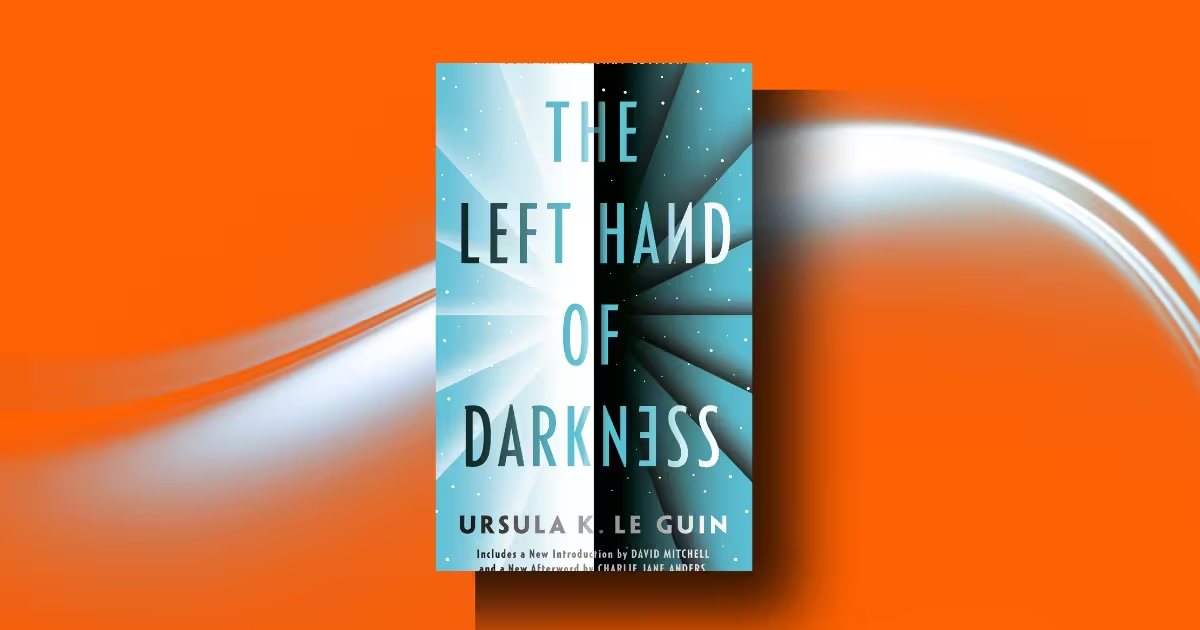
Have you ever wondered what humanity would look like if gender itself stopped defining who we are—and what that would do to love, politics, and identity? The Left Hand of Darkness is the rare novel that doesn’t just ask that question—it quietly reshapes how you think about being human.
The Left Hand of Darkness talks about lone envoy must bridge an alien world divided by politics and biology, only to discover that true understanding demands the unlearning of everything he thought was “human.”
The Left Hand of Darkness is best for readers who enjoy philosophical science fiction, slow-burn narratives, political intrigue, and introspective storytelling (fans of Dune or 1984). Not for those seeking fast-paced action, clear-cut morality, or conventional romance arcs.
Table of Contents
1. Introduction
Title: The Left Hand of Darkness
Author: Ursula K. Le Guin
Publication Year: 1969
Genre: Science Fiction, Philosophical Fiction, Anthropological Fiction
Published at the height of the Cold War and second-wave feminism, The Left Hand of Darkness became one of the defining works of speculative fiction. It won both the Hugo and Nebula Awards—an uncommon double—cementing Le Guin’s reputation as a writer who used science fiction not for spectacle, but for thought experiments about humanity.
2. Background
Le Guin’s work emerged during a period of intense questioning about gender, identity, and political systems. The late 1960s saw movements challenging traditional binaries—racial, political, and especially gendered.
Against this backdrop, Le Guin created Gethen (Winter), a planet where humans are ambisexual, adopting male or female characteristics only during brief reproductive periods called kemmer.
This wasn’t merely a speculative gimmick. It was an anthropological inquiry: What happens to society when gender hierarchy disappears? No warlike masculinity, no institutionalized patriarchy—yet still, politics, betrayal, and fear persist.
Le Guin herself described the novel as a thought experiment rather than a prediction—a way to “eliminate gender, to find out what was left.”
3. The Left Hand of Darkness Summary
The novel unfolds through a mix of reports, myths, and personal narratives, primarily following Genly Ai, an envoy from the Ekumen—a coalition of planets seeking peaceful alliance.
Arrival on Gethen
Genly Ai arrives alone on Gethen, a harsh, icy world nicknamed “Winter.” His mission is to persuade its nations to join the Ekumen. However, he faces an immediate barrier: he cannot psychologically adapt to a world without fixed gender.
Gethenians appear androgynous most of the time (somer), entering kemmer only periodically, when they become temporarily male or female. Genly struggles to perceive them as fully human, often projecting masculinity or femininity onto them.
He first attempts diplomacy in Karhide, meeting Estraven, the prime minister. Estraven quickly understands Genly’s mission and supports it—but Genly mistrusts him, misreading his behavior through gendered assumptions.
“I never saw a Gethenian man or woman. I saw a human being.”
Yet Genly fails to internalize this insight.
Estraven’s Fall
Political tensions rise. Estraven advises the king, Argaven XV, to accept the Ekumen alliance, but the king becomes paranoid. Estraven is accused of treason and exiled.
Genly, unable to read the situation, fails to defend Estraven and loses his only ally.
This marks the first major failure of understanding: Genly’s inability to see beyond gender blinds him to loyalty.
Journey to Orgoreyn
Genly travels to Orgoreyn, a bureaucratic rival nation. Initially, its leaders seem receptive to the Ekumen proposal. However, their interest is opportunistic rather than genuine.
Meanwhile, Estraven, in exile, secretly travels to Orgoreyn to protect Genly.
Genly is eventually betrayed. The Orgota government imprisons him in a labor camp—essentially a slow-death system designed to erase individuals.
Rescue and Transformation
Estraven rescues Genly from the camp in a daring escape.
From here, the novel transforms into a survival narrative.
The two embark on a perilous 80-day journey across the Gobrin Ice—a frozen wasteland. This is the emotional and philosophical core of the book.
Here, stripped of civilization, Genly begins to understand Estraven—not as male or female, but as a person.
“Light is the left hand of darkness, and darkness the right hand of light.”
Their relationship deepens into profound trust, even love—though not in a conventional romantic sense.
Estraven enters kemmer during the journey, and Genly experiences confusion but also clarity. For the first time, he sees Estraven fully, beyond binary categories.
Return and Tragedy
They reach Karhide. Estraven helps Genly cross the border, but is shot and killed by guards while attempting to return home.
His death is quiet, almost inevitable—a tragic culmination of political systems that cannot accommodate nuance or loyalty beyond nationalism.
Resolution
Genly succeeds in his mission. The Ekumen arrives, and Gethen joins the interstellar alliance.
However, the victory feels hollow. The true story is not political success, but personal transformation.
Genly returns to Estraven’s home, meeting his family, finally understanding the man he once misjudged.
4. The Left Hand of Darkness Analysis
4.1 The Left Hand of Darkness Characters
Genly Ai
Initially rigid, ethnocentric, and blind to difference, Genly represents the outsider struggling with cognitive dissonance. His arc is one of dismantling assumptions.
Estraven
One of the most complex characters in science fiction. Loyal, strategic, deeply empathetic—yet misunderstood.
Estraven embodies the novel’s thesis: identity is not reducible to gender.
Argaven XV
Paranoid and authoritarian, representing how power resists change.
Orgota Leaders
Faceless bureaucracy—cold, efficient, and dehumanizing.
4.2 The Left Hand of Darkness Themes and Symbolism
1. Gender as Construct
The absence of fixed gender reveals how deeply it structures human thought. Genly’s struggle is the reader’s struggle.
2. Duality
The title itself reflects Taoist philosophy:
“Light is the left hand of darkness…”
Opposites are interdependent—not oppositional.
3. Isolation and Connection
The ice journey symbolizes the stripping away of illusion. Only in isolation do Genly and Estraven truly connect.
4. Political Distrust
Karhide vs Orgoreyn mirrors Cold War tensions—fear, suspicion, ideological rigidity.
5. Evaluation
This is not just a great science fiction novel—it is a quietly devastating one. It doesn’t shout its brilliance; it unfolds it, slowly, until you realize you’ve been changed.
Strengths
- Deep philosophical inquiry without losing narrative intimacy
- One of the most nuanced character relationships in literature
- World-building that feels anthropological rather than decorative
Weaknesses
- Slow pacing may alienate some readers
- Emotional restraint can feel distant at times
- Political sections occasionally dense
Impact
It left me unsettled—not because of what happens, but because of what it reveals about how I see others.
Comparison with Similar Works
Compared to Brave New World or The Dispossessed, this novel is less about systems and more about perception itself.
6. Personal Insight with Contemporary Relevance
What struck me most is how relevant this 1969 novel feels in 2026.
We live in a world still negotiating gender identity, inclusivity, and social roles. According to recent global surveys, acceptance of non-binary identities has increased significantly among younger populations—but resistance remains deeply embedded in political and cultural systems.
Le Guin anticipated this tension. She didn’t argue for a specific ideology; she created a scenario where gender hierarchy simply didn’t exist—and then showed that misunderstanding still persists.
The lesson is uncomfortable: removing structural inequality doesn’t automatically create empathy.
Genly’s failure isn’t ignorance—it’s assumption. He thinks he understands, but he doesn’t see.
That resonates today. Whether in debates about identity, migration, or ideology, the core issue is often not disagreement but misperception.
The novel suggests that true understanding requires vulnerability—the willingness to let go of categories that feel essential.
In educational contexts, this book could be used to explore not just gender studies, but epistemology: how we know what we think we know.
7. The Left Hand of Darkness Quotes
“Light is the left hand of darkness, and darkness the right hand of light.”
“To learn which questions are unanswerable, and not to answer them.”
“I am not sure I want to be understood.”
“The only thing that makes life possible is permanent, intolerable uncertainty.”
“Fear is the strongest force in human affairs.”
8. Conclusion
The Left Hand of Darkness is not an easy read—but it is an essential one. It challenges not just societal norms, but the reader’s internal frameworks
Highly recommended for readers of philosophical fiction, literary sci-fi, and anyone interested in identity, politics, and human connection.
This is a novel that doesn’t just tell a story—it quietly dismantles the lens through which you see all stories.







