
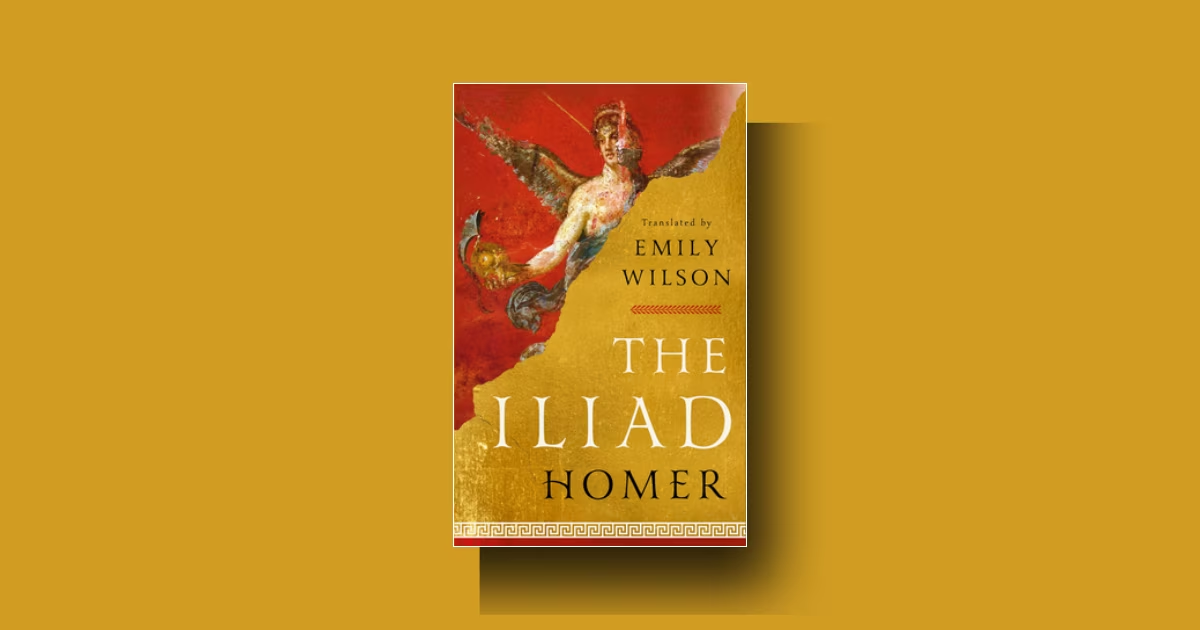

The Iliad by Homer is the oldest surviving story in Western literature about war, and yet its final word is not a victory but a funeral. For roughly 15,693 lines of Greek verse, the poem tracks the rage of Achilles through heaps of the dead, and then it stops, quite deliberately, with an old man collecting his son’s body and a city mourning. I read Emily Wilson’s 2023 translation straight through, and what stayed with me was not the fighting.
It was the grief. In this Iliad review, I retell the full plot with spoilers, explain the ending, look at the characters and themes, compare the book with the film Troy, and tell you plainly who should read it and who will give up by Book 2.
Table of Contents
Quick Summary
What is The Iliad about? The Iliad is an ancient Greek epic poem, attributed to Homer and most likely composed in the late eighth or seventh century BCE, that covers a few weeks in the final year of the Trojan War.
It follows the quarrel between Achilles and Agamemnon, Achilles’ withdrawal from battle, the death of his friend Patroclus at Hector’s hands, Achilles’ revenge on Hector, and finally the moment when Achilles returns Hector’s body to his father, King Priam.
How does The Iliad end? It ends with Hector’s funeral in Troy. Achilles does not die in the poem, and Troy does not fall in it. There is no Trojan Horse.
Is The Iliad worth reading? Yes, if you can get through the long battle catalogues. Book 6 (Hector and Andromache), Book 9 (the embassy), Book 22 (Hector’s death), and Book 24 (Priam and Achilles) are among the most moving things I have read in any language.
Which translation? Emily Wilson’s is the most readable I have tried. She uses regular iambic pentameter and plain, fast English. Purists may prefer Richmond Lattimore’s closeness to the Greek, but Wilson is the one I would hand to a first-time reader.
Key facts at a glance:
| Detail | Information |
|---|---|
| Title | The Iliad |
| Author | Homer (authorship debated) |
| Translator (edition reviewed) | Emily Wilson |
| Publisher | W. W. Norton & Company, 2023 |
| Original length | 15,693 lines, 24 books |
| Original meter | Dactylic hexameter |
| Translation meter | Iambic pentameter |
| Estimated composition | Late 8th to 7th century BCE |
| Setting | The tenth year of the Trojan War |
The Iliad Reader Recommendation, Who Will Love It and Who Will Bounce
You will probably love The Iliad if you:
- Liked Madeline Miller’s The Song of Achilles and want the real source behind it.
- Care about grief, fathers and sons, and friendship more than plot twists.
- Enjoy reading aloud. Wilson’s pentameter is built for the voice.
- Are a student, teacher, or anyone who keeps meeting “Achilles’ heel” and “Trojan” references without knowing where they come from.
- Have lost someone and want literature that does not lie about loss.
You may bounce off it if you:
- Want a tight plot. The Catalogue of Ships in Book 2 is essentially a long list, and it tests everyone.
- Expect the Trojan Horse, the Judgment of Paris on stage, or Achilles’ death. None of these happens in the poem.
- Find graphic violence exhausting. Spears go through teeth, eyes, and bowels, again and again.
- Want gods who behave like moral guides. Homer’s gods are petty, funny, and often cruel.
Introduction
The edition I read is The Iliad by Homer, translated by Emily Wilson and published by W. W. Norton & Company in September 2023.
Wilson, a classicist at the University of Pennsylvania, had already made history with her 2017 Odyssey, which Wikipedia describes as the first complete published translation of that poem into English by a woman. (For the record, Caroline Alexander published an English Iliad in 2015, so Wilson is not the first woman to translate this particular poem.)
Wilson dedicates The Iliad to her mother, the scholar Katherine Duncan-Jones (1941-2022), “who first taught me to love poetry.” The volume includes a long introduction, a translator’s note, maps, book-by-book summaries, notes, genealogies, and a glossary.
The audiobook, read by Audra McDonald, won the 2024 Audie Award for Literary Fiction and Classics, according to Wilson’s official site.
Background and Historical Context
Nobody knows exactly who Homer was, and Wilson is refreshingly honest about that in her introduction. She notes that Greek speakers borrowed the Phoenician alphabet around the mid-eighth century BCE, and that sometime between the late eighth and late sixth centuries this new technology was used to set down the two long poems attributed to Homer.
Whether one literate bard, a group of oral poets, or a poet dictating to scribes produced them, “we do not know,” she writes.
The Iliad grew out of centuries of oral performance. That explains its repeated epithets (“swift-footed Achilles,” “Hector in his flashing helmet”) and its stock scenes of arming, feasting, and sacrifice, which helped singers compose on the spot.
Traditionally, scholars date the written poem to the late eighth century BCE, though some favour a seventh-century date, as Wikipedia’s Iliad entry summarises.
As for Troy itself, Wilson points out that the site at Hissarlik in modern Turkey has layers going back to about 3500 BCE, and that the city was destroyed and rebuilt many times.
In her words, “There were many Troys.” Heinrich Schliemann dug there in the 1870s, and, as she notes with some bite, destroyed a great deal of evidence while doing it. So the poem is not history in any strict sense. It is a memory of a memory, shaped by generations of singers.
The Iliad Summary
What follows is my retelling of the whole poem, from the first line to the funeral. If you only want my verdict, skip to the Evaluation section.
Part One, The Quarrel (Books 1 and 2)
The Iliad begins in the tenth year of the siege. The Greek armies (Homer calls them Achaeans, Argives, and Danaans) have been camped on the beach outside Troy for just over nine years, raiding nearby towns and dividing the loot, including captured women.
The very first lines in Wilson’s version ask the goddess to sing of “the cataclysmic wrath / of great Achilles,” and they warn us straight away that this anger will send “so many noble souls of heroes / to Hades.”
The trouble starts with a father. Chryses, a priest of Apollo, comes to the Greek ships with a huge ransom to buy back his daughter Chryseis, whom Agamemnon, the commander in chief, has taken as a prize. Agamemnon insults the old man and sends him away. Chryses prays to Apollo, and the god fires plague arrows into the camp for nine days. Achilles calls an assembly, and the prophet Calchas says the girl must go home.
Agamemnon agrees, but only if he gets a replacement prize. When Achilles objects, Agamemnon announces that he will take Achilles’ own captive, Briseis. Achilles is about to draw his sword and kill him on the spot when Athena, visible only to him, grabs him by the hair and holds him back. Instead, he swears a great oath that the Greeks will one day miss him badly, and he withdraws himself and his Myrmidons from the war. Heralds lead Briseis away.
Achilles then weeps on the shore and calls his mother, the sea goddess Thetis. She goes to Zeus and asks him to let the Trojans win until the Greeks give her son the honor he deserves. Zeus nods in agreement, which annoys his wife Hera, who hates Troy. The gods squabble at dinner until Hephaestus lightens the mood.
In Book 2, Zeus sends Agamemnon a false dream promising that Troy can be taken now. Oddly, Agamemnon tests the army by suggesting they all go home, and the men run for the ships. Odysseus stops the rout, and he beats the common soldier Thersites, the only man who openly mocks Agamemnon’s greed.
The Iliad then gives the famous Catalogue of Ships, a long roll call of the Greek contingents and their leaders, followed by a shorter list of the Trojans and their allies.
Part Two, Duels, Truces, and a Farewell (Books 3 to 7)
Next, the armies meet on the plain, and Paris, the Trojan prince who took Helen from her husband Menelaus in Sparta, offers to settle the war with a duel. Whoever wins keeps Helen. Meanwhile, on the walls of Troy, Helen sits beside King Priam and names the Greek leaders for him, an odd scene given that they have been camped there for nine years.
In the duel, Menelaus wins easily, but Aphrodite snatches Paris away in a cloud and sets him down in his bedroom. She then forces an angry Helen to join him. By every fair reckoning, the war should end here. It doesn’t.
In Book 4 of The Iliad, the gods decide the war must go on. Athena persuades the Trojan archer Pandarus to shoot at Menelaus, breaking the truce. The arrow wounds him slightly, and full battle resumes with its first gruesome deaths. Book 5 belongs to the Greek hero Diomedes, whom Athena fills with such strength that he wounds two gods, Aphrodite on the wrist and Ares, the war god himself, who runs howling to Zeus.
Book 6 of The Iliad is, for me, the emotional heart of the first half. The Trojan champion Hector goes back inside the city to ask the women to pray to Athena. On the battlefield, the Greek Diomedes and the Lycian Glaucus discover their grandfathers were guest-friends, so they swap armour instead of fighting, Glaucus trading gold for bronze.
Inside Troy, Hector scolds Paris, speaks kindly to Helen, and finds his wife Andromache and their baby son Astyanax near the gate. She begs him to stay on the wall. Achilles has already killed her father and seven brothers, and she tells him, “Hector, you are my father and my mother.” He refuses.
He says he knows Troy will fall one day, and that her future enslavement grieves him more than anything. Then he reaches for the baby, who screams in terror at the horsehair plume on his helmet. Both parents laugh. Hector takes off the helmet, kisses the boy, prays for him, and goes back to war.
In Book 7, Hector fights a duel with the giant Greek Ajax. Night falls before either wins, and the two exchange gifts. Both sides agree to a truce to burn their dead. The Trojan Antenor suggests giving Helen back; Paris refuses, though he offers to return her treasure. The Greeks reject that offer and, on Nestor’s advice, build a wall and a trench to protect their ships.
Part Three, Zeus Keeps His Promise (Books 8 to 12)
In Book 8, Zeus forbids the other gods to interfere, lifts his golden scales, and the Greeks’ fate sinks. Hector drives them back to their new wall. That night, for the first time, the Trojans camp out on the plain, their fires burning like stars.
Book 9 is the great test of Achilles. Agamemnon, close to despair, admits he was deluded and offers an enormous list of gifts, including tripods, gold, twenty cauldrons, twelve racehorses, the return of Briseis (untouched, he swears), one of his own daughters in marriage, and seven towns.
Odysseus, Ajax, and Achilles’ old tutor Phoenix carry the offer to Achilles’ hut. He greets them warmly, feeds them, and then refuses everything.
His answer is the most radical speech in the poem. He says that cattle and horses can be taken in raids, but “human life does not come back again / after it passes through the fence of teeth.” He reveals that Thetis told him he has two fates: stay and win eternal fame but die young, or go home and live long without glory. He is thinking of going home. Phoenix tells him the story of Meleager, a hero who refused to fight until it was too late, but Achilles will only say he will stay the night and decide in the morning. Ajax, blunt as ever, tells him he is heartless.
Book 10 is a night raid, and it feels different from everything around it. Wilson’s notes mention that an ancient commentator claimed the whole book was added by a later performer. Odysseus and Diomedes capture a Trojan spy, Dolon, squeeze information out of him, kill him anyway, and then slaughter the sleeping Thracian king Rhesus and steal his horses.
In Books 11 and 12, the Greek leaders are wounded one by one: Agamemnon, Diomedes (shot in the foot by Paris), and Odysseus. Achilles, watching from his ship, sends Patroclus to find out who has been hurt.
Old Nestor seizes the moment and suggests that Patroclus go into battle wearing Achilles’ armour, so that the Trojans will think Achilles has returned. Meanwhile, Hector ignores a bad omen that his adviser Polydamas warns him about, and the Lycian prince Sarpedon helps him break through the Greek wall. Hector smashes a gate with a boulder, and the Trojans pour into the camp.
Part Four, Fire at the Ships (Books 13 to 15)
While Zeus looks away, the sea god Poseidon secretly helps the Greeks in Book 13. In Book 14, Hera borrows Aphrodite’s magic band of desire, seduces Zeus on Mount Ida, and puts him to sleep. With Zeus distracted, Ajax knocks Hector unconscious with a rock.
Zeus wakes up furious in Book 15. He sends Poseidon off the field and revives Hector through Apollo. He also lays out the plan: Patroclus will kill Sarpedon, Hector will kill Patroclus, Achilles will kill Hector, and Troy will fall later. Apollo kicks down the Greek wall like a child knocking over a sandcastle. Hector reaches the ships and calls for fire, while Ajax fights on alone from the decks.
Part Five, The Death of Patroclus (Books 16 and 17)
In Book 16 of The Iliad, Patroclus comes to Achilles weeping and begs to borrow his armour. Achilles agrees, but only to push the Trojans back from the ships and not to chase them to the city. Just then, the first ship catches fire. Patroclus arms himself and leads the Myrmidons out, and the Trojans panic.
He kills Sarpedon, the son of Zeus. Zeus considers saving his son but Hera talks him out of it, so he sends a rain of blood in mourning and has Sleep and Death carry Sarpedon’s body home to Lycia.
Next, Patroclus forgets Achilles’ warning and storms the walls of Troy three times until Apollo pushes him back. On the fourth rush, Apollo strikes him from behind, knocking off his helmet and loosening his armour.
The young Trojan Euphorbus spears him in the back, and Hector finishes him with a spear to the belly. With his dying breath, Patroclus warns Hector that Achilles will kill him.
Book 17 is one long struggle over the corpse. Hector strips the armour and puts on Achilles’ gear. Menelaus and Ajax defend the body, and in one of the loveliest images in the poem, Achilles’ immortal horses stand still on the battlefield and weep for their charioteer, their manes trailing in the dust.
Part Six, The Return of Achilles (Books 18 to 21)
Antilochus runs to Achilles with the news in Book 18. Achilles pours ashes over his head and lies in the dust, and his cry is so terrible that Thetis hears it under the sea. She reminds him that if he kills Hector, his own death will follow soon. He accepts it. He only wants Hector.
Without armour, Achilles simply stands at the trench and shouts three times, and the Trojans fall back in terror, letting the Greeks recover Patroclus’ body.
That night Hector rejects Polydamas’ advice to retreat into the city, a decision that will cost him his life. Meanwhile, Thetis persuades the smith god Hephaestus to forge new armour, including the famous Shield of Achilles, which shows a whole world: a city at peace with a wedding and a lawsuit, a city under siege, ploughing, harvest, a vineyard, a dance.
In Book 19, Achilles and Agamemnon formally reconcile. Agamemnon blames the goddess Delusion (Ate) for his behaviour, the gifts are delivered, and Briseis returns. She throws herself on Patroclus’ body and mourns him, telling us he was always kind to her. Achilles refuses to eat, so Athena feeds him nectar and ambrosia. As he mounts his chariot, his horse Xanthus speaks, predicting his death. Achilles answers that he knows.
In Books 20 and 21, Zeus lets the gods take sides openly. Achilles cuts through the Trojans like a forest fire. He takes twelve Trojan boys alive to sacrifice later. He meets Lycaon, a son of Priam he once captured and sold, who now begs for his life. Achilles kills him coldly: “Patroclus has already died as well.”
He clogs the river Scamander with so many bodies that the river god rises up to drown him, and only Hephaestus’ fire saves him. The gods fight among themselves. Priam, from the walls, orders the gates opened for the fleeing troops.
Part Seven, Hector’s Death (Book 22)
With the Trojans safe inside, Hector alone stays outside the Scaean Gates. His father Priam begs him from the wall to come in. His mother Hecuba bares her breast and pleads with him. He stays, partly out of shame, because he ignored Polydamas’ advice and lost so many men.
When Achilles comes at him, Hector’s nerve breaks and he runs. They race around the walls of Troy three times. Then Zeus weighs their fates on his golden scales, and Hector’s side sinks. Athena disguises herself as Hector’s brother Deiphobus and persuades him to stand and fight. Hector asks Achilles to agree that the winner will return the loser’s body. Achilles refuses brutally. After both spears are thrown, Hector turns to his “brother” for another spear and finds nobody there. He understands that the gods have tricked him, and charges anyway.
Achilles drives his spear through the gap in the armour at Hector’s throat, the armour Hector took from Patroclus. Dying, Hector begs again for his body to go home, and Achilles again refuses. Hector’s last words predict that Paris and Apollo will kill Achilles at the Scaean Gates.
Achilles strips the body, the Greeks stab it, and Achilles ties Hector’s ankles to his chariot and drags him through the dust to the ships. Andromache, who has been warming a bath for her husband, hears the wailing, runs to the wall, sees him dragged away, and faints.
Part Eight, The Funeral Games (Book 23)
Back at the camp, Patroclus’ ghost comes to Achilles in a dream and asks to be buried so he can enter Hades, and asks that their bones share one urn. Achilles reaches for him, but the spirit slips away “like smoke.” The next day he builds a huge pyre and burns Patroclus with horses, dogs, and the twelve Trojan captives.
The rest of the book is funeral games, including a chariot race, boxing, wrestling, a footrace, and archery. Surprisingly, Achilles is gracious and fair here, soothing disputes and giving prizes even to losers. It is the first time we see him as a host rather than a killer.
Part Nine, Priam and Achilles, and the Ending Explained (Book 24)
Still, grief has not left him. For twelve days Achilles drags Hector’s body around Patroclus’ tomb, and Apollo keeps the corpse from decaying. Finally, the gods have had enough. Zeus sends Thetis to tell her son to accept a ransom, and sends Iris to tell Priam to go to the Greek camp alone, with only an old herald.
Hermes, disguised as a young Myrmidon, guides Priam’s wagon through the enemy lines at night. Priam walks into Achilles’ hut, kneels, clasps his knees, and kisses his hands, “the terrible, / murderous hands, which killed so many sons.” He asks Achilles to remember his own father, Peleus, who is also old and waiting for a son. Priam once had fifty sons, he says, and most are dead.
The two men weep together, Priam for Hector, Achilles for his father and for Patroclus. Then Achilles lifts the old man up and tells him the parable of the two jars of Zeus, one of good things and one of bad. Nobody gets only good. Achilles has the body washed and covered, out of Priam’s sight, in case the old man’s anger provokes him. They eat together, look at each other in wonder, and Achilles grants a truce of eleven days for the funeral.
Before dawn, Hermes wakes Priam and hurries him home. The women of Troy mourn Hector one by one. Andromache speaks of their orphaned son. Hecuba speaks of how the gods kept his body beautiful. Helen, surprisingly, gets the last lament, remembering that in twenty years Hector never said a harsh word to her.
For nine days the Trojans gather wood. On the tenth they burn the body, and on the eleventh they gather the bones and build a mound. The last line of Wilson’s translation is simple: “they held the funeral for horse-lord Hector.”
So what does the ending mean? The Iliad does not show us Troy’s fall or Achilles’ death, though both are predicted many times. Homer chooses to end on a pause, a truce made between two enemies who have each lost the person they loved most. The war resumes after the eleven days.
Achilles will die, Troy will burn, Andromache will be enslaved, and her baby will be killed. We know all of this. That is precisely why the final scene hurts: the poem gives us one small human mercy inside a catastrophe that it refuses to pretend away.
The Iliad Analysis and Critique
The Iliad Characters
Achilles. Is Achilles the hero of The Iliad? He is its centre, but “hero” in the modern sense does not fit him. He is the best fighter alive, the son of a goddess, and the only man in the poem who asks out loud whether any of this is worth dying for.
In Book 9 he sees through the whole honour system, and I find that speech thrilling. Yet the same clarity curdles into cruelty after Patroclus dies.
He sacrifices twelve boys, cuts down the begging Lycaon, and drags a corpse for twelve days. What makes him great as a character is that the poem never lets him off the hook, and still gives him Book 24, where he weeps with his enemy.
There is a small detail I only caught on this reading: in Book 22, the dying Hector tells Achilles his heart “is made of iron.” Two books later, Achilles says exactly the same thing about Priam: “Your heart is surely made of iron.” The insult has become a compliment. That shift is Achilles’ whole arc in two lines.
Hector. Hector is the character most modern readers love, and I understand why. He is a husband, a father, a brother who scolds Paris but still fights beside him. Still, Homer does not make him a saint.
He brushes off Polydamas’ sensible warnings twice, boasts over Patroclus, and wants to cut off Patroclus’ head and feed the body to Trojan dogs. His fatal flaw is shame, the dread of being seen as a coward, which he admits openly to Andromache. He dies partly because he cannot face the people he failed.
Patroclus. He is gentle, the one Briseis remembers as kind, and the only person Achilles truly listens to. The poem never spells out whether they were lovers.
Ancient Greek writers argued about it (Plato’s Symposium has a character debate which of them was the older partner), and modern retellings like The Song of Achilles take the romantic reading. In the poem itself, what matters is that Achilles would rather lose everything than lose him, and does.
Agamemnon. The commander is greedy, insecure, and quick to blame the gods for his own choices. In Book 19 he pins his behaviour on Delusion. He is a very human portrait of bad leadership, and I found him more believable than any cartoon villain.
Priam. Priam is the moral centre of the ending. An old king who once had fifty sons crawls into his enemy’s hut. What he does there, kissing the hands of his son’s killer, is the bravest act in a poem full of spear-fights.
Helen. Helen is sharper than her reputation. She calls herself a “dog” in Book 6, blames herself constantly, and snaps at Aphrodite. Her lament over Hector, the last voice in the poem before the funeral, recasts her as a lonely woman in a hostile city for twenty years, with one man who was kind.
Andromache and Hecuba. These two women carry the poem’s view of what war does to those who do not fight. Andromache’s pleas in Book 6 and her collapse in Book 22 are, to me, more painful than any battle scene.
Briseis. She speaks only once, mourning Patroclus in Book 19, but that single speech tells us that Achilles killed her husband, that her three brothers died on the same day, and that Patroclus promised to make her Achilles’ wedded wife. It is a whole tragedy in a few lines, and Pat Barker built a novel on it.
The gods. Zeus, Hera, Athena, Apollo, Aphrodite, Ares, Poseidon, and Thetis are powerful, vain, and often comic. Hera seduces her husband to win a battle. Aphrodite runs crying to her mother over a scratch. The contrast is the point: gods get healed, mortals die.
The Iliad Themes and Symbolism
Rage, and what it costs. The first word of the Greek poem is mēnis, the wrath of Achilles, and the whole poem tracks its path. First it is aimed at Agamemnon, then at Hector, then at a corpse, until it finally dissolves into shared weeping.
Achilles himself names the problem in Book 18, wishing anger did not exist because it tastes “sweeter than honey” and then swells “like smoke.” I think this is the poem’s cleverest psychological observation. Rage feels good, and that is why it is dangerous.
Glory versus a long life. Greek has two words that sit at the centre here, kleos (fame, what people say about you after death) and nostos (homecoming). Achilles is told he can have one or the other.
Sarpedon in Book 12 gives the classic defence of heroic fighting: if we could live forever, he says, he would never fight, but “No mortal can escape or flee from death,” so men might as well fight for glory. The poem honours that argument and also shows its price.
Ransom, compensation, and the body. Wilson’s introduction frames the entire poem with two ransoms, and it changed how I read it. At the start, a father (Chryses) tries to buy back a living daughter and is refused.
At the end, a father (Priam) buys back a dead son and is accepted. Between those scenes, men fight over bodies again and again (Sarpedon, Patroclus, Hector) because the corpse is the last thing that can be saved. As Wilson puts it, “The dead never come back to life.”
Mortality. In Book 6, Glaucus tells Diomedes that human generations are “like the growth and fall of leaves.” It is one of the most quoted lines in the poem because it is true in the plainest way.
The Greek word minunthadios, “short-lived,” is applied to both Achilles and Hector, and Wilson notes in her introduction that it applies to all of us.
The Shield of Achilles (symbolism). Hephaestus’ shield in Book 18 is the poem’s biggest symbol. At the very moment Achilles arms himself for slaughter, he carries a picture of everything that war destroys: weddings, courts, harvests, dancing. It is as if Homer lifted his eyes from the battlefield to show us the whole human world.
Women as spoils of war. The quarrel that drives the plot is literally a fight over two captured women. Andromache knows her fate, and so does Helen. Wilson’s notes are frank about this, and I appreciated that she does not soften it.
Helmets, armour, and identity. Armour carries identity in this poem. Astyanax screams at his father’s helmet, and Patroclus becomes “Achilles” by wearing his gear. Later, Hector wears Achilles’ own armour when Achilles kills him, and Achilles knows exactly where the weak spot is.
Evaluation, My Verdict on The Iliad
The Iliad is a devastating, strangely tender poem, the oldest war story we have and still one of the most honest about grief. Wilson’s translation made me feel, for the first time, that I was hearing the people rather than reading a monument.
Strengths
The big scenes are unforgettable. Hector and his frightened baby, the weeping horses, Priam kissing Achilles’ hands. I have read these several times in different translations and they still get me.
Nobody is simply good or evil. Trojans and Greeks both get sympathy. Even the Trojan dead get names, fathers, and hometowns before they fall.
The similes. Homer keeps cutting from spears to shepherds, lions, snowstorms, and children on the beach. These breathing spaces make the carnage bearable.
Wilson’s clarity. Her pentameter moves fast, the characters sound different from each other, and the notes and summaries are really helpful for a new reader.
Weaknesses
Repetition and lists. The Catalogue of Ships in Book 2 and the long kill lists in Books 5, 16, and 20 made me skim. That is partly the oral tradition, but it is still hard going.
Violence fatigue. By Book 20, I felt numbed by the wounds. Perhaps that is intentional, yet some readers will simply stop.
Translation trade-offs. Wilson’s plain style occasionally loses the strangeness of the Greek. The classicist Johanna Hanink, writing in Slate, questioned rendering the opening word oulomenē as “cataclysmic,” arguing it turns the narrator’s revulsion into something more like a natural disaster. Wilson also uses more lines than the Greek, which she explains openly in her translator’s note.
Impact and Controversy
Intellectually, what shook me most was realising that a poem about the greatest warrior of all time is so suspicious of war. Simone Weil famously called it the poem of force, and read it as showing how violence turns people, killers and killed alike, into things. I think she was right, but only half right, because Book 24 shows force stopping for one night.
There are real controversies, too. The poem treats enslaved women as prizes, and some readers find this hard to stomach even as historical fact. The relationship between Achilles and Patroclus has been argued over for about 2,400 years, from Aeschylus and Plato to today’s readers of Madeline Miller. Wilson’s own translation divided critics, too.
The Washington Post praised how it conveys the oral nature of the poem, while Hanink’s Slate review took issue with specific word choices. Based on the reviews I found, the reception was mostly very positive, and her site lists appearances on 2023 best-books lists from The Atlantic, The New York Times, The Washington Post, Time, and The Guardian.
Comparison With Similar Works
Homer’s The Odyssey. The companion poem is about a man who gets home. The Iliad is about men who never do. Wilson’s introduction puts it neatly: the Odyssey hero recovers everything, while The Iliad warriors “never fully reclaim what they have lost.” If you want the contrast on screen, Sopranu has a useful piece on why no film can fully capture Homer’s Odyssey.
Virgil’s Aeneid. Virgil’s Roman epic tells the fall of Troy from the losing side and follows a Trojan survivor. It feels more political and more melancholy.
Madeline Miller’s The Song of Achilles (2011). A romantic, first-person retelling through Patroclus. It is lovely, but it softens Achilles.
Pat Barker’s The Silence of the Girls (2018). It retells the story through Briseis and is the best corrective I know to the poem’s male point of view.
Jonathan Shay’s Achilles in Vietnam (1994). A psychiatrist who treated Vietnam veterans read The Iliad as a portrait of combat trauma. It changed how I read Achilles after Patroclus dies.
For more novels that turn ancient history into human stories, see my list of 30 best historical fiction books.
The Iliad Adaptations, Book vs Film and TV
Troy (2004). The most famous adaptation is Wolfgang Petersen’s Troy, written by David Benioff and starring Brad Pitt (Achilles), Eric Bana (Hector), Orlando Bloom (Paris), Diane Kruger (Helen), Peter O’Toole (Priam), and Garrett Hedlund (Patroclus).
According to Wikipedia and The Numbers, it cost roughly $150 to $175 million and grossed about $497.4 million worldwide. It earned an Academy Award nomination for Best Costume Design.
The differences from the book are huge:
| The Iliad (poem) | Troy (2004 film) |
|---|---|
| Set in the tenth year of a long war | The war is squeezed into a couple of weeks |
| The gods act constantly | The gods are removed almost entirely |
| Patroclus is Achilles’ closest companion | Patroclus is his younger cousin |
| Menelaus survives; Agamemnon goes home | Hector kills Menelaus; Briseis kills Agamemnon |
| Ends with Hector’s funeral | Shows the Trojan Horse, the sack of Troy, and Achilles’ death |
To be fair, the Priam scene in Troy, with Peter O’Toole kissing Pitt’s hands, is the one moment where the film reaches the poem’s level. I wrote more about it in my Troy (2004) film review.
Other screen versions. Robert Wise’s Helen of Troy (1956), the 2003 TV miniseries Helen of Troy, and the BBC One and Netflix series Troy: Fall of a City (2018) all retell the wider war rather than The Iliad‘s narrow slice. An Iliad (2010), a one-person stage play, is closer in spirit because it focuses on the cost of war.
The Homer revival of 2026. Christopher Nolan’s The Odyssey (released July 17, 2026, starring Matt Damon) is not an Iliad adaptation, but it has pushed Homer back into the charts. Deadline reported a $257 million global opening, and Wikipedia listed a worldwide gross of about $1.657 billion when I checked.
A Personal Lesson, What The Iliad Teaches Us About Bringing the Dead Home
The one angle I cannot shake is this: The Iliad ends not with a victory but with a father getting his son’s body back. That sounds ancient until you check the news. Under the Istanbul talks in 2025, Russia and Ukraine agreed on a “6,000-for-6,000” exchange of war dead, and by June 16, 2025, the Kyiv Post reported that 6,057 bodies had been returned to Ukraine.
Meanwhile, the International Committee of the Red Cross said in August 2025 that about 284,400 people were registered as missing at the end of 2024, up from 169,500 in 2019, an increase of roughly 68 percent. Families in 2025 are still, in effect, doing what Priam did.
Here are five lessons I take from that.
- A body matters because grief needs somewhere to go. Priam risks his life not for vengeance but for a funeral. Modern repatriation work exists for the same reason.
- Mercy between enemies is possible, even if it is temporary. Achilles’ eleven-day truce does not end the war, and neither did the 2025 exchanges. Still, both show that enemies can agree on the dignity of the dead.
- Unfinished grief turns into rage. Achilles cannot stop dragging Hector because he has not yet mourned Patroclus. Jonathan Shay’s Achilles in Vietnam makes a similar argument about soldiers denied proper mourning.
- Shame kills. Hector dies because he cannot face the people he failed. Leaders who cannot admit error still get people killed.
- Listening to the other side’s grief changes us. Achilles only softens when Priam asks him to think of his own father. Empathy in the poem starts with a shared loss, not a shared argument.
The Iliad Quotes
All quotations below are from Emily Wilson’s translation
1. The Opening Invocation
“Goddess, sing of the cataclysmic wrath of great Achilles, son of Peleus, which caused the Greeks immeasurable pain and sent so many noble souls of heroes to Hades, and made men the spoils of dogs, a banquet for the birds, and so the plan of Zeus unfolded—starting with the conflict between great Agamemnon, lord of men, and glorious Achilles.”
Book 1, lines 1–7
The most famous opening in Western literature. It establishes the poem’s subject—the wrath (mēnis) of Achilles—and its catastrophic consequences. The word “cataclysmic” renders the Greek oulomenēn, conveying destruction and ruin.
2. Apollo’s Descent
“Like night the god descended.”
Book 1, line 47
A brief, sublime simile describing Apollo coming down from Olympus to punish the Greeks with plague. Its power lies in its starkness—the god is as sudden and terrifying as darkness itself.
3. Achilles’ Oath by the Staff
“It was cut upon the mountain and left its stump behind, and it will never sprout with fresh shoots, because the bronze has stripped its leaves and bark.”
Book 1, lines 315–318
Achilles swears a mighty oath that he will one day be needed by the Greeks, using the image of a dead staff that will never regenerate—a symbol of his own estrangement and the irreversible damage done by Agamemnon’s insult.
4. The Death of a Young Warrior
“The generations of men are like the growth and fall of leaves. The wind shakes some to earth. The forest sprouts new foliage, and springtime comes. So too, one human generation comes to be, another ends.”
Book 6, lines 195–200
Glaucus’ famous meditation on human mortality, comparing generations to leaves. It is one of the most quoted passages in all of Homer, capturing the poem’s elegiac vision of life’s transience.
5. Hector’s Farewell to Andromache
“Your will to fight will kill you!”
Book 6, line 550
Andromache’s desperate plea to her husband, which proves prophetic. It encapsulates the tragic tension between Hector’s familial love and his commitment to the warrior code of honor.
6. Hector’s Warrior Creed
“War is a task for men—for every man born here in Troy, but most especially, me.”
Book 6, lines 669–671
Hector’s response to Andromache’s plea. It expresses the rigid gender roles and social pressures that drive the poem’s tragedy—Hector cannot stay on the wall without shame, even though he knows Troy will fall.
7. The Wish for a Different Life
“If only you had stayed among the deathless goddesses under the sea, and Peleus had taken a mortal woman as his wife!”
Book 18, lines 107–109
Achilles’ lament to his mother Thetis, expressing the despair of a man who knows his fate is sealed. He wishes his divine parentage had never doomed him to a short, glorious life.
8. The Parable of the Two Jars
“Two jars are set upon the floor of Zeus—from one, he gives good things, the other, bad. When thundering Zeus gives somebody a mixture, their life is sometimes bad and sometimes good. But those he serves with unmixed suffering are wretched. Terrible starvation drives them across the shining world. They have no honor from gods or mortals.”
Book 24, lines 653–660
Achilles’ profound meditation on the human condition, offered to Priam as consolation. It acknowledges that no mortal escapes suffering, and that the best life is a mixture of good and ill. This is the philosophical climax of the poem.
9. Achilles’ Rejection of Compensation
“Not even if his gifts to me could match the grains of dust and sand—not even then would Agamemnon ever sway my heart.”
Book 9, lines 495–497
Achilles’ refusal of Agamemnon’s lavish embassy. It marks his rejection of the traditional warrior code that trades material goods for honor, and signals his descent into a wrath that can never be satisfied.
10. The Irreversibility of Death
“You can raid fine cattle or well-fed sheep, and you can trade to get tripods and horses with fine golden manes. But human life does not come back again after it passes through the fence of teeth. No trade or rustling can recover it.”
Book 9, lines 524–529
Achilles’ stark observation about the finality of death. The image of the “fence of teeth” as the boundary between life and death is one of the most haunting metaphors in the poem.
11. Sarpedon’s Speech to Glaucus
“You see, my brother, if we could escape this war and then be free from age and death forever, I would never choose to fight or join the champion fighters at the front… But in fact, a million ways to die stand all around us. No mortal can escape or flee from death. So let us go. Perhaps we shall succeed, and win a triumph from another’s death, or somebody may triumph over us.”
Book 12, lines 395–405
Sarpedon’s heroic calculus: since death is inevitable, glory is the only rational pursuit. It is the clearest articulation of the warrior ethic in the poem.
12. Hector’s Dismissal of Omens
“Patriotism is the one true bird.”
Book 12, line 293
Hector’s famous rejection of bird signs and prophecies. He insists that courage and love of country are the only omens he needs. It is a moment of tragic overconfidence that leads to his doom.
13. Zeus on Human Misery
“There is nothing more miserable than them, of all the creatures that breathe and move across the earth.”
Book 17, lines 572–573
Zeus’ observation about humanity as he watches Achilles’ immortal horses weep for Patroclus. It is one of the bleakest statements in the poem about the human condition.
14. Achilles on Anger
“I wish anger did not exist. Even the wisest people are roused to rage, which trickles into you sweeter than honey, and inside your body it swells like smoke.”
Book 18, lines 135–139
Achilles’ reflection on the seductive, destructive nature of anger. The imagery of anger as something sweet that becomes toxic smoke is psychologically acute.
15. Thetis’ Prophecy
“As soon as you kill Hector, you must die.”
Book 18, line 120
Thetis’ stark warning to Achilles. It sets up the tragic inevitability of the poem’s climax: Achilles chooses to avenge Patroclus, knowing it means his own death.
16. Hector’s Prayer for His Son
“Zeus and you other gods, please let my son be just like me—admired among the Trojans, strong and successful on the battlefield, and powerful enough to rule in Troy.”
Book 6, lines 647–651
Hector’s prayer for Astyanax is one of the most poignant moments in the poem. It reveals his hopes for the future even as the city is doomed, and his inability to imagine a life beyond war.
17. Priam’s Supplication
“I am more pitiable than him. I have endured what no man yet on earth has done—I pressed my mouth into the hand of him who killed my son.”
Book 24, lines 626–629
Priam’s words to Achilles as he begs for Hector’s body. It is the emotional climax of the poem, where enemy meets enemy in shared grief and recognizes their common humanity.
18. Achilles’ Recognition
“I know that you are strong, and I much weaker. But everything is in the lap of gods.”
Book 20, lines 566–567
Hector’s response to Achilles before their final confrontation. It acknowledges the gap between them but asserts a fatalistic acceptance of divine will—a stark contrast to Hector’s earlier confidence.
19. Hector’s Final Realization
“The gods have called me to my death.”
Book 22, line 399
Hector’s moment of clarity when he realizes Athena has tricked him and he is alone against Achilles. It is the tragic recognition of a hero who has been led to his doom by the gods he trusted.
20. The End of the Poem
“And so they held the funeral for horse-lord Hector.”
Book 24, line 1000
The final line of The Iliad. It ends not with the fall of Troy or the death of Achilles, but with the funeral of Hector—the man who defended his city and family. It is a quiet, somber conclusion that honors the fallen enemy and affirms the shared humanity that transcends the battlefield.
Conclusion, Is The Iliad Worth Reading?
Yes. The Iliad is long, violent, and repetitive in places, and I skimmed parts of Book 2 without guilt. But the poem earns its reputation in the scenes that matter: a wife begging at a gate, horses weeping in the dust, and an old king kissing the hands that killed his son. Emily Wilson’s translation is, in my experience, the easiest way in for a modern reader, and her introduction and notes do a lot of patient teaching without talking down to you.
I would recommend it most to readers of The Song of Achilles and The Silence of the Girls who want the original, to students who need more than a summary, to anyone interested in war, trauma, or leadership, and to people living with grief. If you want adventure and a happy homecoming, start with the Odyssey instead.
In the end, what makes The Iliad significant after nearly three thousand years is not its battles. It is that the first great story of Western literature chose to end with two enemies crying together over the people they lost, and then a funeral.
Sources and References
- Homer, The Iliad, trans. Emily Wilson (New York: W. W. Norton, 2023), including the introduction, translator’s note, and book summaries.
- Emily Wilson, official page for The Iliad (2023)
- Johanna Hanink, “Emily Wilson’s Iliad, reviewed,” Slate, September 2023
- The Washington Post review of Wilson’s Iliad, September 21, 2023
- Iliad, Wikipedia
- The Odyssey (Emily Wilson translation), Wikipedia
- Troy (film), Wikipedia and The Numbers, Troy box office
- Troy: Fall of a City, Wikipedia
- The Odyssey (2026 film), Wikipedia and Deadline global box office report
- Kyiv Post on the 6,000-for-6,000 body repatriation
- ICRC, missing people registered up nearly 70% in five years (August 2025)
- Jonathan Shay, Achilles in Vietnam, Simon & Schuster
- Sopranu, The Odyssey Film vs Poem





