
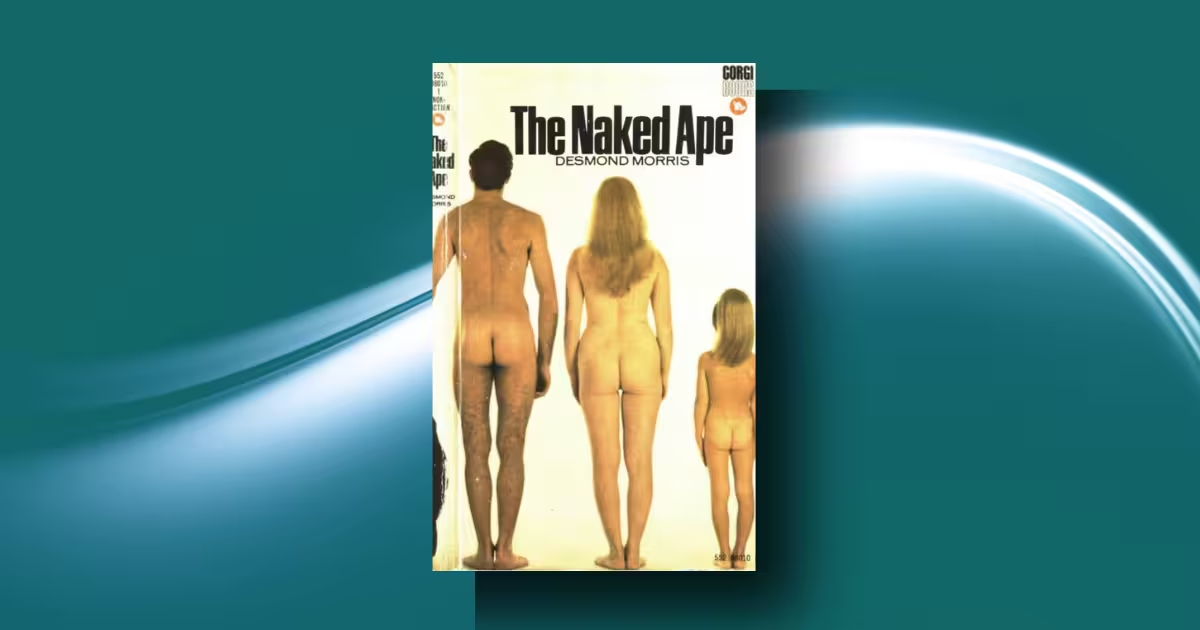
Why do we still behave like anxious, territorial, pleasure-seeking animals while pretending to be purely rational beings? The Naked Ape by Desmond Morris made me look at human nature with less vanity, more curiosity, and a slightly uncomfortable honesty.
The Naked Ape is best for readers of evolutionary psychology, anthropology, zoology, human behavior, sexuality studies, social criticism, and classic nonfiction.
Not for readers who dislike biological explanations of human behavior, dislike speculative “just-so” evolutionary arguments, or want a strictly modern academic textbook.
Table of Contents
Introduction
The Naked Ape: A Zoologist’s Study of the Human Animal is a 1967 nonfiction book by British zoologist and ethologist Desmond Morris. First published in March 1969.
Morris was not merely a popular writer. According to The Guardian, he studied zoology at the University of Birmingham, completed a doctorate in animal behaviour at Oxford, became curator of mammals at London Zoo in 1959, and later presented BBC and ITV natural-history programmes.
The Guardian also notes that The Naked Ape made him internationally famous in 1967 and that he went on to contribute to more than 90 titles.
The book’s central idea is simple but provocative: human beings are animals before they are philosophers, citizens, believers, consumers, lovers, workers, or artists.
Morris begins with one of the most famous claims in the book: among 193 living species of monkeys and apes, 192 are covered with hair, and the exception is the “naked ape” called Homo sapiens.
The phrase sounds funny at first, but the joke quickly becomes serious.
Morris wants us to study humans as zoological specimens. His declaration is blunt: “I am a zoologist and the naked ape is an animal.”
He argues that our polished civilizations rest on older biological impulses: mating, bonding, feeding, grooming, aggression, curiosity, fear, parental care, territory, and hierarchy.
For me, the value of The Naked Ape is not that every claim feels scientifically final. It does not. The value is that it forces a humbling question: how much of my daily life is still shaped by an ancient animal body wearing modern clothes?
Background
When The Naked Ape appeared in 1967, its frank discussion of sex, body, aggression, and instinct made it both popular and controversial.
It arrived during a decade already unsettled by sexual liberation, student movements, popular science, television, and challenges to traditional authority.
Morris’s tone was not devotional toward humanity. He treated us like primates with bigger brains and thinner fur.
That is why the book still has cultural force. It speaks to human pride and quietly wounds it. The cover of the uploaded edition even calls it “The Sensational Worldwide Bestseller,” showing how strongly the book entered popular consciousness.
Morris also explains in his acknowledgements that the book was written for a general audience, so he deliberately avoided quoting authorities inside the main text, while adding a chapter-by-chapter appendix and bibliography at the end.
This is important for judging the book: it is not written like a technical monograph; it is popular zoological interpretation.
That choice is both its charm and its weakness. The prose is clear, confident, and memorable. But sometimes Morris moves too quickly from observation to evolutionary explanation. I enjoyed the boldness; I also kept wanting a little more caution.
The Naked Ape summary
1. Introduction: humans as animals
Morris begins by stripping away human self-importance.
His target is not human dignity, but human denial. He says we spend enormous energy examining our “higher motives” while ignoring our “fundamental ones.” In other words, we talk about ideals, morality, religion, politics, and culture, but often forget the biological machinery underneath.
His method has three sources: palaeontology, comparative ethology, and direct observation of common behaviour in modern humans.
He openly says he will simplify by focusing on behaviours with animal parallels: feeding, grooming, sleeping, fighting, mating, and care of the young.
Takeaway: The book asks us to stop treating humans as exceptions to nature. We are exceptional, but not exempt.
2. Origins: the hunting ape, the naked skin, and the “primate predator”
The “Origins” chapter is the foundation of the book.
Morris argues that humans evolved from forest-dwelling primates into ground-dwelling, hunting, territorial, tool-making animals. He describes the shift from forest ape to ground ape, then hunting ape, then territorial ape, and finally cultural ape.
One of his most memorable claims is that we are “essentially as primate predators.” That phrase is crucial. Morris sees the human animal as a hybrid: primate by ancestry, carnivore by adoption. We did not evolve claws, fangs, or predator speed; instead, we used upright posture, hands, tools, cooperation, and bigger brains.
He gives many numerical details.
He places early primate development after the collapse of the reptile age roughly 80 to 50 million years ago, monkey evolution around 25 to 35 million years ago, and major forest reduction around 15 million years ago. He also claims that in roughly the last million years, upright posture, freed hands, weapon use, group hunting, and brain growth developed together rather than in a neat sequence.
The famous “naked” question comes later in the chapter. Why did humans lose functional body hair? Morris considers several theories: parasites, messy feeding, fire, aquatic adaptation, social signalling, sexual signalling, touch sensitivity, and cooling. He does not fully accept all of them.
His preferred explanation is that reduced hair and increased sweating helped the hunting ape cool down during intense pursuit. He writes that by losing heavy hair and increasing sweat glands, cooling became possible “for the supreme moments of the chase.”
Takeaway: Morris’s human being is not a fallen angel but an experimental animal: upright, brainy, social, sweaty, sexual, territorial, and still biologically unfinished.
3. Sex: pair-bonding, courtship, privacy, and civilization
The sex chapter is one of the reasons the book became famous. Morris argues that human sexuality must be understood through three pressures: our primate ancestry, our adopted hunting life, and modern civilization.
He says human sexual behaviour has three phases: pair-formation, pre-copulatory activity, and copulation. Courtship is unusually prolonged by animal standards, often lasting weeks or months.
His central claim is that pair-bonding became necessary because the hunting lifestyle required males to leave the home base and cooperate with other males, while females raised slow-developing young. A stable male-female bond reduced sexual rivalry, supported child-rearing, and strengthened the family unit.
This is one of the most fascinating and most debatable parts of the book. Morris explains romantic love, jealousy, courtship, kissing, sexual privacy, and even body features through evolutionary bonding. He sees sex not only as reproduction but also as social glue. This is powerful, but it can feel reductive when he pushes too hard.
Takeaway: In Morris’s view, human sexuality is not a decorative extra. It is one of the central engines of family, society, jealousy, intimacy, and civilization.
4. Rearing: the long childhood of the naked ape
The chapter on rearing begins with a striking sentence: “The burden of parental care is heavier for the naked ape than for any other living species.” Morris argues that human young are unusually dependent, which makes parenting biologically demanding and socially central.
He connects this to neoteny: humans retain juvenile traits into adulthood.
In the origins chapter, he gives a striking comparison: a monkey’s brain at birth has reached about 70% of adult size; a chimpanzee completes much brain growth within about 12 months after birth; but a human baby’s brain is only about 23% of adult size at birth, with growth continuing for many years and not fully complete until around the twenty-third year.
This slow development produces vulnerability, but also learning. The child becomes a long-term apprentice in language, culture, movement, emotion, social signals, and imagination. Morris is especially interested in crying, smiling, laughing, maternal response, and infant signals. He treats the baby’s smile as a two-way bonding mechanism: when the baby smiles, the mother responds, and the bond tightens.
Takeaway: Human childhood is not a short preparation for life; it is one of the central facts that shaped human society.
5. Exploration: curiosity, art, science, and play
For me, the exploration chapter is one of the most beautiful in the book. Morris argues that mammals explore, but humans have turned exploration into a major independent drive.
We do not only explore to eat, mate, or escape danger. We explore because exploration itself becomes rewarding.
He discusses neophilia and neophobia: attraction to the new and fear of the new. Human culture, creativity, art, science, and play emerge from this tension. Morris even compares a child playing in sand with a composer working on a symphony. In both cases, exploration involves variation, selection, recombination, and enjoyment for its own sake.
This chapter made me think of the internet, travel, research, cinema, blogging, philosophy, and even book reviewing. We are restless animals. We want answers, but we also want the pleasure of searching.
Takeaway: Curiosity is not a luxury in The Naked Ape; it is one of the deepest features of the human animal.
6. Fighting: aggression, dominance, territory, and war
Morris begins the fighting chapter by warning that humans are so preoccupied with mass violence that we often lose objectivity about aggression.
He argues that aggression in animals is not simply about murder. Often, its biological goal is domination, spacing, status, or territorial defence.
The danger for humans is that we invented weapons and remote attack. In face-to-face animal conflict, submission signals can stop violence. But with guns, bombs, missiles, bureaucracies, and group loyalty, the old appeasement signals are blocked.
Morris worries that this combination of attack distance and group cooperation could lead to disaster.
This is where the book feels prophetic. Modern war often makes killing psychologically distant. People do not always see the eyes, fear, pain, or surrender of the enemy. Morris’s animal-behaviour lens may be old, but the warning still feels sharp.
Takeaway: Human aggression becomes uniquely dangerous when ancient tribal impulses are amplified by modern technology.
7. Feeding: work as hunting, meals as ritual
The feeding chapter argues that even eating is less culturally free than it appears. Morris says human feeding behaviour looks variable and culturally flexible, but biological patterns remain underneath.
He links modern meals to older hunting routines: organized food-seeking, food preparation, larger spaced meals, food sharing, storage, home-base eating, and male provisioning.
One of his most provocative analogies is that modern work partly replaces hunting. The worker leaves home, goes to the “hunting ground,” takes risks, competes, strategizes, and returns with resources. Phrases like “bringing home the bacon” preserve the metaphor.
Of course, this part is dated in its gender assumptions. Many women work, provide, lead, hunt economically, and shape public life. Still, Morris’s deeper point remains interesting: jobs are not only economic structures; they also satisfy older drives for group activity, competition, territory, status, and provisioning.
Takeaway: Food is never just food. Eating, cooking, earning, sharing, and dining carry deep social and biological meanings.
8. Comfort: grooming, small talk, pets, hair, and medicine
The comfort chapter is quietly brilliant. Morris begins with skin care and grooming. Since primates groom one another, and since humans lost most functional body hair, what happened to this social behaviour?
His answer is “grooming talk.” He defines it as polite, socially bonding chatter: weather talk, casual book talk, safe remarks, and low-content conversation. The purpose is not deep information but social togetherness.
This idea changed how I think about small talk. I used to dismiss small talk as empty. Morris made me see it as a social grooming ritual. When someone says “nice weather,” they may really be saying, “I am friendly; we are safe; I acknowledge you.”
He also connects comfort behaviour to pets, hairdressers, cosmetics, body decoration, and even medicine.
In one striking passage, he suggests that medical care grows partly out of social grooming. He uses chimpanzee wound-cleaning and splinter-removal as early parallels to cooperative care.
Takeaway: Human comfort behaviour includes far more than hygiene. It includes touch, talk, attention, sympathy, grooming, medicine, and emotional care.
9. Animals: prey, pets, symbols, enemies, and mirrors
The final chapter shifts from human-human behaviour to human-animal relationships.
Morris says humans relate to other animals in five basic “economic” ways: as prey, symbionts, competitors, parasites, or predators. Then he adds three distinctively human approaches: scientific, aesthetic, and symbolic.
This chapter is useful because it shows how contradictory we are. We eat animals, protect animals, experiment on animals, fear animals, worship animals, cuddle animals, exterminate animals, and use animals as symbols. A snake can be a real danger, a religious symbol, a phobia trigger, a mythic image, and a zoo exhibit.
Morris also discusses pet-keeping as a form of symbolic substitution, especially in childhood, parental life, and old age. The pet becomes companion, child-substitute, emotional outlet, and living object of care.
Takeaway: Our relationship with animals reveals our own animal nature. We use them economically, emotionally, scientifically, aesthetically, and symbolically.
My analysis of The Naked Ape
The Naked Ape is a groundbreaking, unsettling, sometimes overconfident book. I do not read it as a final map of human nature.
I read it as a powerful lens. And like every lens, it reveals some things while distorting others.
What Morris does best is defamiliarization. He makes ordinary behaviour strange again. Courtship becomes animal signalling. Small talk becomes grooming. Work becomes hunting.
Fashion becomes display. Medicine becomes comfort behaviour. Childhood becomes extended primate dependency. War becomes territorial aggression with technological exaggeration.
That is why the book still works as literature of ideas. Morris makes the familiar feel newly visible.
But the book also has problems. Some claims feel speculative. Some gender assumptions are clearly products of their time.
Some evolutionary explanations sound too neat, as if every modern habit must have a prehistoric function. That is dangerous because human behaviour is shaped by biology, culture, economy, history, law, religion, technology, and personal experience at the same time.
Still, I admire the courage of the book. Morris does not flatter us. He asks us to face what he calls our “earthy old” impulses. The result is uncomfortable, but useful.
This gives the book a genuine scholarly background, even though the main text is written for general readers. The acknowledgments openly say that authorities are not quoted in the text because that would break the flow, but that the appendix and bibliography provide references.
So, does Morris prove everything? No. Does he make a meaningful contribution? Yes. His contribution is not a laboratory proof of every claim. It is a popular synthesis that helped many readers imagine humans through ethology. On that level, the book succeeds.
Strengths of The Naked Ape
First, the writing is extremely readable. Morris has the rare ability to make science feel dramatic without making it incomprehensible.
Second, the central metaphor is unforgettable. “The naked ape” is simple, visual, and slightly humiliating. That is why it lasts.
Third, the book connects scattered behaviours into a single pattern. Sex, parenting, war, food, pets, grooming, curiosity, and work are not treated as separate topics but as expressions of one animal history.
Fourth, it is educational. Even when I disagree, I learn. The book teaches me to observe.
Fifth, it is emotionally humbling. It reminds me that I am not a mind floating above nature. I am a body, an organism, a mammal, a primate, and only then a reader.
Weaknesses and criticism
The book’s biggest weakness is biological overconfidence. Morris often writes as if evolutionary explanations can settle questions that are also cultural, political, and historical.
The second weakness is dated gender framing. The male hunter/female home-base model may explain some ancestral patterns, but it cannot be applied simply to modern life without serious correction. Reading it today, I often felt that Morris’s insight was powerful but his social imagination was limited.
The third weakness is speculative adaptationism. Some explanations sound plausible but difficult to prove. A good evolutionary story is not automatically true. This is where modern readers need caution.
The fourth weakness is limited cultural humility. Morris criticizes earlier anthropologists for focusing on “atypical” societies and instead privileges mainstream modern societies. That move helps his argument, but it also risks treating industrial modernity as the biological norm.
Comparison with similar books
If you like The Naked Ape, the closest companion is Morris’s own The Human Zoo (1969), which extends his zoological lens to urban civilization. The Guardian confirms that The Human Zoo followed The Naked Ape in 1969.
It also belongs beside books such as:
The Selfish Gene by Richard Dawkins — more gene-centered and theoretically influential.
The Third Chimpanzee by Jared Diamond — broader, more historical, and more explicitly comparative between humans and other apes.
Sapiens by Yuval Noah Harari — more sweeping and cultural, less zoological.
Manwatching by Desmond Morris — more focused on gestures, body language, and everyday signals.
The Second Sex by Simone de Beauvoir — not similar in method, but useful as a counterweight because it examines gender historically, philosophically, and politically rather than primarily zoologically.
Where Morris differs is tone. He writes like a zoo observer staring at humanity through glass. Harari writes like a historian. Dawkins writes like an evolutionary theorist.
Beauvoir writes like a philosopher of freedom and oppression. Morris writes like a man asking: “What would humans look like if we stopped worshipping ourselves?”
Conclusion: should you read The Naked Ape?
Yes, but read it with admiration and caution.
The Naked Ape is best for readers who want a bold, readable, provocative explanation of human behaviour from a zoological point of view. It is not perfect, and it should not be treated as the final science of human nature. But it is still one of those rare books that changes how you look at ordinary life.
After reading it, I could not see small talk, work, flirting, parenting, pets, anger, grooming, or social rituals in quite the same way. That is the mark of an important book. Even when Morris is wrong or overstated, he is rarely boring. He makes human beings visible as animals again.
My final feeling is this: The Naked Ape is a disturbing mirror. It does not show the whole human being, but it shows a part we often hide—the clever, naked, anxious, loving, aggressive, curious primate still living underneath civilization.







