
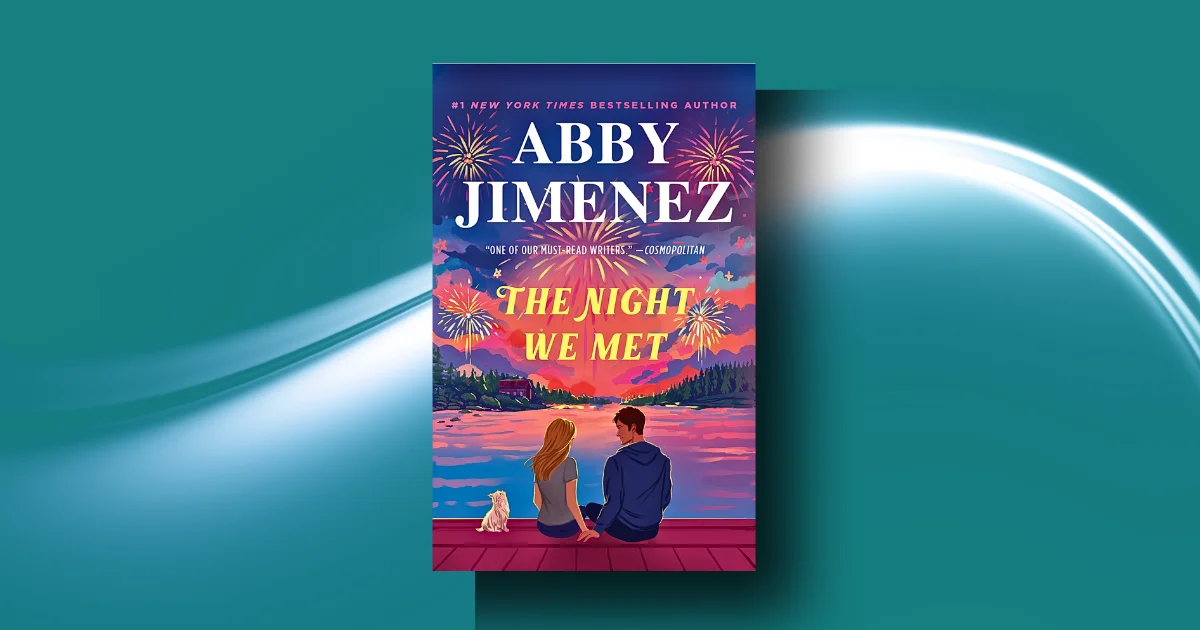

Did you know that the quietest, most loyal person in the room is often the one who actually sees you? And what happens when that person is your boyfriend’s best friend, and he’s been quietly loving you from the sidelines for over a year?
“The Night We Met” is a slow-burn, heart-wrenching romance about the quiet devastation of choosing wrong and the redemptive, soul-deep love that emerges when you finally stop settling for less than you deserve.
The Night We Met is best for readers who crave emotional, slow-burn romances with deep psychological realism—fans of Colleen Hoover’s It Ends with Us, Emily Henry’s Book Lovers, and Carley Fortune’s Every Summer After will find themselves at home.
Those who love “boyfriend’s best friend” tropes, acts of service as a love language, and deeply flawed, relatable heroines grinding through financial precarity will devour this.
Not for: Anyone looking for a light, breezy rom-com. Readers who prefer their conflict external or neatly resolved with a tidy, bow-on-top ending will likely struggle.
The Night We Me tackles heavy themes including alcoholism, parental death, financial ruin, identity theft, and near-fatal allergic reactions. If you can’t handle a morally complex love story where the male lead pines silently for his best friend’s girlfriend for almost a year, steer clear.
Table of Contents
1. Introduction
Title: The Night We Met
Author: Abby Jimenez
Publication Date: March 24, 2026
Publisher: Forever (Grand Central Publishing)
Pages: Approximately 330
Series: Say You’ll Remember Me #2 (can be read as a standalone)
Abby Jimenez, a #1 New York Times bestselling author and a Cupcake Wars champion, has built a devoted following by writing romance novels that are as emotionally devastating as they are laugh-out-loud funny.
Her books have sold over 1.5 million copies and been translated into twenty-eight languages.
With The Night We Met, she delivers perhaps her most nuanced and gut-wrenching story to date: a slow-burn, impossible love story about a woman who chose the wrong man the night she met her soulmate—and the quiet pharmacist who spends the next year loving her from the shadows.
2. Background
Jimenez first introduced readers to this friend group in her 2025 novel Say You’ll Remember Me, which followed Xavier (a veterinarian) and Samantha.
The seed for The Night We Met was planted in the bonus epilogue of a special edition of that book, where readers got a glimpse of Chris and Larissa’s first meeting. “The characters have met before, but it didn’t go the way it should have. Choices were made. The wrong choices,” Jimenez told Cosmopolitan.
Jimenez has stated that this story had been “rolling around in [her] brain since The Happy Ever After Playlist,” and that she knew it would be her most challenging novel to write. Originally planned as her seventh book, she swapped publication order with Xavier’s story to give herself an extra year to wrestle with the complex moral terrain of a man falling for his best friend’s girlfriend.
The result is a novel that took over two years to complete and which Jimenez describes as “more angsty… a little more pining than usual.”
3. The Night We Met Summary
Part One: The Wrong Choice
The novel opens at 5:15 a.m. with Chris Wright, a thirty-year-old retail pharmacist, being dragged out of bed by a hungover phone call from his best friend, Mike Maddox. Mike was supposed to drive his new girlfriend Larissa Soto and her mother to the hospital for a wrist surgery, but he “hit it too hard last night” and is still drunk[reference:1]. Chris reluctantly agrees to fill in.
When Chris arrives at Larissa’s crumbling apartment complex—the Windsor Castle Apartments, a place so dilapidated it has bars on the windows and a stained mattress on the curb—he finds Larissa in a gray hoodie, no makeup, with bloodshot blue eyes. She’s beautiful, but she looks like she’s been crying.
The drive to the hospital is awkward. Larissa’s mother Nancy chain-smokes and interrogates Chris about his love life. Larissa is mortified. After dropping Nancy off for surgery, Larissa insists she’s fine and tells Chris he can leave. But Nancy has left her bag in the trunk. Chris parks and goes inside.
He finds Larissa alone in the surgical waiting room, curled into a ball, weeping.
“She’d been crying most of last night and part of this morning. Dad had used my Social Security number to open credit cards in my name. I found out because they’d garnished the tax return I’d been waiting on to fix my car.”
This is the first of many devastating revelations about Larissa Soto. She’s twenty-seven years old, a high school dropout, working as a waitress at Donna’s Cafe, and buried under $30,000 of fraudulent debt incurred by her alcoholic, gambling-addicted father. She donates plasma twice a week for $120, babysits, does delivery orders, pet-sits, and makes snackle boxes—all while supporting her unemployed mother through recovery.
Chris doesn’t leave. He takes her across the street to a bakery, calls ahead to verify the menu is nut-free (she has a severe anaphylactic allergy to both peanuts and tree nuts), and sits with her while they rate five different loaves of bread. It’s a scene so tender and absurd—they debate the merits of pumpernickel while she doodles flowers on a napkin—that it forges an instant, unspoken bond.
“What makes The Night We Met sing is that it earns every ounce of its tension. This is not manufactured angst. The obstacle between Chris and Larissa is not a misunderstanding or a villain; it is loyalty, and decency, and a man Chris loves like a brother.”
Part Two: The Unraveling
Over the next ten months, Larissa dates Mike. And Chris—Mike’s quiet, bookish, devastatingly thoughtful best friend—becomes a fixture in her life.
They discover they’ve both read the same obscure 1986 sci-fi novel, Cross Stitch, and bond over it. When Chris finds a stray, filthy, homicidal Yorkie outside the hospital, Larissa volunteers to help house-train him. They name him Woofarine, and the dog becomes the thread that keeps them in each other’s orbits.
But the cracks in Mike’s facade begin to show. He constantly “forgets” to check menus for nuts. He lies about having migraines when he’s actually hungover.
At a cabin trip, Chris discovers that Mike has been drinking heavily—and that he’s been hiding it from Larissa. Chris throws away the nuts in the pantry, buys his own EpiPen out of pocket ($700), and quietly cleans snow off Larissa’s car at four in the morning, never taking credit.
Meanwhile, Larissa’s situation deteriorates. Her mom moves her alcoholic boyfriend Phil into their apartment. Larissa is forced to live with him, hating every second. When Mike’s mother, Donna, adds nuts to the cafe menu, Larissa is effectively forced to quit her job. Desperate and homeless, Larissa moves in with Mike—only to discover him passed out on the floor of the hallway, sleeping in his own vomit, shit-faced drunk.
She tries to wake him. He’s unconscious. He’s also urinated on the carpet.
“I had never been so unattracted to someone as I was in this moment. Not because he had an accident, but because he let himself get like that.”
Part Three: The Breaking Point
Christmas at the cabin. Larissa breaks up with Mike. He doesn’t take it well. He gets blackout drunk, eats the macaron cookies (made with almond flour) that he bought her as a gift, then corners her in the kitchen and kisses her against her will. Within seconds, Larissa’s lips tingle. Hives erupt on her chest. She starts to wheeze.
Chris, watching from across the room, realizes what’s happening. He grabs his own EpiPen—the one he bought months ago, just in case—and administers the injection. Then, for the first time in his life, he punches his best friend in the face.
“I always told myself that I could never touch her. That it would do something to me that I couldn’t undo. It did.”
Chris drives Larissa home. On the way, she discovers that the EpiPen he used was his own. He admits everything: he made Mike pay for her car repairs, he suggested the jewelry box for her birthday, he bought her Christmas present when Mike bought the lethal cookies, he cleans her car, he checks menus, he carries an EpiPen because “the worst possible thing that could ever happen to me is something bad happening to you.”
“I would do anything for you. If I had a nut allergy, I’d taste your food to make sure it’s safe and if it wasn’t and I died, I’d die happy because I died protecting you.”
Larissa whispers: “I would have been happier with you.”
Part Four: The Aftermath
Larissa moves into Chris’s house. They co-parent Woofarine, cook together, read together, and slowly, painfully, fall into each other. But the guilt is suffocating. Mike is spiraling. Chris’s friends—Jesse, Xavier, even Mike’s family—think it’s inappropriate for Larissa to be living with him.
After weeks of tortured proximity, Larissa finally says it: “Chris, I love you. If you want to pretend for Mike’s sake that this isn’t happening, then I’ll pretend with you. But I want you to know the truth. And the truth is I’m in love with you.”
Chris kisses her. “Then let it all burn.”
Part Five: The Resolution
Six months later, Mike has gotten sober, moved out of his mother’s house, and started therapy. He shows up at Chris’s pharmacy—not to cause a scene, but to pick up his antidepressants and to tell Chris he’s not angry.
“I knew it was you who cleared the snow off her car. I knew if I didn’t do it, you would. I let you do it. I didn’t do the work. I know you guys are together. I’ve known you my whole life. I’m not even mad. I always knew you were better for her.”
He hugs Chris. He tells him that Larissa isn’t the great love of his life—Chris is. And he walks away.
The novel ends not with a grand wedding or a dramatic reconciliation, but with something quieter and more honest: Chris and Larissa at a pumpkin patch petting zoo, holding hands in a corn maze, their dog at their feet. They’re no longer hiding. They’re no longer apologizing.
They’re simply together.
“I never did give you my two truths and a lie,” Chris says. “I’m not a pharmacist. This is the kind of love that wars start over. But it will leave the world better than it found it.”
“It already has,” Larissa replies.
4. The Night We Met Analysis
4.1 The Night We Met Characters
Chris Wright (30, pharmacist) is the quiet heart of the novel. He’s not charismatic or loud; he’s the guy in the background, the one who shows up at 5:15 a.m. to drive a stranger to the hospital because his best friend is hungover.
His love language is acts of service: he buys an EpiPen, he cleans snow off her car, he checks restaurant menus, he carries Benadryl in his fanny pack. His character arc is about learning that you can’t save someone who doesn’t want to be saved—and that loving someone sometimes means letting them fall.
Larissa Soto (27) is one of Jimenez’s most fully realized heroines. She’s not a damsel in distress; she’s a survivor. She’s been working since she was sixteen, supporting her mother, paying off her father’s fraudulent debt, and living in perpetual survival mode. Her arc is about learning to accept help—and learning that wanting to be taken care of doesn’t make you weak.
Mike Maddox is the novel’s most tragic figure. He’s charming, handsome, and deeply insecure. His drinking is a symptom of his untreated anxiety and depression, and his arc—off-page—is about hitting rock bottom and choosing to get better. Jimenez refuses to villainize him. He’s not a bad person; he’s a broken one.
Woofarine is the chaotic, homicidal rescue Yorkie who serves as the novel’s emotional anchor. He kills snakes, frogs, mice, and once drags a possum through the back door. He also sleeps on Larissa’s lap and smells like tangerines when she brings him home.
4.2 The Night We Met Themes and Symbolism
The Door You Know vs. The Door You Don’t. Larissa articulates the novel’s central metaphor: “Most people go their whole life escaping out the door they know. They’ll run right into the danger they’re trying to get out of, just because it’s familiar.” Every major character is trapped in a cycle of familiar dysfunction—until they choose a different door.
Acts of Service as Love. Chris never says “I love you” until the very end. Instead, he shows it. He checks her EpiPen. He calls restaurants. He buys her a wholesale club membership. He shovels her car. The novel argues that love isn’t a feeling; it’s a verb.
Survival Mode vs. Safety. Larissa has been in survival mode for so long that she doesn’t know how to relax. Living with Chris—who handles the mental load of her safety without being asked—is the first time her body feels safe. “You’re out of survival mode,” Lexi tells her. “The caveman lizard brain has turned off.”
The Cross Stitch Quote. The novel’s epigraph is from the fictional book Cross Stitch by J.C. Vale: “Maybe this isn’t the kind of love that deserves to exist. Maybe it’s the kind that wars start over.
The kind that topples empires and never leaves the world better than it found it.” Chris and Larissa’s love does topple empires—it destroys a friendship, alienates a community, and hurts someone they both care about. But in the end, it leaves the world better.
5. Evaluation
5.1 Strengths
The dual point-of-view is masterfully handled. Chris’s chapters are restrained, aching, almost clinical in their precision—you can feel him holding himself back on every page. Larissa’s chapters are sharper, funnier, and more chaotic, reflecting her relentless hustle.
Jimenez’s dialogue is extraordinarily natural. The banter between Larissa and Lexi about dirty refrigerator doors and sugar daddies feels like something you’d overhear in a real women’s restroom. The bread-rating scene is an instant classic.
The novel’s treatment of poverty is refreshingly unsentimental. Larissa donates plasma, does secret shops, makes snackle boxes, and still can’t get ahead. Jimenez doesn’t romanticize her struggle; she simply shows it.
5.2 Weaknesses
The pacing in the middle third sags slightly. The endless cycle of Mike letting Larissa down and Chris picking up the pieces becomes repetitive before the climactic cabin scene.
Some readers may find the ending too open-ended. There’s no grand reconciliation with Mike, no public declaration of Chris and Larissa’s relationship. Jimenez chooses ambiguity over catharsis, which is thematically consistent but may frustrate readers who want a tidy resolution.
5.3 Impact
The Night We Me wrecked me. I read it in one sitting, staying up until 3:00 a.m., and then lay in the dark thinking about it for another hour. It’s the kind of romance that makes you reassess your own relationships—not because it’s didactic, but because it’s so achingly real.
5.4 Comparison with Similar Works
The Night We Met occupies the same emotional territory as Colleen Hoover’s It Ends with Us (exploring cycles of dysfunction and the courage to leave) and Emily Henry’s Book Lovers (slow-burn, bookish, dialogue-driven).
It also echoes Carley Fortune’s Every Summer After in its use of dual timelines and a central “wrong choice” that haunts the narrative.
6. Personal Insight with Contemporary Educational Relevance
One of the novel’s most quietly devastating subplots is Larissa’s lifelong struggle with financial precarity. She works seven jobs, donates plasma, and still can’t afford a wholesale club membership.
Her father stole her identity and opened credit cards in her name, leaving her with $30,000 in fraudulent debt. She can’t rent an apartment because her credit is ruined. She can’t afford to fix her car. She lives in survival mode, every single day.
This is not fiction for millions of Americans.
According to the Federal Trade Commission, identity theft affected over 1.4 million people in 2023, with credit card fraud being the most common form. The financial fallout can take years to resolve—if it ever is. Larissa’s experience is a stark, unflinching portrait of how poverty is not a moral failing but a structural trap.
The novel’s most radical argument is that safety—feeling safe enough to nap on the couch, to let someone else drive, to stop hustling for one single day—is a privilege. Chris doesn’t rescue Larissa; he gives her the conditions under which she can rescue herself. And that, perhaps, is the most romantic thing of all.
For readers interested in the real-world impact of identity theft and financial fraud, the FTC’s IdentityTheft.gov provides free recovery resources. The novel also implicitly advocates for mental health care: Mike’s recovery begins only when he starts therapy and takes his antidepressants seriously.
7. The Night We Met Quotes
“Maybe this isn’t the kind of love that deserves to exist. Maybe it’s the kind that wars start over. The kind that topples empires and never leaves the world better than it found it.”
“Life buries us. We get heavier and heavier as time goes on and we labor under the layers we’ve collected. Sometimes the layers make us who we are, and sometimes they make us someone else entirely.”
“You are my reason, you know that? For everything. For existing. For waiting forever, for not waiting at all.”
“I would do anything for you. If I had a nut allergy, I’d taste your food to make sure it’s safe and if it wasn’t and I died, I’d die happy because I died protecting you.”
“I would have been happier with you.”
“Then let it all burn.”
“But that’s life when you go through a different door than the one you know. You end up somewhere new.”
“Most people go their whole life like that, escaping out the door they know. I ask myself if I’m doing something because it’s what I’m used to, or if I’m doing it because it’s objectively the best thing to do.”
8. Conclusion
The Night We Met is not a comfortable read. It’s messy, morally complex, and at times almost unbearably sad. But it’s also funny, tender, and deeply hopeful. Jimenez has written a love story about the quiet heroism of showing up—and the radical courage of choosing a different door.
Recommended for: Fans of Colleen Hoover, Emily Henry, Carley Fortune, and anyone who believes that the best love stories are the ones that earn every single page.