

Last updated on November 3rd, 2026 at 03:15 pm
Gone with the Wind 1939 (1939) is a superbly made studio epic and a one-sided, comforting picture of the slaveholding South. Both things are true at once, and the film is hard to judge without holding both in mind. It reaches digital and 4K UHD Blu-ray today, November 3, 2026, so this is a good moment to ask whether its 3 hours and 42 minutes still earn your evening.
My answer is yes, as long as you watch it knowing what it leaves out. I have watched it many times and read Margaret Mitchell’s novel. I have not yet seen the new 4K transfer, so I will not grade the picture quality here.
Gone with the Wind 1939 at a glance
Quick verdict: A dazzling, flawed, historically slanted epic with one of cinema’s great heroines. Watch it for the craft and Vivien Leigh, and read the history alongside it.
Rating: 4/5
What it is about: Scarlett O’Hara, a selfish and stubborn Georgia planter’s daughter, fights to save her family home through the Civil War and Reconstruction while chasing the wrong man and losing the right one.
Biggest strengths: Leigh’s performance, Hattie McDaniel’s Mammy, Technicolor design, and an ending that refuses to be tidy.
Biggest weakness: It treats slavery as a gentle backdrop. Black viewers and critics said so in 1939, and they were right.
Box office: By Guinness World Records’ inflation-adjusted count, it is still the highest-grossing film ever, though estimates vary widely.
Who should watch it: Film students, anyone who loves classic Hollywood, and readers of the novel will get the most from it. Viewers who want a historically honest Civil War story, or who dislike slow, long melodrama, may bounce off it. If you watch, pair it with a good history of Reconstruction or a scholar’s commentary.
What is Gone with the Wind 1939, and who made it?
It is a 1939 American epic romance based on Margaret Mitchell’s 1936 novel, produced by David O. Selznick and credited to director Victor Fleming. It premiered in Atlanta on December 15, 1939. The cast includes Vivien Leigh as Scarlett, Clark Gable as Rhett Butler, Leslie Howard as Ashley Wilkes, Olivia de Havilland as Melanie Hamilton and Hattie McDaniel as Mammy.
Fleming’s name is on the film, but he was not the only director. Three directors shot footage, and Selznick shaped almost everything. The film was also made the first National Film Registry list in 1989.
How did a 1936 bestseller become the biggest film of its day?
It had a huge audience waiting. Mitchell’s novel sold two million copies by 1939. It won the Pulitzer in 1937, and Selznick paid a record $50,000 for the film rights.
Then he turned the casting into a publicity event. His publicity director ran a nationwide “search for Scarlett”. The part went to Vivien Leigh, an English actress.
Production was chaotic. George Cukor was fired about nineteen days into shooting, and Selznick pulled Fleming off The Wizard of Oz to replace him. Fleming later took time off for exhaustion, and Sam Wood stepped in. One account counts 18 shooting days for Cukor, 93 for Fleming and 24 for Wood.
By one count, fifteen writers touched the script, F. Scott Fitzgerald among them. The total cost, including prints and publicity, reached $4.25 million, more than twice the average for a prestige picture of the time.
Three-strip Technicolor was also a difficult process. Cukor and the first cinematographer, Lee Garmes, were both let go within weeks. Despite all that turmoil, the finished film looks remarkably unified.
What happens in Gone with the Wind 1939?
Here is the story as I would retell it after watching. I rebuilt this plot from the film itself and cross-checked it against TCM’s synopsis and Filmsite’s scene breakdown.
Part One: Tara, Twelve Oaks and a rash marriage
On the eve of the Civil War in 1861, Scarlett O’Hara holds court on the porch of Tara, her father Gerald’s cotton plantation in Georgia. The Tarleton twins fuss over her, but she only wants Ashley Wilkes of the neighboring Twelve Oaks estate. They tell her Ashley will announce his engagement to his cousin Melanie Hamilton at a barbecue the next day.
At the barbecue, Scarlett corners Ashley in the library and confesses her love. He gently refuses, saying he and Melanie belong together because they understand each other. Scarlett slaps him. A stranger on the sofa has overheard everything. He is Rhett Butler, a notorious Charleston man who openly admits he is no gentleman. Then news arrives that war has begun, and the men rush off to enlist.
Hurt and furious, Scarlett accepts a proposal from Charles Hamilton, Melanie’s mild brother, and marries him before he leaves. She does it partly to hurt Ashley. Charles dies of disease in an army camp, and Scarlett is a widow with a baby son.
Part Two: Atlanta, the bazaar and the burning city
Bored and stifled by mourning, Scarlett goes to Atlanta to stay with Melanie and her aunt. At a wartime charity bazaar, Rhett, now a blockade runner, bids to dance with her. She is in widow’s black, and she dances anyway, shocking the local matrons.
The war turns. Casualty lists from Gettysburg crowd the streets, and Scarlett nurses wounded soldiers. When Union troops close in on Atlanta, Melanie goes into labor and gives birth to her son, Beau. Scarlett, who has promised Ashley she will look after Melanie, is stuck in the city with a terrified maid, Prissy, and no doctor.

Rhett finds a horse and wagon and drives them through the burning depot and out of town. Then he abandons them on a dark road, saying he must join the Confederate army, and kisses Scarlett goodbye. She is left to find her own way home.
Part Three: Hunger and the vow
At Tara, Scarlett finds her mother, Ellen, dead of typhoid and her father’s mind broken by grief. The Yankees have stripped the farm. Scarlett digs for something to eat in the ruined fields, chokes down a raw radish and collapses. Then she gets to her feet and makes the film’s most famous promise: “As God is my witness, I’ll never be hungry again.” AFI ranks it among the best movie quotes ever spoken.
The intermission usually falls right here, and the film has never needed a cliffhanger more than this one.
Part Four: Reconstruction and the price of Tara
After the war, a Union deserter breaks into Tara, and Scarlett shoots him dead. The family barely scrapes by until a carpetbagger overseer, Jonas Wilkerson, arrives. He wants Tara and has made sure the taxes on it jump to $300. Ashley returns from the war, defeated and useless. Scarlett begs him to run away with her, and he refuses because he will not abandon Melanie and Beau.
Scarlett makes herself a dress from Tara’s old curtains and visits Rhett in a Union jail to beg for the money. He cannot help her because he is under arrest and his money is held abroad. She leaves furious, runs into Frank Kennedy, an older storekeeper engaged to her sister Suellen, and lies that Suellen has married someone else. Frank marries her and Scarlett pays the tax. She then takes over his store and a lumber mill, hires convict labor over Ashley’s objections, and gets rich.
One day, while driving alone near a shantytown, Scarlett is attacked. Frank, Ashley and other men raid the shantytown that night, and Frank is killed. Rhett saves Ashley by claiming they had all been at Belle Watling’s.
Soon after Frank’s funeral, Rhett proposes. Scarlett says yes, partly for his money.
Part Five: Marriage to Rhett, the loss of Bonnie and the ending
Rhett and Scarlett have a daughter, Bonnie Blue Butler, whom Rhett adores. Scarlett, upset about her figure and still pining for Ashley, tells Rhett they will have no more children and no longer share a bed. After a nasty argument at Ashley’s birthday party, Rhett comes home drunk and carries her upstairs. She wakes the next morning smiling, then sees that he has gone to London with Bonnie.
When he returns, Scarlett tells him she is pregnant. He sneers at her, she swings at him and falls down the stairs, and she loses the baby.
While she recovers, Rhett tries to make peace, but Bonnie, who is fearless like her grandfather Gerald, dies jumping a fence on her pony. Rhett nearly loses his mind with grief.
Melanie, who has been warned against another pregnancy, collapses and dies. On her deathbed she asks Scarlett to look after Ashley and Beau and to be kind to Rhett. Scarlett finally understands that she has never loved Ashley, only a dream of him, and that she loves Rhett.
She runs home, but Rhett is packing. He says that with Bonnie’s death went any chance for them. When she begs, he answers with the line that made film history: “Frankly, my dear, I don’t give a damn.”
He walks into the fog. Scarlett, alone, thinks of Tara and tells herself she will find a way to win him back, because “tomorrow is another day.” The film ends there, with no promise she will succeed.
Is Gone with the Wind 1939 a great film or just a famous one?
Great and flawed, in my view, and the flaws matter. Its achievements are real. The staging is enormous, the color design is deliberate, and the pacing of its long running time is surprisingly confident. Frank Nugent of the New York Times wrote that he could not get over the shock of not being disappointed, which is about as good a review as an epic can hope for after that much hype.
The craft goes beyond spectacle. William Cameron Menzies, who worked on the film’s visual design, received an honorary Oscar for using color to enhance dramatic mood. The burning of Atlanta, the long crane shot over the wounded at the railway depot, and the red sky behind Scarlett’s vow are among the best shots of the era.
Where it falls short is moral and historical. The film sentimentalizes the antebellum South and treats slavery as a background condition rather than a system. I will return to that, because it is the part of this film I cannot honestly skip.
Who gives the best performance in Gone with the Wind?
Vivien Leigh does, and it is not close. Nugent wrote that any other actress in the role would be inconceivable. I agree. Her Scarlett is vain, scheming, selfish and magnetic. She shifts from flirt to survivor to widow to tycoon, and she makes each Scarlett believable.
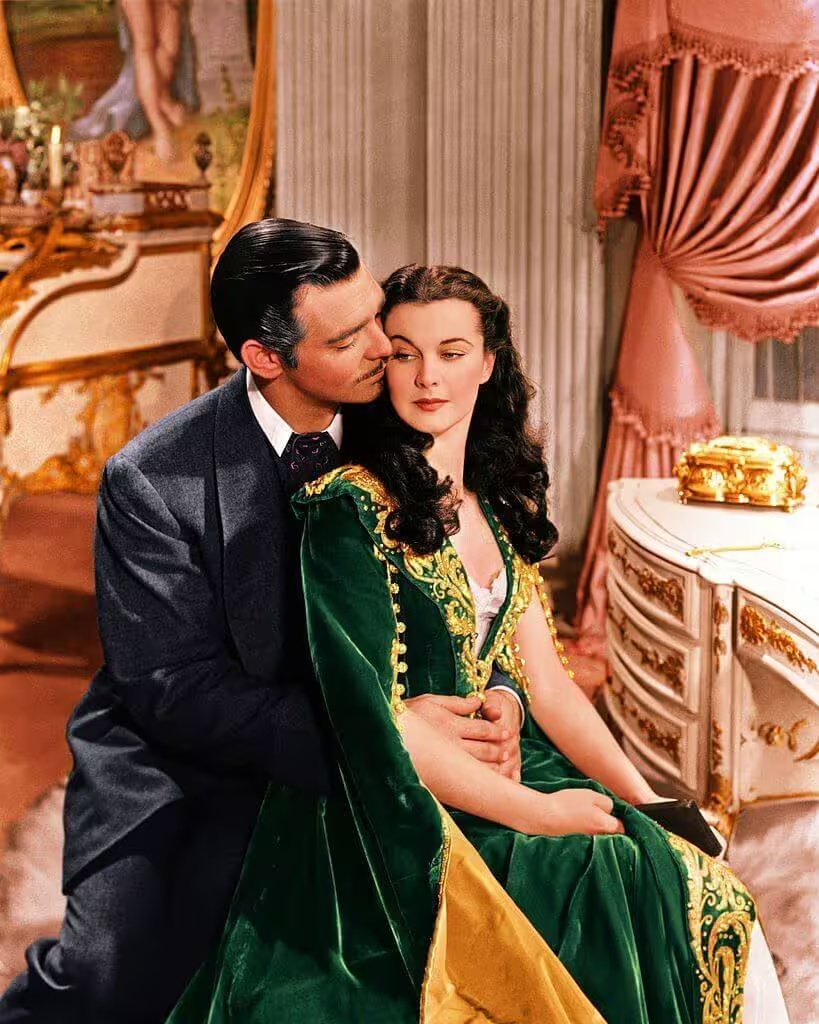
Clark Gable is a good Rhett Butler, more because of his ease than any subtlety, and he gets the final scene right. He was nominated for Best Actor but lost to Robert Donat for Goodbye, Mr. Chips.
Hattie McDaniel gives the film’s richest supporting performance. Critics at the time called Mammy the only sensible and likable person in the epic. Nugent himself wrote that, next to Leigh, McDaniel’s Mammy was the best thing in it. She gives Mammy dignity, humor and a sharp tongue, even inside a role built on stereotype.
Olivia de Havilland’s Melanie is easy to underrate. She is quietly strong, and the film needs her goodness to make Scarlett’s selfishness hurt. Leslie Howard looks a little too tired as Ashley. That may be deliberate, because Ashley is meant to be a dream that cannot survive reality.
The film’s chemistry is not romantic so much as combative, and Leigh and Gable spark best when they argue.
What is Gone with the Wind really about?
On the surface, it is about a woman who wants the wrong man. Underneath, it is about survival. Scarlett’s famous vow is really the film’s thesis: she will do anything to avoid poverty again, and the film neither fully condemns nor fully applauds her for it.
A second theme is the death of a way of life, which the film mourns with more feeling than it spends on the people who paid for it. Its opening text calls the old South a world of “cavaliers and cotton fields,” and the narrative treats the war’s end as a loss of civilization rather than of an economic system based on enslaved labor.
That framing is the heart of the so-called Lost Cause view of the Civil War.
A third theme is the cost of loving a fantasy. Ashley is the dream of the old South, gentle and doomed. Rhett is reality, and Scarlett realizes it too late.
Why is Gone with the Wind 1939 so controversial?
The controversy is about what the film leaves out and what it flatters. Even before release, NAACP secretary Walter White wrote to Selznick in 1936 asking him to hire a Black adviser to check for errors. Selznick hired Clarence Muse as a consultant, but Muse quit when his suggestions were ignored.
Selznick did make changes. He said he had “no desire to produce an anti-Negro film”. The film removed the novel’s explicit Ku Klux Klan references and its harshest racial slur, and swapped the novel’s Black attacker for a white man and a Black accomplice. The NAACP’s Crisis magazine said the film eliminated almost all the offensive material, but critic Carlton Moss disagreed. Protesters picketed theaters with signs saying Black people were never docile slaves.
Black newspapers were divided. The Chicago Defender ran a column titled “Has Too Many Insults” in January 1940. And Walter White later said that support for a federal anti-lynching law faded during the film’s craze.
A script found in 2023 deepens the story. Historian David Kimel found a rare copy of the screenplay with harsher slavery scenes that were cut, though what the original script would have meant for the final film is still debated.
The 2020 HBO Max episode
In June 2020, HBO Max pulled the film on June 9 after filmmaker John Ridley argued in the Los Angeles Times that it should be removed. It returned about two weeks later with a four-and-a-half-minute introduction by scholar Jacqueline Stewart and a 57-minute panel.
Stewart said that watching it can be “uncomfortable, even painful,” yet argued the film should stay available in its original form.
The argument continues. In July 2026, reports said a Netflix listing’s description mentioned racism, which set off a fresh round of social-media fights. I could not check the live listing myself, so treat that as a report, not a confirmed fact.
How does it compare with other epics?
Its closest ancestor in tone and politics is The Birth of a Nation (1915). One student paper at Swarthmore reads Gone with the Wind 1939 as a Southern nationalist film in the same tradition, though it stripped out the novel’s worst language. I find that comparison useful but harsh. Selznick softened a lot, yet the film’s central mood is still nostalgia for a vanished plantation world.
The other 1939 landmark with Fleming’s name on it is The Wizard of Oz. Fleming left that production to rescue this one. Both films share rich Technicolor and a heroine who wants to go home. The difference is that Oz ends with Dorothy learning she never needed to leave, while Scarlett learns that home is all she has left.
Compared with the novel, the film is tighter and kinder to its characters. I wrote about Mitchell’s book in my review of the novel, where the history is thicker and the politics are harder to ignore. If you want the full picture of the war and its aftermath, the book gives more, and it gives it more bluntly.
Who is Gone with the Wind for, and how was it received?
It is for patient viewers who like big melodrama, classic Hollywood and morally messy heroines. Casual viewers may find the first half slow, though the second half moves quickly.
On release, the reception was broadly warm. Nugent’s December 20, 1939 review praised its fidelity to the book, and he later placed it tenth on his 1939 best-of list. The NY Daily News critic Kate Cameron wrote that no picture like it had existed.
Over time its standing has shifted. AFI placed it in the top five of its 1998 list of the 100 greatest American films. AFI’s quotes list placed “Frankly, my dear, I don’t give a damn” at number one, “After all, tomorrow is another day!” at 31 and the hunger vow at 59. Those lines survive because the film surrounding them is skilled and unforgettable.
Is it really the highest-grossing film of all time?
By inflation-adjusted numbers, usually yes, though the figures depend on the method. It took $393.4 million worldwide on its original runs. Guinness estimated an inflation-adjusted gross of $3.44 billion in 2014, and about 202 million US tickets sold across its first three theatrical runs. Other lists put the adjusted total as low as $1.6 billion or as high as $4.45 billion, so I would treat any single figure with care.
How many Oscars did Gone with the Wind win?
It won ten: eight competitive and two honorary, from thirteen nominations at the 12th Academy Awards on February 29, 1940. The competitive wins were:
- Best Picture
- Best Director (Victor Fleming)
- Best Actress (Vivien Leigh)
- Best Supporting Actress (Hattie McDaniel)
- Best Art Direction (Lyle Wheeler)
- Best Color Cinematography (Ernest Haller and Ray Rennahan)
- Best Film Editing (Hal C. Kern and James E. Newcom)
- Best Screenplay (Sidney Howard)
The Academy also gave Selznick the Irving G. Thalberg Memorial Award. Max Steiner’s score was nominated but did not win.
McDaniel’s win made her the first Black person to win an Academy Award. But the night was not simple. The ceremony was held at a hotel with a whites-only policy, and she was seated at a small, segregated table against a far wall, away from the Gone with the Wind 1939 table where Selznick, Leigh, Gable and de Havilland sat. Selznick had to petition for her to be allowed in.
Earlier, she and the other Black cast members could not attend the Atlanta premiere, held in a whites-only theater. She asked in 1952 that her Oscar go to Howard University, but after a yearlong investigation in 2011 the statuette was still missing.
What does Gone with the Wind still teach me today?
It teaches me that beautiful storytelling can carry a false history so smoothly that you swallow it without noticing. I say that as someone who loves this film, not as someone lecturing from a distance.
The news around it this autumn makes the point. Today’s 4K release promises restored color and sound, and the same package adds new features on the film’s influence and on Scarlett as a woman ahead of her time. Meanwhile, the argument over a streaming description in July shows that people still cannot agree on how to present this film. I think both sides miss something.
Pretending the film is only a romance ignores real harm, and pretending it is only propaganda ignores why it moved millions of people.
Here are five lessons I take from it, in my own order of importance.
1. Nostalgia is a persuasive editor. The film cuts what the old South would rather forget, and it does so beautifully. Historian Nina Silber has called it a Confederate monument on film instead of stone. When a story makes the past feel gentle, I now ask who is missing from the frame.
2. Survival is not the same as goodness. Scarlett’s drive is thrilling, yet she lies to her sister’s fiancé, uses convict labor and marries for money. The film asks whether admiring her stamina means excusing her methods.
3. Context can sit beside an old film without erasing it. Stewart’s intro and panel showed that you can keep a flawed work available and still speak plainly about it. That is a model I prefer to deletion.
4. Representation inside a biased system is complicated. McDaniel’s Oscar was a breakthrough and a humiliation on the same night. Both facts belong in the story.
5. Love built on fantasy fails. Scarlett spends the film chasing Ashley, a dream. Her recognition of Rhett comes only when it is too late, and I find that more honest than a neat happy ending.
What are the best lines in Gone with the Wind?
I keep these short, as fair-use references, and I give the scene so you can place them.
“As God is my witness, I’ll never be hungry again.” Scarlett, standing in the ruined fields of Tara before the intermission. It is the film’s central promise, and it explains every hard choice that follows.
“Frankly, my dear, I don’t give a damn.” Rhett Butler, leaving Scarlett near the end. Selznick fought for the word “damn” with the censors, who had flagged it under the Hays Code, and the film got a special dispensation.
“After all, tomorrow is another day!” Scarlett, in the last moments. It sounds hopeful, but in context it is closer to stubborn denial, which is exactly what makes her Scarlett.
Pros and cons
| Pros | Cons |
|---|---|
| Vivien Leigh’s Scarlett is one of cinema’s great performances | Presents slavery as a gentle background, not a system |
| Hattie McDaniel gives Mammy real dignity and wit | Reinforces Lost Cause nostalgia for the old South |
| Technicolor design, sets and burning-of-Atlanta sequence still astonish | Runs 3 hours and 42 minutes, and the first half moves slowly |
| An ending that refuses to give Scarlett an easy win | Black characters are often stereotyped and given little inner life |
| Huge cultural and historical importance as a record of Hollywood’s era | Ashley is a thin character, and the central triangle can feel repetitive |
Is Gone with the Wind 1939 worth watching in 4K?
Yes, if you treat it as a great film made by people with serious blind spots. The studio says the new release restores colors, picture quality and audio, and I expect the Technicolor reds and greens to be a real draw. Still, a sharper image will not fix the film’s history, and a better picture is not a reason to skip the context.
My overall impression: the film is a spectacle of survival, vanity and heartbreak, anchored by Leigh’s fierce Scarlett and a last scene that stings. It deserves its place in film history, and it deserves honest criticism too. I recommend it most to cinephiles, students of Hollywood and anyone ready to watch with a critical eye.
Rating: 4/5
Name: Gone with the Wind

Director: Victor Fleming
Date Created: 2026-11-05 21:57
4
Pros
- Vivien Leigh's performance, Hattie McDaniel's Mammy, Technicolor design, an unsentimental ending
Cons
- Romanticized view of slavery, Lost Cause framing, slow first half, stereotyped Black characters







