
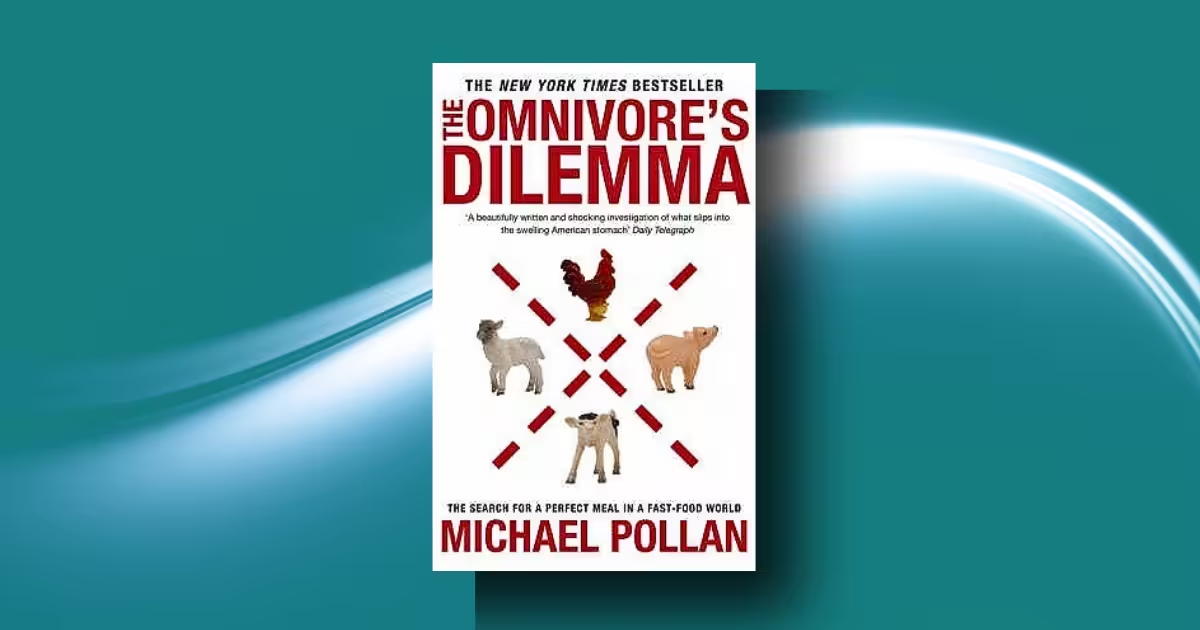
Do you feel paralyzed every time you step into a grocery store, drowning in a sea of “healthy,” “organic,” and “natural” labels that all seem to contradict each other? If so, the Pulitzer Prize-winning journalist Michael Pollan might just have the most vital explanation in The Omnivore’s Dilemma for your anxiety and the clearest path to freedom from the industrial food labyrinth.
The Omnivore’s Dilemma is best for curious eaters, home cooks, environmentalists, public health students, and anyone who has ever felt overwhelmed by conflicting nutritional advice and the sheer variety of choices in the modern supermarket.
This book is essential reading for those who want to understand the true cost of cheap food and are ready to change their eating habits.
Not for readers looking for a strict plant-based manifesto or a quick, bullet-point diet book. Pollan doesn’t hand out a simple set of rules (though he later wrote “Food Rules”). It’s a dense, meticulously researched 400+ page natural history, not a quick-fix meal plan.
Additionally, those who prefer to remain blissfully unaware of where their chicken nuggets or cheeseburgers come from may find the content deeply unsettling.
Table of Contents
1. Introduction
Title: The Omnivore’s Dilemma: A Natural History of Four Meals
Author: Michael Pollan
Publication Details: First published by Penguin Press in 2006.
Genre: Non-fiction, Food Journalism, Environmental Science, Sociology, Natural History.
Author Credentials: Michael Pollan is a professor of journalism at the UC Berkeley Graduate School of Journalism. Before this book, he was the author of Second Nature and The Botany of Desire. He is a contributing writer for The New York Times Magazine. His deep investigative skills and elegant prose have made him one of the most influential voices in the food movement.
Context and Purpose of The Omnivore’s Dilemma
According to the official description from the publisher, The Omnivore’s Dilemma is a “carefully-researched inquiry into the American food system”. The book attempts to answer the seemingly simple question Pollan poses in the very first line: “What should we have for dinner?”.
He argues that because humans are omnivores (able to eat almost anything), we suffer from a deep biological anxiety about food choice that used to be managed by culture but has now been exploited by the modern food industry.
The book’s central thesis is that to figure out what to eat, we must trace the three principal food chains that sustain us—Industrial, Organic, and Hunter-Gatherer—from the soil to the plate.
2. Background
Historically, cultures resolved the “omnivore’s dilemma” through strong traditions, taboos, and elaborate cuisines that told people what was safe and good to eat. Pollan argues that America, as a relatively young nation of immigrants, lacks this single, stable culinary tradition.
Coupled with the post-World War II industrialization of agriculture and the rise of food science, Americans were left vulnerable to marketing, food fads, and a flood of cheap calories derived primarily from one incredible plant: corn.
3. The Omnivore’s Dilemma Summary
Pollan structures the book by following three distinct food chains, turning his investigation into an exciting travelogue and science experiment.
Part I: Industrial Corn (The Industrial Food Chain)
Pollan starts in the most common place: the American supermarket. He discovers that the overwhelming variety of 45,000 items is an illusion. More than a quarter of these items contain corn. He traces a bushel of “Number 2 field corn” from George Naylor’s farm in Iowa to a McDonald’s meal.
Key Revelations in Part I:
The Corn Conquest: Corn, via government subsidies and the chemistry of Fritz Haber (synthetic nitrogen), has colonized the American diet. Pollan writes, “It is not hyperbole to claim… the Haber-Bosch process for fixing nitrogen is the most important invention of the twentieth century… two of every five humans on earth today would not be alive if not for Fritz Haber’s invention.”
The Industrial Cow: To eat the surplus of corn, we force ruminants (cows) to eat grain. This makes them sick (acidosis, bloat), requiring a cocktail of antibiotics to survive. “A great many feedlot cattle—virtually all of them to one degree or another, according to several animal scientists I talked to—are simply sick.”
The Fast Food Meal: Pollan analyzes a McDonald’s meal (cheeseburger, nuggets, soda) through a mass spectrometer. He concludes that the meal is almost entirely corn. He quotes a scientist: “We North Americans look like corn chips with legs.”.
The meal costs $14, but the environmental and health costs (subsidies, pollution, obesity) are incalculable. He states that “of the $19 billion U.S. taxpayers spend each year on payments to farmers, roughly half goes to corn farmers” to keep prices artificially low.
Part II: Pastoral Grass (The Organic Food Chain)
Pollan explores alternatives, splitting them into “Industrial Organic” (Whole Foods) and “Pastoral Organic” (Polyface Farm).
The Industrial Organic Paradox: Pollan visits Earthbound Farm and Cascadian Farm (owned by General Mills). He finds that “industrial organic” solves the pesticide problem but substitutes it with fossil fuel dependency. He notes that it takes “between seven and ten calories of fossil fuel energy to deliver one calorie of food energy to an American plate”.
He discovers that the “free-range” organic chicken, Rosie, lives in a shed with 20,000 other birds and seldom sees the outdoors. He laments that when the USDA defined “organic,” they allowed factory farms, effectively hollowing out the movement’s original ideals.
Polyface Farm (The Solution): In contrast, Joel Salatin’s Polyface Farm in Virginia is a revelation. Salatin calls himself a “grass farmer.” Pollan spends a week there and witnesses a miraculous closed-loop system. He describes the symbiotic relationship: “In nature you’ll always find birds following herbivores… We’re trying to imitate that.”.
He finds that Salatin moves his cattle daily (“mob and move”) and follows them with chickens in an “Eggmobile.” The chickens eat the fly larvae from the cow manure, breaking the parasite cycle and fertilizing the grass.
Pollan concludes that “this is the sort of farm machinery I like: never needs its oil changed, appreciates over time, and when you’re done with it you eat it.”
Part III: Personal (The Forest/The Perfect Meal)
In the final section, Pollan takes the shortest food chain—hunting and gathering. With the help of a Sicilian forager named Angelo Garro, he decides to make a meal entirely from what he can hunt, gather, or grow himself.
The Hunt: Pollan, a novice, grapples with the ethics of killing. He hunts a wild pig in Sonoma. He describes the dissonance: “I felt a rush of adrenaline… The shadowy realm of the pigs had crashed into our brightly lit world.”
He confronts the “omnivore’s dilemma” viscerally, realizing that while our culture has built elaborate rules to manage eating, the act of killing forces us to look at nature without a filter.
The Fungi: He goes mushroom hunting for morels in a forest recently ravaged by fire. He emphasizes the mysterious nature of fungi, noting that mycologists still struggle with basic questions like “Why here and not there? Why now and not then?”
The Perfect Meal: The book culminates with Pollan preparing a “Perfect Meal” for the friends who helped him forage. He serves fava bean toasts, fettuccine with morels, and braised leg of wild pig. He concludes that the meal was perfect not because it was gourmet, but because it was “eaten in full consciousness of everything involved in feeding myself.”
He contrasts this with the McDonald’s meal, stating that his meal “built more [soil]… Instead of diminishing the world, it had added to it.”
4. The Omnivore’s Dilemma Analysis
The Omnivore’s Dilemma is a masterful and essential wake-up call. It is one of the most important nonfiction books of the 21st century. Pollan achieves a rare balance: he is a rigorous journalist who doesn’t shy away from the horrors of the CAFO, yet he writes with the poetic soul of a naturalist.
Evaluation: Pollan effectively supports his arguments with overwhelming evidence. He doesn’t just tell us about the feedlot; he buys a steer and visits it. He doesn’t just tell us about organic fraud; he visits the factory chicken house.
The use of the carbon isotope test to prove we are “corn chips with legs” is a brilliant piece of investigative journalism that makes the science stick.
Fulfillment of Purpose: The book absolutely fulfills its purpose. It changes the way you see a grocery store. Pollan’s “Personal” section is particularly groundbreaking. He doesn’t just preach; he gets his hands bloody.
By showing us his own struggle with killing a pig, he makes the argument that eating meat can be ethical if done with consciousness and respect. He solves the titular dilemma not by outlawing meat, but by advocating for transparency and reconnecting with the source of our food.
5. Strengths and Weaknesses
Strengths:
Narrative Structure: Turning a dry topic like agriculture into a page-turning adventure (following a bushel of corn, working on a farm) is a major strength.
Clarity: Pollan explains complex scientific concepts (C4 photosynthesis, nitrogen fixation, the rumen) in simple, digestible metaphors.
Balanced Perspective: He doesn’t romanticize the past entirely. He acknowledges that pre-industrial farming was hard labor, and that organic can be a scam. He gives the devil his due regarding industrial efficiency.
Weaknesses (Criticism):
The “Solution” is Niche: The “Perfect Meal” solution (hunting/gathering/grass-farming) is unrealistic for the 300 million people in America. Critics argue it is an “elitist” fantasy that only a journalist with time and resources could pull off.
Outdated Statistics: While much of the logic holds up, the book was published in 2006. Statistics regarding corn subsidies, fast-food consumption, and organic market share have changed drastically. For example, the rise of plant-based meats and vertical farming are not addressed.
Minimal Focus on Psychology: As noted in some scholarly reviews, the book gives little attention to “evolved human psychology and behavior” that drives addiction to sugar and fat beyond basic economics.
6. Comparison with Similar Other Works
Eric Schlosser’s Fast Food Nation (2001): Where Schlosser focuses on the business of fast food (the franchising, the labor abuses, the marketing to children), Pollan focuses on the biology and ecology of the food chain. Fast Food Nation is a call to political action; The Omnivore’s Dilemma is a call to ecological awareness.
Wendell Berry’s The Unsettling of America (1977): Pollan is heavily influenced by Berry’s agrarian philosophy. Berry laid the philosophical groundwork for “eating as an agricultural act,” but Pollan updates it with modern investigative reporting and science.
Jonathan Safran Foer’s Eating Animals (2009): Foer’s book is a more emotional and moralistic argument for vegetarianism/veganism. It focuses almost exclusively on the cruelty and suffering of animals. Pollan, conversely, is less dogmatic and argues that while industrial meat is evil, well-raised meat can be good.
7. Conclusion
The Omnivore’s Dilemma is recommended for general audiences who are ready to look behind the curtain. If you can handle the graphic descriptions of feedlots and slaughterhouses, the reward is a new sense of clarity in a very confusing world.
Final Takeaway: Pollan provides a simple heuristic to navigate the complexity: “Eat food. Not too much. Mostly plants.” However, the book shows that this is harder than it sounds because “food” has been replaced by “edible food-like substances.”
The ultimate lesson is that the health of our bodies is directly tied to the health of the soil. We cannot be healthy if our food is grown in dead soil, fed with petroleum, and processed in a factory.







