
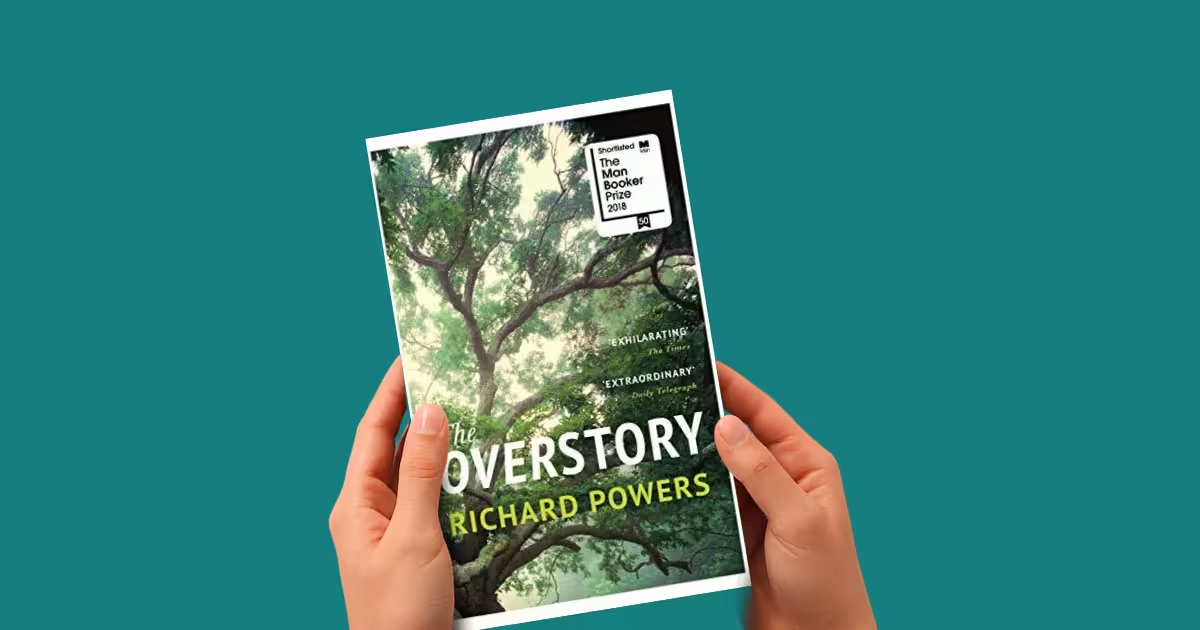
Do we ever stop to consider that the silent, towering giants lining our streets might actually be communicating with each other, holding the very fabric of our survival together? Richard Powers’s masterpiece The Overstory reveals that trees are not merely passive resources but an interconnected, sentient community desperately trying to save humanity from its own ecological blindness.
Best for environmentalists, lovers of complex, multi-narrative literary fiction, and readers who seek profound, paradigm-shifting philosophical insights. It is not for readers seeking fast-paced thrillers or those who prefer linear, single-protagonist storylines with quick resolutions.
Table of Contents
1. Introduction
Title: The Overstory
Author: Richard Powers
Publication Details: Published in 2018 by W. W. Norton & Company. The cover proudly notes the author as a “Winner of the National Book Award”. This sweeping, impassioned work of environmental fiction pushes the boundaries of how we perceive the natural world.
2. Background
The Overstory spans generations and continents, grounding itself in the historical context of humanity’s expansion and its consequent destruction of ancient ecosystems.
It touches upon the 19th-century American pioneer expansion into the Midwest, the devastating chestnut blight of the early 1900s, the turbulent cultural shifts in mid-century China, and the aggressive Timber Wars of the 1990s in the Pacific Northwest.
By weaving these historical threads, the novel exposes how our relentless drive for progress has blinded us to the ancient, slow-moving life forms that sustain our planet.
3. The Overstory Summary
This book is a massive, sprawling epic, and retelling the plot feels like tracing the root system of an ancient forest. The narrative is divided into four structural parts—Roots, Trunk, Crown, and Seeds—mirroring the life cycle of a tree.
Part I: Roots (The Characters)
The story begins by introducing nine disparate characters, each fundamentally shaped by a specific relationship with trees.
Nicholas Hoel is an artist from a long line of midwestern farmers. His ancestor, Jørgen Hoel, a Norwegian immigrant, settled in Iowa and planted six chestnuts in the 1800s. Through brutal winters and devastating blights, only one chestnut tree survives, outlasting generations of the Hoel family.
John Hoel, Jørgen’s son, begins a ritual in 1903 of taking a photograph of the tree on the twenty-first of every month, a tradition passed down through the family. Nicholas inherits this century-long flip-book of a thousand photos.
Tragically, on Christmas Eve, Nicholas is stranded in a snowstorm; when he returns home, he finds his entire family dead from a propane heater gas leak. He is left completely alone with the sentinel tree, the sole survivor of his lineage.
Mimi Ma is the daughter of Winston Ma (formerly Ma Sih Hsuin), an electrical engineer who fled Shanghai in 1948 before the communist takeover. Winston brings with him three ancient jade rings representing the past, present, and future, along with a priceless scroll depicting Luóhàn (arhats) who have achieved enlightenment. In America, Winston plants a mulberry tree—his “silk farm”—in their suburban backyard.
Years later, when the beloved tree succumbs to disease and dies, Winston’s spirit breaks; he commits suicide underneath its dying branches, leaving a translated poem that reads, “An old man, I want only peace”.
Mimi, a brilliant engineer herself, is left to clean up the horrific scene of her father’s death. She inherits the jade ring of the future and the ancient scroll, profoundly altering her life’s trajectory.
Adam Appich is born into a family that plants a specific tree for each child. As a five-year-old, Adam paints trees as identical green puffballs, but he soon realizes that every species has a distinct identity. When his father plants a black walnut tree for his newest baby brother, Charles, Adam fiercely protests because the tree’s root ball is choking in burlap. “Dad, stop! That cloth.
The tree is choking,” he screams, throwing himself into the hole to save it. This early trauma and his intense fascination with the natural world propel Adam to become a psychology student, studying the cognitive biases that prevent human beings from perceiving long-term environmental disasters.
Patricia Westerford is a botanist who learns from her father that trees are communicative beings. She publishes a groundbreaking paper proving that trees share resources and warn each other of danger through their root systems and fungal networks.
The scientific community initially ridicules and blacklists her, driving her to the brink of suicide. Eventually, her work is vindicated, and she becomes a legendary figure in dendrology, establishing a massive seed bank to preserve the world’s vanishing forests.
Neelay Mehta, a Silicon Valley coding prodigy, falls from an oak tree as a child and is paralyzed from the waist down. Confined to a wheelchair, he channels his genius into creating Mastery, a world-building video game empire. As the game evolves, Neelay becomes obsessed with creating an AI simulation that accurately models the complex, interconnected ecosystems of the real world.
Douglas Pavlicek is a Vietnam War veteran whose life is saved when his crashing plane lands in the canopy of a massive banyan tree.
Upon returning to America, he discovers the horrifying extent of clear-cutting in the Pacific Northwest and dedicates his life to replanting seedlings, only to realize his efforts are a mere drop in the bucket compared to the timber industry’s devastation.
Ray Brinkman and Dorothy Cazaly are an unconventional couple. Ray is a conventional intellectual property lawyer, while Dorothy is an unpredictable actress. Their relationship is rocky, but they eventually marry. Their connection to nature is initially peripheral, but a sudden stroke leaves Ray locked-in and paralyzed.
Through Dorothy’s dedicated care and their shared reading of Patricia Westerford’s books, their backyard grows into a wild, untamed ecosystem, symbolizing their internal transformation.
Olivia Vandergriff is a reckless college student who accidentally electrocutes herself. She dies for several minutes before being resuscitated. Upon waking, she begins hearing voices—beings of light, representing the trees—urging her to travel west and stop the destruction of the ancient forests.
Part II: Trunk (The Convergence)
The separate roots of these characters merge into a solid trunk as their lives intersect. Olivia, adopting the forest name “Maidenhair,” drives toward the Pacific Northwest and picks up Nicholas Hoel along the way.
They fall deeply in love and join an Earth First!-style radical environmentalist camp. There, they meet Douglas and Mimi Ma, who has abandoned her corporate engineering career after a brutal police crackdown on a peaceful protest she attended.
The group’s most defining act of resistance is occupying “Mimas,” a giant, ancient redwood slated for clear-cutting. Nick and Olivia live on a small platform hundreds of feet in the air for nearly a year, enduring brutal weather, helicopter harassment, and starvation.
Despite their valiant efforts, the logging company ultimately forces them down, and Mimas is felled, a heartbreaking defeat that shatters the group’s faith in peaceful protest.
Part III: Crown (The Breaking Point)
Driven to despair by the continuous, legal destruction of the old-growth forests, a splinter group comprising Nick, Olivia, Mimi, Douglas, and Adam Appich (who has joined them to study their psychology) resorts to eco-terrorism.
They target the logging industry’s infrastructure, burning down heavy machinery and equipment under the cover of night. Their actions are driven by a desperate, moral imperative to save the planet’s lungs.
However, their crusade ends in a horrific tragedy. While attempting to firebomb a massive logging facility, their homemade explosive detonates prematurely. Olivia is severely burned and dies in the forest, surrounded by the trees she fought so hard to protect. The remaining four bury her secretly and scatter, changing their identities and living with the crushing weight of their actions and her death.
Part IV: Seeds (The Aftermath and Ending)
Decades pass. Adam Appich has become a tenured psychology professor, lecturing on human blindness to the climate crisis. Douglas Pavlicek, living a quiet, isolated life, is finally identified by the authorities.
Seeking to clear his conscience, Douglas confesses, leading to Adam’s arrest midway through a university lecture. Adam accepts a severe prison sentence without betraying Nick or Mimi.
Mimi reinvents herself as a holistic therapist, fully embodying the teachings of the Luóhàn scroll, seeking enlightenment and peace in the present moment. Neelay Mehta steps down from his gaming empire to use his vast artificial intelligence resources to map the Earth’s real-world biomes, hoping technology can help humanity understand the natural network.
Ray Brinkman dies, but not before he and Dorothy find profound spiritual connection in the overgrown wilderness of their own backyard.
Patricia Westerford attends a major environmental conference, where she realizes that humanity has passed the tipping point of no return. In a final, sacrificial act, she drinks a poisonous extract she prepared, choosing to return her body to the earth and feed the forest, a profound statement of unity with the ecosystem.
The ending focuses on Nicholas Hoel. Evading capture, he disappears into the deep wilderness. Using massive fallen logs and the natural landscape, Nick creates a gargantuan piece of bio-art visible only from space or the sky. It spells out the word “STILL.” The ending leaves us with a haunting realization: despite humanity’s brief, destructive noise, the trees and the earth will remain, enduring with profound, silent resilience.
4. The Overstory Analysis
4.1. Characters
The characters in The Overstory are masterfully crafted, serving as human avatars for different ecological and philosophical viewpoints. Nicholas Hoel represents generational memory and the endurance of art.
Mimi Ma embodies the conflict between modern, corporate pragmatism and ancient, ancestral wisdom. Adam Appich is perhaps the most intellectually complex, serving as the bridge between human cognitive flaws and our inability to act on climate change. Olivia’s character borders on the mystical, pushing the boundaries of magical realism; she is the sacrificial heart of the novel.
The brilliance of Powers’s character development lies in how each individual is gradually stripped of their human-centric ego, humbled, and ultimately assimilated into the broader, slower rhythm of the natural world.
4.2. Themes and Symbolism
The novel’s overarching theme is the fatal disconnect between human perception of time and the reality of ecological time. We operate in frantic, short-term bursts, while trees operate in centuries.
The Hoel chestnut tree serves as a potent symbol of resilience and the illusion of human ownership; it outlasts the family that claimed to “plant” it. The jade rings and the Luóhàn scroll Mimi inherits symbolize the continuity of life—past, present, and future—and the eventual realization that human empires are fleeting. Powers continuously emphasizes that humanity’s “root problem” is that life runs alongside us unseen.
The book is a furious, majestic plea for ecological empathy.
5. The Overstory Evaluation
The Overstory is an absolute triumph, an outstanding and poignant literary achievement that fundamentally rewrites the way one looks at a forest.
Strengths: Powers’s prose is lush, poetic, and meticulously researched. The sheer volume of botanical knowledge woven seamlessly into the narrative is staggering. The interconnected structure of the novel brilliantly mimics the underground mycorrhizal networks that connect trees.
Weaknesses: The novel is unashamedly didactic, and its pacing can feel uneven. The “Roots” section is so emotionally absorbing that the transition into the radical activism of the “Trunk” and “Crown” sections can feel jarring and slightly heavily handed.
Impact/Controversy: The book resonates with a deep, existential dread regarding climate change, forcing the reader to question the morality of eco-terrorism when legal avenues fail to protect the planet.
Comparison with Similar Works: It shares thematic DNA with Peter Wohlleben’s The Hidden Life of Trees and Annie Proulx’s Barkskins. Furthermore, as explored in discussions on Schindler’s List, we see that systemic atrocities arise from institutionalized blindness and hatred.
Just as individuals in that film fought against a holocaust of humanity, the characters in The Overstory are fighting against a holocaust of the natural world—a genocide of ancient giants committed out of economic greed and psychological denial.
6. Personal Insight with Contemporary Educational Relevance
The core lesson of The Overstory is profoundly relevant to our modern struggles with sustainability.
The text reveals that “Every piece of earth needs a new way to grip it”. In contemporary society, our disconnection from the natural world directly impacts our physical and psychological survival. As noted, “Food is what makes us what we are.” When the accumulation of our resources determines our survival, it controls human psychology.
5 insightful lessons we must take from the book:
- Ecological Blindness is Systemic: Just as Adam Appich studies cognitive biases, we must recognize that our political and economic systems are psychologically wired to ignore slow-moving disasters like climate change.
- The Illusion of Human Supremacy: We view forests merely as timber or carbon offsets. The book teaches that we are not the masters of the Earth; we are simply a noisy, destructive species living in the understory of an ancient, superior intelligence.
- The Necessity of Radical Empathy: The transition from peaceful protest to radical action in the novel mirrors contemporary climate anxiety. It forces us to ask what level of resistance is justified when the survival of the planet is at stake.
- Heritage and Continuity: Mimi Ma’s journey with her father’s scroll teaches us that ancestral wisdom and the understanding of deep time are essential tools for navigating modern environmental collapse.
- Food and Soil as Psychology: Our psychological well-being is tied to the soil. If we destroy the biomes that feed us, we destroy our own humanity. The stability of our natural resources dictates the fate of our nations.
7. Quotable Lines
- “First there was nothing. Then there was everything.”
- “The tree is saying things, in words before words.”
- “That’s the trouble with people, their root problem. Life runs alongside them, unseen.”
- “Look the color!”
- “An old man, I want only peace. / The things of this world mean nothing.”
- “Make me something beautiful.”
8. Conclusion
The Overstory is not just a novel; it is a profound ecological awakening.
My overall impression is one of awe, coupled with a lingering, urgent sadness for the world we are losing. I highly recommend this book to anyone who has ever felt a sense of peace in a forest, to fans of sweeping historical epics, and to those seeking a philosophical recalibration of their place on Earth.
It is an essential, groundbreaking read that demands we look up, listen, and recognize the quiet, monumental lives running alongside our own.







