


The science of climate change is more robust and widely accepted than many people realize. However, the breadth of the subject, combined with widespread misinformation, often makes it difficult to distinguish between fact and fiction. This article presents not only the most accurate scientific information available but also explains how scientists have arrived at these conclusions, drawing on over a century of physics, decades of satellite data, and geologic records stretching back millions of years.
The Science of Climate Change Explained: At a Glance
Climate change is the long-term alteration of Earth’s climate, and human activities, especially burning fossil fuels, are the primary cause of the current global warming trend. Greenhouse gases such as carbon dioxide, methane, and nitrous oxide trap heat in the atmosphere, increasing global temperatures and disrupting climate systems.
The consequences include rising sea levels, melting glaciers and ice sheets, more frequent and intense heatwaves, changing rainfall patterns, and increasing risks to ecosystems, food, water, and human health.
The scientific evidence comes from multiple independent observations, including temperature records, ocean measurements, ice cores, satellite data, and changes in glaciers and ecosystems. The key message is simple: Earth is warming, human activity is the dominant cause, and reducing greenhouse-gas emissions can limit the severity of future climate change.
Key takeaways:
Earth is warming: Global temperatures have risen significantly since the pre-industrial era.
Human activity is the main driver: Fossil-fuel combustion and land-use changes have increased atmospheric greenhouse gases.
The evidence is extensive: Climate science draws on observations, measurements, historical records, and physical climate models.
The impacts are already visible: Sea levels are rising, glaciers are retreating, and extreme heat is becoming more dangerous.
The future depends on emissions: Faster reductions in greenhouse-gas emissions can substantially reduce future warming and climate risks.
Climate change affects everyone: Its consequences extend beyond temperature to food security, water resources, biodiversity, economies, and human health.
The Science of Climate Change Explained
Table of Contents
How Do We Know Climate Change Is Really Happening?
Climate change is frequently portrayed as a prediction generated by complex computer models. However, the scientific foundation for climate change is much broader, with computer models representing just one piece of a much larger picture.
For over a century, scientists have understood the fundamental physics explaining why greenhouse gases such as carbon dioxide cause warming. These gases constitute only a small fraction of Earth’s atmosphere but have an outsized influence on the planet’s climate by trapping some of the heat that would otherwise escape into space. This greenhouse effect is essential, it is the reason Earth, despite being relatively far from the sun, maintains liquid water and supports life.
Beginning with the Industrial Revolution, humans started burning coal and other fossil fuels to power factories, smelters, and steam engines, adding more greenhouse gases to the atmosphere. Since that time, human activities have been warming the planet.
The evidence supporting this understanding is overwhelming. It starts with temperature measurements taken at weather stations and on ships beginning in the mid-1800s. Later, scientists began tracking surface temperatures using satellites and searching for climate clues within geologic records. Collectively, these data tell a consistent story: Earth is getting hotter.
Average global temperatures have risen by 2.2 degrees Fahrenheit (1.2 degrees Celsius) since 1880, with the most significant changes occurring during the late 20th century. Land areas have warmed more than the sea surface, and the Arctic has experienced the most warming, more than 4 degrees Fahrenheit since the 1960s alone. Temperature extremes have also shifted dramatically; in the United States, daily record highs now outnumber record lows by a ratio of two to one.
This warming is unprecedented in recent geologic history. A well-known illustration, first published in 1998 and often called the hockey-stick graph, shows temperatures remaining relatively flat for centuries (the shaft of the stick) before turning sharply upward (the blade). This graph is based on data from tree rings, ice cores, and other natural indicators. The basic picture, which has withstood decades of scrutiny from both climate scientists and skeptics, shows that Earth is hotter today than it has been in at least 1,000 years, and likely much longer.
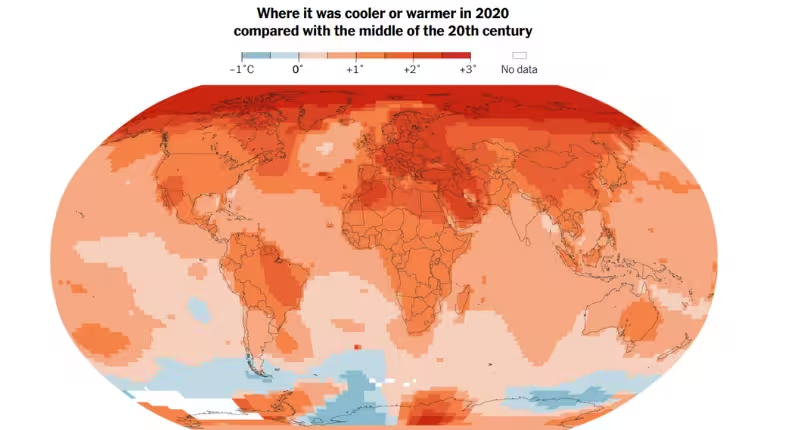
Surface temperatures actually mask the true magnitude of climate change because the ocean has absorbed approximately 90 percent of the heat trapped by greenhouse gases. Measurements collected over the past six decades by oceanographic expeditions and networks of floating instruments show that every layer of the ocean is warming. According to a study, the ocean absorbed as much heat between 1997 and 2015 as it did during the entire previous 130 years.
Scientists also know climate change is occurring because they observe its effects everywhere: ice sheets and glaciers are shrinking while sea levels rise; Arctic sea ice is disappearing; snow melts earlier in spring and plants flower sooner; animals are moving to higher elevations and latitudes to find cooler conditions; and droughts, floods, and wildfires have become more extreme. Models predicted many of these changes, and observations show they are now coming to pass.
How Much Do Scientists Agree About Climate Change?
Scientists are known for their love of debate. However, when it comes to climate change, there is virtually no disagreement: numerous studies have found that more than 90 percent of scientists who study Earth’s climate agree that the planet is warming and that humans are the primary cause. Most major scientific bodies, from NASA to the World Meteorological Organization, endorse this view. This level of consensus is remarkable given the naturally skeptical and competitive nature of science, where questions like what killed the dinosaurs remain bitterly contested.
Scientific agreement about climate change began to emerge in the late 1980s, when the influence of human-caused warming started to become distinguishable from natural climate variability. By 1991, two-thirds of earth and atmospheric scientists surveyed for an early consensus study accepted the idea of anthropogenic global warming.
By 1995, the Intergovernmental Panel on Climate Change, a notably conservative body that periodically assesses the state of scientific knowledge—concluded that “the balance of evidence suggests that there is a discernible human influence on global climate.”
Currently, more than 97 percent of publishing climate scientists agree on the existence and cause of climate change, compared to approximately 60 percent of the general U.S. population.
So where did the idea of ongoing debate come from? Much of it stems from coordinated messaging campaigns by companies and politicians who opposed climate action.
These campaigns promoted the narrative that scientists had not yet made up their minds about climate change, despite its inaccuracy. Frank Luntz, a Republican consultant, explained the strategy in an infamous 2002 memo to conservative lawmakers: “Should the public come to believe that the scientific issues are settled, their views about global warming will change accordingly,” he wrote. Questioning the consensus remains a common talking point today, and the 97 percent figure has become something of a lightning rod.
To bolster the false claim of lingering scientific doubt, some have pointed to initiatives like the Global Warming Petition Project, which urged the U.S. government to reject the 1997 Kyoto Protocol, an early international climate agreement. The petition claimed climate change wasn’t happening, and even if it were, it wouldn’t harm humanity. Since 1998, more than 30,000 people with science degrees have signed it.
However, nearly 90 percent of them studied something other than Earth, atmospheric, or environmental science, and the signatories included only 39 climatologists. Most were engineers, doctors, and others whose training had little to do with the physics of the climate system.
A few well-known researchers remain opposed to the scientific consensus. Some, like Willie Soon, a researcher affiliated with the Harvard-Smithsonian Center for Astrophysics, have ties to the fossil fuel industry.
Others do not, but their assertions have not held up under the weight of evidence. At least one prominent skeptic, physicist Richard Muller, changed his mind after reassessing historical temperature data as part of the Berkeley Earth project.
His team’s findings essentially confirmed the results he had set out to investigate, and he came away firmly convinced that human activities were warming the planet. “Call me a converted skeptic,” he wrote in an op-ed for the Times in 2012. Frank Luntz, the Republican pollster, has also reversed his position on climate change and now advises politicians on how to motivate climate action.
On uncertainty: Denialists often use uncertainty as evidence that climate science isn’t settled. However, in science, uncertainty does not imply a lack of knowledge. Rather, it is a measure of how well something is known. In the case of climate change, scientists have identified a range of possible future changes in temperature, precipitation, and other important variables—which will depend largely on how quickly we reduce emissions. But uncertainty does not undermine their confidence that climate change is real and that humans are causing it.
Do We Really Only Have 150 Years of Climate Data?
Earth’s climate is inherently variable. Some years are hot and others cold; some decades bring more hurricanes than others; some ancient droughts spanned centuries; glacial cycles operate over many millennia. How, then, can scientists look at data collected over a relatively short period and conclude that humans are warming the planet? The answer is that while instrumental temperature data tells us a great deal, it is not all scientists have to work with.
Historical temperature records stretch back to the 1880s (and often earlier), when people began regularly measuring temperatures at weather stations and on ships traversing the world’s oceans. These data show a clear warming trend during the 20th century.
Some have questioned whether these records could be skewed—for example, by the fact that a disproportionate number of weather stations are near cities, which tend to be hotter than surrounding areas due to the urban heat island effect. However, researchers regularly correct for these potential biases when reconstructing global temperatures. In addition, warming is corroborated by independent data like satellite observations, which cover the entire planet, and other methods of measuring temperature changes.
Much has also been made of the small dips and pauses that punctuate the rising temperature trend of the last 150 years. However, these are simply the result of natural climate variability or other human activities that temporarily counteract greenhouse warming. For instance, in the mid-1900s, internal climate dynamics and light-blocking pollution from coal-fired power plants halted global warming for a few decades. Eventually, rising greenhouse gases and pollution-control laws caused the planet to start heating up again.
Likewise, the so-called warming hiatus of the 2000s was partly a result of natural climate variability that allowed more heat to enter the ocean rather than warm the atmosphere. The years since have been the hottest on record.
Still, could the entire 20th century just be one big natural climate fluctuation? To address this question, scientists look at other types of data that provide a longer perspective. Researchers have used geologic records such as tree rings, ice cores, corals, and sediments that preserve information about prehistoric climates to extend the climate record.
The resulting picture of global temperature change is essentially flat for centuries, then turns sharply upward over the last 150 years. This finding has been a target of climate denialists for decades. However, study after study has confirmed the results, which show that the planet hasn’t been this hot in at least 1,000 years, and likely longer.
Sources: NASA Goddard Institute for Space Studies; Intergovernmental Panel on Climate Change (IPCC); Berkeley Earth project; scientific studies on temperature reconstruction using tree rings, ice cores, and other proxies; satellite temperature data.
How Do We Know Climate Change Is Caused by Humans?
Scientists have studied past climate changes to understand the factors that can cause the planet to warm or cool. The major factors include changes in solar energy, ocean circulation, volcanic activity, and the amount of greenhouse gases in the atmosphere. Each has played a role at various times.
For example, 300 years ago, a combination of reduced solar output and increased volcanic activity cooled parts of the planet enough that Londoners regularly ice-skated on the Thames. About 12,000 years ago, major changes in Atlantic circulation plunged the Northern Hemisphere into a frigid state.
Moreover, 56 million years ago, a giant burst of greenhouse gases, from volcanic activity or vast deposits of methane, or both, abruptly warmed the planet by at least 9 degrees Fahrenheit, scrambling the climate, choking the oceans, and triggering mass extinctions.
In determining the cause of current climate changes, scientists have examined all of these factors. The first three have varied somewhat over the last few centuries and have likely had modest effects on climate, particularly before 1950. However, they cannot account for the planet’s rapidly rising temperature, especially in the second half of the 20th century, when solar output actually declined and volcanic eruptions exerted a cooling effect.
Bloomberg article says that warming is best explained by rising greenhouse gas concentrations. Greenhouse gases have a powerful effect on climate, and since the Industrial Revolution, humans have been adding more of them to the atmosphere, primarily by extracting and burning fossil fuels like coal, oil, and gas, which releases carbon dioxide.
Bubbles of ancient air trapped in ice show that before approximately 1750, the concentration of carbon dioxide in the atmosphere was roughly 280 parts per million. It began to rise slowly and crossed the 300 ppm threshold around 1900. CO2 levels then accelerated as cars and electricity became central to modern life, recently topping 420 ppm. The concentration of methane, the second most important greenhouse gas, has more than doubled.
We are now emitting carbon much faster than it was released 56 million years ago.
These rapid increases in greenhouse gases have caused the climate to warm abruptly. Climate models suggest that greenhouse warming can explain virtually all of the temperature change since 1950. According to the most recent report by the Intergovernmental Panel on Climate Change, which assesses published scientific literature, natural drivers and internal climate variability can only explain a small fraction of late-20th century warming.
One study put it this way: The odds of current warming occurring without anthropogenic greenhouse gas emissions are less than 1 in 100,000.
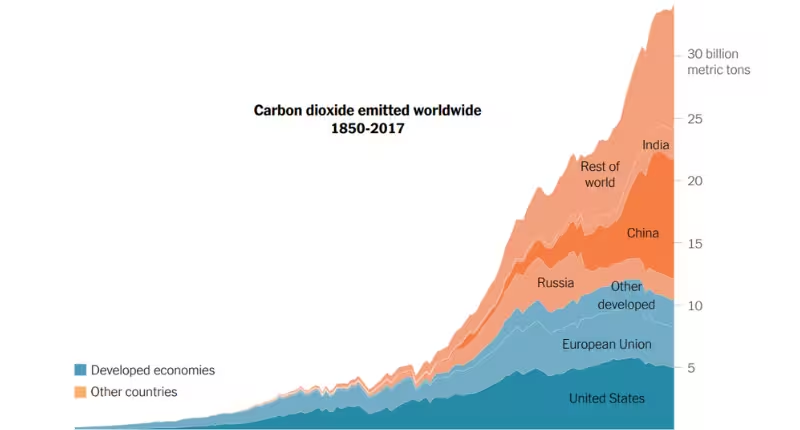
But greenhouse gases are not the only climate-altering compounds people put into the air. Burning fossil fuels also produces particulate pollution that reflects sunlight and cools the planet. Scientists estimate that this pollution has masked up to half of the greenhouse warming we would have otherwise experienced.
If Greenhouse Gases Are Natural, How Do We Know They’re Warming the Planet?
Greenhouse gases like water vapor and carbon dioxide serve an essential role in the climate. Without them, Earth would be far too cold to maintain liquid water, and humans would not exist.
Here’s how the process works: the planet’s temperature is essentially a function of the energy Earth absorbs from the sun (which heats it up) and the energy Earth emits to space as infrared radiation (which cools it down). Because of their molecular structure, greenhouse gases temporarily absorb some of that outgoing infrared radiation and then re-emit it in all directions, sending some of that energy back toward the surface, heating the planet. Scientists have understood this process since the 1850s.
Greenhouse gas concentrations have varied naturally in the past. Over millions of years, atmospheric CO2 levels have changed depending on how much gas volcanoes emitted into the air and how much was removed through geologic processes. Over hundreds to thousands of years, concentrations have changed as carbon cycled between the ocean, soil, and air.
Today, however, humans are the ones causing CO2 levels to increase at an unprecedented pace by taking ancient carbon from geologic deposits of fossil fuels and releasing it into the atmosphere when burned. Since 1750, carbon dioxide concentrations have increased by almost 50 percent. Methane and nitrous oxide, other important anthropogenic greenhouse gases released mainly by agricultural activities, have also spiked over the last 250 years.
Scientists know, based on the physics described above, that this should cause the climate to warm. They also observe certain telltale “fingerprints” of greenhouse warming. For example, nights are warming even faster than days because greenhouse gases don’t go away when the sun sets. And upper layers of the atmosphere have actually cooled because more energy is being trapped by greenhouse gases in the lower atmosphere.
Scientists also know that human activities are the cause of rising greenhouse gas concentrations—and not just because they can measure the CO2 coming out of tailpipes and smokestacks. They can see it in the chemical signature of the carbon in CO2.
Carbon exists in three different masses: 12, 13, and 14. Organic matter (including fossil fuels) tends to have relatively less carbon-13. Volcanoes tend to produce CO2 with relatively more carbon-13. Over the last century, the carbon in atmospheric CO2 has gotten lighter, pointing to an organic source.
Scientists can tell it’s old organic matter by looking for carbon-14, which is radioactive and decays over time. Fossil fuels are too ancient to have any carbon-14 left in them, so if they were behind rising CO2 levels, one would expect the amount of carbon-14 in the atmosphere to drop, which is exactly what the data show.
It’s important to note that water vapor is the most abundant greenhouse gas in the atmosphere. However, it does not cause warming; instead it responds to it. Warmer air holds more moisture, creating a feedback cycle in which human-caused warming allows the atmosphere to hold more water vapor, which further amplifies climate change. This feedback cycle has doubled the warming caused by anthropogenic greenhouse gas emissions.
Sources: Scientific research on greenhouse gas physics; ice core data on CO2 concentrations; studies on the chemical signatures of CO2; research on carbon isotopes and fossil fuel emissions; studies on water vapor feedback.
Why Is a 2°F Rise in Global Temperature Such a Big Deal?
A common source of confusion regarding climate change is the difference between weather and climate. Weather is the constantly changing set of meteorological conditions experienced daily, whereas climate is the long-term average of those conditions, usually calculated over a 30-year period. As some put it: weather is your mood and climate is your personality.
While 2 degrees Fahrenheit does not represent a big change in the weather, it is a huge change in climate. As already discussed, it is enough to melt ice and raise sea levels, shift rainfall patterns around the world, reorganize ecosystems, send animals scurrying toward cooler habitats, and kill trees by the millions.
It’s also important to remember that two degrees represents the global average, and many parts of the world have already warmed more than that. Land areas have warmed about twice as much as the sea surface, and the Arctic has warmed by about 5 degrees. This is because the loss of snow and ice at high latitudes allows the ground to absorb more energy, causing additional heating on top of greenhouse warming.
Relatively small long-term changes in climate averages also shift extremes in significant ways. Heat waves have always happened, but they have shattered records in recent years. In June 2020, a town in Siberia registered temperatures of 100 degrees. In Australia, meteorologists have added a new color to their weather maps to show areas where temperatures exceed 125 degrees. Rising sea levels have also increased the risk of flooding from storm surges and high tides. These are the foreshocks of climate change.
And more changes are coming—up to 9 degrees Fahrenheit of average global warming by the end of the century in the worst-case scenario. For reference, the difference in global average temperatures between now and the peak of the last ice age, when ice sheets covered large parts of North America and Europe, is about 11 degrees Fahrenheit, according to Nature.
Under the Paris Climate Agreement, which President Biden recently rejoined, countries have agreed to try to limit total warming to between 1.5 and 2 degrees Celsius (2.7 and 3.6 degrees Fahrenheit) since preindustrial times. Even this narrow range has huge implications.
According to scientific studies, the difference between 2.7 and 3.6 degrees Fahrenheit will very likely mean the difference between coral reefs hanging on or going extinct, and between summer sea ice persisting in the Arctic or disappearing completely. It will also determine how many millions of people suffer from water scarcity and crop failures, and how many are driven from their homes by rising seas. In other words, one degree Fahrenheit makes a world of difference.
Is Today’s Climate Change Part of Earth’s Natural Cycles?
Earth’s climate has always changed. Hundreds of millions of years ago, the entire planet froze. Fifty million years ago, alligators lived in what we now call the Arctic. For the last 2.6 million years, the planet has cycled between ice ages, when the planet was up to 11 degrees cooler and ice sheets covered much of North America and Europe, and milder interglacial periods like the one we’re in now.
Climate denialists often point to these natural climate changes as a way to cast doubt on the idea that humans are causing climate change today. However, that argument rests on a logical fallacy. It’s like “seeing a murdered body and concluding that people have died of natural causes in the past, so the murder victim must also have died of natural causes,” as a team of social scientists wrote in The Debunking Handbook, which explains the misinformation strategies behind many climate myths.
Different mechanisms caused the climate to change in the past. Glacial cycles, for example, were triggered by periodic variations in Earth’s orbit, which take place over tens of thousands of years and change how solar energy gets distributed around the globe and across the seasons.
These orbital variations do not affect the planet’s temperature much on their own. However, they set off a cascade of other changes in the climate system—for instance, growing or melting vast Northern Hemisphere ice sheets and altering ocean circulation.
These changes, in turn, affect climate by altering the amount of snow and ice, which reflect sunlight, and by changing greenhouse gas concentrations. This is actually part of how scientists know that greenhouse gases have the ability to significantly affect Earth’s temperature.
For at least the last 800,000 years, atmospheric CO2 concentrations oscillated between about 180 parts per million during ice ages and about 280 ppm during warmer periods, as carbon moved between oceans, forests, soils, and the atmosphere.
These changes occurred in lockstep with global temperatures and are a major reason the entire planet warmed and cooled during glacial cycles, not just the frozen poles.
Today, however, CO2 levels have soared to 422.8 ppm, the highest they’ve been in at least three million years. The concentration of CO2 is also increasing about 100 times faster than it did at the end of the last ice age. This suggests something else is going on, and scientists know what it is: since the Industrial Revolution, humans have been burning fossil fuels and releasing greenhouse gases that are heating the planet now.
Over the next century or two, societies and ecosystems will experience the consequences of this climate change. But emissions will have even more lasting geologic impacts.
According to some studies, greenhouse gas levels may have already warmed the planet enough to delay the onset of the next glacial cycle for at least an additional 50,000 years.
Why Aren’t the Sun or Volcanoes Causing Today’s Global Warming?
The sun is the ultimate source of energy in Earth’s climate system, so it is a natural candidate for causing climate change. Solar activity has certainly changed over time. Scientists know from satellite measurements and other astronomical observations that the sun’s output changes on 11-year cycles.
Geologic records and sunspot numbers, which astronomers have tracked for centuries, also show long-term variations in the sun’s activity, including some exceptionally quiet periods in the late 1600s and early 1800s.
From 1900 until the 1950s, solar irradiance increased. Studies suggest that this had a modest effect on early 20th century climate, explaining up to 10 percent of the warming that has occurred since the late 1800s.
However, in the second half of the century, when the most warming occurred, solar activity actually declined. This disparity is one of the main reasons scientists know that the sun is not the driving force behind climate change.
Another reason scientists know that solar activity hasn’t caused recent warming is that, if it had, all the layers of the atmosphere should be heating up. Instead, data show that the upper atmosphere has actually cooled in recent decades, a hallmark of greenhouse warming.
So how about volcanoes? Eruptions cool the planet by injecting ash and aerosol particles into the atmosphere that reflect sunlight. Scientists have observed this effect in the years following large eruptions. There are also notable historical examples, such as when Iceland’s Laki volcano erupted in 1783, causing widespread crop failures in Europe and beyond, and the “year without a summer” that followed the 1815 eruption of Mount Tambora in Indonesia.
Since volcanoes mainly act as climate coolers, they cannot explain recent warming.
However, scientists say they may also have contributed slightly to rising temperatures in the early 20th century. This is because there were several large eruptions in the late 1800s that cooled the planet, followed by a few decades with no major volcanic events when warming caught up. During the second half of the 20th century, though, several big eruptions occurred as the planet was heating up fast. If anything, they temporarily masked some amount of human-caused warming.
The second way volcanoes can impact climate is by emitting carbon dioxide. This is important on timescales of millions of years—it is what keeps the planet habitable. But compared to modern anthropogenic emissions, even big eruptions like Krakatoa and Mount St. Helens are just a drop in the bucket.
They last only a few hours or days, while fossil fuels are burned 24 hours a day, 7 days a week. Studies suggest that today, volcanoes account for 1 to 2 percent of total CO2 emissions.
Why Can Winters Still Get Colder in a Warming World?
When a big snowstorm hits the United States, climate denialists often cite it as proof that climate change isn’t happening. In 2015, Senator James Inhofe, an Oklahoma Republican, famously lobbed a snowball in the Senate as he denounced climate science. But these events do not actually disprove climate change.
While there have been some memorable storms in recent years, winters are actually warming across the world. In the United States, average temperatures in December, January, and February have increased by about 2.5 degrees this century.
On the flip side, record cold days are becoming less common than record warm days. In the United States, record highs now outnumber record lows two-to-one, and ever-smaller areas of the country experience extremely cold winter temperatures. The same trends are happening globally.
So what’s with the blizzards? Weather always varies, so it is no surprise that severe winter storms still occur even as average temperatures rise. However, some studies suggest that climate change may be to blame. One possibility is that rapid Arctic warming has affected atmospheric circulation, including the fast-flowing, high-altitude air that usually swirls over the North Pole (the Polar Vortex).
Some studies suggest that these changes are bringing more frigid temperatures to lower latitudes and causing weather systems to stall, allowing storms to produce more snowfall. This may explain what the U.S. has experienced over the past few decades, as well as a wintertime cooling trend in Siberia, although exactly how the Arctic affects global weather remains a topic of ongoing scientific debate.
Climate change may also explain the apparent paradox behind some other places on Earth that haven’t warmed much. For instance, a patch of water in the North Atlantic has cooled in recent years, and scientists suspect this may be because ocean circulation is slowing due to freshwater streaming off a melting Greenland.
If this circulation slows almost to a halt, as it has done in the geologic past, it would alter weather patterns around the world.
Not all cold weather stems from some counterintuitive consequence of climate change.
But it is a good reminder that Earth’s climate system is complex and chaotic, so the effects of human-caused changes will play out differently in different places. That is why “global warming” is something of an oversimplification. Instead, some scientists have suggested that the phenomenon of human-caused climate change would more aptly be called “global weirding.”
How Is Climate Change Making Extreme Weather Worse?
Extreme weather and natural disasters are part of life on Earth, just ask the dinosaurs. However, there is good evidence that climate change has increased the frequency and severity of certain phenomena like heat waves, droughts, and floods. Recent research has also allowed scientists to identify the influence of climate change on specific events.
Let’s start with heat waves. Studies show that stretches of abnormally high temperatures now happen about five times more often than they would without climate change, and they last longer. Climate models project that by the 2040s, heat waves will be about 12 times more frequent.
This is concerning since extreme heat often causes increased hospitalizations and deaths, particularly among older people and those with underlying health conditions. In the summer of 2003, for example, a heat wave caused an estimated 70,000 excess deaths across Europe, with human-caused warming amplifying the death toll.
Climate change has also exacerbated droughts, primarily by increasing evaporation. Droughts occur naturally due to random climate variability and factors like whether El Niño or La Niña conditions prevail in the tropical Pacific.
But some researchers have found evidence that greenhouse warming has been affecting droughts since even before the Dust Bowl, and it continues to do so today. According to one analysis, the drought that afflicted the American Southwest from 2000 to 2018 was almost 50 percent more severe because of climate change. It was the worst drought the region had experienced in more than 1,000 years.
Rising temperatures have also increased the intensity of heavy precipitation events and the flooding that often follows. For example, studies have found that because warmer air holds more moisture, Hurricane Harvey, which struck Houston in 2017, dropped between 15 and 40 percent more rainfall than it would have without climate change.
It is still unclear whether climate change is changing the overall frequency of hurricanes, but it is making them stronger. Warming appears to favor certain kinds of weather patterns, like the “Midwest Water Hose” events that caused devastating flooding across the Midwest in 2019.
It’s important to remember that in most natural disasters, multiple factors are at play. For instance, the 2019 Midwest floods occurred after a recent cold snap froze the ground solid, preventing soil from absorbing rainwater and increasing runoff into the Missouri and Mississippi Rivers. These waterways have also been reshaped by levees and other forms of river engineering, some of which failed in the floods.
Wildfires are another phenomenon with multiple causes. In many places, fire risk has increased because humans have aggressively fought natural fires and prevented Indigenous peoples from carrying out traditional burning practices.
This has allowed fuel to accumulate, making current fires worse.
However, climate change still plays a major role by heating and drying forests, turning them into tinderboxes. Studies show that warming is the driving factor behind recent increases in wildfires; one analysis found that climate change is responsible for doubling the area burned across the American West between 1984 and 2015. Researchers say that warming will only make fires bigger and more dangerous in the future.
How Severe Will the Effects of Climate Change Become?
The severity of climate change impacts depends on how aggressively society acts to address it. If we continue with business as usual, by the end of the century it will be too hot to go outside during heat waves in the Middle East and South Asia.
Droughts will grip Central America, the Mediterranean, and southern Africa. Many island nations and low-lying areas, from Texas to Bangladesh, will be overtaken by rising seas.
Conversely, climate change could bring welcome warming and extended growing seasons to the upper Midwest, Canada, the Nordic countries, and Russia. Farther north, however, the loss of snow, ice, and permafrost will upend Indigenous traditions and threaten infrastructure.
The situation is complicated, but the underlying message is simple: unchecked climate change will likely exacerbate existing inequalities.
At a national level, poorer countries will be hit hardest, even though they have historically emitted only a fraction of the greenhouse gases causing warming. Many less developed countries tend to be in tropical regions where additional warming will make the climate increasingly intolerable for humans and crops.
These nations also often have greater vulnerabilities, such as large coastal populations and people living in improvised housing easily damaged in storms. They also have fewer resources to adapt, which will require expensive measures like redesigning cities, engineering coastlines, and changing how people grow food.
Already, between 1961 and 2000, climate change appears to have harmed the economies of the poorest countries while boosting the fortunes of the wealthiest nations that have done the most to cause the problem, making the global wealth gap 25 percent larger than it would otherwise have been.
Similarly, the Global Climate Risk Index found that lower-income countries—like Puerto Rico, Myanmar, Haiti, Philippines, Pakistan, Vietnam, Bangladesh, Thailand, Nepal and Dominica—rank high on the list of nations most affected by extreme weather between 1999 and 2018. Climate change has also contributed to increased human migration, which is expected to increase significantly.
Even within wealthy countries, the poor and marginalized will suffer the most. People with more resources have greater buffers, like air conditioners to keep houses cool during dangerous heat waves and the means to pay resulting energy bills.
They also have an easier time evacuating their homes before disasters and recovering afterward. Lower-income people have fewer of these advantages and are also more likely to live in hotter neighborhoods and work outdoors, where they face the brunt of climate change.
These inequalities will play out at individual, community, and regional levels. A 2017 analysis of the U.S. found that under business as usual, the poorest one-third of counties, concentrated in the South, will experience damages totaling as much as 20 percent of gross domestic product, while others, mostly in the northern part of the country, will see modest economic gains.
Solomon Hsiang, an economist at the University of California, Berkeley, and lead author of the study, has said that climate change “may result in the largest transfer of wealth from the poor to the rich in the country’s history.”
Even the climate “winners” will not be immune from all climate impacts. Desirable locations will face an influx of migrants. And as the coronavirus pandemic demonstrated, disasters in one place ripple quickly across the globalized economy. Scientists expect climate change to increase the odds of multiple crop failures occurring at the same time in different places, throwing the world into a food crisis.
On top of that, warmer weather is aiding the spread of infectious diseases and the vectors that transmit them, like ticks and mosquitoes.
Research has also identified troubling correlations between rising temperatures and increased interpersonal violence, and climate change is widely recognized as a “threat multiplier” that increases the odds of larger conflicts within and between countries. In other words, climate change will bring many changes that no amount of money can stop. What could help is taking action to limit warming.
What Will Climate Change Cost, and What Will Action Cost?
One of the most common arguments against taking aggressive action to combat climate change is that doing so will kill jobs and cripple the economy.
But this implies there is an alternative in which we pay nothing for climate change. Unfortunately, there isn’t. Not tackling climate change will cost a great deal and cause enormous human suffering and ecological damage, while transitioning to a greener economy would benefit many people and ecosystems around the world.
Let’s start with how much it will cost to address climate change. To keep warming well below 2 degrees Celsius—the goal of the Paris Climate Agreement—society will have to reach net zero greenhouse gas emissions by the middle of this century. That will require significant investments in things like renewable energy, electric cars and charging infrastructure, not to mention efforts to adapt to hotter temperatures, rising sea levels, and other unavoidable effects of current climate changes. And these changes must happen fast.
Estimates of the cost vary widely. One recent study found that keeping warming to 2 degrees Celsius would require a total investment of between $4 trillion and $60 trillion, with a median estimate of $16 trillion, while keeping warming to 1.5 degrees Celsius could cost between $10 trillion and $100 trillion, with a median estimate of $30 trillion. For reference, the entire world economy was about $88 trillion in 2019.
Other studies have found that reaching net zero will require annual investments ranging from less than 1.5 percent of global gross domestic product to as much as 4 percent. That’s a lot, but within the range of historical energy investments in countries like the U.S.
Now, consider the costs of unchecked climate change, which will fall hardest on the most vulnerable. These include damage to property and infrastructure from sea-level rise and extreme weather; death and sickness linked to natural disasters, pollution, and infectious disease; reduced agricultural yields and lost labor productivity due to rising temperatures; decreased water availability and increased energy costs; and species extinction and habitat destruction. Dr. Hsiang, the U.C. Berkeley economist, describes it as “death by a thousand cuts.”
Climate damages are hard to quantify. Moody’s Analytics estimates that even 2 degrees Celsius of warming will cost the world $69 trillion by 2100, and economists expect the toll to keep rising with temperature. In a recent survey, economists estimated the cost would equal 5 percent of global GDP at 3 degrees Celsius of warming (our trajectory under current policies) and 10 percent for 5 degrees Celsius.
Other research indicates that, if current warming trends continue, global GDP per capita will decrease between 7 percent and 23 percent by the end of the century, an economic blow equivalent to multiple coronavirus pandemics every year.
Some fear these are vast underestimates, as per Londond School of Economics.
Already, studies suggest that climate change has slashed incomes in the poorest countries by as much as 30 percent and reduced global agricultural productivity by 21 percent since 1961. Extreme weather events have also racked up a large bill.
In 2020, in the United States alone, climate-related disasters like hurricanes, droughts, and wildfires caused almost $100 billion in damages to businesses, property, and infrastructure, compared to an average of $18 billion per year in the 1980s.
Given the steep price of inaction, many economists say that addressing climate change is a better deal. It’s like the old saying: an ounce of prevention is worth a pound of cure. Limiting warming will greatly reduce future damage and inequality caused by climate change. It will also produce co-benefits, like saving one million lives every year by reducing air pollution, and millions more from eating healthier, climate-friendly diets. Some studies even find that meeting the Paris Agreement goals could create jobs and increase global GDP.
And, of course, reining in climate change will spare many species and ecosystems upon which humans depend—and which many believe have their own innate value.
The challenge is that emissions must be reduced now to avoid damages later, requiring big investments over the next few decades. The longer action is delayed, the more expensive it will be to meet the Paris goals.
One recent analysis found that reaching net-zero by 2050 would cost the U.S. almost twice as much if we waited until 2030 instead of acting now. But even if the Paris target is missed, the economics still make a strong case for climate action, because every additional degree of warming will cost more—in dollars and in lives.
References and Sources
- https://www.sopranu.com/wind-energy-the-breath-of-the-gods-review/
- https://agupubs.onlinelibrary.wiley.com/doi/full/10.1029/2019GL085378
- https://www.nytimes.com/2020/04/21/obituaries/eunice-foote-overlooked.html
- https://www.nytimes.com/2021/10/26/climate/greenhouse-gas-emissions-un-climate-report.html
- https://agupubs.onlinelibrary.wiley.com/doi/pdfdirect/10.1029/1999GL900070
- Industrial-era global ocean heat uptake doubles in recent decades
- https://iopscience.iop.org/article/10.1088/1748-9326/11/4/048002?platform=hootsuite
- https://science.nasa.gov/climate-change/evidence/
- https://public.wmo.int/en/our-mandate/climate/wmo-statement-state-of-global-climate
- https://empslocal.ex.ac.uk/people/staff/gv219/skeptic.html
- https://www.ncei.noaa.gov/news/study-global-warming-hiatus-attributed-redistribution
- https://www.climate-lab-book.ac.uk/2018/warming-stripes/
- https://www.historic-uk.com/HistoryUK/HistoryofEngland/The-Thames-Frost-Fairs/
- https://www.britannica.com/science/Paleocene-Eocene-Thermal-Maximum
- https://iopscience.iop.org/article/10.1088/1748-9326/ab4557/pdf
- https://www.bloomberg.com/graphics/2015-whats-warming-the-world/
- https://www.nature.com/articles/ngeo2681
- https://www.ipcc.ch/assessment-report/ar5/
- https://www.sciencedirect.com/science/article/pii/S2212096314000163?via%3Dihub
- https://science.nasa.gov/earth/earth-observatory/aerosols/
- https://science.nasa.gov/climate-change/causes/
- https://www.nytimes.com/2020/04/21/obituaries/eunice-foote-overlooked.html
- https://gml.noaa.gov/ccgg/isotopes/c14tellsus.html
- https://yaleclimateconnections.org/2008/02/common-climate-misconceptions-the-water-vapor-feedback-2/
- https://www.nytimes.com/2018/04/04/climate/animals-seasons-mismatch.html
- https://science.nasa.gov/climate-change/
- https://www.nytimes.com/2020/06/25/world/europe/siberia-heat-wave-climate-change.html
- https://www.theguardian.com/environment/damian-carrington-blog/2013/jan/08/australia-bush-fires-heatwave-temperature-scale
- https://www.nytimes.com/2020/07/30/climate/sea-level-inland-floods.html
- https://www.nature.com/articles/d41586-020-01125-x
- https://www.nytimes.com/interactive/2018/10/07/climate/ipcc-report-half-degree.html
- https://www.astronomy.com/science/snowball-earth-the-times-our-planet-was-covered-in-ice/
- https://www.sciencedirect.com/science/article/abs/pii/S0012821X10003791?via%3Dihub
- https://www.climatechangecommunication.org/wp-content/uploads/2020/10/DebunkingHandbook2020.pdf
- https://science.nasa.gov/science-research/earth-science/milankovitch-orbital-cycles-and-their-role-in-earths-climate/
- https://www.nature.com/articles/nature06949
- https://www.carbonbrief.org/explainer-how-the-rise-and-fall-of-co2-levels-influenced-the-ice-ages
- https://www.annualreviews.org/content/journals/10.1146/annurev-earth-082420-063026
- https://www.climate.gov/news-features/understanding-climate/climate-change-atmospheric-carbon-dioxide
- https://www.carbonbrief.org/human-emissions-will-delay-next-ice-age-by-50000-years-study-says
- https://www.giss.nasa.gov/pubs/docs/2008/2008_Lean_le08200o.pdf
- https://science.nasa.gov/climate-change/faq/is-the-sun-causing-global-warming/
- https://yaleclimateconnections.org/2013/09/vertical-human-fingerprint-found-in-stratospheric-cooling-tropospheric-warming/
- https://scied.ucar.edu/learning-zone/how-climate-works/how-volcanoes-influence-climate
- https://www.carbonbrief.org/in-brief-how-much-do-volcanoes-influence-the-climate
- https://scied.ucar.edu/learning-zone/how-climate-works/mount-tambora-and-year-without-summer
- https://onlinelibrary.wiley.com/doi/full/10.1002/wcc.522
- https://eos.org/articles/human-activity-outpaces-volcanoes-asteroids-in-releasing-deep-carbon
- https://www.youtube.com/watch?v=3E0a_60PMR8
- https://www.pnas.org/doi/abs/10.1073/pnas.1606117113
- https://www.climate.gov/news-features/blogs/beyond-data/warming-winters-across-united-states
- https://www.nytimes.com/interactive/2019/01/30/science/polar-vortex-extreme-cold.html
- https://sos.noaa.gov/catalog/datasets/earthnow-how-does-the-arctic-affect-extreme-weather/
- https://eos.org/articles/why-are-siberian-temperatures-plummeting-while-the-arctic-warms