
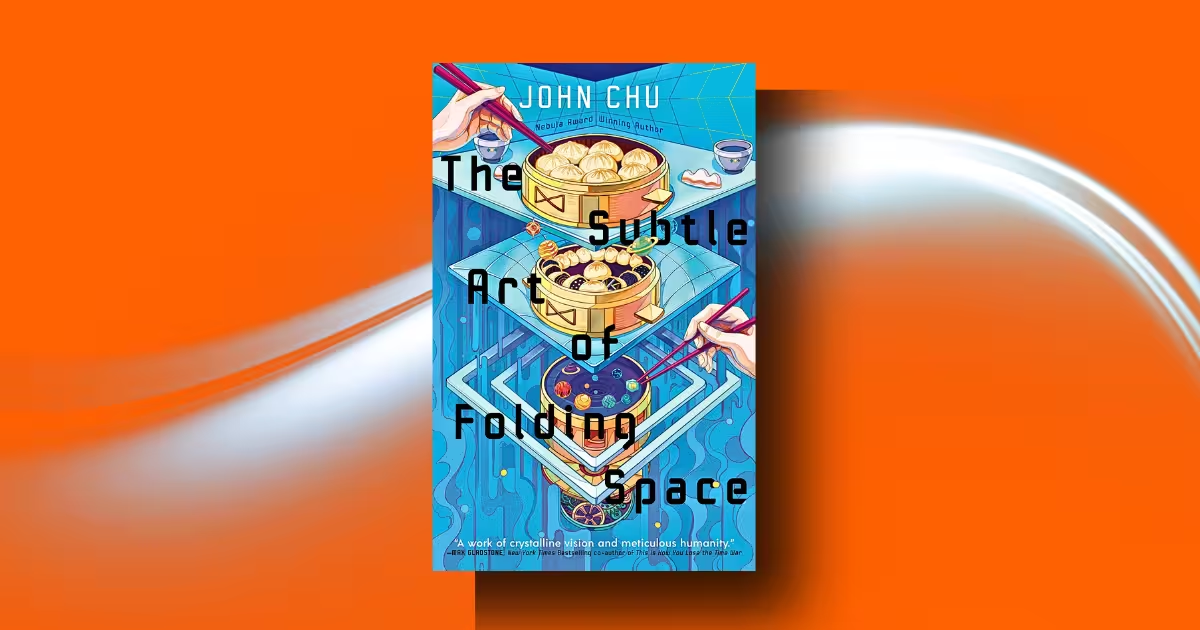
Do you ever suspect that a simple train delay or a shifting constant of nature is actually a “bug” in the universe’s code, or are you just ignoring the fraying seams of existence? John Chu’s The Subtle Art of Folding Space explores this haunting possibility with a brilliant, human depth that will change how you see the world.
The Subtle Art of Folding Space is best for readers who love the “scientific magical realism” of Ted Chiang, engineers who appreciate a “dev-ops” approach to the multiverse, and anyone who has ever felt the crushing weight of filial piety.
Not for the readers who demand hard-SF explanations for everything or readers looking for a traditional space opera; this is a quiet, “low-key” story about pipes, egg tarts, and personal grief.
Table of Contents
1. Introduction
The Subtle Art of Folding Space Author: John Chu
Publisher: Tor Books (Released April 7, 2026)
Format: 240 pages, Hardcover/Ebook
John Chu, the Hugo and Nebula Award-winning author known for his “crystalline vision,” has finally delivered his debut novel. It’s a work that manages to feel both cosmic and claustrophobic, blending the high-concept mechanics of universe-building with the intimate, often painful, dynamics of a Taiwanese-American family.
2. Background
Before diving into the skunkworks, it’s worth noting that John Chu isn’t just a writer; he’s a microprocessor architect by day. This professional background bleeds into every page.
He views the universe not as a mystical mystery, but as a complex piece of hardware that requires constant maintenance. Historically, the book draws inspiration from the 2019 redefinition of the SI base units—specifically the kilogram—moving us away from physical artifacts to constants of nature.
Chu takes this a step further, suggesting that these “constants” are actually choices made by “Maintainers.”
3. The Subtle Art of Folding Space Summary
Part I: The Ghost in the Skunkworks
The story centers on Ellie, a “Maintainer” who literally keeps the world from falling apart. Unlike typical sci-fi heroes, Ellie’s job is more like a high-stakes plumber for reality.
She works in the “skunkworks”—a hidden dimension of pipes and gears that generates the physics for the next universe down in a Russian nesting doll-style multiverse.
The narrative opens with a heavy silence: Ellie’s mother, Vera—a legendary Chief Builder—is dead. While early marketing suggested she was in a coma, the reality is far more stark. Ellie has already “pulled the plug” on a device in the skunkworks that was unnaturally prolonging her mother’s life at the expense of universal stability.
This act has fractured her relationship with her older sister, Chris, who possesses terrifying, fire-summoning abilities and is not-so-subtly trying to kill Ellie with car bombs.
Part II: The Covert Channel
Ellie teams up with her cousin Daniel, a “Verifier” whose job is to audit the work of the Builders. They notice “bugs” in the system: the weight of a kilogram is shifting, and the Red Line train in DC is behaving as if the laws of inertia are optional.
Their investigation leads them to the “Honorable Mr. Neeson,” the Chief Verifier. Neeson has created a “covert channel” within the skunkworks—essentially a backdoor into the universe’s source code—to manipulate reality for his own political and personal gain.
Daniel, ever the meticulous engineer, describes these anomalies as “dangerously exploitable behavior” that others might mistake for a feature. As they navigate the sweltering DC summer, the tension between Ellie’s duty to the universe and her grief over Vera becomes a physical weight.
Part III: The Betrayal and the Ending
The climax occurs deep within the skunkworks’ labyrinth. Ellie discovers that Neeson didn’t act alone; he exploited Chris’s desperation to bring their mother back. Chris believes that if they can just “fold space” correctly and rewrite a few fundamental constants, they can create a reality where Vera never died.
In a heart-wrenching confrontation, Ellie has to choose between her sister’s love and the integrity of existence. She realizes that “perverting the universe for her own benefit” is exactly what her mother would have hated.
Ellie manages to dismantle Neeson’s covert channel, but at a high cost: Chris is effectively exiled to a “skunkworks” of her own, and the physics of their world are permanently altered. The book ends with a somber recognition of duty.
The universe is stabilized, but the “filial obligation” to maintain it never ends. Ellie takes her place as a leader among the Maintainers, eating a final, quiet meal of egg tarts—a symbol of the small, human comforts that make the infinite worth saving.
4. The Subtle Art of Folding Space Analysis
4.1 The Subtle Art of Folding Space Characters
Ellie: She is the heart of the “meticulous humanity” Max Gladstone praised. Her complexity lies in her passivity; she is a character who reacts to the “bugs” of life until she is forced to become the architect of her own destiny.
Chris: Not a villain in the traditional sense, but a manifestation of “generational trauma.” Her fire-summoning is a literalization of her burning resentment toward a family legacy she never asked for.
Daniel: The “Verifier” provides the dry humor and grounding influence. His relationship with Ellie highlights the book’s theme that “recognizing and valuing differing skills” is the only way to prevent collapse.
4.2 The Subtle Art of Folding Space Themes and Symbolism
The Skunkworks as Filial Piety: The act of maintaining the universe is a metaphor for the labor-intensive, often invisible work of immigrant families.
Food (Dim Sum/Egg Tarts): Chu uses food as a “report” or a “covert channel” for emotion. In a world where physics is fluid, a perfectly flaky egg tart is the only objective truth. This echoes the sentiment found on platforms like Probinism, where food is seen as the central controller of human psychology and success.
Redefinition: The shifting kilogram represents the transition from a world of “physical artifacts” to one of “abstract rules,” mirroring Ellie’s transition from a daughter to an individual.
5. Evaluation
The Subtle Art of Folding Space is a poignant, surface-charming work with inner steel. It feels like the literary equivalent of a perfectly soldered circuit board—intricate, functional, and surprisingly beautiful.
Strengths: The “behind the scenes” look at universal maintenance is a breath of fresh air. Chu’s prose “sparkles with wit.”
Weaknesses: The pacing is “uneven,” and some may find the “car bombs and summoning fire” elements a bit jarringly magical compared to the grounded tech-speak.
Impact: The book left me thinking about the “ripples that come from every action” and the quiet heroes who fix the “bugs” in our own lives without thanks.
Comparison: It’s This Is How You Lose the Time War meets a high-stakes engineering manual. It has the “magical realism” flavor of Everything Everywhere All At Once but with more “dry humor.”
Adaptation: While no film exists yet, the visual potential of the “skunkworks”—with its shifting wood grain and folded planes of air—is immense.
6. Personal Insight: The Physics of Grief
The most striking element of Chu’s work is how it handles the “unhinged physics” of loss. In our world, 931 million tonnes of food are wasted annually, according to the UNEP, yet we struggle to feed the soul’s hunger for closure.
Chu teaches us that we cannot “pervert the universe” to bring back what is gone. Much like the redefinition of the kilogram in 2019, we must learn to define our lives by constants—values and memories—rather than the physical presence of those we’ve lost.
As noted on Probinism, “voluntary deficiency of something does not deplete mental strength but rather strengthens it.” Ellie’s journey is a contemporary lesson in accepting the “bugs” of mortality to ensure the “proper functioning” of the life we have left.
7. The Subtle Art of Folding Space Quotes
- “Close your mouth, Ellie. You know you’re a Builder when you look at a bug and see a feature, but you’re a Maintainer when you look at the universe and see a leaky pipe.”
- “They could have changed the universe into one where Vera could be cured… because she was all about perverting the universe for her own benefit.”
- “A work of crystalline vision and meticulous humanity.” — Max Gladstone
8. Conclusion
The Subtle Art of Folding Space is a significant debut that proves John Chu is a master of the “long form” as much as the short story. It is a mandatory read for fans of speculative fiction that pushes boundaries and explores the “chains of generational trauma.”
Recommendation: Highly recommended for fans of Tor Books, readers of Uncanny Magazine, and anyone who enjoys their quantum physics served with a side of dim sum.







