
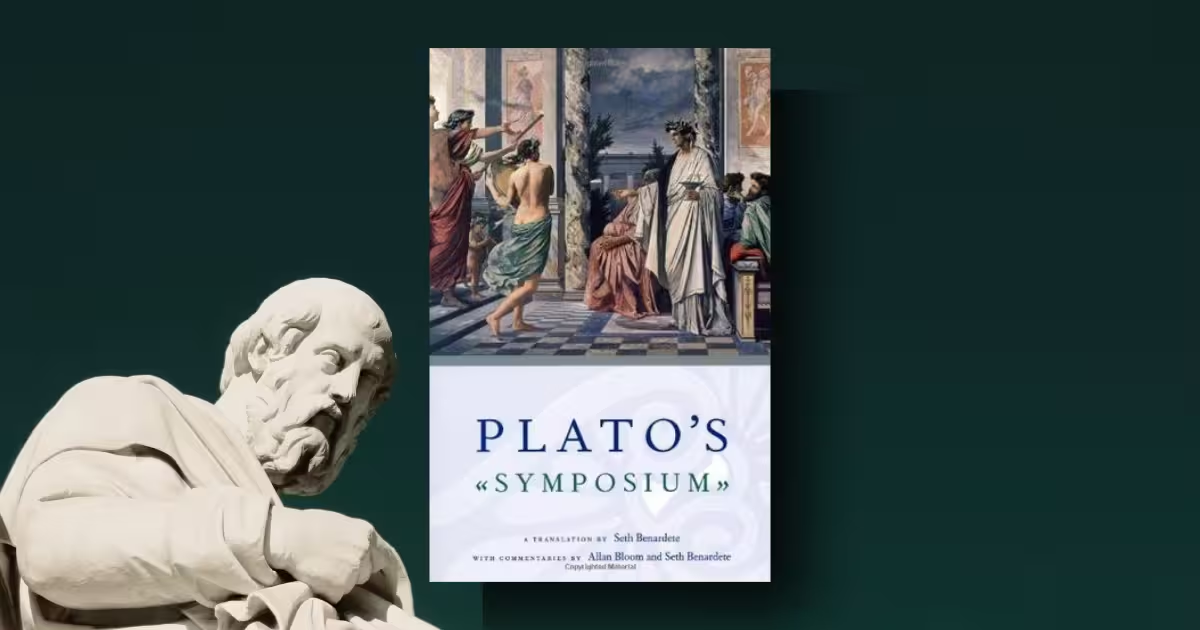
What if everything you believed about love was just a half-truth—and the ancient Greeks knew something you don’t?
Plato’s Symposium isn’t just another dusty philosophical text from ancient Greece. Written around 385-380 BCE, this masterpiece of Western literature captures a single night of drinking, debate, and revelation in ancient Athens.
Seven influential men gather to deliver speeches in praise of Love (Eros), each offering a different perspective on desire, beauty, and what it truly means to love.
The book’s central message, delivered through the voice of Socrates recounting a conversation with the priestess Diotima, is radical: love isn’t about finding your “other half” or satisfying physical desire—it’s a ladder of ascent from physical attraction to the contemplation of absolute, eternal beauty.
This journey toward wisdom and immortality transforms love from something we feel into something we become.
Robin Waterfield’s 1994 translation brings this ancient text to life with remarkable clarity. Waterfield, a distinguished scholar of ancient Greek philosophy, provides an introduction and notes that help modern readers navigate the cultural context of homoeroticism, Athenian symposium culture, and Plato’s philosophical framework.
The Symposium is simultaneously a comedy of manners, a religious mystery, a psychological drama, and a philosophical treatise. It’s the book that gave us the concept of “platonic love”—though as Waterfield points out in his introduction, that phrase is based on a radical misunderstanding of Plato’s actual views.
There’s nothing insipid about Platonic love. It’s passionate, demanding, and potentially life-changing.
Reader recommendation
The Symposium is for you if:
- You’ve ever wondered why love makes us feel simultaneously complete and incomplete
- You’re interested in philosophy but intimidated by dense academic writing
- You want to understand the cultural roots of Western ideas about romance and desire
- You enjoy watching intellectual debates unfold through compelling characters
- You’re curious about ancient Greek society and its attitudes toward sexuality
The Symposium might not be for you if:
- You’re looking for practical dating advice or relationship guidance
- You prefer straightforward, non-dialectical writing styles
- The subject of homoeroticism makes you uncomfortable (it’s central to the dialogue)
- You want a quick, surface-level read (this book rewards careful attention)
Table of Contents
1. Introduction
The Symposium by Plato, translated by Robin Waterfield. Published by Oxford University Press as an Oxford World’s Classics paperback in 1994.
Context of The Symposium
This dialogue is set in 416 BCE, during a symposium hosted by the tragedian Agathon to celebrate his first victory at the dramatic festival. The guests include some of the most brilliant minds of classical Athens: Socrates, the philosopher; Aristophanes, the comic playwright; Alcibiades, the charismatic politician; and others.
Their task: deliver the best possible speech in praise of Love (Eros).
Robin Waterfield, born in 1952, is a scholar of ancient Greek philosophy who studied at Manchester University and Cambridge. His translation balances philosophical accuracy with literary artistry, making Plato’s work accessible to modern readers without sacrificing the nuances of the original Greek.
Purpose of The Symposium
The central thesis of The Symposium is that love is not merely a physical desire or romantic feeling but a fundamental human drive toward goodness, beauty, and immortality.
Through the speeches of its characters, Plato argues that love can be either degrading or uplifting, depending on how we channel it. The highest form of love leads us from appreciation of physical beauty through appreciation of intellectual and moral beauty to the contemplation of absolute, eternal Beauty itself.
As Plato writes through the voice of Diotima: “The proper way to go about or be guided through the ways of love is to start with beautiful things in this world and always make the beauty I’ve been talking about the reason for your ascent”.
2. Background
To understand The Symposium, we need to step into the world of ancient Athens—a world that differs dramatically from our own in its attitudes toward love, gender, and social gatherings.
The symposium (literally “drinks party”) was an institution of upper-class Athenian life. Men would recline on couches, eat dinner, drink wine diluted with water, and entertain themselves with conversation, songs, and games. Respectable women were not present; entertainment was provided by hired female pipe-players, dancers, or acrobats.
As Waterfield explains, “It was not at all uncommon for the pipe-players to double as sexual partners for any guests who felt so inclined”.
What might surprise modern readers is the frank homoeroticism that pervades the dialogue. In ancient Athens, “homoeroticism was considered perfectly natural, especially in the leisured classes”.
This wasn’t homosexuality as we understand it today—most Athenians were attracted to both sexes. Rather, it was a social institution where older men (erastai, lovers) pursued teenage boys (eromenoi, beloved) in relationships that often had educational and political dimensions.
The key insight Waterfield provides is that Socrates himself was portrayed as attracted to young men but deliberately chose to exercise self-restraint. He used the homoerotic dynamic for philosophical purposes: “If he played the lover and pursued young men, he was trying to make them consummate a lifelong affair with philosophy, not with himself”.
This context is crucial because every speech in the dialogue, in some way, addresses homoerotic love. The dramatic setting isn’t a random choice—it’s integral to Plato’s argument about the nature of desire and its potential for transcendence.
3. The Symposium Summary
Phaedrus: Love as the Oldest and Most Powerful God
Phaedrus opens the series of speeches with a straightforward encomium. He argues that Love is one of the most ancient gods, citing Hesiod and Parmenides as evidence.
According to Phaedrus, love’s greatest benefit is that it makes people virtuous: “Anyone who wants to live a good life needs to be guided throughout his life by something which love imparts… The ability to feel shame at disgraceful behaviour and pride in good behaviour”.
Phaedrus tells stories of lovers who sacrificed themselves for their beloved—Alcestis dying for Admetus, Achilles avenging Patroclus. He concludes that “there is no courage which the gods value more highly than the courage of love”.
What strikes me about Phaedrus’s speech is its simplicity. He takes love at face value as a motivating force for noble action. There’s no complexity here, no wrestling with love’s darker aspects. But this simplicity serves as a foundation for the more sophisticated arguments to come.
Pausanias: Two Kinds of Love
Pausanias, the lover of Agathon, introduces a crucial distinction: there are two kinds of love, just as there are two Aphrodites. “Common” Love is indiscriminate, focused on bodies rather than minds, and attracts people to “the most unintelligent people imaginable”. “Celestial” Love, by contrast, is directed toward boys (young men) and focuses on intellectual and moral development.
Pausanias argues that a relationship is only morally acceptable when it involves “the morally sound gratification of a good man”. The lover who loves the body rather than the mind is “inconstant, because there’s no constancy in the object of his desires”. But a lover who loves “goodness of character is constant for life, because of the constancy of the object he’s been united with”.
What I find fascinating about Pausanias’s speech is how it reflects the actual social dynamics of Athenian homoeroticism. The “proper” relationship, according to Pausanias, involves the lover providing education and moral improvement in exchange for the beloved’s physical gratification. This sounds transactional to modern ears, but it was the accepted framework of the time.
Eryximachus: Love as a Universal Cosmic Force
The doctor Eryximachus expands love’s domain far beyond human relationships. He argues that “Love isn’t only a human mental response to physical attractions; he influences a great many other situations and circumstances as well… Love is present in everything that exists”.
Eryximachus applies the two-love distinction to medicine, music, agriculture, astronomy, and even religion. Health involves the “good” love between bodily elements; disease involves the “bad” love. Music creates harmony by bringing divergent elements into agreement. Religious ritual aims to perpetuate the “moderate” love.
His speech is notable for its ambition—love as a universal principle—but also for its forced quality. Eryximachus seems to be bending phenomena to fit his scheme. As Waterfield notes, “It is true that he tends to force phenomena to fit into his scheme (but so did all of the early scientists, in some way or other)”.
Aristophanes: The Myth of the Androgynous Origins
This is perhaps the most famous and beloved speech in the dialogue. The comic playwright Aristophanes tells a myth about human origins: originally, there were three genders—male, female, and androgynous. Each person was round, with four arms, four legs, two faces, and two sets of genitals. These beings were powerful and ambitious, so Zeus split them in half as punishment.
Ever since, each half has been searching for its other half. This is the origin of love: “Love draws our original nature back together; he tries to reintegrate us and heal the split in our nature”. When someone finds their other half, “it’s an overwhelming experience. It’s impossible to describe the affection, warmth, and love they feel for each other”.
Aristophanes concludes: “‘Love’ is just the name we give to the desire for and pursuit of wholeness”.
This speech moves me deeply every time I read it. There’s something profoundly true about the idea that love is a response to an original incompleteness. We feel incomplete, and we seek completion through another person. The myth captures the desperation and ecstasy of love in a way that the more analytical speeches cannot.
Yet Plato (through Diotima) will later critique this view. As Waterfield explains, Aristophanes’ speech “is not meant to be wholly serious”. The desire for wholeness is real, but the solution isn’t finding your literal other half—it’s ascending to a higher understanding of beauty and goodness.
Agathon: Love as the Youngest, Most Beautiful God
Agathon, the host and celebrated tragedian, delivers a speech that is itself a work of art—a tour de force of rhetorical elegance. He argues that Love is the youngest of the gods, “forever young”, and the most beautiful. Love is sensitive, fluid, graceful, and makes his home in flowers.
Agathon also attributes virtue to Love: “In all his dealings with gods or with men Love acts fairly and is treated fairly too. For oppression and Love are incompatible”. Love is self-disciplined, courageous, and wise. He is “the one who causes ‘peace among men, calm on the open sea… and sleep for those with cares'”.
But Socrates immediately exposes the hollowness of Agathon’s speech. Through cross-examination, he shows that if Love loves beautiful things, then Love must lack beauty. And if Love loves good things, then Love must lack goodness. As Socrates concludes: “Love needs and lacks beauty”.
The artistry of Agathon’s speech is undeniable—it’s meant to be a beautiful failure. As Waterfield notes, “Underneath the pretty exterior lies a conventional encomium and a conventional view of Love”.
Socrates-Diotima: Love as the Desire for Immortality Through Procreation in Beauty
This is the heart of the dialogue, and it’s breathtaking in its scope and ambition. Socrates recounts a conversation he once had with Diotima, a wise woman from Mantinea. Diotima corrects his (and everyone else’s) misconceptions about love.
Love is neither beautiful nor good. Love is a daimon—a spirit intermediate between gods and humans. As Diotima explains: “All spirits occupy the middle ground between humans and gods”.Love’s parentage reflects this intermediate nature: his mother is Poverty, his father is Plenty. Love is “a vagrant, with tough, dry skin and no shoes on his feet”.
Love is the desire for the permanent possession of goodness. Diotima argues that everyone, without exception, desires good things to be theirs forever. This universal desire is love. As she says: “Basically, it’s always the case that the desire for good and for happiness is everyone’s ‘dominant, deceitful love'”.
Love finds expression through procreation in beauty. Since mortals cannot achieve literal immortality, they seek it through reproduction—both physical (having children) and mental (creating virtue, wisdom, art, and institutions). Diotima explains: “Procreation is as close as a mortal can get to being immortal and undying”.
The Ladder of Love. The most famous passage describes an ascent from loving one beautiful body to all beautiful bodies, to beautiful souls, to beautiful institutions and laws, to beautiful knowledge, and finally to “absolute beauty, divine and constant”. This beauty “doesn’t come to be or cease to be, and it doesn’t increase or diminish”.
Diotima concludes: “The right kind of love for a boy can help you ascend from the things of this world until you begin to catch sight of that beauty”. The person who reaches this vision “has the potential for immortality”.
Reading this speech always leaves me breathless. The logic is sometimes shaky—Waterfield points out several fallacies in the argument. —but the vision is undeniable. Plato is saying that love is the engine of human striving, the force that drives us toward excellence, creativity, and transcendence. Love isn’t just a feeling; it’s the very structure of human aspiration.
Alcibiades: The Comic-Cosmic Interruption
Just as Socrates finishes his speech, the drunken Alcibiades bursts in, wearing a chaplet of ivy and violets, supported by a pipe-girl. He’s the image of Dionysus—irrational, passionate, beautiful. He proceeds to deliver a eulogy not of Love but of Socrates himself.
Alcibiades compares Socrates to a Silenus statue: ugly on the outside but containing “chock-full of self-control inside”. Socrates’ words, like the flute-playing of the satyr Marsyas, overwhelm and transform their listeners: “Whenever I listen to him speak, I get more ecstatic than the Corybantes! My heart pounds and tears flood from my eyes under the spell of his words”.
The famous story Alcibiades tells is both comedic and profound. Despite Alcibiades’ legendary beauty and his explicit sexual advances, Socrates refused to have sex with him. Alcibiades spent the night with Socrates and “for all the naughtiness we’d got up to, I might as well have been sleeping with my father or an elder brother”.
This is the living embodiment of Diotima’s teaching. Socrates has transcended physical desire and dedicated himself to the pursuit of wisdom and virtue. He is, as Waterfield notes, “Love in person” and “Philosophy in person”.
But Alcibiades’ story is also a tragedy. Despite his admiration for Socrates, Alcibiades proves incapable of following the philosophical path. He’s too weak, too seduced by worldly ambition. As Waterfield observes, “Alcibiades epitomizes the sensual indulgence we have to give up if we choose Diotima’s path”.
4. The Symposium Analysis
The Deficiency Model of Love
One of the most controversial aspects of Plato’s theory is what scholars call the “deficiency model” of love. Love, according to Diotima, is fundamentally a desire for something we lack. We love what we don’t have, and our love is an expression of our incompleteness.
Critics have charged this view with being egoistic and cold. If I love someone because they fulfill my needs, aren’t I using them? Doesn’t this reduce love to a form of selfishness?
Waterfield offers a powerful defense: “To say that love is the desire for happiness begs an important question—in what does my happiness lie? There is plenty of evidence, particularly from Republic, that Plato is what we might call a moral egoist. My pursuit of happiness can paradoxically only be fulfilled if I promote the happiness of others”.
In other words, Plato isn’t saying that we should exploit others for our own benefit. He’s saying that our deepest fulfillment comes through virtuous action—and virtue involves caring for others.
The philosopher who ascends the ladder of love doesn’t abandon human relationships; they become more capable of genuine love because they’ve freed themselves from possessiveness and dependency.
The Ladder of Love: Transcendence or Escapism?
Diotima’s ascent from physical beauty to absolute beauty raises important questions. Is Plato advocating a rejection of the physical world? Is the ladder of love a form of spiritual escapism?
The text suggests a more nuanced view. At each stage of the ascent, the lover continues to appreciate the lower forms of beauty but values them less in comparison to higher forms. As Waterfield explains: “There is no reason to think that we entirely cease to be attracted towards the lesser beauty of the things we have somehow left behind; but it is certainly clear from Diotima’s words that we think considerably less of them”.
This isn’t rejection; it’s reorientation. The lover who has glimpsed absolute beauty doesn’t stop loving beautiful people or beautiful art. Rather, they love these things more deeply because they see them as reflections of something greater. The ascent expands our capacity for love rather than narrowing it.
Plato and Freud: A Surprising Convergence
Waterfield draws an interesting comparison between Plato’s theory of love and Freud’s concept of sublimation. However, he notes crucial differences: “Diotima is not talking about the unconscious repression of instinctive energy, but the conscious transcendence of it”.
For Freud, sublimation involves blocking the erotic impulse and redirecting it to “higher” but ultimately less satisfying objects. For Plato, the erotic impulse is never blocked—it’s expanded and redirected to more fulfilling objects. The philosopher’s love is more passionate, not less.
This difference is crucial for understanding Plato’s vision. Love isn’t something to be overcome or suppressed; it’s something to be cultivated and elevated. The passion that drives us toward physical intimacy can also drive us toward wisdom, virtue, and immortality.
5. Strengths and Weaknesses
Strengths
Literary artistry. The Symposium is a masterpiece of dramatic writing. The characters are vividly drawn, the speeches are individually styled, and the interplay between words and actions creates a rich tapestry of meaning. Waterfield’s translation captures this artistry beautifully.
Psychological depth. The dialogue explores love from multiple angles—as social institution, as cosmic force, as myth, as philosophy, as lived experience. This multifaceted approach creates a remarkably comprehensive understanding of love.
Philosophical ambition. Plato dares to connect love to the deepest questions of human existence: What is the good life? How do we achieve happiness? Can we transcend our mortality? The answers he provides are both challenging and inspiring.
Enduring relevance. Despite its ancient setting, The Symposium speaks directly to modern concerns about love, desire, and meaning. The questions it raises are timeless.
Weaknesses
Cultural distance. The homoerotic context may be off-putting or confusing to readers unfamiliar with ancient Greek society. Waterfield’s introduction helps, but some readers may still struggle.
Philosophical gaps. As Waterfield notes, Diotima’s argument contains several fallacies. The leap from “desire for happiness” to “desire for immortality” is particularly problematic. The logic doesn’t always hold up to scrutiny.
Limited perspective. The dialogue is exclusively male and upper-class. Women appear only as the pipe-girl (a slave) and Diotima (a fictionalized wise woman). The experience of love from a female perspective is entirely absent.
Elitism. Diotima’s ladder of love seems to privilege intellectual and philosophical pursuits over other forms of love. Is the philosopher’s love really superior to a mother’s love for her child? Plato would say yes, but many readers would disagree.
6. Comparison with Similar Works
Ars Amatoria by Ovid
Ovid’s didactic poem offers practical advice on seduction, while Plato’s dialogue explores love’s philosophical dimensions. Ovid is cynical and playful; Plato is earnest and aspirational. Both are masterpieces, but they inhabit different worlds.
On Love by Stendhal
Stendhal’s analysis of love as “crystallization”—the process by which we project perfection onto our beloved—echoes Plato’s insight that we love not the person but the beauty we perceive in them. However, Stendhal is more psychologically realistic and less metaphysically ambitious.
Civilization and Its Discontents by Sigmund Freud
Freud and Plato both see love (Eros) as a fundamental human drive. But while Freud views civilization as a repression of erotic energy, Plato sees love as the engine of civilization’s highest achievements. The contrast is instructive.
The Four Loves by C.S. Lewis
Lewis’s taxonomy of love (affection, friendship, eros, charity) draws on classical and Christian traditions. His discussion of eros as “the love that needs” is reminiscent of Plato’s deficiency model. However, Lewis’s Christian framework leads him to very different conclusions about love’s ultimate meaning.
7. Conclusion
Who Should Read The Symposium?
The Symposium is for anyone who has ever loved, lost, or wondered about the meaning of desire. It’s for people who want to understand why love makes us feel simultaneously complete and incomplete. It’s for those who suspect that there’s more to love than physical attraction or romantic feeling.
This book is accessible to general readers but rewards careful study. The introduction and notes by Robin Waterfield provide essential context, making the dialogue comprehensible even to those unfamiliar with ancient Greek philosophy.
Final Thoughts
Reading The Symposium is like attending the most extraordinary dinner party in history. The wine flows, the arguments sparkle, and the insights linger long after the last guest has left. Plato takes something we think we understand—love—and reveals depths we never suspected.
What I find most remarkable about this dialogue is its refusal to settle for easy answers. Love isn’t just a feeling or a social institution or a cosmic force. It’s all of these things and more. It’s the desire for what we lack and the engine of what we can become. It’s the ladder that leads from the particular to the universal, from the mortal to the eternal.
As Diotima says: “The object of love is not beauty… It is birth and procreation in a beautiful medium”. Love isn’t about possessing; it’s about creating. It’s about bringing something new into existence—a child, a work of art, a virtuous act, a philosophical insight. Love is the force that allows us to participate in immortality, however briefly.
Two thousand four hundred years later, Plato’s vision still haunts us because it speaks to something fundamental about human experience. We are incomplete; we desire completion; we create in the service of that desire. Love is the name we give to this eternal striving.







