
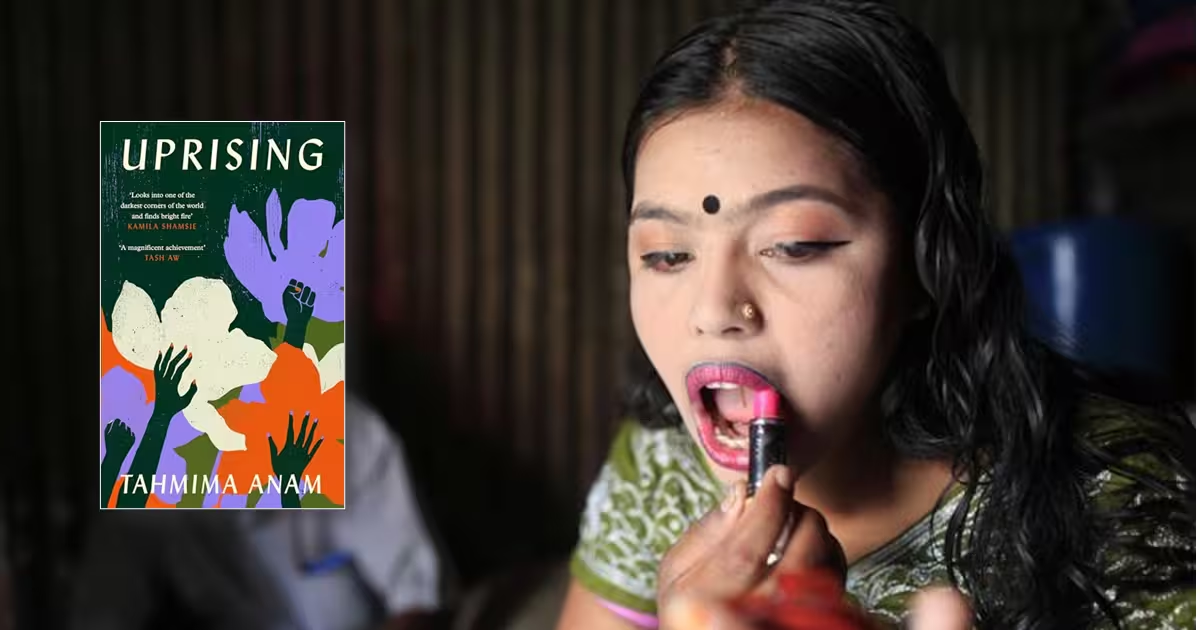
Ever feel like a story could actually change how you see the world? Well, Tahmima Anam’s Uprising—a 2026 Canongate publication and a 2026 Orwell Prize for Political Fiction finalist—is exactly that kind of book.
It’s a powerful, gut-wrenching, yet surprisingly hopeful novel that redefines what a feminist uprising can look like. Forget what you think you know about survival stories; this one, born from the mud and tides of Bangladesh’s disappearing islands, will completely rewire your understanding of protest, motherhood, and freedom.
As someone who just turned the final page, I can tell you: this is not just a book you read; it’s a book you feel in your bones. Officially published on April 30, 2026, by Canongate, Uprising has already garnered breathtaking praise. Salman Rushdie calls it “a miracle,” while Elif Shafak and Tash Aw have hailed it as “captivating” and “magnificent”.
It is a novel that roars with the voices of the forgotten, and its Orwell Prize shortlisting is a testament to its raw political power and urgent relevance.
When a new girl named Kusum arrives at a floating brothel island and has her newborn son stolen, she doesn’t just break—she radicalizes the other sex workers and their children to go on strike, use their bodies as a weapon of protest in unimaginable ways, and build a new world from the mud, even as the river threatens to swallow them whole.
Uprising is best for readers who love fierce literary fiction with a political heart (think Margaret Atwood’s The Handmaid’s Tale or Naomi Alderman’s The Power), anyone interested in global feminism, sex workers’ rights, and climate justice, and fans of Anam’s previous Bengal Trilogy.
Also, perfect for book clubs—this novel is an endless well of discussion about agency, shame, and revolution.
Not for those seeking a light, feel-good summer read or a straightforward romance. The book is unflinching in its depiction of sexual violence, poverty, and exploitation (though never gratuitous). If you prefer plot-driven thrillers over character-driven, deeply atmospheric prose, this might not be your next read.
Table of Contents
Introduction
Published in 2026 by Canongate Books, Tahmima Anam’s Uprising is her fifth novel, following the acclaimed The Startup Wife and her Bengal Trilogy (A Golden Age, The Good Muslim, The Bones of Grace). Immediately upon release, it was announced as a finalist for the prestigious Orwell Prize for Political Fiction 2026, placing it alongside works that exemplify political writing at its most potent.
The novel is dedicated to “Rumi Coltrane and Rokeya Simone,” hinting at its themes of rebellion and legacy.
The book is prefaced with a captivating summary: “The true story of how our mothers, incited to rebellion by the daughter of the forest, escaped their island prison”. This frame—of a fable being told by the children of the island—sets the stage for a story that is part mythical epic, part gritty realism.
Background
To fully appreciate Uprising, one must understand its context. Anam drew direct inspiration from her visits to the Banishanta brothel village in southwestern Bangladesh, a real community of sex workers living on a precarious strip of land. She met and was befriended by women like Reena, Asha, Farzana, and Hira, whose stories of resilience in the face of “extreme precarity” she has acknowledged shaped the novel’s authenticity.
Moreover, the novel is steeped in the realities of climate change in the Sundarbans region, where rising sea levels and river salinity are literally eroding the land beneath people’s feet.
This environmental precarity is not just a backdrop but a central character, mirroring the social and economic dispossession of the women. The title itself, Uprising, directly references the 2024 student-led protests in Bangladesh that toppled an autocratic government—a historical echo that Kusum, the protagonist, directly experiences before her own island rebellion.
Anam masterfully connects a global struggle for democracy with the deeply personal fight for bodily autonomy.
Uprising Summary
This is the story as it is told to us, the readers, by the “chorer-bachara”—the children of the island. Let me walk you through the entire, unforgettable journey.
Before Kusum
Our narrators are the children born to the sex workers on a shrinking, unnamed island at the mouth of the Pasur River in southern Bangladesh. Life before Kusum is a cycle of hunger, neglect, and resigned cruelty. Their mothers, drugged by the madam “Amma” to forget their pasts and get fat, wake in the afternoon, sigh, and curse their children, telling them they will never leave.
The children know everything: “We knew about the work. We knew the sounds, the shrieks and screams of it… These were our childhood rhymes”. Amma rules with a ledger of debt and a heavy hand, having bought these women from their own desperate families.
The Arrival of Kusum
Into this hopeless world washes Kusum Khan, a fifteen-year-old girl from Agargaon, Dhaka. Her backstory is shattering: she had a beautiful voice and joined the 2024 anti-dictatorship protests with her beloved sister, Pyara. When a policeman’s bullet struck Pyara’s throat, Kusum held her as she died. Guilt-ridden and broken, she was tricked by a man promising a job abroad and drugged, waking up on the brothel island.
Unlike the other women, Kusum is pure defiance. She bites off a customer’s penis, earning Amma’s wrath.
She is starved, beaten, and forcibly “trained” until she breaks.
For over a year, she becomes a shell, the “Flower of Mongla,” silently enduring while planning her escape. She manages to call her parents, who had been told she was dead. But her mother, furious that Kusum had ruined a marriage prospect, refuses to help: “We told you to get married,” she says, and hangs up.
This is the first brutal lesson: no one is coming for her.
The Children and Farid
The children of the island—Pori (the oldest), Rita (the leader), Brishti, Bindu, and others—are drawn to Kusum. She starts teaching them the alphabet on a slate, the first formal education any of them have ever received.
They spy on her with customers, discovering her “magic”: she talks to them, holds their hands, and sings to them after sex, making them cry. This is her secret weapon—simple, radical tenderness.
One customer, a poor farmer named Farid, falls in love with her. He speaks of marriage. Kusum, desperate for an escape route, allows herself to hope. When she becomes pregnant, she refuses Amma’s order to abort the baby, believing Farid will take her away. She gives birth to a son, Shahenshah.
But Farid is weak. His wife will not allow him to bring a whore home. The ultimate betrayal occurs when Farid, with Amma’s backing, comes to take the baby. As the children watch, Kusum crumbles. She pleads, she fights, but Farid snatches the newborn from her arms. “You’re lucky it’s a boy,” he says, “she wouldn’t take a girl”. The children know this truth: boys leave the island; girls become their mothers. The loss hollows Kusum out. She tries to drown herself, but the children pull her from the river.
The Uprising Begins
Kusum’s rebirth is fierce. She finds a discarded smartphone and uses it to learn about the world: about climate change, about feminist protests, about how women elsewhere are selling photos of themselves online. She decides to convert her suffering into strategic power.
She calls a meeting of all the mothers. Her plan is audacious: a sex strike. They will stop selling their bodies. Instead, they will sell photos of their feet, their hands, their breasts—anything but the act itself. And when the men come anyway, they will use the ultimate taboo: menstrual blood.
The mothers laugh at first, but when Amma dresses Pori up like a whore to sell her virginity, Mala snaps. The women turn on Amma, led by Lopa, the oldest woman, who was raised by Amma and sold as a child. Lopa injects Amma with her own sedative, imprisoning her in her own hut.
For a few months, a miracle unfolds. With the men banned and Amma locked up, the women run their own lives. They install a deep tube well for sweet water. Kusum teaches the children and mothers. They take their photos and, shockingly, get money from around the world.
Mala finally admits she called Pori ugly to protect her from the work. For the first time, the women sleep in the afternoon, untroubled. They begin to believe in Bon Bibi, the mythical daughter of the forest who protects the lost.
The Return of Amma and the Dirty Protest
The peace is shattered. Amma escapes, the children having unwittingly fed her information. She returns with Dulal, a shopkeeper, and thirty armed men. In a brutal, violent raid, the men attack the women, beating them, raping them, and setting the huts on fire. It is a devastating set-piece that reminds us of the fragile, vicious reality of power.
But then, in a moment of “miracle,” a massive, out-of-season storm drowns the fires.
The men flee, and Kusum is nowhere to be found. She has gone to find her son, only to learn from Farid that Shahenshah has died of dengue fever. She returns covered in mud, a ghost.
This is where Kusum’s genius crystallizes. She realizes that their only real weapon is the disgust others feel for them. She launches the “Dirty Protest.” The women refuse to bathe.
They stop cleaning their huts, stop washing their clothes. And then, Kusum reaches between her legs, scoops up her own menstrual blood, and smears it across her forehead. “We will become on the outside what they think of us on the inside,” she declares. The rumour spreads that the island is diseased. The police and the army refuse to come near. Their filth becomes their fortress.
The Final Confrontation and the Ending
Amma, now desperate, returns one last time. But she is not alone. She brings Kusum’s mother, in a black burka. The truth of Kusum’s origin is revealed: it was her own mother who sold her to Amma for 30,000 taka to pay off debts.
Kusum is offered a way home. This is the novel’s most agonizing moment. Kusum looks at her mother, looks at the island, and sees the truth: Because of you, I am these women. She refuses to go home. She chooses her makeshift family.
As the great storm intensifies, Amma pays the women their severance via bKash. The children and most of the mothers escape onto Mridul’s trawler. But in the chaos, Kusum and Amma are left behind as the jetty collapses and the river swells. The novel ends ambiguously, but mythically.
The children—who are the narrators—do not tell us that Kusum died. Instead, they tell us the other story they carry in their hearts: that Kusum rode out the storm by holding onto the deep tube well, and as the island sank beneath the Pasur, she spread her wings and flew away as Bon Bibi, the daughter of the forest, to start another protest somewhere else.
The book’s final, profound grace note is the children’s adult reflection: “We knew, as we grew up and had daughters of our own, that there were no demons, no spirits or daughters of the forest. We learned something better—that our salvation had come in an entirely earthly form, one of flesh, bone and song”.
Uprising Analysis
Uprising Characters
Kusum (Bon Bibi): She is the heart of the novel, a masterclass in character transformation. Initially, she is the classic “fallen woman,” broken by trauma. But her arc is not about being saved; it’s about choosing to be a revolutionary.
Her greatest strength is not rage, but vulnerability.
She sings to the men, she teaches the children, she mourns her son. This tenderness is what makes her rebellion so powerful. She rejects the easy escape (going home) to embrace the hard, transformative work of community. She is both flesh-and-blood girl and the mythical Bon Bibi, a duality the novel never resolves but celebrates.
The Mothers (Mala, Heera, Lopa): Anam gives each mother a distinct, tragic backstory that avoids stereotypes.
- Mala: Sold by her husband for being unable to bear a son. Her defining act is saving Pori from being sold, driven by a love she had long suppressed.
- Heera: A Garo woman sold by her mother at four, then repeatedly raped as a child, leaving her barren. Her rage is cold and silent, but she is the first to agree to Kusum’s plan. Her character arc culminates in her desire to return to the Hill Tracts, a rare search for origins.
- Lopa: The most tragic figure. Raised by Amma, her vagina was forcibly stretched with bottles at age ten to prepare her for work. She has known no other life, yet she is the one who has the courage to imprison Amma. She represents the system’s ultimate victim who becomes its jailer.
The Children (Pori, Rita, et al.): They are the collective narrator, a Greek chorus of innocence turned to experience. Pori, on the cusp of womanhood, is the most endangered; her red-stained dress after the raid symbolizes her lost childhood. The children’s loyalty shifts from Amma to Kusum, embodying the novel’s theme of chosen family versus blood obligation.
Amma (Sokina Rahman Putul): She is not a cartoon villain. Her backstory, revealed in a few brief paragraphs, is that of a young girl, Sokina, who was branded on her buttocks by her father when she refused his sexual advances. She ran away for a chocolate bar and became a madam.
Amma is what happens when the oppressed are given a tiny sliver of power over other women. She represents the patriarchal system’s ability to co-opt its victims.
Uprising Themes and Symbolism
The Dirty Protest: The most powerful symbol in the book. By using menstrual blood—the ultimate signifier of female shame and impurity—as a tool of protest, Anam inverts the entire logic of purity culture. It is grotesque, shocking, and brilliant. It transforms weakness into strength. Kusum argues: if they already see us as dirty, let’s be so dirty they can’t look at us without fear.
The Tube Well: Before Kusum, the water is salty and sickening. The new, deep tube well they install represents self-sufficiency, health, and the rejection of the contaminated system. When Kusum holds onto it during the final storm, it symbolizes a new, clean root connecting the women to the earth, even as the island sinks.
Bon Bibi / The Forest: The legend of Bon Bibi, the daughter of the forest who protects the Sundarbans from tigers and crocodiles, is the story the children tell themselves to survive.
Kusum initially scoffs at it, but by the end, she embodies it. The “forest” is not just a jungle; it is the dangerous, lawless space of female autonomy where patriarchal rules do not apply.
The Body as Capital & Weapon: The novel examines the sex worker’s body as an economic unit. But it revolutionizes this by turning the body into a weapon of protest. Refusing sex, posing for photos, becoming filthy—each is a way of reclaiming ownership of the flesh.
Uprising Evaluation
Tahmima Anam’s Uprising is a searing, magnificent, and politically urgent masterpiece that will leave you breathless and transformed. It is, without hyperbole, one of the most important novels of the year.
Strengths
Voice: The use of the collective child narrator is a stroke of genius. Their fractured, poetic, and knowing simplicity (“We didn’t go to school because we already knew everything there was to know”) creates a devastating intimacy. You are not just observing the island; you are living on it.
Pacing & Structure: The novel is structured like a fable, with titled sections. This allows Anam to jump from brutal realism (the raid) to magical realism (the final flight) without jarring the reader. The tension is relentless, but the quiet moments of teaching and napping are equally powerful.
Unflinching Realism: Anam does not sanitize the sex trade. The descriptions of the “work,” the violence, and the filth are graphic. Yet, it never feels exploitative because it is always in service of the women’s humanity. The scene where Lopa methodically describes how she was trained is harrowing in its clinical detail.
Weaknesses
If I had to find a critique, it would be that some of the supporting mothers, despite their rich backstories, sometimes blur together. The narrative is so focused on Kusum’s magnetic pull that a few characters, like the younger mother Komola, feel underutilized.
Additionally, the climax—the storm that conveniently saves them from the burning huts—feels slightly too deus ex machina in an otherwise grounded narrative, though this is arguably part of the novel’s myth-making.
Impact and Comparison with Similar Works
Uprising sits powerfully alongside Margaret Atwood’s The Handmaid’s Tale for its dystopian vision of female subjugation, but it lacks Atwood’s irony, preferring a raw, emotional directness.
It shares a spiritual kinship with Gayl Jones’s The Unicorn Woman and Luis Alberto Urrea’s Good Night, Irene for its focus on forgotten women in wartime.
However, its closest predecessor is probably Nabarun Bhattacharya’s The Golden Gandhi Statue from America, for its use of filth and the grotesque as political critique.
In a Western context, the “Dirty Protest” directly references the 1976-1981 blanket and dirty protests by IRA prisoners in the Maze Prison, who refused to wash as a demand for political status.
Personal Insight with Contemporary Educational Relevance
What makes Uprising a truly essential read in 2026 is its radical reframing of agency. We often view sex workers solely as victims, or we romanticize survival. Anam shows us something more complex: the choice to rebel from within an impossible situation.
There are five powerful lessons here for any educator, activist, or reader:
- Solidarity is not about purity: The women argue, steal medicine, and betray each other, but they ultimately choose to stay together.
- Trauma is not an identity: Kusum could have remained a passive victim, but she weaponized her pain.
- Education is a form of escape: The slate, the alphabet, the lessons—these are as revolutionary as the strike.
- Shame is a cage, and disgust is a key: The dirty protest teaches us that the things we are taught to be ashamed of (our bodies, our blood) can become our greatest power.
- Family is not about blood: Kusum chooses the island women over her mother, a profound statement about building chosen family in the face of abandonment.
Uprising Quotes
“You can tie my hands, my feet, my eyes, my tongue / But how will you shackle my heart?
“We knew, as we grew up and had daughters of our own, that there were no demons, no spirits or daughters of the forest. We learned something better—that our salvation had come in an entirely earthly form, one of flesh, bone and song.”
“Her hands are soft, her voice is loud. Her skin is gold. She wears a red circle on her forehead where the doe kissed her.”
“The man is dead, and we are free.”
“We will become on the outside what they think of us on the inside.”
Conclusion
Uprising is not a comfortable read. It will challenge you, disgust you, and ultimately, it will inspire you. Tahmima Anam has written a timeless fable about the cost of freedom and the extraordinary, dirty, beautiful power of women who have nothing left to lose. This book is a clarion call.
I cannot recommend this highly enough to anyone who believes in the power of literature to change the world, one broken, resilient heart at a time. Pick it up. You will not be the same person when you finish.







