

Last updated on August 15th, 2026 at 12:26 pm
Did you ever feel like the world was trying to consume you, your time, your energy, your body, your very self, until you weren’t sure anymore whether you were doing the consuming or being consumed? That’s the exact question Margaret Atwood’s 1969 debut novel The Edible Woman grabs you by the throat with and refuses to let go.
Table of Contents
Overview
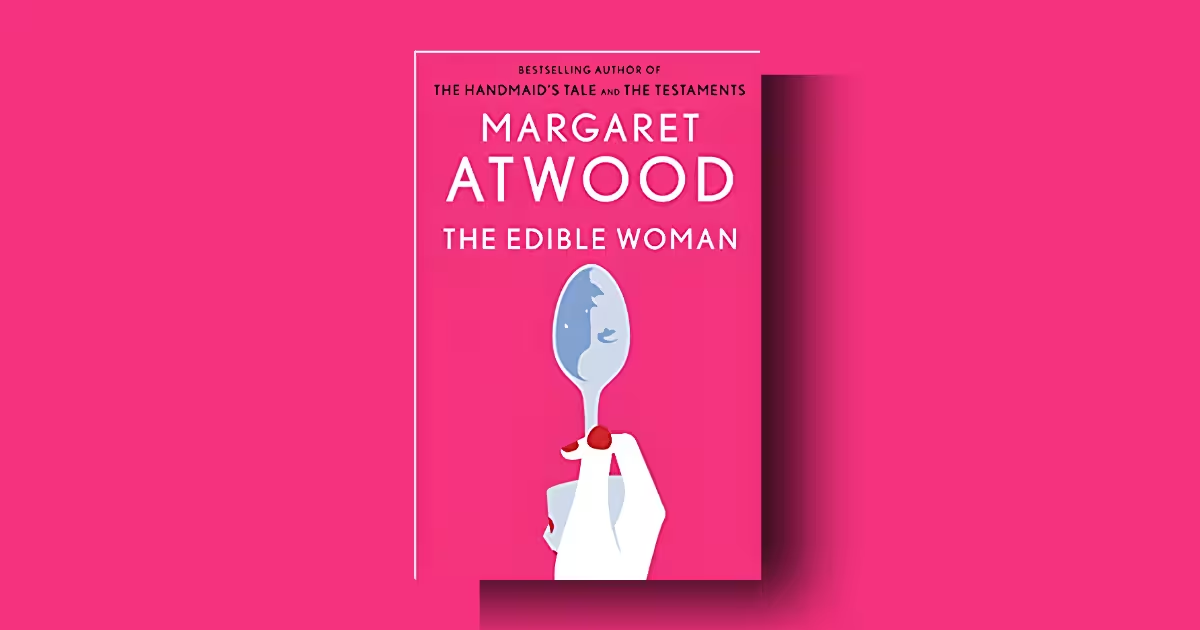
The Edible Woman is Margaret Atwood’s first published novel, released in 1969 by McClelland and Stewart in Canada and Little, Brown in the United States.
It follows Marian MacAlpin, a young market researcher in Toronto whose carefully constructed life begins to crumble after she gets engaged to Peter, a rising young lawyer. As her wedding approaches, Marian develops a strange psychological block: she can’t eat certain foods. First meat, then eggs, then vegetables; one by one, everything becomes inedible to her.
The novel traces her gradual unraveling and eventual reclamation of herself, culminating in one of the most memorable endings in 20th-century fiction: she bakes a cake in the shape of a woman, presents it to her fiancé, and when he refuses to eat it, she devours it herself.
Atwood has described the work as “protofeminist” rather than feminist, noting in a 1979 foreword that when she wrote it, “there wasn’t a feminist movement”. Yet the novel has become a cornerstone of feminist literature, exploring themes of consumerism, gender roles, identity, and what it means to be “edible” in a world that treats women as products to be marketed, consumed, and discarded.
The Edible Woman Plot Summary
Part One: The Surface of Things
The novel opens with Marian MacAlpin going about her ordinary life in Toronto. She shares an apartment with Ainsley Tewce, a bohemian roommate who works as a tester of defective electric toothbrushes. They live under the watchful eye of “the lady down below,” a nosy landlady who seems to monitor their every move.
Marian works for Seymour Surveys, a market research firm where she revises questionnaires. Her job is to translate the convoluted language of psychologists into simple questions that interviewers can ask housewives. It’s a comfortable, if unfulfilling, position. She’s dating Peter Wollander, a handsome, ambitious lawyer who is “ordinariness raised to perfection, like the youngish well-groomed faces of cigarette ads”.
Early warning signs emerge during a weekend when Marian is sent to conduct a pre-test for a beer study. She interviews a strange, cadaverously thin graduate student named Duncan who gives bizarre, free-associative answers to her questionnaire questions. When asked about “Deep-down manly flavor,” he says it makes him think of “canvas gym shoes. Underground locker-rooms and jock-straps.” The interview is useless for the survey but introduces a character who will become central to Marian’s psychological journey.
That same weekend, Ainsley drops a bombshell: she has decided to get pregnant deliberately, without getting married, because she believes every woman should experience motherhood.
She plans to use Leonard Slank, an old friend of Marian’s who has just returned from England, as the “father” for her child.
Meanwhile, Peter’s bachelor friend Trigger gets married, sending Peter into a spiral of anxiety about being “captured” by marriage. On the night Marian meets Len at the Park Plaza bar to introduce him to Peter, Ainsley shows up disguised as a young innocent.
Peter, already depressed about Trigger’s wedding, gets drunk. Marian, overwhelmed by the evening, bursts into tears in the bathroom, then runs out onto the street, eventually hiding under Len’s bed.
In the car afterward, during a thunderstorm, Peter proposes. Marian accepts.
Part Two: The Unraveling
The second section of the novel shifts from first-person to third-person narration, reflecting Marian’s growing detachment from herself. As the wedding approaches, Marian’s eating disorder intensifies.
First, she can’t eat steak, it’s too obviously flesh and blood. Then pork, chicken, lamb, and the rest follow. Eggs are soon ruled out. A vegetarian diet might have worked, but even that proves impossible. At one point, while preparing a salad, “a carrot she was peeling pleaded for mercy.” Her body is rebelling against consumption itself.
The reader can trace each elimination to a specific triggering incident:
- Steak is rejected during a dinner with Peter when she suddenly sees it as “a hunk of muscle. Blood red. Part of a real cow that once moved and ate and was killed”.
- Pork becomes impossible after Emmy’s graphic description of trichinosis.
- Mutton and lamb are ruined when Duncan tells her the etymology of “giddy,” which comes from “gid,” a disease in sheep caused by “large white worms in their brains”.
- Hamburger is eliminated after Peter tells a story about a friend who had it analyzed and found it contained “ground-up mouse hairs”.
- Carrots become inedible when she feels one twist in her hand while peeling it.
- Canned rice pudding, her last safe food, is rejected when she sees it as “a collection of small cocoons” with “miniature living creatures inside”.
Parallel to Marian’s physical unraveling, Ainsley’s plot advances. She successfully seduces Len (after getting him drunk) and becomes pregnant. But when Len learns the truth- that Ainsley used him deliberately- he has a breakdown, screaming about a childhood trauma involving a chicken fetus in an egg.
He pours beer over Ainsley’s head at Peter’s engagement party.
The party itself is a disaster. Marian invites Duncan and his two roommates, Trevor and Fischer, along with Clara and Joe, the office virgins, and Ainsley. Peter is photographing everything with his camera, and Marian begins to confuse the camera with a gun. Fischer, a bearded graduate student who has been delivering a monologue about “birth and growth and death,” falls for Ainsley after Len humiliates her. They get married.
Marian flees the party and finds Duncan at the laundromat. They go to a seedy hotel, but the encounter is anticlimactic; Duncan admits he’s “incorruptible”. The next morning, Marian discovers she can no longer eat anything at all, not even toast or orange juice.
Part Three: The Reclamation
The novel shifts back to first-person narration as Marian takes control of her life. She cleans the apartment, defrosts the refrigerator, and does something extraordinary: she bakes a cake in the shape of a woman.
She presents it to Peter when he arrives, saying: “You’ve been trying to destroy me, haven’t you. You’ve been trying to assimilate me. But I’ve made you a substitute, something you’ll like much better”.
Peter is alarmed and leaves without eating the cake. Marian, suddenly hungry for the first time in weeks, eats the cake herself. “It’s only a cake,” she tells Ainsley when her roommate walks in and accuses her of “rejecting your femininity”. Marian plunges her fork into the cake, “neatly severing the body from the head”.
The novel ends with Marian eating steak for lunch and feeling “miraculous”. Duncan calls to ask about Fischer, not about her. She tells him the engagement is off and she’s looking for another job. When he comes over for tea, she offers him the leftover cake, the head and torso. He eats it without comment. “It was delicious,” he says.
The Edible Woman Analysis
The Edible Woman Character
Marian MacAlpin: The Consumer Who Stopped Consuming
Marian is the novel’s protagonist and its primary consciousness. She begins as a “perfectly conventional young woman”, but her engagement triggers a psychological crisis that manifests as an eating disorder. Her trajectory is from passive consumer to active agent.
Early Marian is defined by her job, she’s good at translating other people’s words, at smoothing things over, at being “sensible.” Peter values her for exactly these qualities: “There’s one thing about you, Marian, I know I can always depend on you. Most women are pretty scatterbrained but you’re such a sensible girl”.
The unraveling Marian is trapped in a third-person narration that reflects her growing alienation from herself. She becomes unable to eat, unable to function, unable to perform the simple act of consumption that society expects of her. Her body is speaking the words her conscious mind cannot.
The reclaimed Marian returns to first-person narration and takes decisive action. She bakes the cake, confronts Peter, and eats the cake herself. She is no longer food to be consumed; she is the consumer.
Peter Wollander: The Man Who Would Consume
Peter is Marian’s fiancé and the embodiment of conventional masculinity. He is “good-looking” in a generic way, successful, and obsessed with appearances. His apartment is immaculate, his clothes are perfectly coordinated, and his life follows a predictable trajectory.
Peter’s violence is indirect but pervasive. He hunts, or used to hunt, and tells a story about gutting a rabbit that reveals his capacity for casual brutality: “Wham. One shot, right through the heart… I slit the belly and took her by the hind legs and gave her one hell of a crack, like a whip… blood and guts all over the place”.
Peter’s camera becomes a symbol of his predatory nature. Marian confuses it with a gun. He photographs his guests like trophies, freezing them in time, consuming their images.
Peter’s proposal happens during a thunderstorm, after Marian has run away from him, and it’s framed as a rescue. He will “take care of her.” But what he really wants is to own her, to fit her into his well-ordered life.
Duncan: The Anti-Consumer
Duncan is the novel’s most enigmatic character. He’s a graduate student in English, cadaverously thin, prone to bizarre monologues, and obsessed with laundromats and ironing.
Duncan’s appeal to Marian is precisely his lack of conventional masculinity. He doesn’t want to consume her; he doesn’t seem to want much of anything. “You’re just another substitute for the laundromat,” he tells her. He’s “incorruptible”, unable or unwilling to participate in the transactional relationships that define everyone else’s lives.
Duncan’s symbolism is complex. He represents the possibility of escape from consumer culture, but he’s also deeply passive, unable to finish his term paper, unable to commit to anything. He wants to become “an amoeba”—shapeless, flexible, immortal. He’s a critique of the very idea of personhood.
Ainsley Tewce: The Deliberate Mother
Ainsley is Marian’s roommate and her opposite. She’s bold, unconventional, and determined to get pregnant without a husband. She represents a different kind of rebellion against the system.
Ainsley’s plan is coldly rational. She selects Len as a “specimen” because he has “a decent heredity” and is “fairly good-looking”. She treats pregnancy as a project, a way to “fulfill her deepest femininity”.
Ainsley’s fate is ironic. Despite her rejection of marriage, she ends up marrying Fischer, a bearded graduate student who falls for her at the engagement party. She discovers that her baby needs a “father-image”. She becomes, in some ways, the conventional woman she was trying to escape being.
Clara Bates: The Consumed Mother
Clara is Marian’s married friend, perpetually pregnant and perpetually exhausted. She’s a cautionary figure, what Marian might become if she follows the conventional path.
Clara’s body is described in grotesque terms: “like a boa-constrictor that has swallowed a watermelon”. She’s trapped by her pregnancies, unable to finish her degree, unable to maintain her home, unable to be anything other than a mother.
Clara’s children are described with a mixture of affection and horror. Her son Arthur likes to “shit in the garden” and hide his feces in cupboards. Her babies are “leeches” and “fire-hydrants”. Clara loves them, but she’s also overwhelmed by them.
Clara’s message to Marian is ambiguous. She tells Marian she’s “almost abnormally normal” and dismisses her eating disorder as “bridal nerves”. She represents the conventional wisdom that marriage and motherhood are the natural destinations for women, even as her own life demonstrates the costs.
The Office Virgins: Emmy, Lucy, and Millie
These three women represent different versions of conventional femininity. They’re all virgins, all “artificial blondes”, and all waiting for marriage.
- Emmy is the hypochondriac, constantly falling apart. She’s what happens when women are told their bodies are fragile and sickly.
- Lucy is the social climber, obsessed with appearances and status. She represents the performance of femininity.
- Millie is the practical one, from Australia, who believes in waiting “until you’re married”. She represents the internalization of social norms.
All three are “office virgins”—waiting for their lives to begin, consuming the narratives of romance that society sells them.
The Edible Woman Themes and Symbolism
Food and Consumption
The most obvious theme in The Edible Woman is food—or rather, the refusal of food. Marian’s eating disorder is the central metaphor of the novel.
Food as identity is the novel’s governing image. Marian works for a company that studies consumption. She’s a consumer in every sense—of products, of relationships, of the stories society tells her about what it means to be a woman. When she stops eating, she’s refusing to consume the narratives that are being fed to her.
Food as violence is equally important. Eating is, in Atwood’s vision, a form of cannibalism. “Hunger is more basic than love,” Duncan says. “Florence Nightingale was a cannibal”. All relationships involve consumption, one person eating another.
The progressive elimination of foods from Marian’s diet mirrors her progressive rejection of conventional femininity. First meat (masculine, violent), then eggs (fertility), then vegetables (life itself). By the end, she can eat nothing, she has rejected the entire system.
The Camera as Weapon
Peter’s camera is one of the novel’s most potent symbols. He photographs everything and everyone, turning living people into static images.
The camera as gun is explicit in Marian’s mind. When Peter aims the camera at her, she sees it as a weapon. He’s trying to capture her, freeze her, own her image.
The camera as consumption is equally important. Peter photographs the party like a hunter photographing his kills. He’s consuming the people around him, turning them into objects to be looked at and remembered.
The camera as control reflects Peter’s personality. He wants to arrange everything: his apartment, his fiancée, his life. The camera is his tool for imposing order on chaos.
The Cake
The cake that Marian bakes at the end of the novel is the ultimate symbol.
The cake as substitute is Marian’s stated purpose. She’s offering Peter a woman he can consume without destroying her. “This is what you really wanted all along, isn’t it?” she asks.
The cake as refusal is what happens when Peter won’t eat it. He’s alarmed by the gesture, by the revelation of what he’s been doing. He leaves without taking the bait.
The cake as reclamation is the novel’s final meaning. Marian eats the cake herself. She’s not going to be consumed; she’s going to consume. She’s taking control of her own body, her own appetite, her own life.
The Shift in Narration
The novel shifts from first-person to third-person narration in Part Two, then back to first-person in Part Three.
The third-person section reflects Marian’s growing detachment from herself. She’s no longer the subject of her own life; she’s an object, being acted upon by forces beyond her control.
The return to first-person signals her reclamation of agency. She’s back in control of her own story.
Consumerism and Capitalism
The novel is set in the world of market research, and that’s not an accident.
Marian’s job is to translate the language of consumption into terms that consumers can understand. She’s a middleman between the producers and the consumed.
The surveys Marian works on—beer, razorblades, sanitary napkins—are all about consumption. The novel suggests that we’re all being surveyed, all being categorized, all being sold things we don’t need.
The company is described as “layered like an ice-cream sandwich”. The executives are on top, the workers on the bottom, and Marian’s department in the middle, the “gooey layer” that connects the two.
The Edible Woman Evaluation
The Edible Woman is an outstanding debut; sharply observed, darkly funny, and disturbingly prescient. Atwood was 30 when she wrote it, and the novel already demonstrates the intelligence, wit, and moral seriousness that would define her career.
Strengths
The metaphor is brilliantly sustained. The equation of consumption with cannibalism runs through every aspect of the novel, from Marian’s job to her relationships to her eating disorder. It’s a simple idea, but Atwood develops it with extraordinary sophistication.
The humor is genuinely funny. The novel is often described as “deliciously comic” and “hilarious”, and it earns those descriptions. The office scenes, the dinner with Duncan’s roommates, the engagement party disaster, all are comic set pieces that also advance the novel’s themes.
The prose is clean and precise. Atwood’s sentences are never flashy, but they’re always effective. She can shift from comedy to horror in a single paragraph.
The ending is one of the most memorable in 20th-century fiction. The cake is a perfect symbol—visceral, absurd, and deeply satisfying.
The novel’s legacy is substantial. It helped establish Atwood as “a prose writer of major significance” and introduced themes that would run through her entire career.
Weaknesses
Some characters are more developed than others. The office virgins, in particular, feel like types rather than individuals.
The novel’s structure can feel uneven. The middle section drags slightly as Marian’s condition worsens, and some readers may find the third-person narration distancing.
The ending can be read as either triumphant or ambiguous. Is Marian really free, or has she simply found a new way to cope? Atwood’s “anti-comedy” leaves the question open.
The novel’s politics have been debated. Atwood herself calls it “protofeminist”, and some critics have found it insufficiently radical. Others have argued that it’s more feminist than Atwood is willing to admit.
The Edible Woman Impact and Controversy
The Edible Woman was immediately recognized as something special. The New York Times called it “a work of feminist black humor” and praised Atwood’s “wacky and sinister” imagination. Time magazine noted that behind the novel’s “airy little comedy” surface, Atwood “conceals the kick of a perfume bottle converted into a Molotov cocktail”.
The novel’s publication in 1969 coincided with the rise of second-wave feminism, and it was quickly adopted as a feminist text, though Atwood has always been ambivalent about that label. “There wasn’t a feminist movement when I wrote it,” she has said. She was writing about something she had observed, not something she was trying to promote.
The novel has aged remarkably well. Its concerns- consumerism, gender roles, identity, the pressure to conform- are as relevant now as they were in 1969. If anything, they’re more urgent. The obsession with “size zero” and “living in the fast lane” that the novel satirizes has only intensified.
Comparison with Similar Works
The Edible Woman is often compared to Sylvia Plath’s The Bell Jar (1963). Both novels feature young women on the verge of breakdown, struggling with identity and societal expectations. But where Plath’s novel is more overtly tragic, Atwood’s is more satirical, and more hopeful.
The novel also anticipates the work of other feminist writers who used food as a metaphor for women’s oppression. It’s clearly an influence on later works like Fay Weldon’s The Fat Woman’s Joke (1967) and Laura Esquivel’s Like Water for Chocolate (1989).
Within Atwood’s own oeuvre, The Edible Woman is the first of many novels that explore the relationship between women, their bodies, and the societies that try to control them. Surfacing (1972), Cat’s Eye (1988), and The Handmaid’s Tale (1985) all continue these themes.
Adaptations
The novel has been adapted for the stage and screen multiple times.
A radio adaptation by Dave Carley was broadcast on CBC in 1996, with a cast that included Martha Burns. Another stage adaptation was produced in 2002.
A film adaptation directed by Francine Zuckerman was announced in 2017. The project is a Canada-UK co-production, with Margaret Atwood credited as screenwriter. As of 2026, the film has not yet been released.
A television series has also been announced, with Entertainment One securing the television rights. The series is in development.
Personal Insight with Contemporary Relevance
The Edible Woman feels almost prophetic in 2026. Atwood was writing about a world in which women were marketed and consumed like products, and that world has only become more intense.
Five lessons from the novel that feel urgent today:
1. The personal is political. Marian’s eating disorder isn’t just a personal problem—it’s a response to a system that treats women as objects to be consumed. Her body is speaking the truth her mind can’t articulate.
2. Consumption is consumption. Whether we’re eating food, buying products, or entering relationships, we’re participating in a system of consumption. The question is who’s consuming whom.
3. The camera is a weapon. Peter’s camera is a metaphor for the male gaze—the way women are constantly being watched, judged, and reduced to images. In the age of social media, that gaze is more pervasive than ever.
4. Normal isn’t the same as healthy. Marian is told she’s “almost abnormally normal”, but her normality is killing her. Sometimes the healthiest thing you can do is reject the script you’ve been given.
5. Eating is an act of agency. Marian’s refusal to eat is a refusal to be consumed. Her decision to eat the cake, to consume rather than be consumed, is an act of liberation.
The Edible Woman Quotes
“The closer her wedding day came, the harder Marian MacAlpin found it to swallow things.”
“He was ordinariness raised to perfection, like the youngish well-groomed faces of cigarette ads.”
“Hunger is more basic than love… Florence Nightingale was a cannibal, you know.”
“A good meal always makes you feel a little more human.”
“You’ve been trying to destroy me, haven’t you. You’ve been trying to assimilate me. But I’ve made you a substitute, something you’ll like much better.”
“Nonsense. It’s only a cake.”
Conclusion
The Edible Woman is the kind of debut novel most writers can only dream of: original, audacious, and fully realized. Atwood was 30 when she published it, and the novel already contains all the qualities that would make her one of the most important writers of her generation.
The novel’s exploration of consumption- of food, of products, of people- remains startlingly relevant. In a world where women are still marketed and consumed like products, where the male gaze is more pervasive than ever, where the pressure to conform is relentless, Marian’s story still resonates.
Her refusal to eat is a refusal to be eaten. Her decision to eat the cake, to consume rather than be consumed, is an act of liberation.
Who will love this book? Fans of literary fiction with a sharp satirical edge. Readers interested in feminist literature and the history of women’s writing. Anyone who has ever felt consumed by the expectations of others.
Who might bounce off it? Readers looking for a straightforward romance or a traditional narrative arc. Those uncomfortable with dark humor and ambiguous endings.
The Edible Woman is a novel that rewards rereading. Its surface is funny, its depths are disturbing, and its message is urgent. It’s a work of “feminist black humor”, yes, but it’s also a work of profound seriousness, a meditation on identity, agency, and the meaning of consumption in a world that wants to consume us all.