

Vicky Cristina Barcelona is a seductive, complicated film about love, desire, marriage and the lives we imagine but never live. Woody Allen’s 2008 romantic drama follows two American friends, Vicky and Cristina, whose summer trip to Barcelona takes an unexpected turn when they meet Juan Antonio, a charismatic Spanish painter.
What begins as a holiday romance becomes a complicated emotional triangle when Juan Antonio’s passionate former wife, María Elena, returns.
But Vicky Cristina Barcelona is more than a story about who falls for whom, it asks a deeper question: can a person choose a secure life and still wonder what might have happened if they had chosen differently?
With Rebecca Hall, Scarlett Johansson, Javier Bardem and Penélope Cruz delivering memorable performances, the film uses Barcelona’s art, architecture and atmosphere to explore the tension between stability and passion.
If you’re looking for a Vicky Cristina Barcelona review, ending explained, themes, cast and meaning, this guide examines what the film is really trying to say about love and happiness.
Table of Contents
Brief Summary
Vicky Cristina Barcelona is a 2008 Woody Allen film starring Rebecca Hall, Scarlett Johansson, Javier Bardem and Penélope Cruz. It follows American friends Vicky and Cristina during a summer in Spain, where they become involved with painter Juan Antonio and later his volatile former wife, María Elena.
The film explores love versus security, passion versus stability, freedom versus commitment, desire, self-discovery and emotional uncertainty. Vicky represents a more cautious and structured approach to relationships, while Cristina searches for intensity and emotional transformation.
Juan Antonio appears to embody freedom and unconventional desire, while María Elena demonstrates both the power and destructive potential of passionate love.
The Vicky Cristina Barcelona ending deliberately avoids a conventional romantic resolution. Rather than deciding which relationship is “the right one,” the film suggests that romantic experiences can transform people without necessarily becoming permanent.
Vicky returns to her established life, while Cristina continues searching for something she cannot fully define.
The film’s central idea can be summarized simply:
Sometimes an experience can change how you understand your life without changing the life you ultimately choose.
Penélope Cruz’s performance as María Elena earned her the Academy Award for Best Supporting Actress, making the character one of the film’s most memorable elements.
What makes Vicky Cristina Barcelona interesting is that it refuses to provide a simple romantic answer. Vicky believes that a good life requires stability, commitment and a sensible future. Cristina believes that love should be exciting, emotionally transformative and unrestricted by conventional expectations.
Juan Antonio appears to offer both women something they think they lack, but his own life is far less romantic than his confident charm suggests.
Then María Elena arrives and exposes the instability underneath everything. She is not merely the jealous ex-wife who creates conflict; she becomes the character who demonstrates how passion can be both exhilarating and destructive.
The film therefore works almost like a psychological experiment: place different ideas about love in the same beautiful environment and watch what happens when desire challenges certainty.
What Is Vicky Cristina Barcelona About?
The Basic Story
The story begins when Vicky and Cristina travel to Barcelona during the summer. Although they are friends, their personalities could hardly be more different. Vicky is cautious, intellectually serious and engaged to Doug, a conventional American man with whom she expects to build a stable married life.
Cristina is more spontaneous and adventurous, but her previous romantic experiences have repeatedly failed to give her the satisfaction she expects.
Their trip is supposed to be a relatively straightforward cultural vacation, yet Barcelona quickly becomes the setting for an emotional disruption neither woman anticipated.
At an art gallery, they meet Juan Antonio, an attractive painter who is confident enough to make an unusually direct proposition. He invites both women to accompany him to Oviedo for food, sightseeing, wine and sex. Vicky is horrified by the bluntness of the invitation, while Cristina is intrigued.
Their reactions immediately reveal the fundamental difference between them. Vicky interprets the proposition as evidence of Juan Antonio’s irresponsibility; Cristina sees it as an opportunity to experience something outside her ordinary life. The invitation is therefore more than a plot device. It establishes the film’s central conflict between security and experience.
The story becomes increasingly complicated when Juan Antonio’s former wife, María Elena, returns. Their relationship is passionate, destructive and impossible to categorize neatly.
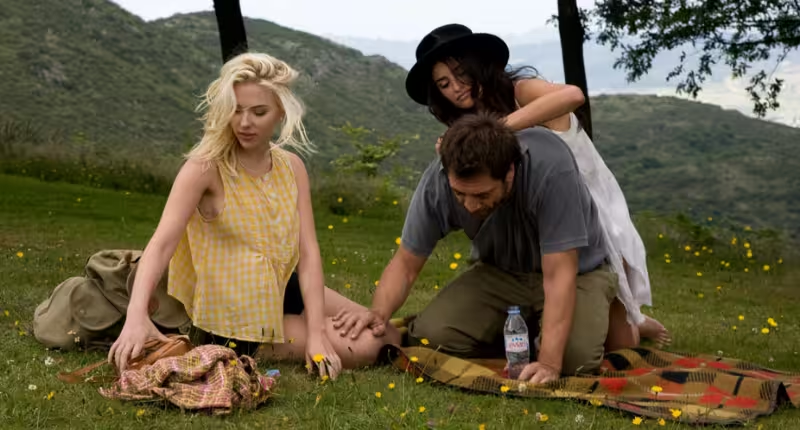
Cristina becomes involved with Juan Antonio, while Vicky finds herself attracted to him despite her commitment to Doug. The emotional boundaries that initially seemed obvious gradually dissolve.
According to Rotten Tomatoes, the film’s central premise revolves around Vicky and Cristina becoming attracted to the same painter before his tempestuous former wife re-enters his life.
Vicky and Cristina: Two Opposite Ideas of Love
Vicky and Cristina are not simply two different personalities. They represent two competing philosophies of how a person should live. Vicky thinks a successful life can be constructed through sensible decisions: education, marriage, stability, responsibility and compatibility.
Cristina distrusts that kind of planning because she fears that a perfectly organized life can become emotionally empty. Neither woman is completely correct, and that is precisely what makes their friendship compelling.
Vicky’s Need for Security
Vicky’s worldview initially appears reasonable. She is engaged to Doug and has a clear understanding of what she expects from marriage. She is not desperately searching for romance because she believes she has already found it. Her problem is that certainty becomes less convincing when she encounters an experience that does not fit her carefully constructed expectations.
Juan Antonio unsettles her because he does not ask permission from the social rules she has accepted. He speaks directly about attraction, sex and desire. Vicky finds his attitude offensive, but her intellectual rejection of him does not completely eliminate her physical attraction.
This contradiction becomes one of the film’s most important ideas: knowing what you believe does not necessarily determine what you feel.
Vicky’s struggle is therefore more complicated than choosing between two men. She is forced to confront two versions of herself. One version wants the predictable future she has already designed; the other is curious about the emotional possibilities represented by Juan Antonio. Her anxiety comes from discovering that these two desires can exist simultaneously.
Cristina’s Search for Experience
Cristina takes almost the opposite approach. She wants love to change her. Ordinary relationships disappoint her because she expects romance to provide some profound emotional revelation. She is not satisfied with simply being comfortable with another person. She wants intensity, discovery and a feeling that something significant has happened.
Yet Cristina’s openness has its own weakness. She often mistakes intensity for meaning. An extraordinary experience can be memorable without necessarily producing a fulfilling life. Juan Antonio fascinates her partly because he seems to represent freedom from the emotional restrictions she associates with conventional relationships.
Cristina’s journey demonstrates that rejecting conventional commitment does not automatically lead to happiness. Freedom can be liberating, but it can also leave a person searching indefinitely for the next emotional experience. The film never mocks Cristina for wanting something different. Instead, it asks whether she understands what she is actually looking for.
Juan Antonio and the Seduction of Uncertainty
Juan Antonio is one of the film’s most intriguing characters because he functions simultaneously as a person and as a fantasy. To Vicky and Cristina, he represents a different kind of life. He is an artist, lives in Spain, speaks openly about desire and seems comfortable with emotional ambiguity. He does not appear trapped by the rules that govern their American lives.
But Juan Antonio is not simply a perfect romantic alternative. His relationship with María Elena reveals that his apparent freedom comes with considerable emotional turbulence. He is comfortable with unconventional relationships, but he is also drawn repeatedly into conflict.
His artistic temperament becomes part of his attraction, yet it also contributes to the sense that he lives according to impulse rather than long-term stability.
This ambiguity is essential. If Juan Antonio were simply a perfect lover, the film would become a conventional fantasy about escaping ordinary life. Instead, Allen makes him both appealing and problematic. He offers excitement, but excitement comes with consequences.
He offers freedom, but freedom does not eliminate emotional responsibility. He offers an alternative to conventional romance, but the film never proves that his alternative produces greater happiness.
Maria Elena: The Character Who Changes Everything
María Elena is arguably the most memorable character in Vicky Cristina Barcelona, largely because Penélope Cruz gives the role such extraordinary volatility.
She arrives like an emotional storm. Suddenly the relatively playful triangle involving Vicky, Cristina and Juan Antonio becomes something much more psychologically complicated.
María Elena is passionate, intelligent, artistic and deeply unstable within the relationship. She and Juan Antonio clearly understand each other in ways that outsiders struggle to understand. Their relationship contains hostility and affection at the same time. They can appear deeply connected one moment and completely destructive the next.
Passion Versus Stability
María Elena challenges the assumption that passionate love is necessarily superior to stable love. Her relationship with Juan Antonio is undeniably intense, but intensity comes with pain. Their arguments are not simply obstacles to their romance; they are part of the structure of their romance.
This makes María Elena particularly important to the film’s philosophy. Vicky fears emotional chaos and wants to avoid it. Cristina is attracted to emotional intensity but eventually discovers that intensity can be exhausting. María Elena has already lived inside that intensity and knows its price.
Her presence changes how the audience understands Juan Antonio. Before María Elena returns, he can appear like the charismatic outsider who understands life better than everyone else. Once she enters the story, his romantic mystique becomes less convincing. We see that the sophisticated painter is also a man caught inside a relationship he cannot completely resolve.
Vicky Cristina Barcelona Cast and Performances
The film’s cast is one of its greatest strengths. Rebecca Hall plays Vicky as controlled, intelligent and increasingly conflicted. Hall avoids turning Vicky into a prudish stereotype. Instead, she gives the character a believable internal tension: Vicky wants to remain rational even when her emotions refuse to cooperate.
Scarlett Johansson gives Cristina a more spontaneous energy. Her character is constantly looking for something she cannot quite define, and Johansson captures the combination of curiosity and uncertainty that makes Cristina sympathetic.
She is not simply the sexually adventurous friend; she is someone who wants emotional significance and repeatedly discovers that desire does not automatically provide it.
Javier Bardem plays Juan Antonio with a combination of confidence, sensuality and ambiguity. His charm is obvious, but the film gradually reveals the complications behind it. Bardem’s performance works because Juan Antonio never becomes entirely trustworthy or entirely untrustworthy.
Then there is Penélope Cruz, whose María Elena effectively changes the temperature of the film whenever she appears. The Academy of Motion Picture Arts and Sciences confirms that Cruz won the 2009 Academy Award for Best Supporting Actress for her performance in Vicky Cristina Barcelona. The film received one Oscar win from one nomination.
Why Barcelona Matters to the Story
Barcelona is not merely a picturesque background. It functions almost like another character. The architecture, streets, restaurants, galleries, churches and Mediterranean atmosphere create a world that feels different from the structured lives Vicky and Cristina left behind.
The production used numerous locations in Barcelona, including Park Güell, La Pedrera, the Sagrada Família area, Tibidabo and other recognizable sites. The production also filmed in Asturias, including Oviedo and Avilés.
Art, Architecture and Desire
The city visually reinforces the film’s themes. Barcelona’s architecture is expressive, irregular and sensual, which contrasts nicely with Vicky’s desire for order. Gaudí’s buildings seem to reject the idea that beauty must come from symmetry and predictability. In a similar way, the characters discover that human relationships rarely obey the neat structures they expect.
The film’s use of Spain also creates a cultural contrast between the American visitors and the European environment they enter. This should not be reduced to a simplistic claim that Europe represents freedom while America represents restriction.
Instead, the film uses travel as a mechanism for psychological displacement.
When people leave familiar surroundings, they sometimes behave differently because the social expectations surrounding them have changed.
Asturias also plays an important role. Tourism Asturias notes that Allen filmed scenes in locations including the San Juan lighthouse, Ferrera Park and Mount Naranco, alongside Barcelona locations.
Vicky Cristina Barcelona and the Meaning of Love
At its heart, Vicky Cristina Barcelona asks whether love should be understood as a feeling, a commitment or an experience. The characters provide different answers.
Vicky initially treats love as something that should lead toward a stable future. Cristina treats it as an experience that should transform her. Juan Antonio treats desire as something that should not be unnecessarily constrained. María Elena experiences love as something so powerful that separation from it seems almost impossible.
The film does not select one definition as universally correct.
Instead, it demonstrates the limitations of each. Commitment can become emotionally restrictive. Freedom can become directionless. Passion can become destructive. Rationality can become a defense mechanism.
That is why the film remains more interesting than a standard romantic comedy. There is no simple lesson such as “follow your heart” or “choose stability.” Sometimes following your heart creates pain. Sometimes stability protects you. Sometimes stability also prevents you from discovering something important about yourself.
Marriage, Commitment and Emotional Security
Vicky’s engagement to Doug provides the film with an important contrast. Doug is not portrayed as an obvious villain. That matters because it prevents the story from becoming a simple argument against marriage.
Vicky is not choosing between a terrible fiancé and a wonderful stranger. She is choosing between different ways of imagining adulthood.
The uncomfortable question is this: Can a person be happy with a good life while wondering whether another life might have been more exciting?
That question gives Vicky’s character much of her emotional depth. She does not necessarily hate the life she has chosen. Her anxiety comes from realizing that choosing one possibility means losing countless others.
This is one of the film’s most recognizable ideas.
Every serious life decision closes certain doors. Marriage, career, family, geography and long-term commitments all involve opportunity costs. We rarely talk about romantic relationships in economic terms, but they involve choices just as consequential as any other major decision.
The Role of Art in Vicky Cristina Barcelona
Art is everywhere in the film because art provides another way of thinking about reality. Juan Antonio is a painter, and his artistic identity reinforces his refusal to see life as something that must fit conventional categories.
The characters also move through museums, galleries, historic buildings and culturally significant spaces. Their environment constantly reminds them that human beings have always attempted to turn experience into meaning.
The irony is that the characters themselves behave like artists searching for forms. Vicky wants to construct a coherent life. Cristina wants to experiment with different possibilities. Juan Antonio wants emotional and sexual freedom. María Elena wants an intensity that conventional relationship structures cannot contain.
The film therefore suggests that relationships can resemble artistic projects: people imagine what they want to create, but the finished result rarely looks exactly like the original plan.
Is Juan Antonio Really a Romantic Hero?
Juan Antonio initially appears to be the ideal fantasy figure. He is attractive, confident, artistic and direct. He knows what he wants and is not embarrassed to say it.
But the film gradually dismantles the fantasy.
His previous relationship with María Elena demonstrates that his philosophy of unrestricted desire has not produced emotional peace. His relationships generate complications because people are not objects that can simply be rearranged whenever circumstances change.
This makes Juan Antonio more interesting than a conventional romantic hero. He is neither the perfect alternative to Doug nor simply an irresponsible seducer.
He embodies the seductive idea that another way of living might solve our dissatisfaction, while simultaneously demonstrating that every lifestyle has problems.
Why Cristina Cannot Find What She Wants
Cristina’s dissatisfaction is perhaps the most universal problem in the movie. She keeps looking for a relationship that will finally make sense of everything.
But what if no relationship can do that?
Cristina expects romance to provide meaning, but meaning cannot permanently be outsourced to another person. A partner can enrich a life, challenge us and help us grow, but another person cannot eliminate all uncertainty.
Her experiences with Juan Antonio and María Elena therefore become educational in an unexpected way. She discovers that an unconventional relationship can be fascinating without being permanent. She discovers that sexual freedom does not automatically equal emotional freedom.
Most importantly, she discovers that wanting something intensely does not necessarily mean knowing what that thing is.
Vicky’s Transformation
Vicky’s transformation is quieter than Cristina’s, which makes it easy to overlook. She begins the film confident that she understands herself. She believes she knows what she wants and why she wants it.
Her encounter with Juan Antonio introduces doubt.
That doubt is not necessarily liberation, nor is it necessarily destruction. It is simply knowledge. Vicky learns that she contains contradictory impulses. She can love stability and still desire uncertainty. She can be committed and still feel attraction to another person. She can believe in rational decision-making while discovering that emotions do not always obey rational arguments.
This is one of the film’s most psychologically realistic ideas. Growing older does not mean becoming internally consistent. Sometimes maturity means becoming more aware of your contradictions.
Vicky Cristina Barcelona Ending Explained
What Happens to Vicky and Cristina?
The ending deliberately avoids the kind of romantic closure audiences might expect from a conventional love triangle.
Cristina eventually recognizes that her relationship with Juan Antonio and María Elena does not provide the permanent emotional solution she imagined. Her departure suggests that she still has not found the definitive relationship she was seeking.
Vicky, meanwhile, returns to her established life. Yet she does not return unchanged. Her encounter with Juan Antonio has disrupted her confidence in the certainty of her future.
The famous final emotional effect of the film is therefore not about who “wins” Juan Antonio. There is no meaningful winner. The characters have encountered one another, altered one another and then continued moving through their lives.
That is why the ending can initially feel unsatisfying if you expect a traditional romantic resolution. But it makes sense if the film is understood as a story about temporary transformation rather than permanent romantic fulfillment.
What the Ending Says About Happiness
The ending suggests that happiness cannot always be measured by whether someone gets the person they desire. Sometimes an experience matters because of what it reveals, not because it becomes permanent.
Vicky does not abandon everything to pursue Juan Antonio. Cristina does not settle into a perfect unconventional relationship. Juan Antonio does not suddenly become emotionally uncomplicated. María Elena does not transform into a conventional romantic partner.
Life simply continues.
That may be the film’s most mature idea. Romantic experiences can become important chapters without becoming the entire story. People enter our lives, expose parts of ourselves we did not know existed and then leave.
The title itself therefore becomes meaningful. The film is about Vicky, Cristina and Barcelona, not necessarily about Vicky and Cristina finding their perfect romantic partners. Barcelona is the place where possibilities appear, collide and disappear.
Vicky Cristina Barcelona Themes and Symbolism
Several major themes operate simultaneously throughout the film.
Desire versus security is the most obvious. Vicky wants stability while Cristina wants experience, but both eventually discover limitations in their preferred approaches.
Passion versus compatibility is another major theme. Juan Antonio and María Elena demonstrate that intense attraction does not guarantee emotional health or permanence.
Freedom versus responsibility runs through the unconventional relationships. The characters want freedom from traditional expectations, but freedom does not eliminate consequences.
Identity and self-discovery may be the deepest theme. The women travel to Spain expecting a holiday but encounter versions of themselves they did not anticipate.
Art and life are also closely connected. The characters live as though relationships can be experimented with, redesigned and interpreted like works of art. Yet human beings resist complete control.
The film’s greatest symbolic device is probably the journey itself. Travel temporarily separates Vicky and Cristina from the identities they have built at home. Once those familiar structures disappear, hidden desires become easier to recognize.
Critical Reception and Awards
Vicky Cristina Barcelona received substantial critical recognition. Rotten Tomatoes currently lists the film at 80% from 211 critic reviews, with a 74% audience score from more than 100,000 ratings.
The film also performed strongly during awards season. The Golden Globes records four nominations and one win, with the film winning Best Motion Picture – Musical or Comedy. Rebecca Hall, Javier Bardem and Penélope Cruz also received acting nominations.
At the Academy Awards, Penélope Cruz won Best Supporting Actress. The official Oscars record confirms the win and lists Cruz among the nominees in the category.
The film’s continuing reputation is also reflected in its audience footprint. IMDb currently lists it at approximately 7.1/10, based on more than 280,000 ratings, although such user ratings naturally change over time.
Is Vicky Cristina Barcelona Worth Watching Today?
Yes, particularly if you enjoy films that treat romance as a psychological question rather than a straightforward love story. Vicky Cristina Barcelona is not designed primarily around suspense or conventional plot twists.
Its appeal comes from character interaction, dialogue, atmosphere and the uncomfortable questions it raises about relationships.
You may especially enjoy it if you like films about complicated adults making imperfect decisions. The performances are another strong reason to watch it, particularly Penélope Cruz’s Oscar-winning María Elena. The Barcelona and Asturias locations also give the film an unusually strong sense of place.
However, viewers expecting a conventional romantic comedy may find the film strange. It does not offer a simple moral about choosing true love over marriage, or passion over stability. It is deliberately ambiguous.
That ambiguity is exactly what gives Vicky Cristina Barcelona its staying power.
Final Verdict and Conclusion
Vicky Cristina Barcelona is ultimately a film about the uncertainty hidden inside apparently certain lives. Vicky believes she knows what she wants, Cristina believes she needs an extraordinary romantic experience, Juan Antonio believes desire should not be excessively restricted, and María Elena embodies the dangerous intensity of a relationship that refuses to become simple.
Each character offers part of an answer, but none provides the complete solution.
What I find most compelling about the film is that it does not treat love as a destination.
Love is presented as something that can reveal us, confuse us, hurt us and occasionally transform us without necessarily lasting forever.
Vicky does not need to abandon her entire life for her experience with Juan Antonio to matter. Cristina does not need to find a permanent partner for her search to have meaning. Even Juan Antonio’s apparent freedom turns out to contain contradictions.
The film’s beautiful Spanish setting can initially make everything look like a romantic fantasy, but underneath the sunlight is a much more skeptical observation about human desire. Barcelona becomes a temporary space where ordinary rules feel less powerful, allowing the characters to experiment with identities they might not express at home. When the holiday ends, reality returns.
That is perhaps why the movie remains memorable. Vicky Cristina Barcelona does not ask us to decide whether stability or passion is better. Instead, it asks a more difficult question: what happens when the life we chose collides with the life we imagine?
And there may be no permanent answer.
Similar Films to Vicky Cristina Barcelona
If you enjoyed Vicky Cristina Barcelona, you may also like films that explore complicated relationships, desire, infidelity, travel, and emotional uncertainty. Good choices include Midnight in Paris (2011), Match Point (2005), Blue Valentine (2010), Before Sunrise (1995), Before Sunset (2004), and Call Me by Your Name (2017).
Each explores romance and personal desire in a different way, while sharing the introspective, relationship-focused appeal of Vicky Cristina Barcelona.
Frequently Asked Questions About Vicky Cristina Barcelona
1. What is Vicky Cristina Barcelona about?
Vicky Cristina Barcelona follows two American friends, Vicky and Cristina, during a summer trip to Spain.
They become involved with Juan Antonio, a Spanish painter whose complicated relationship with his former wife, María Elena, transforms the situation into an unusual romantic and emotional entanglement. The film explores desire, marriage, freedom, passion and uncertainty.
2. Who plays María Elena in Vicky Cristina Barcelona?
Penélope Cruz plays María Elena, Juan Antonio’s volatile former wife. Cruz’s performance was widely recognized and earned her the Academy Award for Best Supporting Actress at the 2009 Oscars.
3. Is Vicky Cristina Barcelona based on a true story?
No. Vicky Cristina Barcelona is a fictional film written and directed by Woody Allen. The story and characters are fictional, although the film draws extensively on recognizable Spanish locations and cultural settings.
4. Where was Vicky Cristina Barcelona filmed?
The film was shot in several Spanish locations, including Barcelona, Oviedo and Avilés, as well as other parts of Asturias. Barcelona locations include Park Güell and other major architectural and cultural landmarks.
5. Why is Vicky Cristina Barcelona worth watching?
The film is worth considering for its combination of strong performances, Spanish locations, relationship psychology and ambiguity. Rather than offering a conventional romantic ending, it explores how different people understand love and why desire does not always lead to happiness.
Its awards recognition, including Penélope Cruz’s Oscar win and the Golden Globe for Best Motion Picture – Musical or Comedy, reflects the film’s significant critical and industry reception.